
Hello,
we are building a solid house on a slab foundation without a basement / KfW70 standard.
Since I wanted to create additional capacity for cables (to the garage, garden, etc.), I was considering an extra 100mm (4 inches) empty conduit in the utility room, incorporated during the slab foundation installation.
The site manager says that a shaft for a multi-utility connection will be provided. The utility companies prefer not to have other supply lines installed inside the pipes intended for the multi-utility connection.
Is the approach with the empty conduit outdated? Would it be better to drill holes after the slab is completed?
How have you solved this?
Käfer
we are building a solid house on a slab foundation without a basement / KfW70 standard.
Since I wanted to create additional capacity for cables (to the garage, garden, etc.), I was considering an extra 100mm (4 inches) empty conduit in the utility room, incorporated during the slab foundation installation.
The site manager says that a shaft for a multi-utility connection will be provided. The utility companies prefer not to have other supply lines installed inside the pipes intended for the multi-utility connection.
Is the approach with the empty conduit outdated? Would it be better to drill holes after the slab is completed?
How have you solved this?
Käfer
N
nordanney29 Apr 2014 15:07In addition to the multi-utility connection, we also installed several empty conduits. Two conduits are for the geothermal probes and one conduit is for the well water connection that will be installed later. This is all straightforward.
However, the electrician laid simple electrical cables on the foundation slab and then routed them through the openings for the floor-to-ceiling windows or patio doors. Later, underfloor heating, insulation, and screed were installed above them, and the door openings were properly sealed during the window and door installation.
However, the electrician laid simple electrical cables on the foundation slab and then routed them through the openings for the floor-to-ceiling windows or patio doors. Later, underfloor heating, insulation, and screed were installed above them, and the door openings were properly sealed during the window and door installation.
W
wadenkneifer29 Apr 2014 15:09Hello,
Our situation (solid house on a concrete slab) is similar. For us, the electricians installed the wiring for outdoor installations (garden lighting, carport, garden/tool shed) inside the house along with the other in-house wiring, then drilled through the concrete slab at the respective points to lead the cables outside. I don’t quite understand the issue with the multi-utility connection. You don’t want to use the conduit for the main house connections but rather an additional one for outgoing cables. Why would that bother the utility provider?
Advantages from my perspective:
- Short cable runs outside the house underground (less cable installation around the house)
Disadvantages:
- Requires prior planning about which cable is needed where (but that should be considered early anyway)
I’m not entirely convinced of the advantage of the conduit yet. Do you want to install and connect the cables yourself, or be able to stay flexible later? Then sealing the conduit, of course, becomes an important factor.
Best regards
Michael
Our situation (solid house on a concrete slab) is similar. For us, the electricians installed the wiring for outdoor installations (garden lighting, carport, garden/tool shed) inside the house along with the other in-house wiring, then drilled through the concrete slab at the respective points to lead the cables outside. I don’t quite understand the issue with the multi-utility connection. You don’t want to use the conduit for the main house connections but rather an additional one for outgoing cables. Why would that bother the utility provider?
Advantages from my perspective:
- Short cable runs outside the house underground (less cable installation around the house)
Disadvantages:
- Requires prior planning about which cable is needed where (but that should be considered early anyway)
I’m not entirely convinced of the advantage of the conduit yet. Do you want to install and connect the cables yourself, or be able to stay flexible later? Then sealing the conduit, of course, becomes an important factor.
Best regards
Michael
Laying the cables towards the optimal exit point before pouring the screed is certainly a good solution.
I would like to have the conduit next to the multi-service connection to remain flexible in the future, for example, to install possible cables outdoors as a DIY project, etc.
Does the conduit generally have any negative properties regarding tightness, insulation, or similar?
I would like to have the conduit next to the multi-service connection to remain flexible in the future, for example, to install possible cables outdoors as a DIY project, etc.
Does the conduit generally have any negative properties regarding tightness, insulation, or similar?
Hello everyone,
I’m bringing this topic back up literally…
Here’s the situation:
Our house, which has no basement, is built on a slab foundation. (Waterproof concrete with multiple utility conduits entering the house connection box)
Now I’m in the fortunate position that, before the street is constructed, our local municipality is installing empty conduits for future fiber optic expansion underground.
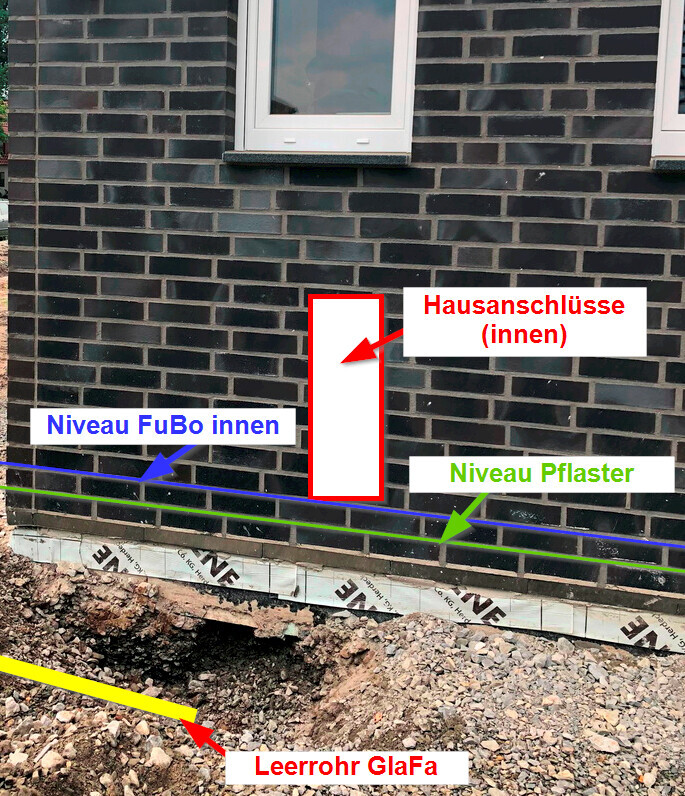
This empty conduit is now located in the ground directly in front of my house connection box (see photo).
Since the excavation is still open, I’d like to extend the empty conduit all the way into the house.
What is the best way to do this?
- Drill a hole through the slab foundation (next to the multiple utility conduits entry)?
- Drilling through the brick facade is not an option since it would emerge above the level of the pavement.
- How should I properly seal the drill hole?
What diameter should I choose for the empty conduit?
I’m bringing this topic back up literally…
Here’s the situation:
Our house, which has no basement, is built on a slab foundation. (Waterproof concrete with multiple utility conduits entering the house connection box)
Now I’m in the fortunate position that, before the street is constructed, our local municipality is installing empty conduits for future fiber optic expansion underground.
This empty conduit is now located in the ground directly in front of my house connection box (see photo).
Since the excavation is still open, I’d like to extend the empty conduit all the way into the house.
What is the best way to do this?
- Drill a hole through the slab foundation (next to the multiple utility conduits entry)?
- Drilling through the brick facade is not an option since it would emerge above the level of the pavement.
- How should I properly seal the drill hole?
What diameter should I choose for the empty conduit?
Similar topics