
Hello fellow building enthusiasts,
We recently purchased two plots of land where a small new residential area (11 single-family homes) is being developed. We are planning to build a townhouse with a living space of about 160 sqm (1,722 sq ft).
You might be wondering why two plots... One parcel was too small for a detached single-family home, so we bought two because we wanted a bit more space in the garden.
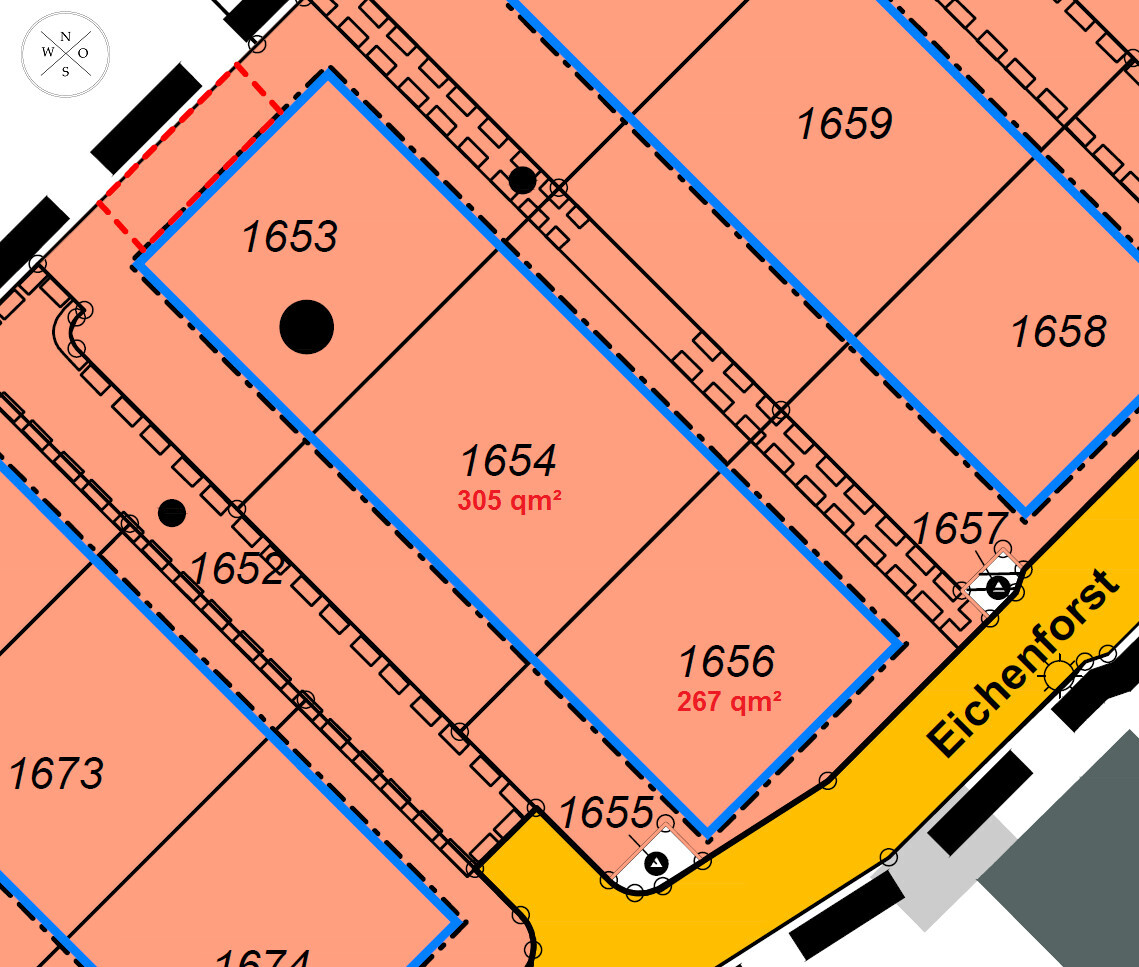
One parcel measures 305 sqm (3,284 sq ft) and the other 267 sqm (2,875 sq ft). Together we have 572 sqm (6,159 sq ft) (parcels 1654 and 1656). Including access paths, the total area is 622 sqm (6,695 sq ft). The plots are approximately 19 meters (62 feet) deep and 30 meters (98 feet) wide.
Now to our questions:
How can we position the house most advantageously on the plots?
The driveway access to the houses is planned from the Southwest street (plot 1652). The street there is 4.5 meters (15 feet) wide. On the Northeast side, a 2-meter (6.5 feet) wide pedestrian walkway is planned.
The blue line in the drawing marks the building boundary. There is no need to maintain a 3-meter (10 feet) setback from the pedestrian walkway; 1.5 to 2 meters (5 to 6.5 feet) are sufficient here. I think the most favorable placement would be to position the house in the Northeast corner with the main entrance facing the pedestrian walkway, so we could have the entire garden on the Southwest side.
How can the garage be positioned conveniently in this layout?
I think the garage would make most sense placed along the boundary of the neighboring plot 1653.
I have sketched four different options that we have considered.
Option 1:
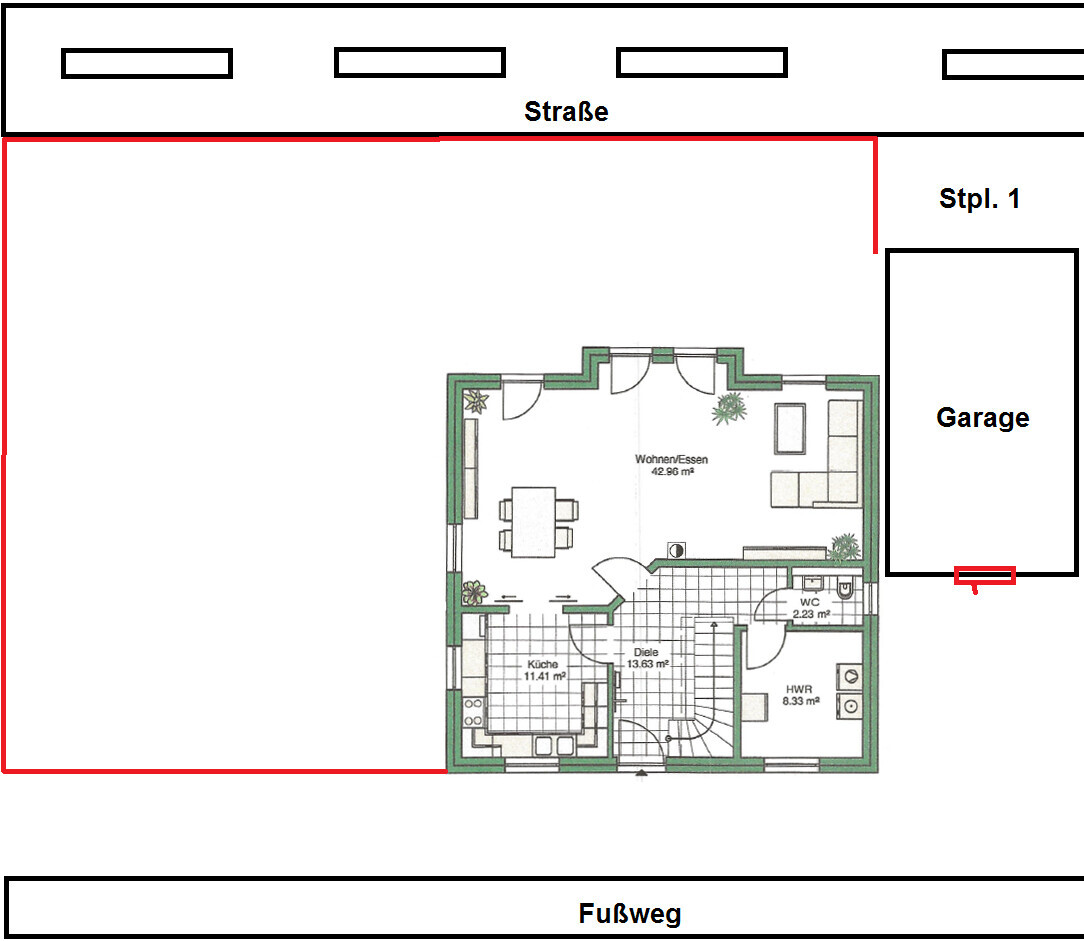
If we place the garage directly attached to the house, we would have to enter the house through the back door of the garage every time, and there would only be space for one parking spot in front of the garage, which is not ideal for two cars.
Option 2:
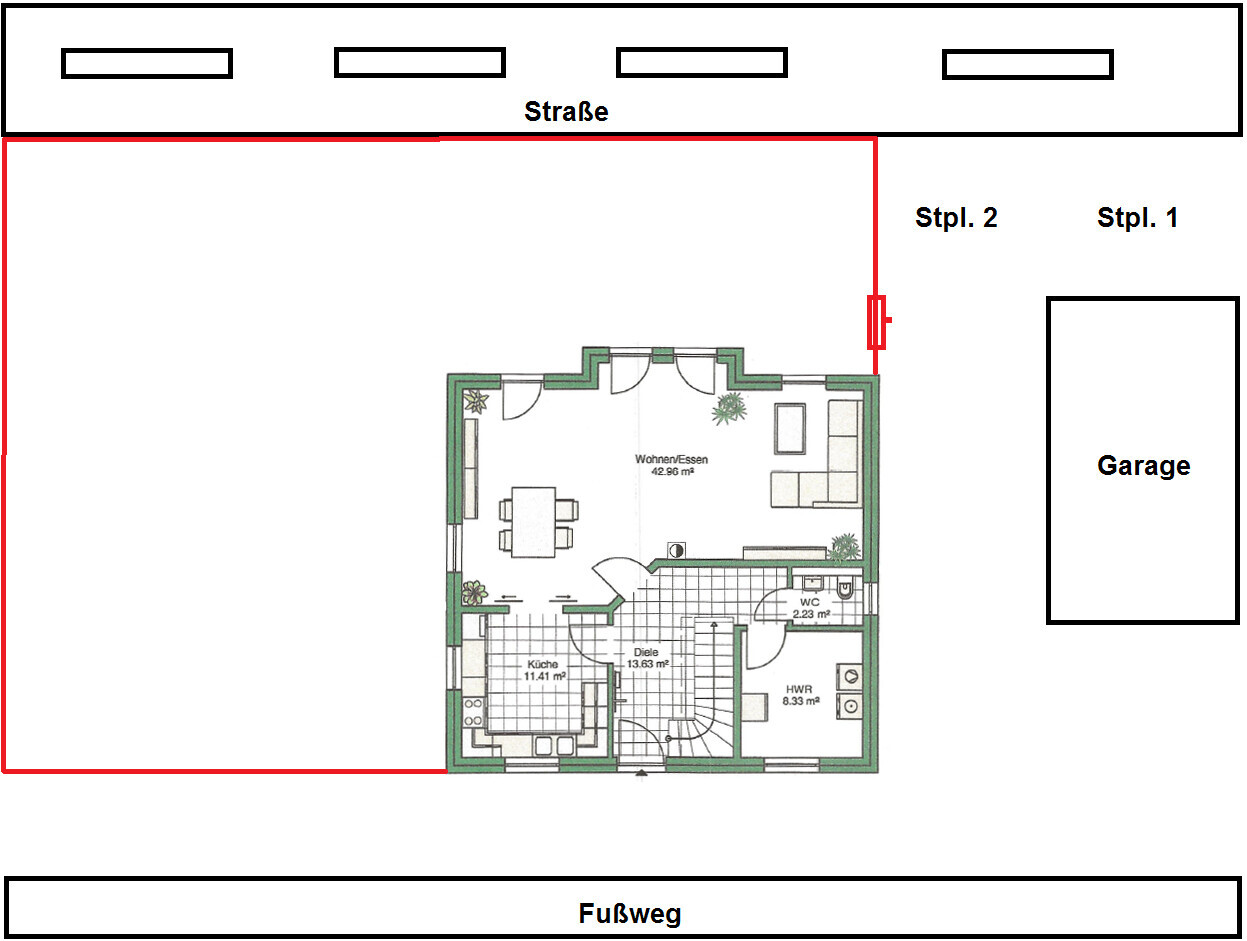
A garage positioned with some distance from the house. This would allow space for a second parking spot. However, with this option, we would need to fence off the garden area near the parking spots to prevent direct views into the garden. We would also be losing a lot of usable space and would have to pave the path leading to the front and the area in front of the house and garage.
Option 3:
Similar to option 2, but with the fencing arranged differently. The garden area next to the garage could still be used as garden space, but we would have to go through the garden gate every time from the garage to reach the house entrance.
In all three options, the pathways to the house entrance are quite long.
Additionally, I have never seen a garage positioned with its back wall facing the side of the house entrance. Usually, the garage door faces the side of the house entrance, or the house entrance is placed on the side adjacent to the garage.
Option 4:
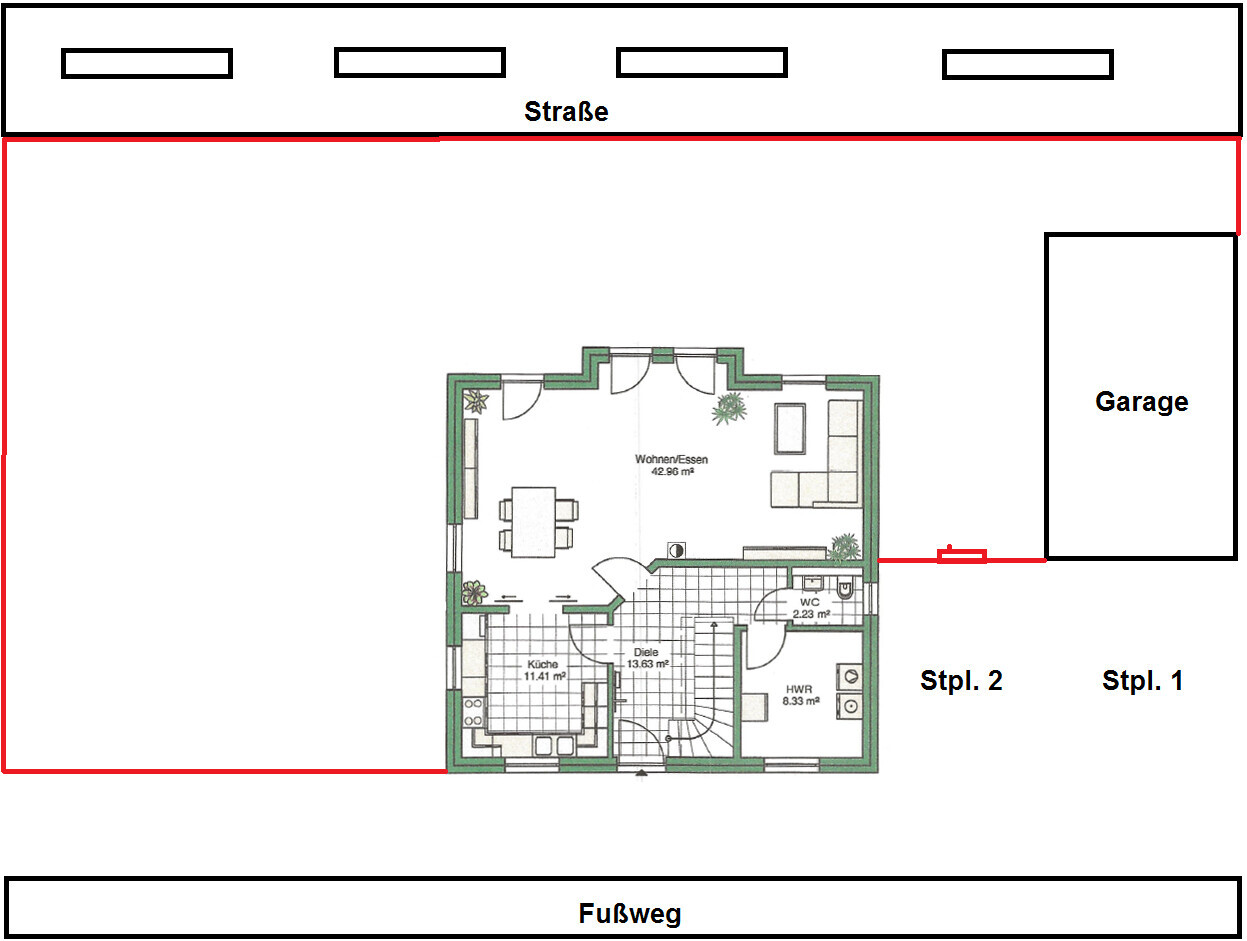
The option we like best is access to the garage via the pedestrian walkway. The walkway was originally planned as a footpath and will be paved 2 meters (6.5 feet) wide during site development. We could widen it by about 1 meter (3 feet), making it a 3-meter (10 feet) wide driveway/walkway that could be used to drive into the garage. We would need to pave that additional meter ourselves and shift the house one meter (3 feet) further, which would not be a problem given the size of the plot. According to the development plan and information from the city, this would be perfectly allowed. We have pedestrian, vehicle access, and utility easements benefiting the residents for this walkway. With this option, we could place the garage directly attached to the house and use the second parking spot in front of the utility room window.
Options 1 to 3 might be possible if the house entrance is placed on the garage side, but then I’m not sure how we would need to change the floor plan.
How would you position the house and garage? Maybe you can help us with some new ideas to move forward.

We recently purchased two plots of land where a small new residential area (11 single-family homes) is being developed. We are planning to build a townhouse with a living space of about 160 sqm (1,722 sq ft).
You might be wondering why two plots... One parcel was too small for a detached single-family home, so we bought two because we wanted a bit more space in the garden.
One parcel measures 305 sqm (3,284 sq ft) and the other 267 sqm (2,875 sq ft). Together we have 572 sqm (6,159 sq ft) (parcels 1654 and 1656). Including access paths, the total area is 622 sqm (6,695 sq ft). The plots are approximately 19 meters (62 feet) deep and 30 meters (98 feet) wide.
Now to our questions:
How can we position the house most advantageously on the plots?
The driveway access to the houses is planned from the Southwest street (plot 1652). The street there is 4.5 meters (15 feet) wide. On the Northeast side, a 2-meter (6.5 feet) wide pedestrian walkway is planned.
The blue line in the drawing marks the building boundary. There is no need to maintain a 3-meter (10 feet) setback from the pedestrian walkway; 1.5 to 2 meters (5 to 6.5 feet) are sufficient here. I think the most favorable placement would be to position the house in the Northeast corner with the main entrance facing the pedestrian walkway, so we could have the entire garden on the Southwest side.
How can the garage be positioned conveniently in this layout?
I think the garage would make most sense placed along the boundary of the neighboring plot 1653.
I have sketched four different options that we have considered.
Option 1:
If we place the garage directly attached to the house, we would have to enter the house through the back door of the garage every time, and there would only be space for one parking spot in front of the garage, which is not ideal for two cars.
Option 2:
A garage positioned with some distance from the house. This would allow space for a second parking spot. However, with this option, we would need to fence off the garden area near the parking spots to prevent direct views into the garden. We would also be losing a lot of usable space and would have to pave the path leading to the front and the area in front of the house and garage.
Option 3:
Similar to option 2, but with the fencing arranged differently. The garden area next to the garage could still be used as garden space, but we would have to go through the garden gate every time from the garage to reach the house entrance.
In all three options, the pathways to the house entrance are quite long.
Additionally, I have never seen a garage positioned with its back wall facing the side of the house entrance. Usually, the garage door faces the side of the house entrance, or the house entrance is placed on the side adjacent to the garage.
Option 4:
The option we like best is access to the garage via the pedestrian walkway. The walkway was originally planned as a footpath and will be paved 2 meters (6.5 feet) wide during site development. We could widen it by about 1 meter (3 feet), making it a 3-meter (10 feet) wide driveway/walkway that could be used to drive into the garage. We would need to pave that additional meter ourselves and shift the house one meter (3 feet) further, which would not be a problem given the size of the plot. According to the development plan and information from the city, this would be perfectly allowed. We have pedestrian, vehicle access, and utility easements benefiting the residents for this walkway. With this option, we could place the garage directly attached to the house and use the second parking spot in front of the utility room window.
Options 1 to 3 might be possible if the house entrance is placed on the garage side, but then I’m not sure how we would need to change the floor plan.
How would you position the house and garage? Maybe you can help us with some new ideas to move forward.
ypg schrieb:
I deliberately brought you into this discussion Thank you, Yvonne. You made my day.
ypg schrieb:
It’s not only me pointing out moral aspects here; others would probably put the common good above their own advantage Considering the use of property by its owner as morally reprehensible—that’s carnival as I love it: socially critical, exaggerated, and striking.
By the way, I noticed that throughout the entire area covered by the development plan, no spaces for children’s playgrounds are designated.
pp1203 schrieb:
One plot was too small for a detached single-family house, so we bought two because we wanted a bit “more” space in the garden. Unbelievable! While the other seven buyers have to endure their miserable lives on pitiful planting areas that hardly deserve to be called gardens, the buyer’s wife lounges comfortably on 400m² (4,300 sq ft) of fenced lawn. And the neighboring children look on enviously at the treehouse of the spoiled TE children.
Luckily, Ash Wednesday is tomorrow and the fool’s cap will go back into the wardrobe.

Escroda schrieb:
but I cannot agree with the argument that use by one, or maybe a second resident, endangers a child-friendly living environment and damages neighborhood relations. Neither can I, but reinforced by the fact
Escroda schrieb:
By the way, I noticed that within the entire scope of the development plan there are no areas designated for children's playgrounds. I also rather expect that the children from all eleven new building plots will choose one or the other path as a joint "play street." In my childhood, scooters, bicycles, and pedal cars from the entire neighborhood gang were often standing or lying in one driveway or the other.
Escroda schrieb:
the others as a subordinate component belonging to the main house I find the immediate proximity of the house and terrace not accidental—therefore it is logical to consider the terrace as an ancillary structure. A windbreak has a small building depth, with each element typically well under one square meter (about 10.8 square feet) of floor area, and the terrace itself is essentially flat by nature. Therefore, it makes sense not to treat it as a building at all and at most to require that it does not cause any drainage issues.
https://www.instagram.com/11antgmxde/
https://www.linkedin.com/company/bauen-jetzt/
Similar topics