
Hello fellow building enthusiasts,
We recently purchased two plots of land where a small new residential area (11 single-family homes) is being developed. We are planning to build a townhouse with a living space of about 160 sqm (1,722 sq ft).
You might be wondering why two plots... One parcel was too small for a detached single-family home, so we bought two because we wanted a bit more space in the garden.
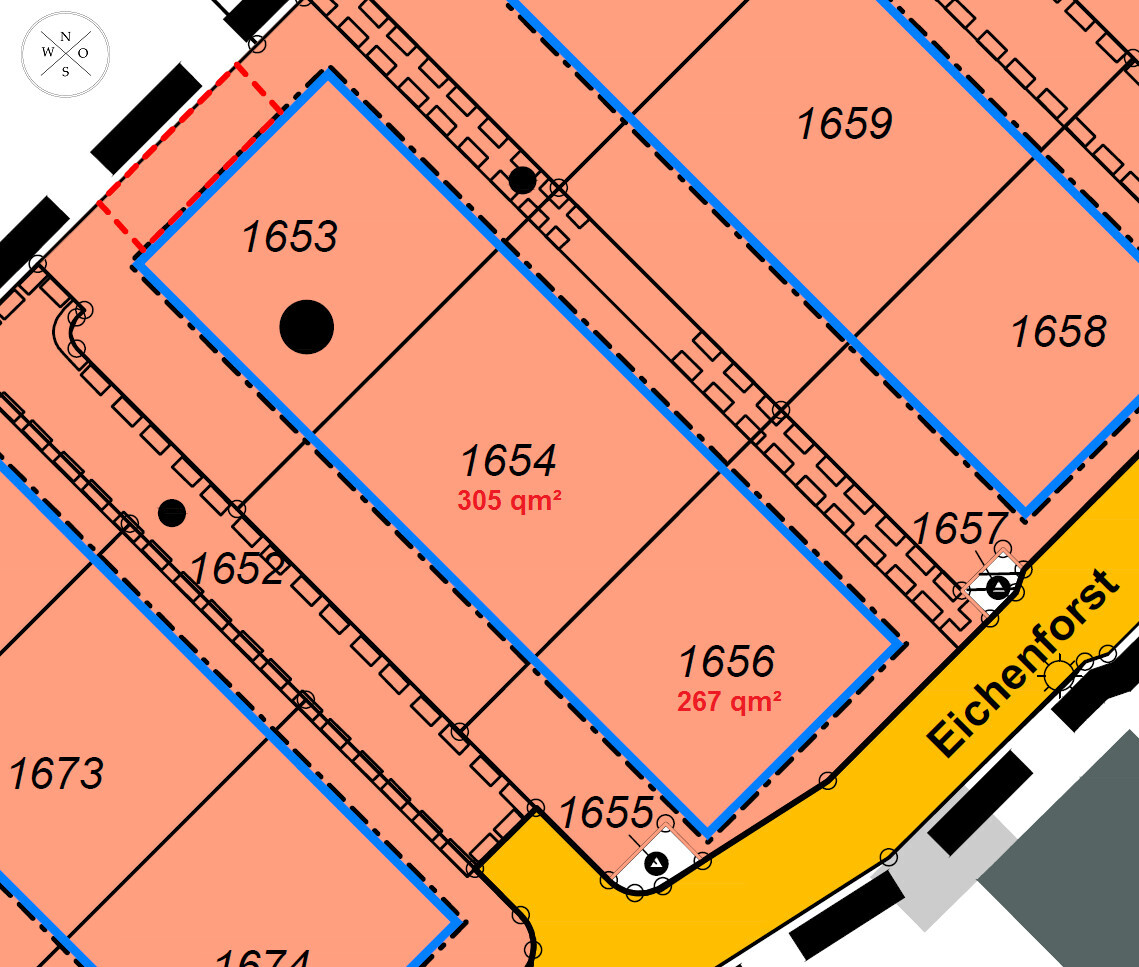
One parcel measures 305 sqm (3,284 sq ft) and the other 267 sqm (2,875 sq ft). Together we have 572 sqm (6,159 sq ft) (parcels 1654 and 1656). Including access paths, the total area is 622 sqm (6,695 sq ft). The plots are approximately 19 meters (62 feet) deep and 30 meters (98 feet) wide.
Now to our questions:
How can we position the house most advantageously on the plots?
The driveway access to the houses is planned from the Southwest street (plot 1652). The street there is 4.5 meters (15 feet) wide. On the Northeast side, a 2-meter (6.5 feet) wide pedestrian walkway is planned.
The blue line in the drawing marks the building boundary. There is no need to maintain a 3-meter (10 feet) setback from the pedestrian walkway; 1.5 to 2 meters (5 to 6.5 feet) are sufficient here. I think the most favorable placement would be to position the house in the Northeast corner with the main entrance facing the pedestrian walkway, so we could have the entire garden on the Southwest side.
How can the garage be positioned conveniently in this layout?
I think the garage would make most sense placed along the boundary of the neighboring plot 1653.
I have sketched four different options that we have considered.
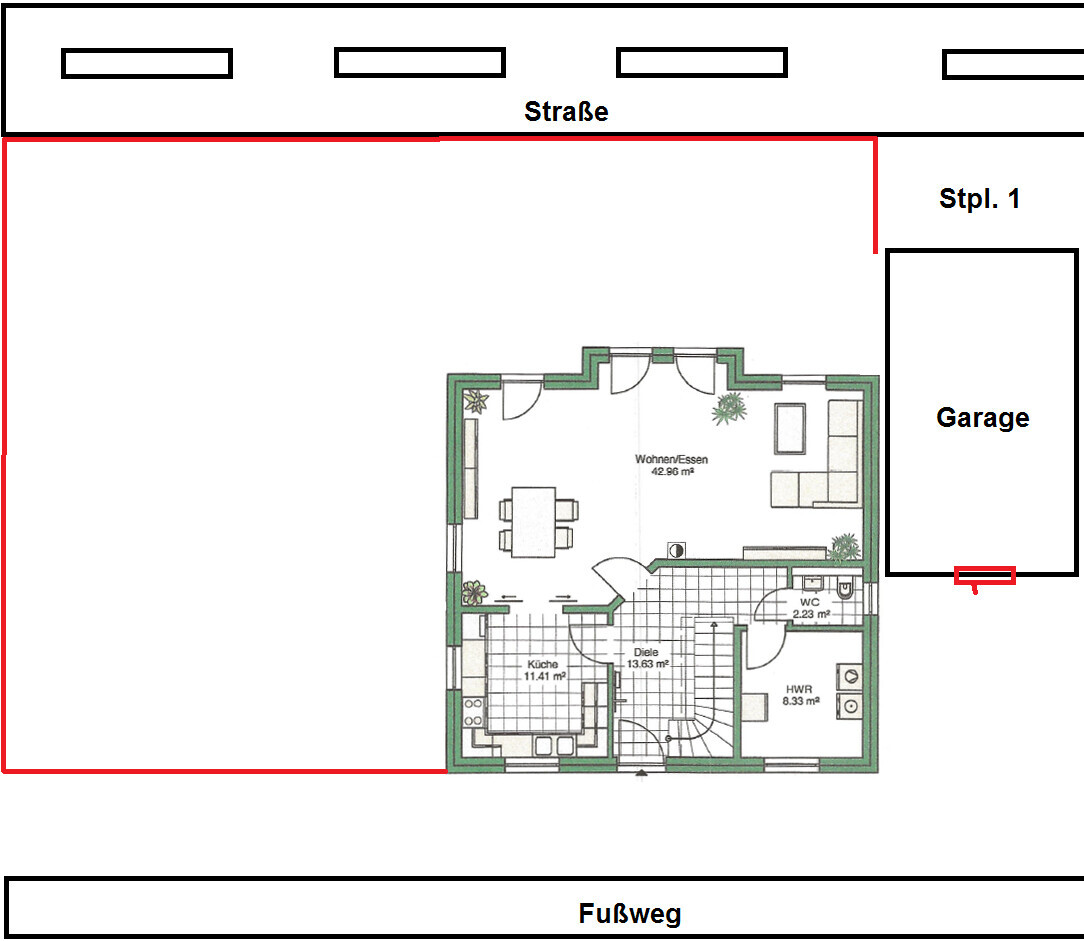
Option 1:
If we place the garage directly attached to the house, we would have to enter the house through the back door of the garage every time, and there would only be space for one parking spot in front of the garage, which is not ideal for two cars.
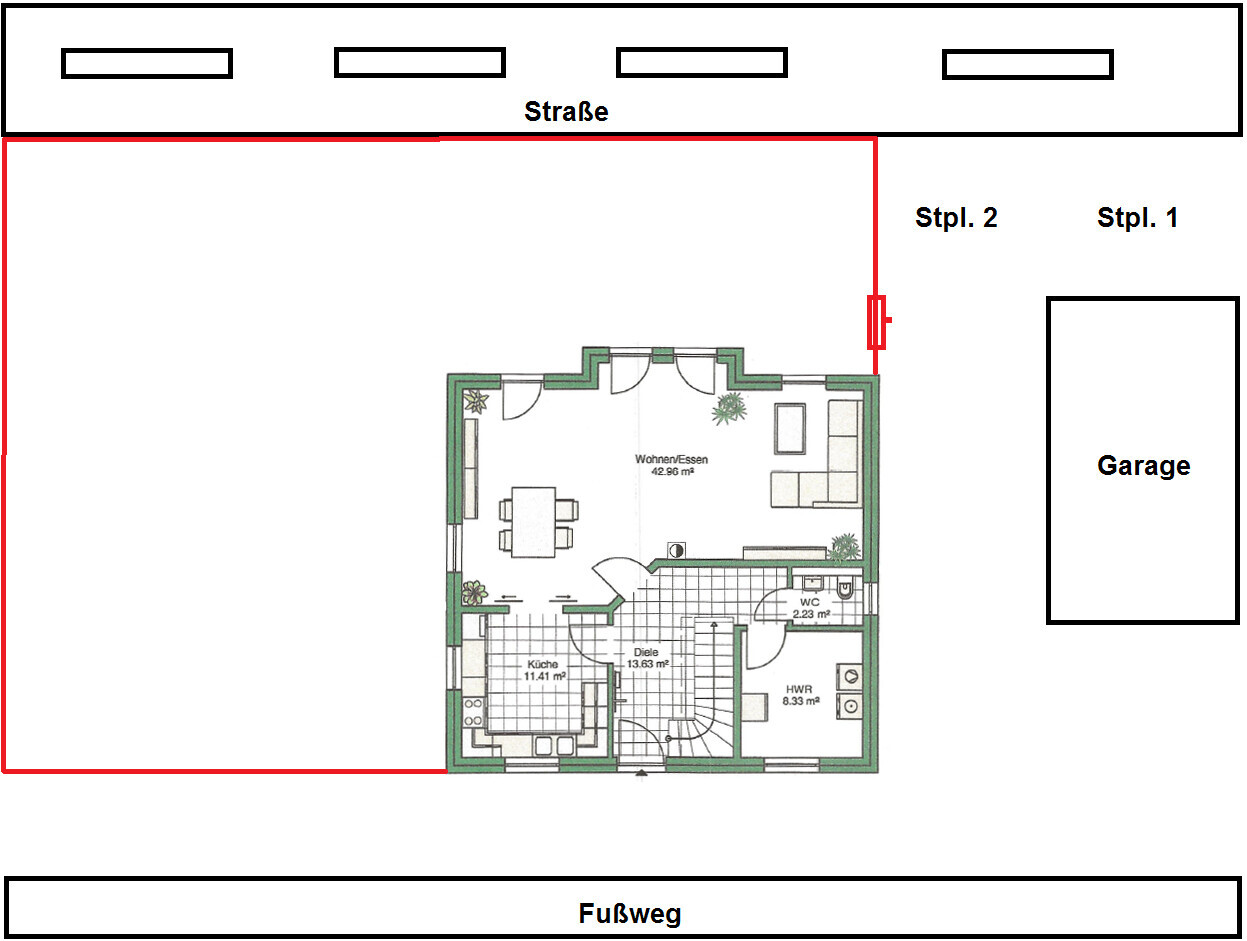
Option 2:
A garage positioned with some distance from the house. This would allow space for a second parking spot. However, with this option, we would need to fence off the garden area near the parking spots to prevent direct views into the garden. We would also be losing a lot of usable space and would have to pave the path leading to the front and the area in front of the house and garage.
Option 3:
Similar to option 2, but with the fencing arranged differently. The garden area next to the garage could still be used as garden space, but we would have to go through the garden gate every time from the garage to reach the house entrance.
In all three options, the pathways to the house entrance are quite long.
Additionally, I have never seen a garage positioned with its back wall facing the side of the house entrance. Usually, the garage door faces the side of the house entrance, or the house entrance is placed on the side adjacent to the garage.
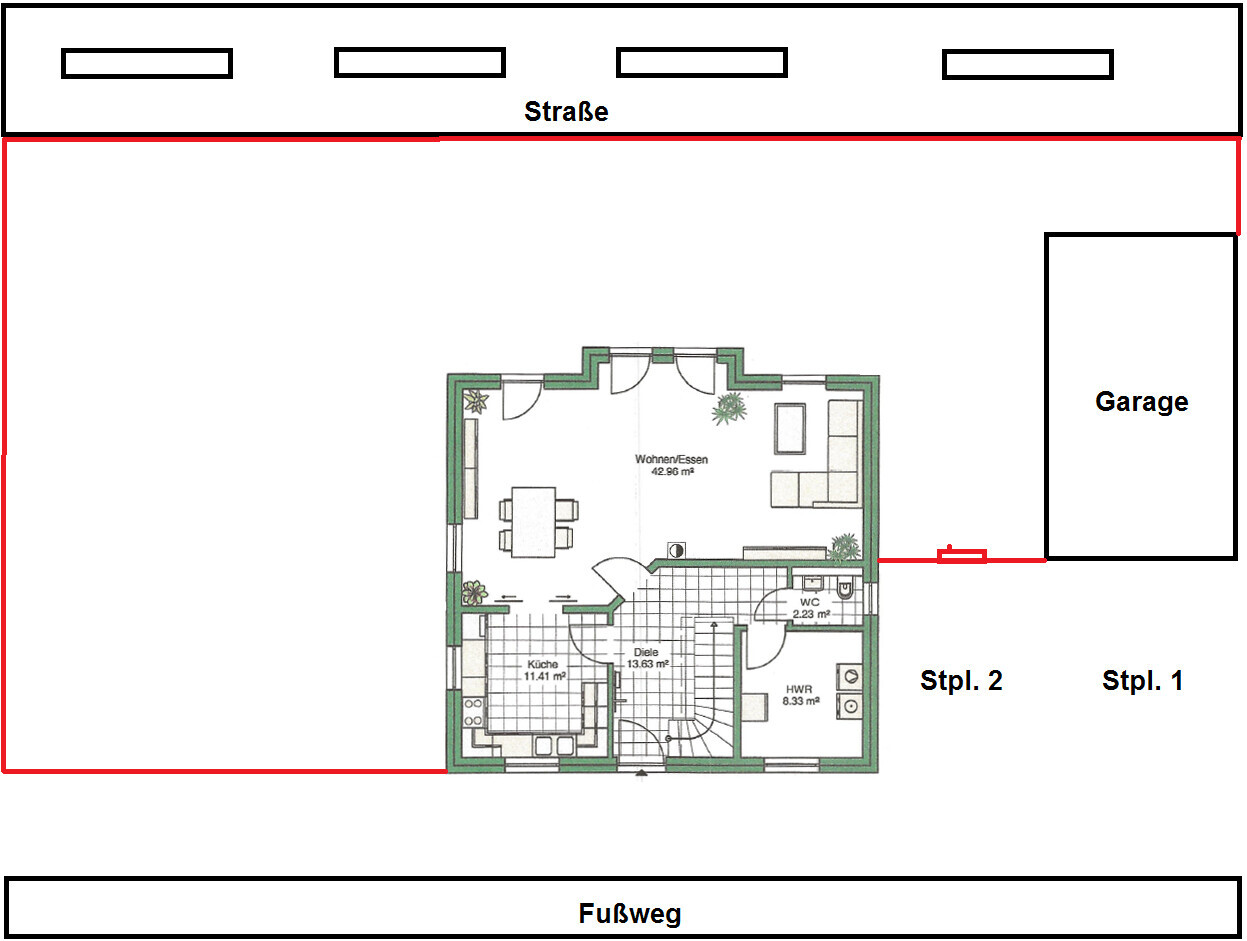
Option 4:
The option we like best is access to the garage via the pedestrian walkway. The walkway was originally planned as a footpath and will be paved 2 meters (6.5 feet) wide during site development. We could widen it by about 1 meter (3 feet), making it a 3-meter (10 feet) wide driveway/walkway that could be used to drive into the garage. We would need to pave that additional meter ourselves and shift the house one meter (3 feet) further, which would not be a problem given the size of the plot. According to the development plan and information from the city, this would be perfectly allowed. We have pedestrian, vehicle access, and utility easements benefiting the residents for this walkway. With this option, we could place the garage directly attached to the house and use the second parking spot in front of the utility room window.
Options 1 to 3 might be possible if the house entrance is placed on the garage side, but then I’m not sure how we would need to change the floor plan.
How would you position the house and garage? Maybe you can help us with some new ideas to move forward.

We recently purchased two plots of land where a small new residential area (11 single-family homes) is being developed. We are planning to build a townhouse with a living space of about 160 sqm (1,722 sq ft).
You might be wondering why two plots... One parcel was too small for a detached single-family home, so we bought two because we wanted a bit more space in the garden.
One parcel measures 305 sqm (3,284 sq ft) and the other 267 sqm (2,875 sq ft). Together we have 572 sqm (6,159 sq ft) (parcels 1654 and 1656). Including access paths, the total area is 622 sqm (6,695 sq ft). The plots are approximately 19 meters (62 feet) deep and 30 meters (98 feet) wide.
Now to our questions:
How can we position the house most advantageously on the plots?
The driveway access to the houses is planned from the Southwest street (plot 1652). The street there is 4.5 meters (15 feet) wide. On the Northeast side, a 2-meter (6.5 feet) wide pedestrian walkway is planned.
The blue line in the drawing marks the building boundary. There is no need to maintain a 3-meter (10 feet) setback from the pedestrian walkway; 1.5 to 2 meters (5 to 6.5 feet) are sufficient here. I think the most favorable placement would be to position the house in the Northeast corner with the main entrance facing the pedestrian walkway, so we could have the entire garden on the Southwest side.
How can the garage be positioned conveniently in this layout?
I think the garage would make most sense placed along the boundary of the neighboring plot 1653.
I have sketched four different options that we have considered.
Option 1:
If we place the garage directly attached to the house, we would have to enter the house through the back door of the garage every time, and there would only be space for one parking spot in front of the garage, which is not ideal for two cars.
Option 2:
A garage positioned with some distance from the house. This would allow space for a second parking spot. However, with this option, we would need to fence off the garden area near the parking spots to prevent direct views into the garden. We would also be losing a lot of usable space and would have to pave the path leading to the front and the area in front of the house and garage.
Option 3:
Similar to option 2, but with the fencing arranged differently. The garden area next to the garage could still be used as garden space, but we would have to go through the garden gate every time from the garage to reach the house entrance.
In all three options, the pathways to the house entrance are quite long.
Additionally, I have never seen a garage positioned with its back wall facing the side of the house entrance. Usually, the garage door faces the side of the house entrance, or the house entrance is placed on the side adjacent to the garage.
Option 4:
The option we like best is access to the garage via the pedestrian walkway. The walkway was originally planned as a footpath and will be paved 2 meters (6.5 feet) wide during site development. We could widen it by about 1 meter (3 feet), making it a 3-meter (10 feet) wide driveway/walkway that could be used to drive into the garage. We would need to pave that additional meter ourselves and shift the house one meter (3 feet) further, which would not be a problem given the size of the plot. According to the development plan and information from the city, this would be perfectly allowed. We have pedestrian, vehicle access, and utility easements benefiting the residents for this walkway. With this option, we could place the garage directly attached to the house and use the second parking spot in front of the utility room window.
Options 1 to 3 might be possible if the house entrance is placed on the garage side, but then I’m not sure how we would need to change the floor plan.
How would you position the house and garage? Maybe you can help us with some new ideas to move forward.
ypg schrieb:
However, in this case, the resident is considered the owner. Why "considered"? We are not talking about a public path here, but about an area of the building plot that must be burdened with pedestrian, vehicle, and utility rights in favor of the neighboring residents and service providers according to the development plan. It is not strictly necessary for the development of the building plots. It is quite helpful for garden waste disposal for the northeastern properties but is more comparable in nature to a garage driveway. If children are playing in front of my garage door, it will not negatively affect their emotional development if I briefly interrupt their play to enter my garage.
More concerning regarding the solution proposed by the original poster is the fact that an area designed as a footpath suffers permanent wear from car use, that extending it by one meter is quite expensive, that cost sharing among neighbors is difficult to regulate—especially with different uses, that a 2m (6.5 feet) area is officially burdened but 3m (9.8 feet) is developed, and that the original poster owns and maintains 2/6 of a road he does not even use. But these are all financial issues, which apparently do not play a major role here.
pp1203 schrieb:
If I understand correctly, the building boundary only applies to residential buildings, not to a terrace. You do not understand that correctly.
pp1203 schrieb:
a city clerk What does this clerk actually handle?
Escroda schrieb:
You are not interpreting that correctly. As I said, I’m not familiar with this.
Escroda schrieb:
What matters does he handle? According to the City of Herne’s website, he is a contact person for the development plan.
If it ultimately turns out to be clearly the worse option, we might have to reconsider and place the driveway as originally planned from the rear, and then have the main entrance on the side. Hmm... difficult.
Terraces, in relation to building boundaries and floor area ratio, divide professionals into two camps:
Some consider the terrace, either out of ignorance of current legal rulings or acceptance of the opinion of the authorized building official, as a subordinate independent accessory structure (similar to a swimming pool), while others see it as a subordinate component belonging to the main building (like a balcony). If the official responsible for the building permit/planning permission also belongs to the first group, you don’t need to worry further about the terrace.
Some consider the terrace, either out of ignorance of current legal rulings or acceptance of the opinion of the authorized building official, as a subordinate independent accessory structure (similar to a swimming pool), while others see it as a subordinate component belonging to the main building (like a balcony). If the official responsible for the building permit/planning permission also belongs to the first group, you don’t need to worry further about the terrace.
Escroda schrieb:
Why "applies"? We are not talking about a public path here, but about an area of the building plot that, according to the development plan, must be burdened with pedestrian, vehicle, and utility rights in favor of the neighbors and utility providers. It is not strictly necessary for the access to the building plots. It is certainly helpful for the disposal of garden waste for the northeastern properties, but in character, it is more comparable to a garage driveway. If children play in front of my garage door, it will not harm their mental development if I briefly interrupt their play to enter my garage.
More concerning in the solution proposed by the original poster is that an area developed as a footpath suffers from permanent use by cars, the independent extension by one meter is quite expensive, and it is difficult to regulate cost-sharing among neighbors,...?Dear Escroda,
I deliberately involved you in this discussion by tagging you here because I respect your expertise.
Still, as someone who is part of a residential community, I believe that rules and laws, costs and benefits alone do not always provide the full picture.
If the original poster wants to do something with their part of the property, that is fine by me.
- I am not the only one pointing out moral considerations here; others would probably also prioritize the common good over individual advantage, because a house is one thing, but a neighborhood is something else where everyone should feel comfortable. Special exceptions are never well received.
Surely children can step aside (with only about 2-3 meters (6-10 feet) left, they would have to), but just imagine if the vehicle belongs to someone else and involves your own children... surely a couple of traffic signs will be needed for this access path... parking on the opposite side will probably no longer be allowed because the original poster won’t be able to maneuver, and so on.
Costs—well, costs are the lesser evil if you simply leave a dirt track or footpath as it is.

ypg schrieb:
It's not really nice when all possible routes are developed for vehicles. Yes, I also find that unfortunate. I don't quite understand the original poster either, since my house is already surrounded by roads on three sides. Two sides would already be annoying, and he’s adding a third one. *shaking my head*
kaho674 schrieb:
Yes, I find that unfortunate too. I also don’t understand the original poster, since my house is surrounded by roads on three sides. Two sides would already be annoying, and he’s adding a third. *shakes head*Nothing is decided yet. I am simply looking for the best solution for us. So far, the tendency has been toward this option. If it turns out in the end that the other option has more advantages, we will prefer that one. That’s what this topic is partly for—to work through the pros and cons. Every argument and post can be helpful.
Similar topics