
ᐅ Insulating the Floor or Screed in a Vacation Home: Yes or No?
Created on: 10 May 2020 12:50
F
FerienhausF
Ferienhaus10 May 2020 12:50Dear forum members,
I have a question regarding my holiday home: I took over the house (situated on a hillside) this spring and have since removed all the interior finishes and structures from the GDR era and early 1990s.
Now, the shell remains (exterior walls to be plastered, utilities installation, and gravel subbase) on the slope.
Up to now, there was a screed floor inside the house – cracked in some places – which was applied directly on a sand base.
My question is: For use as a holiday home (including winter use), is it advisable to construct the new floor with vapor barrier, base concrete, bitumen layer, insulation, and screed? Or, in your experience, would a simpler structure with just a vapor barrier and screed suffice?
I intend to grind and seal the screed, and possibly install a wooden floor in one room.
Logically, I would think that after a week without heating in winter, a fully constructed floor with base concrete and insulation would be just as cold underfoot as one with only insulation – since eventually even the thickest insulation cools down completely. Is this assumption correct, or is it misguided? What would you recommend if I want to prevent my guests from having freezing feet and also ensure my own comfort during winter stays?
Thank you in advance for all advice, opinions, and tips (please also feel free to suggest effective alternative floor builds).
Kind regards,
Michael
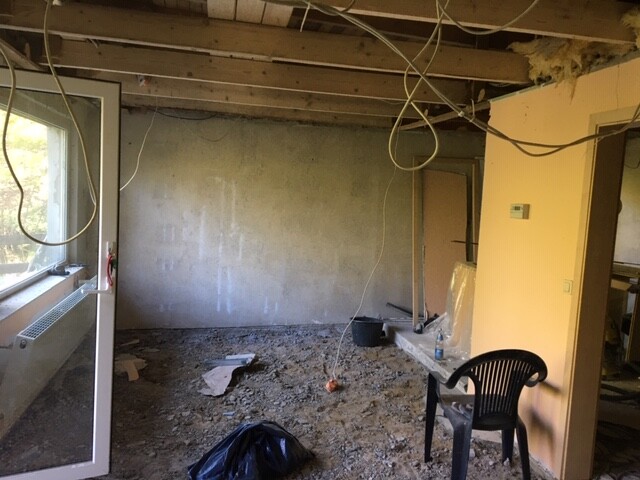
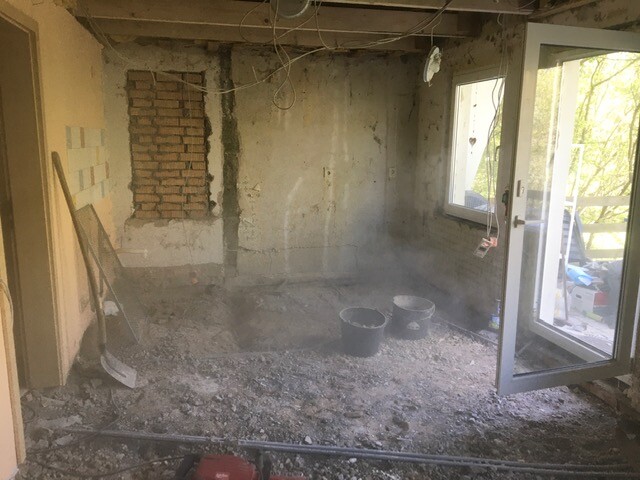
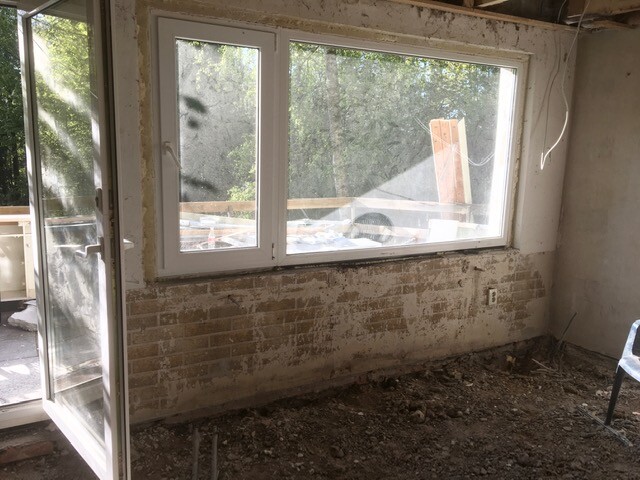
I have a question regarding my holiday home: I took over the house (situated on a hillside) this spring and have since removed all the interior finishes and structures from the GDR era and early 1990s.
Now, the shell remains (exterior walls to be plastered, utilities installation, and gravel subbase) on the slope.
Up to now, there was a screed floor inside the house – cracked in some places – which was applied directly on a sand base.
My question is: For use as a holiday home (including winter use), is it advisable to construct the new floor with vapor barrier, base concrete, bitumen layer, insulation, and screed? Or, in your experience, would a simpler structure with just a vapor barrier and screed suffice?
I intend to grind and seal the screed, and possibly install a wooden floor in one room.
Logically, I would think that after a week without heating in winter, a fully constructed floor with base concrete and insulation would be just as cold underfoot as one with only insulation – since eventually even the thickest insulation cools down completely. Is this assumption correct, or is it misguided? What would you recommend if I want to prevent my guests from having freezing feet and also ensure my own comfort during winter stays?
Thank you in advance for all advice, opinions, and tips (please also feel free to suggest effective alternative floor builds).
Kind regards,
Michael
 Vicky Pedia11 May 2020 09:44
Insulation is not about storing heat, as insulation cannot retain warmth. Rather, it is about preventing cold from coming through from below. So, insulation is recommended here as well. For this purpose, I like to use 8-10 cm (3-4 inches) of Linizherm or an equivalent product (make sure to seal it properly).
F
Ferienhaus11 May 2020 09:46Thank you for your response, that makes perfect sense...
so insulation would be the recommended approach – now I have a question: is it technically feasible to use a simplified version of the floor construction – that is, the cabin’s base (sand fill), insulation, membrane, screed – or is a concrete subfloor with bitumen absolutely necessary for this system to work or make sense?
I would like to avoid, if possible, moving 4-5 cubic meters of soil down the slope... Without this earthwork, a construction with a concrete subfloor wouldn’t be possible because the floor level inside the cabin would be too high.
Best regards, Michael Nager
so insulation would be the recommended approach – now I have a question: is it technically feasible to use a simplified version of the floor construction – that is, the cabin’s base (sand fill), insulation, membrane, screed – or is a concrete subfloor with bitumen absolutely necessary for this system to work or make sense?
I would like to avoid, if possible, moving 4-5 cubic meters of soil down the slope... Without this earthwork, a construction with a concrete subfloor wouldn’t be possible because the floor level inside the cabin would be too high.
Best regards, Michael Nager
Similar topics