
Hello everyone,
we are currently planning a new build (KFW 55 standard) in the style of an urban villa with a hipped roof and are considering removing the intermediate floor between the upper floor and attic in some or all rooms to create a loft-like space, possibly with multiple levels. In this case, I would invest more in the roof insulation since we would save money by omitting the intermediate floor 😀
But how significant is the temperature difference in a well-insulated new build? Will I have a sauna-like warmth at the ceiling and cold feet on the floor??? 😕 Should I expect a considerable increase in heating costs, or is this less of an issue nowadays?
I would really appreciate your help and experiences.
Best regards
Judyyy
we are currently planning a new build (KFW 55 standard) in the style of an urban villa with a hipped roof and are considering removing the intermediate floor between the upper floor and attic in some or all rooms to create a loft-like space, possibly with multiple levels. In this case, I would invest more in the roof insulation since we would save money by omitting the intermediate floor 😀
But how significant is the temperature difference in a well-insulated new build? Will I have a sauna-like warmth at the ceiling and cold feet on the floor??? 😕 Should I expect a considerable increase in heating costs, or is this less of an issue nowadays?
I would really appreciate your help and experiences.
Best regards
Judyyy


Then you won’t have cold feet... or only to a limited extent. Otherwise, the heat will naturally rise and accumulate near the ceiling, but since the heat source is at the floor level, heat loss is kept to a minimum.
See the following images:
Radiator heating:
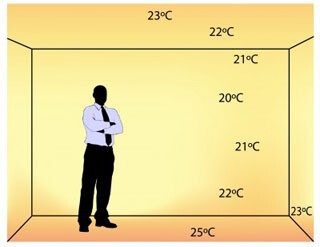
Underfloor heating:
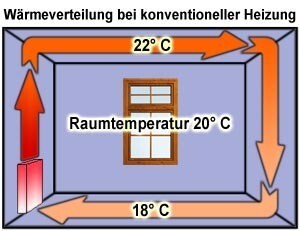
See the following images:
Radiator heating:
Underfloor heating:
Well, you will have to pay more compared to having existing ceilings because the air volume to be heated will be larger, and the ratio of the exterior wall area to the heat-emitting surface will increase.
However, since the insulation and so on will retain the heat, and as mentioned before, the heat-emitting surface is the floor, the overall efficiency should not become excessively uneconomical.
Additionally, you have planned a controlled mechanical ventilation system with heat recovery, which will also distribute the heat throughout the entire house (albeit to a limited extent). With or without an intermediate ceiling, you will have relatively uniform temperatures on the ground floor and upper floor thanks, among other things, to the controlled ventilation system.
No matter how you look at it, heating costs will only differ marginally, provided the roof area is adequately insulated.
However, since the insulation and so on will retain the heat, and as mentioned before, the heat-emitting surface is the floor, the overall efficiency should not become excessively uneconomical.
Additionally, you have planned a controlled mechanical ventilation system with heat recovery, which will also distribute the heat throughout the entire house (albeit to a limited extent). With or without an intermediate ceiling, you will have relatively uniform temperatures on the ground floor and upper floor thanks, among other things, to the controlled ventilation system.
No matter how you look at it, heating costs will only differ marginally, provided the roof area is adequately insulated.
Similar topics