
ᐅ Planning a Home Theater System – Control Options and Various Questions
Created on: 6 Nov 2015 11:44
W
Weitling09W
Weitling096 Nov 2015 11:44We are currently at the shell construction stage and are planning the electrical installation. So far, we have used very basic equipment for listening to music (AIWA micro system, TV sound directly from the TV), but we want to plan for more "proper" equipment in the house.
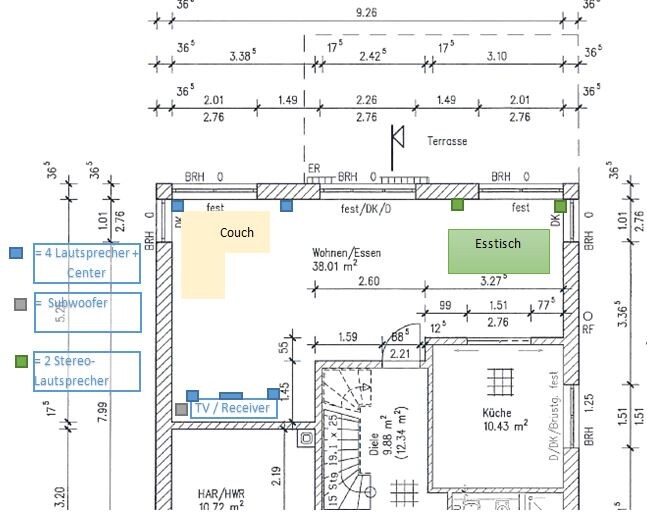
What I have in mind:
> In the living room, I would like a surround sound system that allows me to listen to both music and TV audio.
> At the same time, I want to transmit sound from this system to the dining area, where stereo sound is sufficient (just for background music).
> Ideally, I would also like to be able to set up speakers on the terrace for garden parties, which can also be connected to the same system.
My questions:
1. I have already seen that there are multi-room control systems – would that be suitable here, or are there better options?
2. What should I pay attention to when purchasing a receiver / speakers?
3. Which connectors should I plan for (receiver -> wall [connector] -> [speaker cable] -> wall [connector] -> speakers)?
4. Is there any downside to the idea of also connecting the dining area speakers via wall connectors, and for garden parties, using those connectors to connect the outdoor speakers?
5. Attached is a draft of the plan on the floor plan – what could be improved? Any advice or tips are welcome!
What I have in mind:
> In the living room, I would like a surround sound system that allows me to listen to both music and TV audio.
> At the same time, I want to transmit sound from this system to the dining area, where stereo sound is sufficient (just for background music).
> Ideally, I would also like to be able to set up speakers on the terrace for garden parties, which can also be connected to the same system.
My questions:
1. I have already seen that there are multi-room control systems – would that be suitable here, or are there better options?
2. What should I pay attention to when purchasing a receiver / speakers?
3. Which connectors should I plan for (receiver -> wall [connector] -> [speaker cable] -> wall [connector] -> speakers)?
4. Is there any downside to the idea of also connecting the dining area speakers via wall connectors, and for garden parties, using those connectors to connect the outdoor speakers?
5. Attached is a draft of the plan on the floor plan – what could be improved? Any advice or tips are welcome!
S
Sebastian796 Nov 2015 12:21Yes, that doesn’t work because of the resistance—you will end up damaging the system.
There are switches you can connect behind the system. A friend of mine built a circuit that allows me to activate the music in any given room at the push of a button (also simultaneously). This also takes from a second zone, meaning someone can still watch TV in the living room while music from the NAS or internet radio plays in the shower.
Additionally, I have a separate HD zone in the garage for music or HD TV.
Rear speakers in surround sound systems are usually not placed behind the listener but alongside them at ear level—unfortunately, this is often not feasible in the floor plans, and we weren’t able to manage it either—I was quite disappointed.
I have arranged it like you, with the speakers slightly elevated behind the sofa, plus an additional output for a second subwoofer there.
There is a product on Amazon from Lyndahl, the LKL005, which I installed here as a 7.2 version—you can connect the speakers nicely with that.
But again: don’t just connect speakers in parallel!
Our system is controllable via an app, so we can adjust channels and volume from the rooms as well as on the terrace.
There are switches you can connect behind the system. A friend of mine built a circuit that allows me to activate the music in any given room at the push of a button (also simultaneously). This also takes from a second zone, meaning someone can still watch TV in the living room while music from the NAS or internet radio plays in the shower.
Additionally, I have a separate HD zone in the garage for music or HD TV.
Rear speakers in surround sound systems are usually not placed behind the listener but alongside them at ear level—unfortunately, this is often not feasible in the floor plans, and we weren’t able to manage it either—I was quite disappointed.
I have arranged it like you, with the speakers slightly elevated behind the sofa, plus an additional output for a second subwoofer there.
There is a product on Amazon from Lyndahl, the LKL005, which I installed here as a 7.2 version—you can connect the speakers nicely with that.
But again: don’t just connect speakers in parallel!
Our system is controllable via an app, so we can adjust channels and volume from the rooms as well as on the terrace.
With my surround sound system, you can connect speakers in parallel, but you need to configure it properly; otherwise, the resistance will be incorrect. Alternatively, there are speakers with higher resistance designed for this purpose. The best option, however, would be a system that natively supports multi-room audio. Otherwise, there are also wireless solutions that allow multiple speakers to be operated.
W
Weitling096 Nov 2015 12:43Hello Sebastian, thank you for your quick reply and all the helpful tips.
What do you mean by "connecting speakers in parallel"? I didn’t intend to connect two speakers to one output on the receiver, but rather to set it up using a 2-zone receiver (for example, an Onkyo TX-NR525 – I see it has outputs for surround plus two separate "Zone 2" outputs on the back).
What do you mean by "connecting speakers in parallel"? I didn’t intend to connect two speakers to one output on the receiver, but rather to set it up using a 2-zone receiver (for example, an Onkyo TX-NR525 – I see it has outputs for surround plus two separate "Zone 2" outputs on the back).
W
Weitling096 Nov 2015 12:51Hello Saruss,
I think I didn’t express myself clearly – by "Parallel möchte ich über diese Anlage auch Ton in den Essbereich übertragen" I meant that I want to transmit sound to the dining area at the same time using this system.
I think I didn’t express myself clearly – by "Parallel möchte ich über diese Anlage auch Ton in den Essbereich übertragen" I meant that I want to transmit sound to the dining area at the same time using this system.
N
nordanney6 Nov 2015 12:53Your living room layout works—you can’t really change it now anyway. You just need to figure out and test the optimal height for the surround speakers. Make sure your future receiver supports network connectivity and plan the appropriate LAN cabling.
Otherwise, you can set up multiple zones if you buy a compatible receiver.
Personally, I wouldn’t go that route but would rather prefer solutions from brands like Teufel, Sonos, or Bose. For example, just buy a Play5 and place it in the dining area if the main system’s sound coverage isn’t enough there, or take it into the garden, or use it in other rooms (you can even operate several units simultaneously). This way, you get internet radio or can stream from your computer.
It’s hard for me to recommend specific receivers or speakers, as it depends on a) your budget, b) your listening preferences, c) the aesthetics you can accommodate in your home, and of course d) your personal sound perception.
You don’t have to focus on the latest models for sound quality; older equipment can still sound excellent (I still have an old Marantz PM16 that’s about 20 years old but still sounds amazing)—this applies to both speakers and amplifiers. However, older devices may have limitations in connectivity (4K, sound formats like Dolby TrueHD, upscaling, number of HDMI inputs, etc.).
We stuck with Marantz and equipped our surround setup with an AV7005 + MM8003 preamp/power amp combination and Canton speakers. It wasn’t cheap, but it’s a good compromise for stereo and surround. With this setup, you could supply music to three different zones, just like you planned.
In the hi-fi area, the best advice is: audition! If possible, borrow equipment from a dealer and test it in your own space, since the room itself greatly impacts the sound. Brands like Teufel and Nubert can also be sent to you for trial.
Otherwise, you can set up multiple zones if you buy a compatible receiver.
Personally, I wouldn’t go that route but would rather prefer solutions from brands like Teufel, Sonos, or Bose. For example, just buy a Play5 and place it in the dining area if the main system’s sound coverage isn’t enough there, or take it into the garden, or use it in other rooms (you can even operate several units simultaneously). This way, you get internet radio or can stream from your computer.
It’s hard for me to recommend specific receivers or speakers, as it depends on a) your budget, b) your listening preferences, c) the aesthetics you can accommodate in your home, and of course d) your personal sound perception.
You don’t have to focus on the latest models for sound quality; older equipment can still sound excellent (I still have an old Marantz PM16 that’s about 20 years old but still sounds amazing)—this applies to both speakers and amplifiers. However, older devices may have limitations in connectivity (4K, sound formats like Dolby TrueHD, upscaling, number of HDMI inputs, etc.).
We stuck with Marantz and equipped our surround setup with an AV7005 + MM8003 preamp/power amp combination and Canton speakers. It wasn’t cheap, but it’s a good compromise for stereo and surround. With this setup, you could supply music to three different zones, just like you planned.
In the hi-fi area, the best advice is: audition! If possible, borrow equipment from a dealer and test it in your own space, since the room itself greatly impacts the sound. Brands like Teufel and Nubert can also be sent to you for trial.
Similar topics