
Hello everyone,
We are currently in the early stages of planning our single-family home, still focusing on the basic room layout.
I am currently considering the type of heating system.
My gut feeling is swinging between an air-to-water heat pump and a ground-source (also called water-to-water) heat pump.
Unfortunately, there is no gas connection available, otherwise that would definitely be another option.
Using a calculation tool, I have entered the following parameters:
Living area 180 m² (will likely be somewhat smaller)
Electricity (heat pump): €0.20 / kWh
Gas: €0.06 / kWh
Specific heating demand 60 kWh/m²*a
Gas boiler efficiency 96%
Gas boiler standby losses 8%
Heating costs:
Gas heating: €740 / year
Air-to-water heat pump: €497 / year
Ground-source heat pump: €488 / year
First question: Are air-to-water and ground-source heat pumps really that close in cost? If so, you can save yourself the question of economic efficiency and drastically shorten your considerations at this point. Or do I have a calculation error here?
I am also interested in the topic of cooling with the heat pump. Both types can provide cooling if designed accordingly, with ground-source heat pumps likely being somewhat cheaper to operate. Does anyone have an estimate of how much energy cooling with a heat pump consumes? A rough figure or rule of thumb would be sufficient for now.
Thanks very much for your input.
We are currently in the early stages of planning our single-family home, still focusing on the basic room layout.
I am currently considering the type of heating system.
My gut feeling is swinging between an air-to-water heat pump and a ground-source (also called water-to-water) heat pump.
Unfortunately, there is no gas connection available, otherwise that would definitely be another option.
Using a calculation tool, I have entered the following parameters:
Living area 180 m² (will likely be somewhat smaller)
Electricity (heat pump): €0.20 / kWh
Gas: €0.06 / kWh
Specific heating demand 60 kWh/m²*a
Gas boiler efficiency 96%
Gas boiler standby losses 8%
Heating costs:
Gas heating: €740 / year
Air-to-water heat pump: €497 / year
Ground-source heat pump: €488 / year
First question: Are air-to-water and ground-source heat pumps really that close in cost? If so, you can save yourself the question of economic efficiency and drastically shorten your considerations at this point. Or do I have a calculation error here?
I am also interested in the topic of cooling with the heat pump. Both types can provide cooling if designed accordingly, with ground-source heat pumps likely being somewhat cheaper to operate. Does anyone have an estimate of how much energy cooling with a heat pump consumes? A rough figure or rule of thumb would be sufficient for now.
Thanks very much for your input.
(
((andreas))10 Aug 2018 15:11OK. Thanks already for the feedback.
So the facts in the first post are definitely wrong. Let’s just let that go ;-)
Homework for me:
I had the topic of a trench collector on my radar before but then forgot about it. It seems very appealing to me.
I still need to reconsider the second electricity meter. That was just my first idea. But I can follow and agree with the argumentation.
Topic trench collector: Does it have any disadvantages? Everything I quickly read about it sounds too good to be true 🙂
So the facts in the first post are definitely wrong. Let’s just let that go ;-)
Homework for me:
I had the topic of a trench collector on my radar before but then forgot about it. It seems very appealing to me.
I still need to reconsider the second electricity meter. That was just my first idea. But I can follow and agree with the argumentation.
Topic trench collector: Does it have any disadvantages? Everything I quickly read about it sounds too good to be true 🙂
The collector is located relatively close to the surface, with heat being supplied by the sun. This generally means it cannot be built over, and shading should be avoided. Deep-rooted plantings are also not allowed.
We are still considering our options and waiting for concrete offers. We have more than enough land, but who wants to limit themselves permanently?
We are still considering our options and waiting for concrete offers. We have more than enough land, but who wants to limit themselves permanently?
R
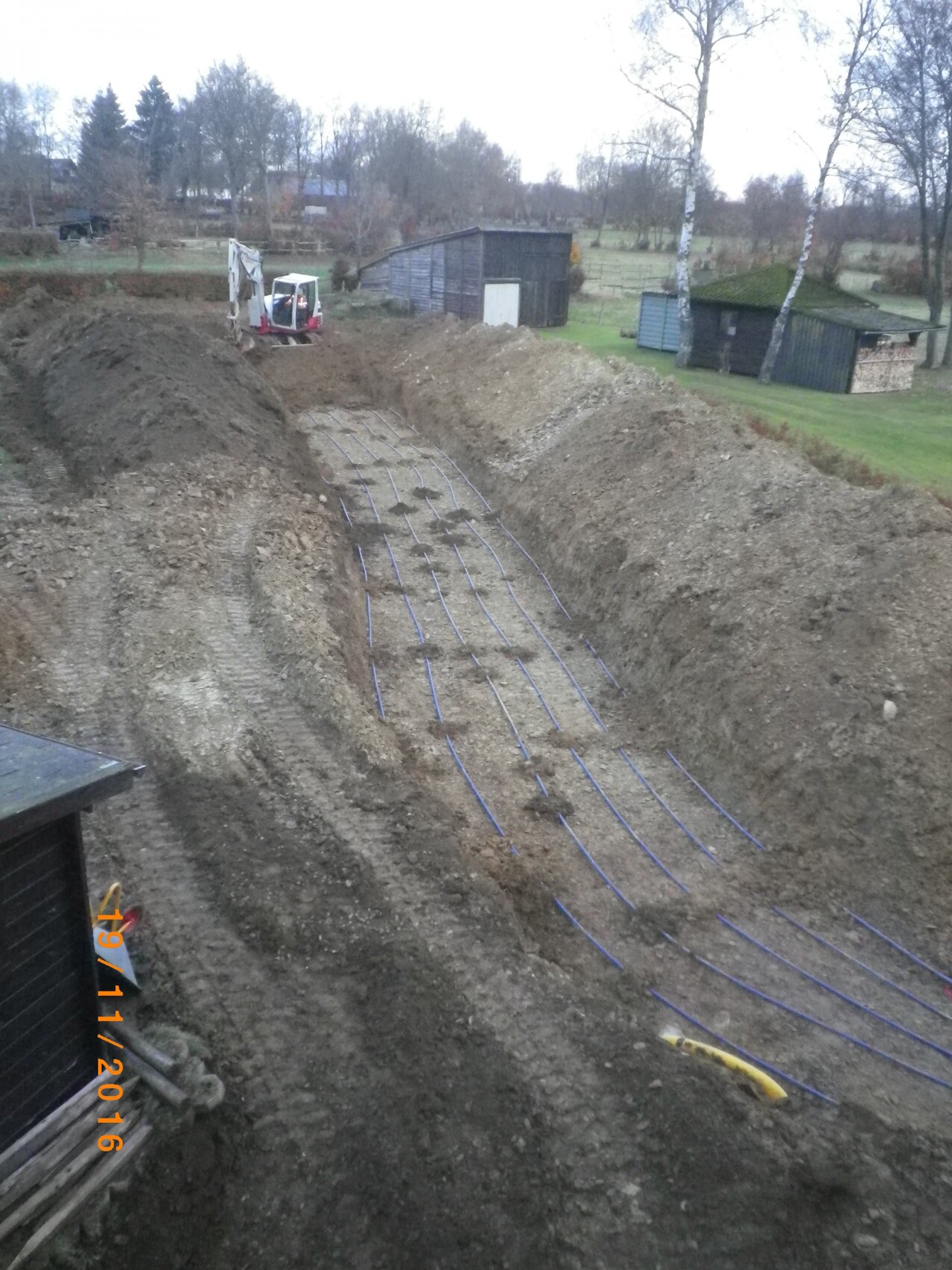
readytorumble10 Aug 2018 15:51We installed a ground collector ourselves. We did it alongside other work since a large excavator was already on site.
I would do it again anytime.
At the same time, we also installed a drainage system for rainwater management above it. This is supposed to be beneficial for the collector, and drainage makes sense anyway to reduce fees.
Disadvantages? You shouldn’t cover or seal the area above it.
Because heat is extracted from the ground, supposedly less vegetation grows above it. So far, we haven’t noticed any difference, but we have only lived in the house for one year.
The biggest downside is probably the space requirement. We have enough room, so we laid 7 PE pipes about 90m (295 feet) long each for 160 sqm (1,722 sqft) of heated floor area. The spacing between the pipes is 0.7 m (28 inches).
The total space needed was about 400 sqm (4,305 sqft), including the pit for the manifold and so on.
Obtaining permits was quite stressful (local water authority...). However, your plumbing company should handle this (we did all plumbing ourselves because we have a professional in the family).
What worked quite smoothly, on the other hand, was getting the subsidy. The money arrived very quickly (€4,500).
In the picture, you can see the last 3 PE pipes being installed.
I would do it again anytime.
At the same time, we also installed a drainage system for rainwater management above it. This is supposed to be beneficial for the collector, and drainage makes sense anyway to reduce fees.
Disadvantages? You shouldn’t cover or seal the area above it.
Because heat is extracted from the ground, supposedly less vegetation grows above it. So far, we haven’t noticed any difference, but we have only lived in the house for one year.
The biggest downside is probably the space requirement. We have enough room, so we laid 7 PE pipes about 90m (295 feet) long each for 160 sqm (1,722 sqft) of heated floor area. The spacing between the pipes is 0.7 m (28 inches).
The total space needed was about 400 sqm (4,305 sqft), including the pit for the manifold and so on.
Obtaining permits was quite stressful (local water authority...). However, your plumbing company should handle this (we did all plumbing ourselves because we have a professional in the family).
What worked quite smoothly, on the other hand, was getting the subsidy. The money arrived very quickly (€4,500).
In the picture, you can see the last 3 PE pipes being installed.
(
((andreas))13 Aug 2018 09:34Thank you for your feedback. Assuming I have a ring trench collector in the garden, how much distance should I maintain before I can start planting trees again?
Assumption: The collector is installed at a depth of 1.5 m (5 feet).
Assumption: The collector is installed at a depth of 1.5 m (5 feet).
Similar topics