
Good morning everyone,
I have the following question. We are planning to renovate/refurbish an older prefabricated house from 1978. To create more space in the kitchen, we would like to remove the radiator. The consultant from the kitchen company pointed out a baseboard heater (model Kickspace 500) that could be connected to the standard heating circuit, potentially saving the cost and space of a larger radiator.
The question now is whether a radiator is absolutely necessary in the kitchen? I guess opinions may vary, but I would like to hear your thoughts.
For example, my parents no longer have a radiator in their kitchen since the door to the heated living room is always open (except when cooking, but then it’s warm anyway).
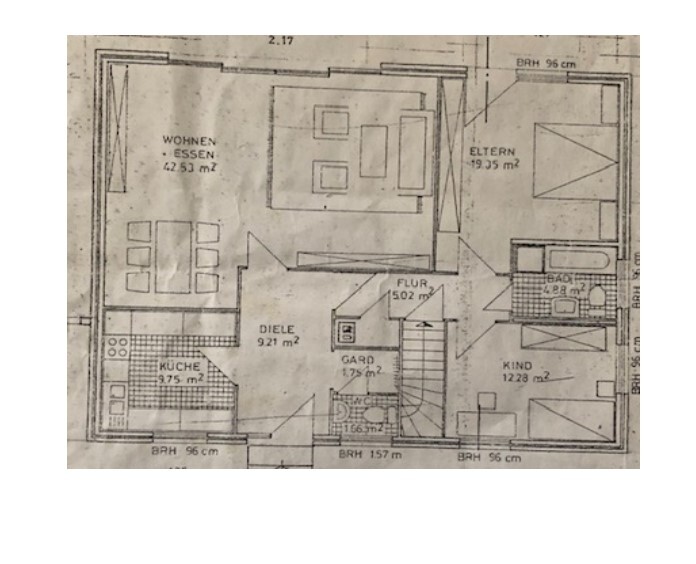
I have attached the floor plan. Below the kitchen there is currently a room for oil tanks, but those will be removed as we are switching to gas. The room underneath will likely become a bathroom. Also, there will be a door to the living room which will probably remain open most of the time, except when the kitchen is in use. The kitchen layout will also be different; this is an old plan. The cabinets will be rearranged to allow for the passage to the living room. No seating is planned in the kitchen.
What do you think— is this baseboard heater necessary? It would save us about 500€ and we could invest that money elsewhere. Besides, I don’t find this baseboard heater very attractive.
Thanks.
I have the following question. We are planning to renovate/refurbish an older prefabricated house from 1978. To create more space in the kitchen, we would like to remove the radiator. The consultant from the kitchen company pointed out a baseboard heater (model Kickspace 500) that could be connected to the standard heating circuit, potentially saving the cost and space of a larger radiator.
The question now is whether a radiator is absolutely necessary in the kitchen? I guess opinions may vary, but I would like to hear your thoughts.
For example, my parents no longer have a radiator in their kitchen since the door to the heated living room is always open (except when cooking, but then it’s warm anyway).
I have attached the floor plan. Below the kitchen there is currently a room for oil tanks, but those will be removed as we are switching to gas. The room underneath will likely become a bathroom. Also, there will be a door to the living room which will probably remain open most of the time, except when the kitchen is in use. The kitchen layout will also be different; this is an old plan. The cabinets will be rearranged to allow for the passage to the living room. No seating is planned in the kitchen.
What do you think— is this baseboard heater necessary? It would save us about 500€ and we could invest that money elsewhere. Besides, I don’t find this baseboard heater very attractive.
Thanks.
Because I would basically keep the layout so that the dining table is placed relatively centered when you step out the door. I just like how it looks that way. Of course, the door can be shifted a bit, which is not a problem. Generally, I want to stick to the current arrangement and keep the kitchen where it has been so far. I think we’re also drifting a bit off topic, but thanks for the ideas and suggestions. I’ll review them again later with my wife.
M
Mottenhausen9 Dec 2019 13:02Under no circumstances skip heating. Kitchens produce a lot of steam, combined with cold walls this leads to condensation and mold.
If you are renovating anyway, why not install (electric) underfloor heating? A 10m² (100 sq ft) heating mat is not very expensive and can be laid as a very thin layer under the floor covering. When the kitchen is replaced (rearranged), the floor will need to be redone anyway because significant color differences will have appeared under the cabinets.
If you are renovating anyway, why not install (electric) underfloor heating? A 10m² (100 sq ft) heating mat is not very expensive and can be laid as a very thin layer under the floor covering. When the kitchen is replaced (rearranged), the floor will need to be redone anyway because significant color differences will have appeared under the cabinets.
My original plan was to install underfloor heating throughout the entire floor (to be milled into the screed), but my wife didn’t want that. The advantage would have been that we could have replaced the convector heater in front of the glass wall in the living room. I don’t like it, but well, what can you do when your wife is against it. Maybe she’ll change her mind after all.
Electric underfloor heating, hmm... sounds good at first glance. But whenever I hear about heating with electricity, alarm bells usually go off for me (possibly unjustified), though it might be worth calculating the potential costs here.
New tiles will be installed anyway, that’s for sure.
Electric underfloor heating, hmm... sounds good at first glance. But whenever I hear about heating with electricity, alarm bells usually go off for me (possibly unjustified), though it might be worth calculating the potential costs here.
New tiles will be installed anyway, that’s for sure.

The mindset that "a kitchen always receives some cooking heat in the air, so additional heating isn’t necessary" is mistaken because this heat input is irregular, is not stored, and is released again without any planned regulation. Cooking heat does not reduce heating demand; it only causes peaks that are better managed in a targeted way. Therefore, a heating system in the kitchen should not only be present but ideally be easily adjustable (meaning instead of removing it, it’s better to install a thermostat control, as there is likely only a simple on-off valve). Keep in mind that temperature fluctuations also affect food preservation. Is this actually a Renolit prefabricated house? To my knowledge, there are renovation specialists for these, although I don’t have any names readily available; I recall they could be found around the Worms area.
https://www.instagram.com/11antgmxde/
https://www.linkedin.com/company/bauen-jetzt/
https://www.instagram.com/11antgmxde/
https://www.linkedin.com/company/bauen-jetzt/
@11ant: Ok, I think it will probably come down to having a heating system after all, but the exact type is still not completely clear.
I wasn’t aiming to reduce the heating demand, but rather questioning whether any heating is absolutely necessary in this room, since I’m not fully satisfied with the baseboard heating yet, and a standard radiator is not ideal due to space constraints.
Yes, it’s a Renolit prefabricated house; the company you mentioned is known to me, it’s called "Remosan" (in case anyone is interested).
I wasn’t aiming to reduce the heating demand, but rather questioning whether any heating is absolutely necessary in this room, since I’m not fully satisfied with the baseboard heating yet, and a standard radiator is not ideal due to space constraints.
Yes, it’s a Renolit prefabricated house; the company you mentioned is known to me, it’s called "Remosan" (in case anyone is interested).

Similar topics