
ᐅ Heating Demand KfW 55 / KfW 70 and Energy Consumption Costs
Created on: 7 Mar 2018 13:25
A
Aliban2014
Hello dear forum,
I am still considering which heating system to choose (air-to-water heat pump/gas) and came across the following question in this context:
According to Wikipedia, the maximum heating energy demand
for a KfW-55 house is 35 kWh/m²a (11 kBtu/ft² per year) and for a KfW-70 house (= Energy Saving Ordinance) it is 45 kWh/m²a (14 kBtu/ft² per year).
However, (?) in addition to this, there is the heating demand for hot water preparation: According to Wikipedia, some general methods calculate 12.5 kWh/m²a (4 kBtu/ft² per year) over the entire area for this. This would correspond to 23 liters (6 gallons) per person (but how many people does this cover? 1? 2? 4?)
1.
If you build only according to the Energy Saving Ordinance, then the final energy demand stated in the energy certificate later must not exceed the value of 45 kWh/m²a (14 kBtu/ft² per year) + hot water, right?
Or does the maximum 45 kWh/m²a already include the value for hot water preparation? This is not entirely clear to me and makes a huge difference in calculating heating costs.
2.
Is it then possible to theoretically calculate future heating costs in € based on this value? Of course, with additional assumptions. But the Energy Saving Ordinance value would definitely have to be met.
Example
For a current Energy Saving Ordinance single-family house (= KfW 70) with, for example, 160 m² (1,722 ft²) of living space + 10 m² (108 ft²) of utility space and 4 occupants, the maximum allowable final energy demand calculation would be:
Heating energy demand: 45 kWh/m²a x 160 m² = 7,200 kWh/a (25,000 kBtu/year)
Hot water: 4 x 12.5 kWh/m²a x 170 m² = 8,500 kWh/a (29,000 kBtu/year)
Total: 15,700 kWh
For a KfW55 house, the theoretical total would be 14,100 kWh.
This all sounds a bit too much.
According to my calculation, the electricity/gas costs would be as follows:
KfW70 = current Energy Saving Ordinance
Gas:
15,700 kWh x €0.05 = €785 ongoing gas costs
€8 basic fee x 12 months = €96
Total gas: €881
Air-to-water heat pump:
15,700 kWh / seasonal performance factor 3.5 = 4,485 kWh electricity
4,485 kWh x €0.29 electricity price = €1,300
€10 basic fee x 12 months = €120
Total electricity: €1,420
Alternatively, air-to-water heat pump with seasonal performance factor 4.0
15,700 kWh / 4.0 = 3,925 kWh electricity
3,925 kWh x €0.29 electricity price = €1,138
€10 basic fee x 12 months = €120
Total electricity: €1,258
KfW55
Gas:
14,100 kWh x €0.05 = €705 ongoing gas costs
€8 basic fee x 12 months = €96
Total gas: €801
Air-to-water heat pump:
14,100 kWh / seasonal performance factor 3.5 = 4,028 kWh electricity
4,028 kWh x €0.29 electricity price = €1,168
€10 basic fee x 12 months = €120
Total electricity: €1,288
Alternatively, air-to-water heat pump with seasonal performance factor 4.0
14,100 kWh / 4.0 = 3,525 kWh electricity
3,525 kWh x €0.29 electricity price = €1,022
€10 basic fee x 12 months = €120
Total electricity: €1,142
I think the most important question is whether the maximum values of 35 (KfW55) and 45 (Energy Saving Ordinance/KfW70) kWh/m²a (11 or 14 kBtu/ft² per year) include or exclude hot water. Or whether the 12.5 kWh per m² (4 kBtu/ft² per year) per person is too high.
In both cases, the result would be significantly lower...
I hope you can help me make sense of this jungle.
Regards
I am still considering which heating system to choose (air-to-water heat pump/gas) and came across the following question in this context:
According to Wikipedia, the maximum heating energy demand
for a KfW-55 house is 35 kWh/m²a (11 kBtu/ft² per year) and for a KfW-70 house (= Energy Saving Ordinance) it is 45 kWh/m²a (14 kBtu/ft² per year).
However, (?) in addition to this, there is the heating demand for hot water preparation: According to Wikipedia, some general methods calculate 12.5 kWh/m²a (4 kBtu/ft² per year) over the entire area for this. This would correspond to 23 liters (6 gallons) per person (but how many people does this cover? 1? 2? 4?)
1.
If you build only according to the Energy Saving Ordinance, then the final energy demand stated in the energy certificate later must not exceed the value of 45 kWh/m²a (14 kBtu/ft² per year) + hot water, right?
Or does the maximum 45 kWh/m²a already include the value for hot water preparation? This is not entirely clear to me and makes a huge difference in calculating heating costs.
2.
Is it then possible to theoretically calculate future heating costs in € based on this value? Of course, with additional assumptions. But the Energy Saving Ordinance value would definitely have to be met.
Example
For a current Energy Saving Ordinance single-family house (= KfW 70) with, for example, 160 m² (1,722 ft²) of living space + 10 m² (108 ft²) of utility space and 4 occupants, the maximum allowable final energy demand calculation would be:
Heating energy demand: 45 kWh/m²a x 160 m² = 7,200 kWh/a (25,000 kBtu/year)
Hot water: 4 x 12.5 kWh/m²a x 170 m² = 8,500 kWh/a (29,000 kBtu/year)
Total: 15,700 kWh
For a KfW55 house, the theoretical total would be 14,100 kWh.
This all sounds a bit too much.
According to my calculation, the electricity/gas costs would be as follows:
KfW70 = current Energy Saving Ordinance
Gas:
15,700 kWh x €0.05 = €785 ongoing gas costs
€8 basic fee x 12 months = €96
Total gas: €881
Air-to-water heat pump:
15,700 kWh / seasonal performance factor 3.5 = 4,485 kWh electricity
4,485 kWh x €0.29 electricity price = €1,300
€10 basic fee x 12 months = €120
Total electricity: €1,420
Alternatively, air-to-water heat pump with seasonal performance factor 4.0
15,700 kWh / 4.0 = 3,925 kWh electricity
3,925 kWh x €0.29 electricity price = €1,138
€10 basic fee x 12 months = €120
Total electricity: €1,258
KfW55
Gas:
14,100 kWh x €0.05 = €705 ongoing gas costs
€8 basic fee x 12 months = €96
Total gas: €801
Air-to-water heat pump:
14,100 kWh / seasonal performance factor 3.5 = 4,028 kWh electricity
4,028 kWh x €0.29 electricity price = €1,168
€10 basic fee x 12 months = €120
Total electricity: €1,288
Alternatively, air-to-water heat pump with seasonal performance factor 4.0
14,100 kWh / 4.0 = 3,525 kWh electricity
3,525 kWh x €0.29 electricity price = €1,022
€10 basic fee x 12 months = €120
Total electricity: €1,142
I think the most important question is whether the maximum values of 35 (KfW55) and 45 (Energy Saving Ordinance/KfW70) kWh/m²a (11 or 14 kBtu/ft² per year) include or exclude hot water. Or whether the 12.5 kWh per m² (4 kBtu/ft² per year) per person is too high.
In both cases, the result would be significantly lower...
I hope you can help me make sense of this jungle.
Regards
munger71 schrieb:
It is definitely possible to build to the KfW55 standard with a gas heating system. You just need solar thermal systems for hot water and heating, plus a controlled mechanical ventilation system with heat recovery.And a corresponding building method that exceeds the requirements of the Energy Saving Ordinance. So better than the 0.24 U-value wall.
Zaba12 schrieb:
There are two independent values that must be met, see the assessment from my energy consultant in the attachment.Yes, the Ht' value also has to be undercut. The requirements of the Energy Saving Ordinance here are moderate, and if necessary, the wall just needs to be a bit thicker. The key factor is usually the primary energy demand, which results from the combination of system technology and building standard.
Zaba12 schrieb:
Primarily, the Energy Saving Ordinance focuses on the building envelope—basically how much heat escapes through windows, exterior walls, floors, ceilings, etc.This applied to the previous thermal insulation regulations from 1978, 1984, and 1995. The Energy Saving Ordinance, with its updates up to 2016, was explicitly defined so that not only the building envelope or the system technology is considered, but rather the combination under certain framework conditions must achieve an efficiency standard.
Aliban2014 schrieb:
The annual heating demand is calculated according to the LEG/PHI method (PHPP) based on the actual heated area (energy reference area) instead of the building usable area according to the Energy Saving Ordinance.You probably get these values when you assess a house built to Energy Saving Ordinance standard using the PHI method. The purpose of the PHI method is indeed to determine the heating load and heating demand. Passive houses are heated with low-energy supply air systems, meaning the supply air is heated directly, and the supply air temperature should not exceed 10 W/m² of energy reference area, otherwise the supply air flow becomes too warm.
The operating costs of an air-to-water heat pump and a gas boiler with solar support will not differ significantly in the long term, at least not fundamentally. For both systems, it is more important that they are properly sized and operated. The initial investment is somewhat higher for the heat pump, maintenance might be a bit cheaper, and operating costs mainly depend on natural gas and electricity prices. No one can predict how these will develop in 5 to 10 years—probably not getting any cheaper.
To estimate heating costs, for KfW55 or Energy Saving Ordinance 2016, you can assume a heating demand of 40–50 kWh/m² of usable floor area, that is, 60–70 kWh/m² of living area plus 700–1000 kWh per person for hot water.
You will not recover the additional costs of the KfW55 standard through energy savings alone. Subsidies help a bit, but it might be better to just build 3 m² (about 32 sq ft) less—you don’t have to pay for or heat that space.
A
Aliban20148 Mar 2018 11:35Zaba12 schrieb:
Primarily, the Energy Saving Ordinance focuses on the building envelope—basically, how much heat is lost through windows, exterior walls, floors, ceilings, etc.
No matter how much technology is installed in the house, if the building envelope does not meet the required U-value, then features like controlled ventilation, mechanical ventilation with heat recovery (MVHR), photovoltaic systems, battery storage, etc. will not help much. The goal is always to first design the building envelope correctly. Only then can you start considering the primary energy demand!
Where does the misconception come from that technology can compensate for a poor U-value? These are two independent values that must each be met; see the assessment by my energy consultant in the attached file.
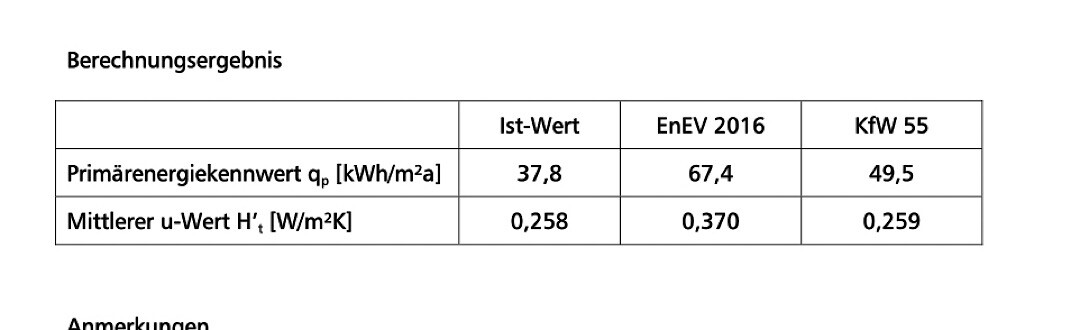
Thank you very much for the excerpt from the assessment. Did the energy consultant also calculate and provide the heating demand value alongside the primary energy demand? The primary energy value is calculated from the energy demand and the primary energy factor.
The actual value (as-built) is impressively low, which would mean that the energy demand is almost negligible?
Is the house already built, or are there any readings from the heat meter as a comparison (after screed heating, etc.)?
dertill schrieb:
The operating costs for an air-to-water heat pump and a gas boiler with solar support will not differ significantly in the long term, at least in principle. For both systems, it is more important that they are properly sized and operated. The initial investment for the heat pump is somewhat higher, the maintenance costs may be slightly lower, and operational costs depend entirely on gas and electricity prices. No one can predict how these prices will develop in 5 to 10 years—but they likely won’t get cheaper.As you said, this is the well-known crystal ball question regarding how gas and electricity prices will develop.
Based on the current situation, gas would still be somewhat cheaper to install (including connection costs, etc.) and also cheaper in ongoing costs, right? I have not yet requested any quotes for gas condensing boilers because I had always planned for an air-to-water heat pump, but I am currently doubting that choice.
dertill schrieb:
To estimate heating costs, you can assume a heating demand of 40–50 kWh/m² of usable floor area for KfW55 or the 2016 Energy Saving Ordinance standard, which corresponds to roughly 60–70 kWh/m² of living space plus 700–1000 kWh per person for domestic hot water.
The additional costs for the KfW55 standard will not be offset by energy savings alone. Subsidies help somewhat, but it might be better to build 3 m² (about 32 square feet) less—you don’t have to pay for or heat that space.We are building without KfW funding; based on our current planning, we would probably meet the KfW55 range regarding heating demand. I based the breakdown only on the figures from the Wikipedia entry since we have to comply with the 2016 Energy Saving Ordinance anyway.
A quick and rough analysis of the heat pump database for air-to-water heat pumps in 2017 showed (unless I miscalculated) an average of 59.80 kWh/m² per year heating demand per heated floor area.
This figure includes domestic hot water in most cases, usually with mechanical ventilation and heat recovery (MVHR). Also, many heat pumps only started operation during 2017, so the numbers may still include effects like screed drying or other one-time factors.
Once 2018 is over, more reliable data might be available for the heat pumps installed in 2017.
dertill schrieb:
And a corresponding construction method above the requirements of the energy saving ordinance. So more than the 0.24 U-value wall.The value according to the 2016 energy saving ordinance is a U-value of 0.24, that is correct. But for the exterior wall, you need at least a U-value of 0.20 or better. This means if you want to build with solid brickwork, you need at least a T8 (unfilled) brick. Since the masonry has the greatest leverage to achieve the U-value.
Aliban2014 schrieb:
Thank you for the excerpt from the report. Besides the primary energy value, did the energy consultant also calculate and provide the heating demand? The primary energy value is calculated based on the energy demand and the primary energy factor.
The actual value is incredibly low, which would mean an almost negligible energy demand?
Is the house already built, or are there any figures from the heat meter available for comparison (after heating up the screed, etc.)?Is that the case? I have never really looked into that because with a basement and solid construction (brick without external insulation) the focus was more on achieving the U-value required for KfW55. We only reach the average U-value (including the few decimal places) through a detailed thermal bridge analysis. That’s just how it is when you want a 36.5cm brick wall without external insulation.
The system consists of an air-to-water heat pump, centralized controlled ventilation with heat recovery, a fireplace, and a photovoltaic system. However, the photovoltaic system is not yet included in the primary energy value since the offer was not available at the time.
The house will be built soon.
Similar topics