
ᐅ Heating Demand KfW 55 / KfW 70 and Energy Consumption Costs
Created on: 7 Mar 2018 13:25
A
Aliban2014A
Aliban20147 Mar 2018 13:25Hello dear forum,
I am still considering which heating system to choose (air-to-water heat pump/gas) and came across the following question in this context:
According to Wikipedia, the maximum heating energy demand
for a KfW-55 house is 35 kWh/m²a (11 kBtu/ft² per year) and for a KfW-70 house (= Energy Saving Ordinance) it is 45 kWh/m²a (14 kBtu/ft² per year).
However, (?) in addition to this, there is the heating demand for hot water preparation: According to Wikipedia, some general methods calculate 12.5 kWh/m²a (4 kBtu/ft² per year) over the entire area for this. This would correspond to 23 liters (6 gallons) per person (but how many people does this cover? 1? 2? 4?)
1.
If you build only according to the Energy Saving Ordinance, then the final energy demand stated in the energy certificate later must not exceed the value of 45 kWh/m²a (14 kBtu/ft² per year) + hot water, right?
Or does the maximum 45 kWh/m²a already include the value for hot water preparation? This is not entirely clear to me and makes a huge difference in calculating heating costs.
2.
Is it then possible to theoretically calculate future heating costs in € based on this value? Of course, with additional assumptions. But the Energy Saving Ordinance value would definitely have to be met.
Example
For a current Energy Saving Ordinance single-family house (= KfW 70) with, for example, 160 m² (1,722 ft²) of living space + 10 m² (108 ft²) of utility space and 4 occupants, the maximum allowable final energy demand calculation would be:
Heating energy demand: 45 kWh/m²a x 160 m² = 7,200 kWh/a (25,000 kBtu/year)
Hot water: 4 x 12.5 kWh/m²a x 170 m² = 8,500 kWh/a (29,000 kBtu/year)
Total: 15,700 kWh
For a KfW55 house, the theoretical total would be 14,100 kWh.
This all sounds a bit too much.
According to my calculation, the electricity/gas costs would be as follows:
KfW70 = current Energy Saving Ordinance
Gas:
15,700 kWh x €0.05 = €785 ongoing gas costs
€8 basic fee x 12 months = €96
Total gas: €881
Air-to-water heat pump:
15,700 kWh / seasonal performance factor 3.5 = 4,485 kWh electricity
4,485 kWh x €0.29 electricity price = €1,300
€10 basic fee x 12 months = €120
Total electricity: €1,420
Alternatively, air-to-water heat pump with seasonal performance factor 4.0
15,700 kWh / 4.0 = 3,925 kWh electricity
3,925 kWh x €0.29 electricity price = €1,138
€10 basic fee x 12 months = €120
Total electricity: €1,258
KfW55
Gas:
14,100 kWh x €0.05 = €705 ongoing gas costs
€8 basic fee x 12 months = €96
Total gas: €801
Air-to-water heat pump:
14,100 kWh / seasonal performance factor 3.5 = 4,028 kWh electricity
4,028 kWh x €0.29 electricity price = €1,168
€10 basic fee x 12 months = €120
Total electricity: €1,288
Alternatively, air-to-water heat pump with seasonal performance factor 4.0
14,100 kWh / 4.0 = 3,525 kWh electricity
3,525 kWh x €0.29 electricity price = €1,022
€10 basic fee x 12 months = €120
Total electricity: €1,142
I think the most important question is whether the maximum values of 35 (KfW55) and 45 (Energy Saving Ordinance/KfW70) kWh/m²a (11 or 14 kBtu/ft² per year) include or exclude hot water. Or whether the 12.5 kWh per m² (4 kBtu/ft² per year) per person is too high.
In both cases, the result would be significantly lower...
I hope you can help me make sense of this jungle.
Regards
I am still considering which heating system to choose (air-to-water heat pump/gas) and came across the following question in this context:
According to Wikipedia, the maximum heating energy demand
for a KfW-55 house is 35 kWh/m²a (11 kBtu/ft² per year) and for a KfW-70 house (= Energy Saving Ordinance) it is 45 kWh/m²a (14 kBtu/ft² per year).
However, (?) in addition to this, there is the heating demand for hot water preparation: According to Wikipedia, some general methods calculate 12.5 kWh/m²a (4 kBtu/ft² per year) over the entire area for this. This would correspond to 23 liters (6 gallons) per person (but how many people does this cover? 1? 2? 4?)
1.
If you build only according to the Energy Saving Ordinance, then the final energy demand stated in the energy certificate later must not exceed the value of 45 kWh/m²a (14 kBtu/ft² per year) + hot water, right?
Or does the maximum 45 kWh/m²a already include the value for hot water preparation? This is not entirely clear to me and makes a huge difference in calculating heating costs.
2.
Is it then possible to theoretically calculate future heating costs in € based on this value? Of course, with additional assumptions. But the Energy Saving Ordinance value would definitely have to be met.
Example
For a current Energy Saving Ordinance single-family house (= KfW 70) with, for example, 160 m² (1,722 ft²) of living space + 10 m² (108 ft²) of utility space and 4 occupants, the maximum allowable final energy demand calculation would be:
Heating energy demand: 45 kWh/m²a x 160 m² = 7,200 kWh/a (25,000 kBtu/year)
Hot water: 4 x 12.5 kWh/m²a x 170 m² = 8,500 kWh/a (29,000 kBtu/year)
Total: 15,700 kWh
For a KfW55 house, the theoretical total would be 14,100 kWh.
This all sounds a bit too much.
According to my calculation, the electricity/gas costs would be as follows:
KfW70 = current Energy Saving Ordinance
Gas:
15,700 kWh x €0.05 = €785 ongoing gas costs
€8 basic fee x 12 months = €96
Total gas: €881
Air-to-water heat pump:
15,700 kWh / seasonal performance factor 3.5 = 4,485 kWh electricity
4,485 kWh x €0.29 electricity price = €1,300
€10 basic fee x 12 months = €120
Total electricity: €1,420
Alternatively, air-to-water heat pump with seasonal performance factor 4.0
15,700 kWh / 4.0 = 3,925 kWh electricity
3,925 kWh x €0.29 electricity price = €1,138
€10 basic fee x 12 months = €120
Total electricity: €1,258
KfW55
Gas:
14,100 kWh x €0.05 = €705 ongoing gas costs
€8 basic fee x 12 months = €96
Total gas: €801
Air-to-water heat pump:
14,100 kWh / seasonal performance factor 3.5 = 4,028 kWh electricity
4,028 kWh x €0.29 electricity price = €1,168
€10 basic fee x 12 months = €120
Total electricity: €1,288
Alternatively, air-to-water heat pump with seasonal performance factor 4.0
14,100 kWh / 4.0 = 3,525 kWh electricity
3,525 kWh x €0.29 electricity price = €1,022
€10 basic fee x 12 months = €120
Total electricity: €1,142
I think the most important question is whether the maximum values of 35 (KfW55) and 45 (Energy Saving Ordinance/KfW70) kWh/m²a (11 or 14 kBtu/ft² per year) include or exclude hot water. Or whether the 12.5 kWh per m² (4 kBtu/ft² per year) per person is too high.
In both cases, the result would be significantly lower...
I hope you can help me make sense of this jungle.
Regards
A
Aliban20147 Mar 2018 13:48Okay, with KfW55 standard using the air-to-water heat pump with an annual performance factor of 3.5, the electricity costs should be €1,288 instead of €1,178. I hope there are no further calculation errors.
oh... there is quite a bit of confusion here.
Since Wikipedia does not issue funding approvals from KfW or conduct energy demand calculations according to the Energy Saving Ordinance, I will refer here to the Technical Minimum Requirements attached to the information sheet for the KfW Program 153: Energy-efficient construction for KfW 55, 40, and 40+ (valid until April 2018).
Neither KfW nor the Energy Saving Ordinance set a maximum heating energy demand. Nowhere, never.
The Energy Saving Ordinance requires the calculation of the primary energy demand using the reference building method. In this process, your planned building is compared to a reference building with reference system technology. If your building’s result is equal to or better than the reference, you are allowed to build according to the Energy Saving Ordinance. The primary energy demand is calculated from your heating energy demand and domestic hot water demand IN COMBINATION with your system technology.
There is also no absolute maximum primary energy demand, only that your primary energy demand must not exceed that of the reference building for your design. The reference building has the same volume and window areas as your building but features predefined wall and window constructions and reference system technology. Your design performance must meet or exceed this overall.
The KfW requirements are based on the reference building method and require that your primary energy demand does not exceed 55% or 40% of the reference building. KfW refers to the specifications from 2014. Since 2016, the Energy Saving Ordinance requires compliance with 75% of the 2014 Qp – which is why the KfW 70 program was discontinued, as it effectively became the standard. So, the 2016 Energy Saving Ordinance Standard = “KfW 75.”
I hope this clarifies all questions about the maximum heating energy demand allowed under the Energy Saving Ordinance and KfW 55. Simply put, there is no absolute limit.
Aside from that: you won’t be able to build a KfW 55 house with a natural gas heating system. With natural gas heating without solar thermal, it will be difficult to meet even new build standards, even with mechanical ventilation with heat recovery.
Regarding domestic hot water, I would estimate about 2 kWh per person per day, which corresponds to 45 liters (12 gallons) of water at 50°C (122°F) per day. The Energy Saving Ordinance is not entirely realistic here: why would you need more hot water just because your living room is 20 m² (215 sq ft) larger?
But domestic hot water demand is completely dependent on the individual: Do you bathe every day? Do you enjoy rain shower sessions at 30 liters/min (8 gallons/min)? Do you go to the gym four times a week and shower there instead of at home? Do you not have a bathtub? Do you work mainly outside or stay frequently in hotels?
This can result in hot water demand ranging from almost zero up to 100 liters (26 gallons) per day.
The actual heating energy demand of a house depends on many factors, which becomes obvious when looking at a heat demand and heating load calculation. And that is just theory.
Aliban2014 schrieb:
According to Wikipedia
Since Wikipedia does not issue funding approvals from KfW or conduct energy demand calculations according to the Energy Saving Ordinance, I will refer here to the Technical Minimum Requirements attached to the information sheet for the KfW Program 153: Energy-efficient construction for KfW 55, 40, and 40+ (valid until April 2018).
Aliban2014 schrieb:
maximum heating energy demand
for a KfW 55 house 35 kWh/m²a and for a KfW 70 house (= Energy Saving Ordinance) 45 kWh/m²a.
Neither KfW nor the Energy Saving Ordinance set a maximum heating energy demand. Nowhere, never.
The Energy Saving Ordinance requires the calculation of the primary energy demand using the reference building method. In this process, your planned building is compared to a reference building with reference system technology. If your building’s result is equal to or better than the reference, you are allowed to build according to the Energy Saving Ordinance. The primary energy demand is calculated from your heating energy demand and domestic hot water demand IN COMBINATION with your system technology.
There is also no absolute maximum primary energy demand, only that your primary energy demand must not exceed that of the reference building for your design. The reference building has the same volume and window areas as your building but features predefined wall and window constructions and reference system technology. Your design performance must meet or exceed this overall.
The KfW requirements are based on the reference building method and require that your primary energy demand does not exceed 55% or 40% of the reference building. KfW refers to the specifications from 2014. Since 2016, the Energy Saving Ordinance requires compliance with 75% of the 2014 Qp – which is why the KfW 70 program was discontinued, as it effectively became the standard. So, the 2016 Energy Saving Ordinance Standard = “KfW 75.”
I hope this clarifies all questions about the maximum heating energy demand allowed under the Energy Saving Ordinance and KfW 55. Simply put, there is no absolute limit.
Aside from that: you won’t be able to build a KfW 55 house with a natural gas heating system. With natural gas heating without solar thermal, it will be difficult to meet even new build standards, even with mechanical ventilation with heat recovery.
Regarding domestic hot water, I would estimate about 2 kWh per person per day, which corresponds to 45 liters (12 gallons) of water at 50°C (122°F) per day. The Energy Saving Ordinance is not entirely realistic here: why would you need more hot water just because your living room is 20 m² (215 sq ft) larger?
But domestic hot water demand is completely dependent on the individual: Do you bathe every day? Do you enjoy rain shower sessions at 30 liters/min (8 gallons/min)? Do you go to the gym four times a week and shower there instead of at home? Do you not have a bathtub? Do you work mainly outside or stay frequently in hotels?
This can result in hot water demand ranging from almost zero up to 100 liters (26 gallons) per day.
The actual heating energy demand of a house depends on many factors, which becomes obvious when looking at a heat demand and heating load calculation. And that is just theory.
A
Aliban20147 Mar 2018 15:38dertill schrieb:
oh... there’s quite a bit of confusion here.
Since Wikipedia does not handle funding approvals from KfW or energy demand calculations according to the Energy Saving Ordinance (EnEV), I am referring here to the Technical Minimum Requirements attached to the fact sheet for KfW Program 153: Energy-efficient construction for KfW 55, 40, and 40+ (valid until April 2018).
Neither the KfW nor the Energy Saving Ordinance specify a maximum heating demand. Nowhere, never.The fact that the Energy Saving Ordinance / KfW do not specify a maximum heating demand is interesting because in the Wikipedia entry on these mysterious "35" or "45" kWh/m²a it only states:
"The annual heating demand is calculated using the LEG/PHI method (PHPP) based on the actual heated area (energy reference area) (instead of the usable floor area AN according to the Energy Saving Ordinance)."
Is it allowed to link Wikipedia here? This is found in the entry "Energy Standard."
I am generally skeptical of all Wikipedia entries and only considered this as a rough guideline. I am not familiar with the calculation behind the "LEG/PHI (PHPP) method" and cannot assess it.
It would have helped me a lot if this could serve as a benchmark for future heating costs.
In the heat pump database, for example, with system number 1922, the primary energy demand calculated at 52 kWh/m²a based on the 2014 Energy Saving Ordinance for the stated heated area of 240 m² (2600 ft²) should theoretically amount to a heating energy of 52 * 240 = 12,480 kWh.
According to the heat meter, however, it was around 14,932 kWh in 2017. It would almost fit if the usable floor area was assumed as 286 m² (3080 ft²) as stated in the remarks.
At least a reference point for calculating future heating costs should be possible?
Primarily, the Energy Saving Ordinance focuses on the building envelope, in simple terms, how much heat escapes through windows, exterior walls, floors, ceilings, and so on.
No matter how much technology is installed in the house, if the building envelope does not meet the required U-value, controlled ventilation, mechanical ventilation with heat recovery (MVHR), photovoltaic systems, storage, etc., will do very little good. The goal is always to design the building envelope first. Only then should you consider the primary energy demand!
Where does the misconception come from that poor U-values can be compensated with technology? These are two independent criteria that both need to be met, as explained in the evaluation by my energy consultant in the attachment.
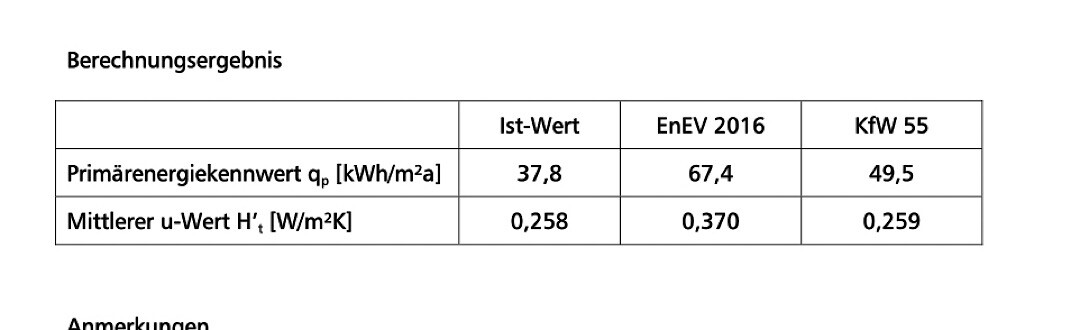
No matter how much technology is installed in the house, if the building envelope does not meet the required U-value, controlled ventilation, mechanical ventilation with heat recovery (MVHR), photovoltaic systems, storage, etc., will do very little good. The goal is always to design the building envelope first. Only then should you consider the primary energy demand!
Where does the misconception come from that poor U-values can be compensated with technology? These are two independent criteria that both need to be met, as explained in the evaluation by my energy consultant in the attachment.
Similar topics