
ᐅ Heat Pump: Which Type Makes Sense? (Viessmann Vitocal 250-A?)
Created on: 15 Nov 2024 19:44
N
Newbi23Hello everyone,
I’m a fairly new homeowner and still getting familiar with these topics, so please bear with me. 😉 Our old Rotex heating system (22 years old) started struggling during the first winter, we managed to fix it temporarily, but it was clear we needed to think about replacing it soon. Given the current political situation, we want to apply for funding in December and have a heat pump installed next year. The company that handles maintenance (also highly rated on Google) recommended the Viessmann Vitocal 250-A, which also seems to perform well according to Stiftung Warentest. I’m aware it’s sold to the Americans, but that’s not necessarily a dealbreaker (I can manage customer service in English with the Indian support if needed).
House details:
- Built in 2001
- 150m² (1615 sq ft) of living space, of which 40m² (430 sq ft) are in the basement (with half-height windows) and currently do not require strong heating, but will in the future
- 65m² (700 sq ft) of utility space
- Previous owner’s consumption: 15,000 kWh/year
- Underfloor heating in kitchen, living room, and bathrooms; thermostats in basement and upper floor
It should be quiet (which seems to be the case) and above all a sensible long-term investment (meaning if the higher efficiency compensates for the higher initial cost, a somewhat higher price is acceptable).
The only thing that puzzles me a bit is that the technician verbally quoted 35,000–40,000 euros (without subsidies). On the internet, e.g., EnBW lists total costs between 17,000 and 27,000 euros. Our situation is a bit more complex since we are considering installing the system behind the garage, meaning another trench and roughly 20 meters (65 ft) of cables routed through the garage (along the wall, not inside it), but that shouldn’t add more than 10,000 euros. Therefore, my questions:
1. Does this model make sense from your perspective, or would you recommend others I should consider (what are the pros & cons)?
2. Is it better to hire smaller local companies for installation or one of the larger providers (if so, which are reliable)? [We live near Worms, between Mannheim and Frankfurt]
Good luck!
I’m a fairly new homeowner and still getting familiar with these topics, so please bear with me. 😉 Our old Rotex heating system (22 years old) started struggling during the first winter, we managed to fix it temporarily, but it was clear we needed to think about replacing it soon. Given the current political situation, we want to apply for funding in December and have a heat pump installed next year. The company that handles maintenance (also highly rated on Google) recommended the Viessmann Vitocal 250-A, which also seems to perform well according to Stiftung Warentest. I’m aware it’s sold to the Americans, but that’s not necessarily a dealbreaker (I can manage customer service in English with the Indian support if needed).
House details:
- Built in 2001
- 150m² (1615 sq ft) of living space, of which 40m² (430 sq ft) are in the basement (with half-height windows) and currently do not require strong heating, but will in the future
- 65m² (700 sq ft) of utility space
- Previous owner’s consumption: 15,000 kWh/year
- Underfloor heating in kitchen, living room, and bathrooms; thermostats in basement and upper floor
It should be quiet (which seems to be the case) and above all a sensible long-term investment (meaning if the higher efficiency compensates for the higher initial cost, a somewhat higher price is acceptable).
The only thing that puzzles me a bit is that the technician verbally quoted 35,000–40,000 euros (without subsidies). On the internet, e.g., EnBW lists total costs between 17,000 and 27,000 euros. Our situation is a bit more complex since we are considering installing the system behind the garage, meaning another trench and roughly 20 meters (65 ft) of cables routed through the garage (along the wall, not inside it), but that shouldn’t add more than 10,000 euros. Therefore, my questions:
1. Does this model make sense from your perspective, or would you recommend others I should consider (what are the pros & cons)?
2. Is it better to hire smaller local companies for installation or one of the larger providers (if so, which are reliable)? [We live near Worms, between Mannheim and Frankfurt]
Good luck!

Viessmann is traditionally on the more expensive side.
Large nationwide companies usually subcontract to local contractors, and you might get either a top-quality or a poor one—you just can't know in advance. If you're lucky, the main contractor sets some guidelines, but these are usually more for their own benefit (mainly to ensure heating and reduce costs) rather than yours (efficient operation).
I would rather look for a local provider who is independent, meaning not tied to a single brand or at least offers several different options.
Then, preferably choose Japanese or Korean brands. Panasonic is something of a secret recommendation, but LG, Samsung, or Daikin are generally all good choices. Monoblock systems with simple software, without too much complexity. The German (or European) systems tend to be overengineered in their controls. The development engineers tried to reinvent the wheel, but the service technicians and installers often can't make sense of it at all.
Large nationwide companies usually subcontract to local contractors, and you might get either a top-quality or a poor one—you just can't know in advance. If you're lucky, the main contractor sets some guidelines, but these are usually more for their own benefit (mainly to ensure heating and reduce costs) rather than yours (efficient operation).
I would rather look for a local provider who is independent, meaning not tied to a single brand or at least offers several different options.
Then, preferably choose Japanese or Korean brands. Panasonic is something of a secret recommendation, but LG, Samsung, or Daikin are generally all good choices. Monoblock systems with simple software, without too much complexity. The German (or European) systems tend to be overengineered in their controls. The development engineers tried to reinvent the wheel, but the service technicians and installers often can't make sense of it at all.
B
Buchsbaum06616 Nov 2024 19:11It is best to complete the first step before the second.
First, it must be verified whether the existing grid connection is sufficiently sized for the additional rated power required by the heat pump. The electrical system inspection is carried out by an electrical company registered in the installer directory of the local grid operator, which coordinates the necessary measures with the grid operator.
First, it must be verified whether the existing grid connection is sufficiently sized for the additional rated power required by the heat pump. The electrical system inspection is carried out by an electrical company registered in the installer directory of the local grid operator, which coordinates the necessary measures with the grid operator.
N
nordanney16 Nov 2024 19:36Buchsbaum066 schrieb:
First, it must be checked whether the existing grid connection is adequately sized for the additional rated capacity required by the heat pump.With the low power consumption, this is not an issue in 99.9% of cases.Thank you for your feedback. I have requested a detailed quote.
The €4,000 (€4,000) also includes €1,000 (€1,000) for additional work in the garage. I think I would be willing to spend the €17,000 (€17,000) for the Viessmann 250 A, but I wonder if all the additional items are necessary or possibly oversized (for example, the 600L (160 gallons) buffer tank). What do you think? Where could costs be reduced, or is everything justified from a long-term business case perspective?
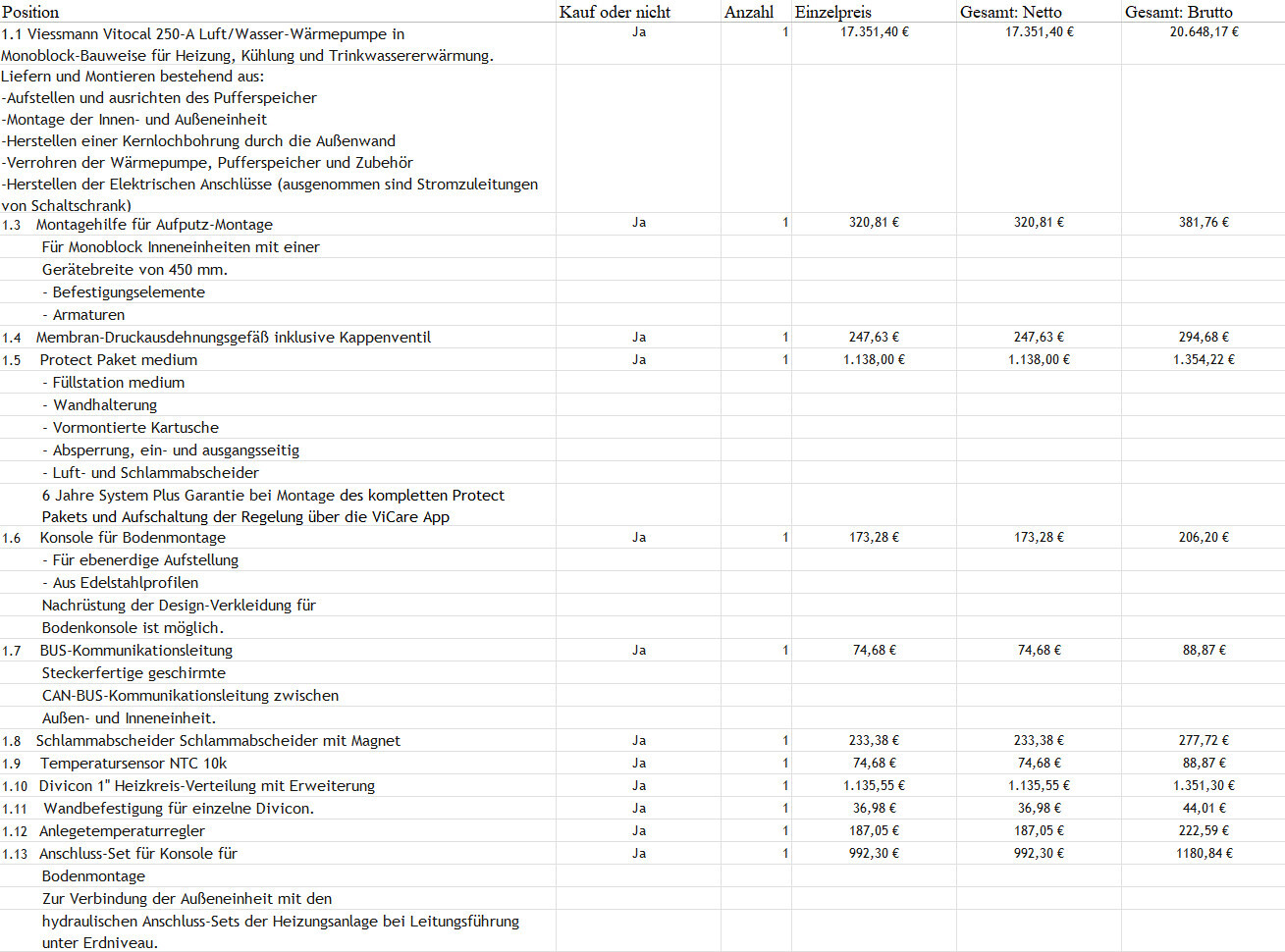
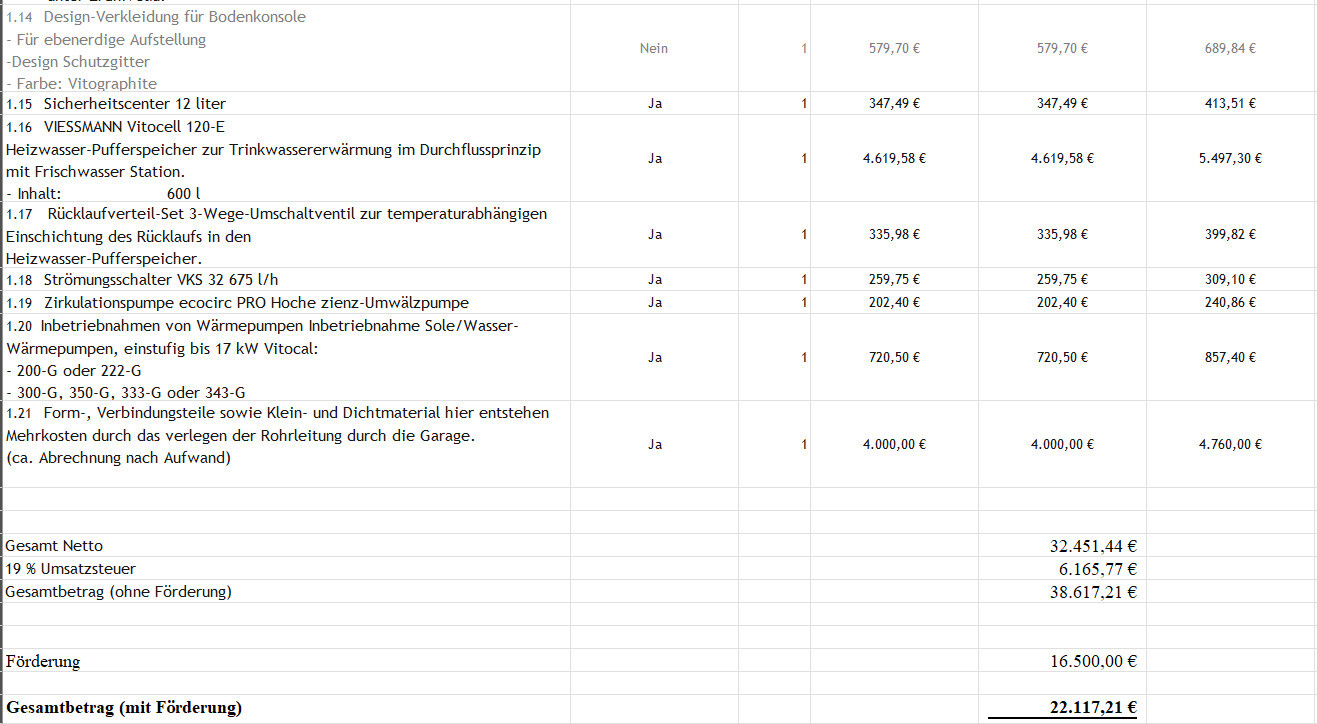
The €4,000 (€4,000) also includes €1,000 (€1,000) for additional work in the garage. I think I would be willing to spend the €17,000 (€17,000) for the Viessmann 250 A, but I wonder if all the additional items are necessary or possibly oversized (for example, the 600L (160 gallons) buffer tank). What do you think? Where could costs be reduced, or is everything justified from a long-term business case perspective?
N
nordanney30 Nov 2024 08:59Newbi23 schrieb:
Topics are relevant or possibly oversized (e.g., 600L (160 gallon) buffer tank).A buffer tank is almost always unnecessary. A domestic hot water (DHW) tank is sufficient – but if the system looks like that because it’s specified that way by Viessmann, then you have a tougher challenge ahead.Similar topics