
ᐅ Heat pump/ventilation system with excessive energy consumption
Created on: 24 Jun 2025 07:44
G
Gintonik
Hello forum,
My brother-in-law sent me a screenshot from his photovoltaic app. The values shown there seem illogical and much too high to me. As far as I can interpret, his photovoltaic system generated 38 kWh and additionally drew 12 kWh from the grid. That adds up to 50 kWh for the day. He has a KfW40 house built in 2022, with a Tecalor THZ 504 heat pump/ventilation system. He also uses this system to cool his house.
The total seems far too high to me, but I have no personal experience with a heat pump/ventilation system. I have now asked him to document the electricity consumption on the meter every evening to see if he really consumes what the app shows. I once had my energy flow meter for my photovoltaic system connected incorrectly, so it showed my generated energy as consumption.
In recent days, we had warm/hot weather. During the day, when the cooling runs, the photovoltaic system supplies electricity. In the evening, when the sun is gone, there is no more power from the photovoltaic system, but then cooling should no longer be necessary.
Do you have any experience with such systems?
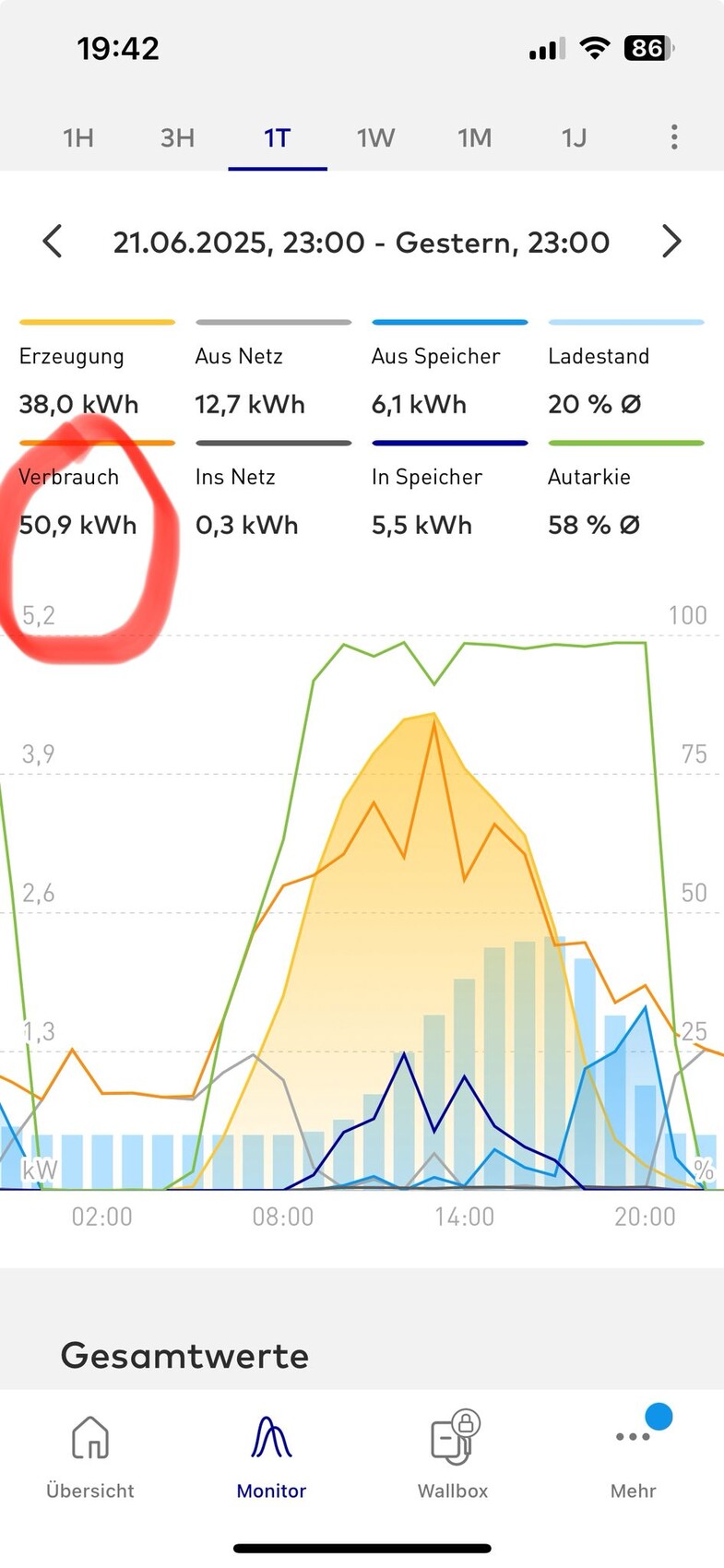
My brother-in-law sent me a screenshot from his photovoltaic app. The values shown there seem illogical and much too high to me. As far as I can interpret, his photovoltaic system generated 38 kWh and additionally drew 12 kWh from the grid. That adds up to 50 kWh for the day. He has a KfW40 house built in 2022, with a Tecalor THZ 504 heat pump/ventilation system. He also uses this system to cool his house.
The total seems far too high to me, but I have no personal experience with a heat pump/ventilation system. I have now asked him to document the electricity consumption on the meter every evening to see if he really consumes what the app shows. I once had my energy flow meter for my photovoltaic system connected incorrectly, so it showed my generated energy as consumption.
In recent days, we had warm/hot weather. During the day, when the cooling runs, the photovoltaic system supplies electricity. In the evening, when the sun is gone, there is no more power from the photovoltaic system, but then cooling should no longer be necessary.
Do you have any experience with such systems?

Gintonik schrieb:
The question I have is: doesn’t the cooling system eventually turn off, or can it run at full capacity all the time? How large is the house, and how much large glazing is exposed to the sun?
Is the system trying to cool the entire house, including the 50t (55 US tons) of concrete in the ceilings and walls? Does the unit run 24/7 or only a few hours per day? Please provide some information about the conditions.
W
wiltshire25 Jun 2025 12:00Gintonik schrieb:
If we consider 10 hours per day when cooling is necessary, we reach 14 kWh, and this period coincides exactly with the time of sun exposure. The electricity demand for cooling is directly related to the difference between the set target temperature and the outside temperature. At an outside temperature of 35°C (95°F) and a set target temperature of 28°C (82°F), the system will require about 3 kW. If someone decides to set the target temperature to 23°C (73°F), consumption will increase significantly because the system loses efficiency as the temperature difference grows.
The cooling power depends on the operating conditions and usage.
As always, comparisons are imperfect, and this one will also be scrutinized: If you drive an electric car, you notice that energy consumption at a constant speed of 90 km/h (56 mph) is pleasantly low, at 130 km/h (81 mph) it is already higher than most would prefer, and at a constant 200 km/h (124 mph) it reaches a level that causes disbelief.
Is it possible that the cooling was run similarly to driving constantly at 200 km/h?
N
nordanney25 Jun 2025 12:35wiltshire schrieb:
The electricity demand for cooling is directly related to the difference between the set target temperature and the outside temperature. At an outside temperature of 35 degrees Celsius (95°F) and a set target of 28 degrees Celsius (82°F), the system requires about 3 kW. If someone decides to lower the target temperature to 23 degrees Celsius (73°F), the energy consumption increases significantly because the system’s efficiency drops as the temperature difference grows.
The cooling capacity depends on the operating conditions and usage.
As always, comparisons have their limits and this one will be scrutinized again: If you drive an electric car, you notice that consumption at a steady 90 km/h (56 mph) is pleasantly low, at a constant 130 km/h (81 mph) it’s higher than most people are comfortable with, and at a constant 200 km/h (124 mph) it reaches a level that causes astonishment.
Is it possible that the cooling was tested similarly to driving constantly at 200 km/h (124 mph)? The power consumption for A35/W7 is 1.4 kW. That’s already like “constant 200.” With that alone, you wouldn’t even reach 50 kWh in 24 hours. That’s only 34 kWh at 24 hours of full load.
W
wiltshire25 Jun 2025 12:46nordanney schrieb:
The power consumption for A35/W7 is 1.4 kW. A35/W7 means 35°C (95°F) outside and 7°C (45°F) less inside. This results in a set temperature of 28°C (82°F).
I know many people, including in my household, who are not aware of this when setting the desired indoor temperature on a control panel. The argument is often, "In the office, they also set the temperature to 21°C (70°F)," and then you operate the system in a completely different range—if it even manages that.
N
nordanney25 Jun 2025 13:05wiltshire schrieb:
35/W7 means 35 degrees outside, 7 degrees less inside. No, that means the system requires 1.4 kW when the outdoor temperature is 35°C (95°F) in order to cool the water down to 7°C (45°F) for cooling purposes (similar to the supply temperature in a heat pump used for heating). This has nothing to do with the indoor temperature.
With this, at 35°C (95°F) outside temperature, an indoor temperature of around 24°C (75°F) should be achievable in a KfW 40 house (with sun protection). However, the energy consumption will not be this high 24 hours a day, since it gets cooler overnight (although it’s unclear what settings have been applied or if there is a malfunction).
@Gintonik: What were the results of trying to switch off the system for an hour? That doesn’t require significant preparation or any construction work. I would have expected this to have been tested immediately yesterday...
nordanney schrieb:
No, this means that the device requires 1.4 kW at an outdoor temperature of 35°C (95°F) to cool the water down to 7°C (45°F) for cooling purposes (basically the supply temperature as with a heat pump that heats). This has nothing to do with the indoor temperature.
With this, an indoor temperature of around 24°C (75°F) should be achievable at 35°C (95°F) outdoor temperature in a KfW 40 house (with sun protection). However, the energy consumption is not that high continuously over 24 hours since it is cooler at night (but who knows what settings have been made or if there is a defect).
@Gintonik: What were the results when you tried turning off the system for an hour? That shouldn’t require any major preparation or construction work. I would have expected this to be tested yesterday... I am currently on a business trip and can realistically only test this over the weekend, so I ask for some patience, also regarding your outstanding questions. Thank you.
Similar topics