
ᐅ Heat pump is not compatible with a hydronic (water-heated) fireplace.
Created on: 20 Oct 2023 18:54
J
Jessica388
Hello everyone,
I hope someone here can help us because our heating engineer doesn’t seem to be able to…
Key data
New build 2022 with 250 m² (2,691 ft²)
Heat pump Viessmann Vitocal 200-A
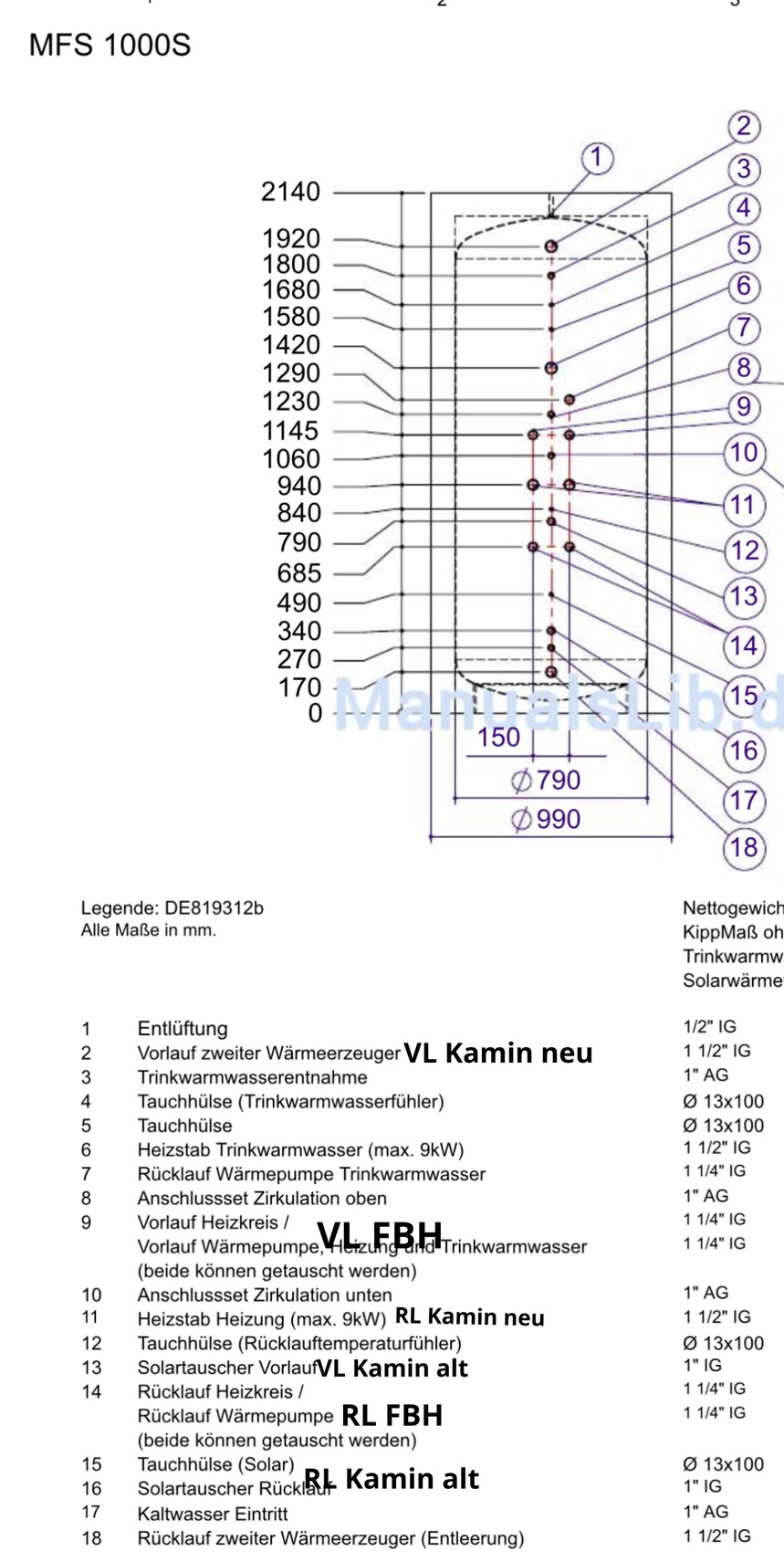
Multifunction storage tank MFS1000S
Water-heated stove with heating capacity on the water side of 8 kW
Photovoltaic system
Electric heating element
I am attaching the schematic of the storage tank layout.
The stove was initially connected under “old” and now it has been modified.
Everything works fine as long as the underfloor heating is off.
When the underfloor heating is on, our hot water temperature doesn’t exceed about 55°C (131°F).
When the underfloor heating is off, the temperature ranges between 65–75°C (149–167°F), either via the electric heating element during sunshine or by stoking the stove.
Now, however, this energy seems to be wasted. It can’t be that the underfloor heating requires 70°C (158°F) supply temperature to achieve a flow temperature of 35°C (95°F), right? The return water is only slightly cooler. So the water should only need to be heated by a maximum of 5°C (9°F).
We assume either a) something is still connected incorrectly, or b) the cold water from the underfloor heating causes such circulation that the hot water cools down within minutes.
What can be done about this?
Has anyone experienced similar problems?
Normally, we should almost run without electric power, but currently the heat pump switches on almost every hour to heat hot water…
I hope someone here can help us because our heating engineer doesn’t seem to be able to…
Key data
New build 2022 with 250 m² (2,691 ft²)
Heat pump Viessmann Vitocal 200-A
Multifunction storage tank MFS1000S
Water-heated stove with heating capacity on the water side of 8 kW
Photovoltaic system
Electric heating element
I am attaching the schematic of the storage tank layout.
The stove was initially connected under “old” and now it has been modified.
Everything works fine as long as the underfloor heating is off.
When the underfloor heating is on, our hot water temperature doesn’t exceed about 55°C (131°F).
When the underfloor heating is off, the temperature ranges between 65–75°C (149–167°F), either via the electric heating element during sunshine or by stoking the stove.
Now, however, this energy seems to be wasted. It can’t be that the underfloor heating requires 70°C (158°F) supply temperature to achieve a flow temperature of 35°C (95°F), right? The return water is only slightly cooler. So the water should only need to be heated by a maximum of 5°C (9°F).
We assume either a) something is still connected incorrectly, or b) the cold water from the underfloor heating causes such circulation that the hot water cools down within minutes.
What can be done about this?
Has anyone experienced similar problems?
Normally, we should almost run without electric power, but currently the heat pump switches on almost every hour to heat hot water…
W
WilderSueden25 Oct 2023 13:40sergutsh schrieb:
We have never actually used it 🙂
However, according to calculations, it was necessary. It’s mounted on the wall behind the door and doesn’t get in the way. It wasn’t expensive either.We were reimbursed over €500 (euros) by the general contractor. I would have to check what exactly was included in the calculation. With that chaotic group, I wouldn’t be surprised if the towel radiator still appears in the heating load calculation.J
Jessica38825 Oct 2023 13:43Daniel-Sp schrieb:
Hello,
Is the radiator supplied from the same mixing circuit as the underfloor heating, or does it have its own mixing circuit? Yes, it uses the same mixing circuit.
H
HeimatBauer25 Oct 2023 13:46I have also heard about varicose veins. Brian’s mother once said, "I heard about germs that have antennae and bite," which she was probably referring to the underfloor heating. And with that, we have already identified the most reliable source for this suspicion.
We have four electric towel radiators. None of them was ever used more than once – yet every year a different one corrodes from the inside (the first after two years, from a well-known manufacturer), and then the floor had to be cleaned for hours. Of course, a new radiator had to be purchased and installed. It was all covered by the warranty, but it was still annoying. If I leave out one thing in the next house, it will be that. A matter of personal taste.
We have four electric towel radiators. None of them was ever used more than once – yet every year a different one corrodes from the inside (the first after two years, from a well-known manufacturer), and then the floor had to be cleaned for hours. Of course, a new radiator had to be purchased and installed. It was all covered by the warranty, but it was still annoying. If I leave out one thing in the next house, it will be that. A matter of personal taste.
Radfahrer schrieb:
OK, that’s just what happens when you heat water with loss first and then pump it through the screed.
But it also works without the water, and the heat pump only heats the area of the room where it’s needed. Now I understand. You have an air-to-air heat pump.
I’ve never read anything positive about Proxon and similar brands. But that doesn’t matter as long as you’re satisfied yourself.
For example, we maintain 21.5°C (70.7°F) everywhere during the heating season.
On the north side, it’s currently lower because we haven’t started heating there yet and it’s not necessary at the moment.
R
Radfahrer25 Oct 2023 14:10Zaba123 schrieb:
Now I get it. You have an air-to-air heat pump.No. An air-to-air heat pump does not provide radiant heat.
D
Daniel-Sp25 Oct 2023 14:16Jessica388 schrieb:
Yes, it has the same mixing circuit. Then you are either heating with unnecessarily high system temperatures, which is neither beneficial for the efficiency nor the operation of the heat pump, or the towel radiator barely contributes to meeting the heating load.
Heating with high system temperatures results in severe throttling of the underfloor heating. This leads to a very low flow rate in the heating circuit. Heat pumps generally operate with high flow rates. If the flow rate is too low, the heat pump won’t be able to transfer the heat and will have to shut down. Even with a buffer tank like yours, this problem can only be minimally mitigated. Therefore, the recommendation is to use electric towel warmers or wall heating. Room temperatures are then not controlled via the thermostatic radiator valves (TRVs), which can only be on or off, but through the flow rate at the manifold. Ideally, TRVs should remain open in almost all rooms to ensure sufficient flow. In the bedroom, they may be used as usual. It is best to disable the TRVs that are not needed so that no one accidentally restricts the flow, which also saves electricity. Room temperature is controlled through the flow of the heating circuits. This should be calculated in advance (hydraulic balancing). In the first years, adjustments will need to be made (thermal balancing). A smart control system is not required—just a thermometer and some time.
Similar topics