
ᐅ Heat pump is not compatible with a hydronic (water-heated) fireplace.
Created on: 20 Oct 2023 18:54
J
Jessica388
Hello everyone,
I hope someone here can help us because our heating engineer doesn’t seem to be able to…
Key data
New build 2022 with 250 m² (2,691 ft²)
Heat pump Viessmann Vitocal 200-A
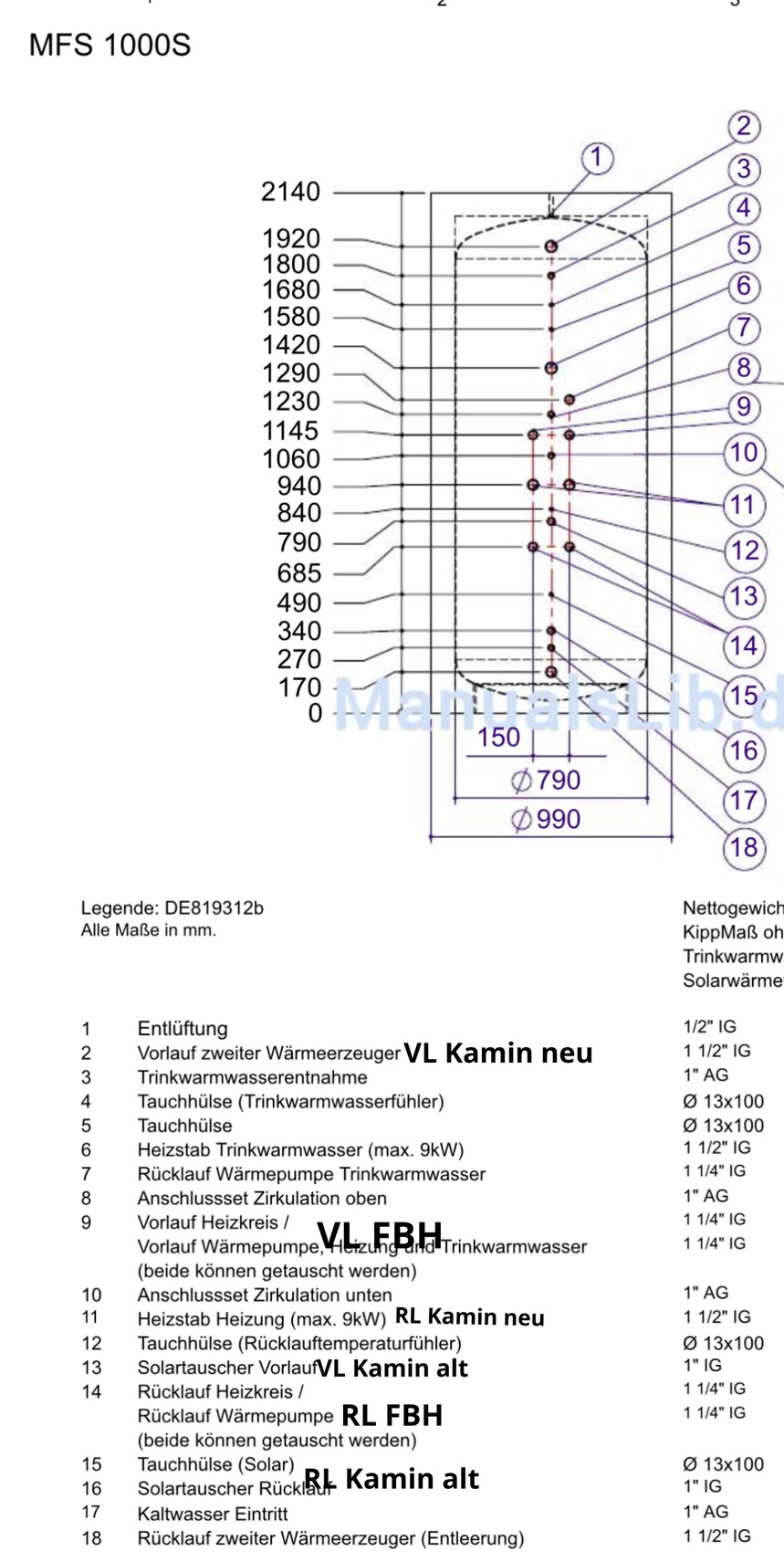
Multifunction storage tank MFS1000S
Water-heated stove with heating capacity on the water side of 8 kW
Photovoltaic system
Electric heating element
I am attaching the schematic of the storage tank layout.
The stove was initially connected under “old” and now it has been modified.
Everything works fine as long as the underfloor heating is off.
When the underfloor heating is on, our hot water temperature doesn’t exceed about 55°C (131°F).
When the underfloor heating is off, the temperature ranges between 65–75°C (149–167°F), either via the electric heating element during sunshine or by stoking the stove.
Now, however, this energy seems to be wasted. It can’t be that the underfloor heating requires 70°C (158°F) supply temperature to achieve a flow temperature of 35°C (95°F), right? The return water is only slightly cooler. So the water should only need to be heated by a maximum of 5°C (9°F).
We assume either a) something is still connected incorrectly, or b) the cold water from the underfloor heating causes such circulation that the hot water cools down within minutes.
What can be done about this?
Has anyone experienced similar problems?
Normally, we should almost run without electric power, but currently the heat pump switches on almost every hour to heat hot water…
I hope someone here can help us because our heating engineer doesn’t seem to be able to…
Key data
New build 2022 with 250 m² (2,691 ft²)
Heat pump Viessmann Vitocal 200-A
Multifunction storage tank MFS1000S
Water-heated stove with heating capacity on the water side of 8 kW
Photovoltaic system
Electric heating element
I am attaching the schematic of the storage tank layout.
The stove was initially connected under “old” and now it has been modified.
Everything works fine as long as the underfloor heating is off.
When the underfloor heating is on, our hot water temperature doesn’t exceed about 55°C (131°F).
When the underfloor heating is off, the temperature ranges between 65–75°C (149–167°F), either via the electric heating element during sunshine or by stoking the stove.
Now, however, this energy seems to be wasted. It can’t be that the underfloor heating requires 70°C (158°F) supply temperature to achieve a flow temperature of 35°C (95°F), right? The return water is only slightly cooler. So the water should only need to be heated by a maximum of 5°C (9°F).
We assume either a) something is still connected incorrectly, or b) the cold water from the underfloor heating causes such circulation that the hot water cools down within minutes.
What can be done about this?
Has anyone experienced similar problems?
Normally, we should almost run without electric power, but currently the heat pump switches on almost every hour to heat hot water…
R
RotorMotor21 Oct 2023 15:06Jessica388 schrieb:
I understood that the old version circulates within a closed loop, while the new version delivers directly into the large open water volume. That may be, but I can’t tell for sure. Honestly, it doesn’t make much difference! Both systems transfer heat to the storage tank. What’s important is that the correct control system and circulation pumps are installed.
Jessica388 schrieb:
No idea. We definitely don’t have anything like that and haven’t needed it so far. Oh yes, you definitely could have used such calculations before planning and installing the heating system. Even now, it would help to understand the issue better. With a proper heating load calculation, the system would surely have been planned more appropriately (smaller). You could have also avoided the water-based fireplace! Then you’d have significantly lower electricity costs, a longer-lasting heat pump, and maybe a small fireplace just for decoration.
Mycraft schrieb:
Previously, the stove was connected so that it only heated the lower part of the storage tank, and some layering may have occurred. Now it’s connected so that the entire tank is flowed through, allowing more heat to be transferred to the contents. Then it might indeed be slightly better. However, layering with warm at the bottom and cold at the top is physically impossible. So in either case, the storage tank fully warms up. The manufacturer explicitly designed this for high-temperature inputs such as fireplaces or solar thermal systems.
With such an inexperienced heating technician, I’d be worried they might overheat the tank. Is it ensured that this cannot happen?
J
Jessica38821 Oct 2023 16:37RotorMotor schrieb:
That may be true, I can’t tell for sure. But it really doesn’t make much difference!
Both options transfer the heat to the storage tank. What’s important is that the correct control system and circulation pumps are connected.
Oh yes, you could have really used these calculations before planning and installing the heating system.
Even now, it would help to understand the problem.
With a proper heating load calculation, the system would certainly have been designed much more efficiently (smaller).
You could have also done without the water-heated fireplace!
That way, you would have significantly lower electricity costs, a longer-lasting heat pump, and maybe just a small fireplace for decoration.
Then it might indeed be slightly better.
Physically, layering with warm at the bottom and cooler at the top is not possible. That’s why the entire storage tank ends up warm in both cases.
The manufacturer specifically designed this for high-temperature inputs like fireplaces or solar thermal systems.
With such an inexperienced heating installer, I would be worried that the tank could be overheated.
Is it ensured that this cannot happen? Yes, we even had that last year. It then makes huge banging noises and pumps cold water in.

J
Jessica38821 Oct 2023 17:56Mycraft schrieb:
Intense!
Was this in summer or winter? In other words, did the energy come from the roof or the fireplace?In winter, from the fireplace. But when we turned it on last week, I throttled it back at 85°C (185°F) and increased the pump’s flow rate to prevent that from happening again. The electric heating element had already preheated to 75°C (167°F), and within an hour the situation got that extreme. However, the underfloor heating was not turned on yet.
Your example clearly illustrates why installing a water jacket in the chimney is generally not recommended in a modern house with a heat pump.
However, since it is already installed, you have to find a way to manage it. Hopefully, sufficient and appropriate safety devices have been installed.
However, since it is already installed, you have to find a way to manage it. Hopefully, sufficient and appropriate safety devices have been installed.
W
WilderSueden21 Oct 2023 19:43The question, of course, is how to resolve this issue most easily. To me, removing the water trap seems like the best solution, followed by properly adjusting the heating system.
Similar topics