
ᐅ Heat Pump for New Single-Family Home Built to Energy Efficiency Standard 55
Created on: 1 Oct 2023 14:51
T
ToBu1991
Hello dear forum members,
I am currently working with the company Lehner Haus from Heidenheim to build my prefabricated timber-frame house. During the plan review, the topic of which air-to-water heat pump to use came up. I tried to get some information beforehand, but I would still appreciate hearing your opinions.
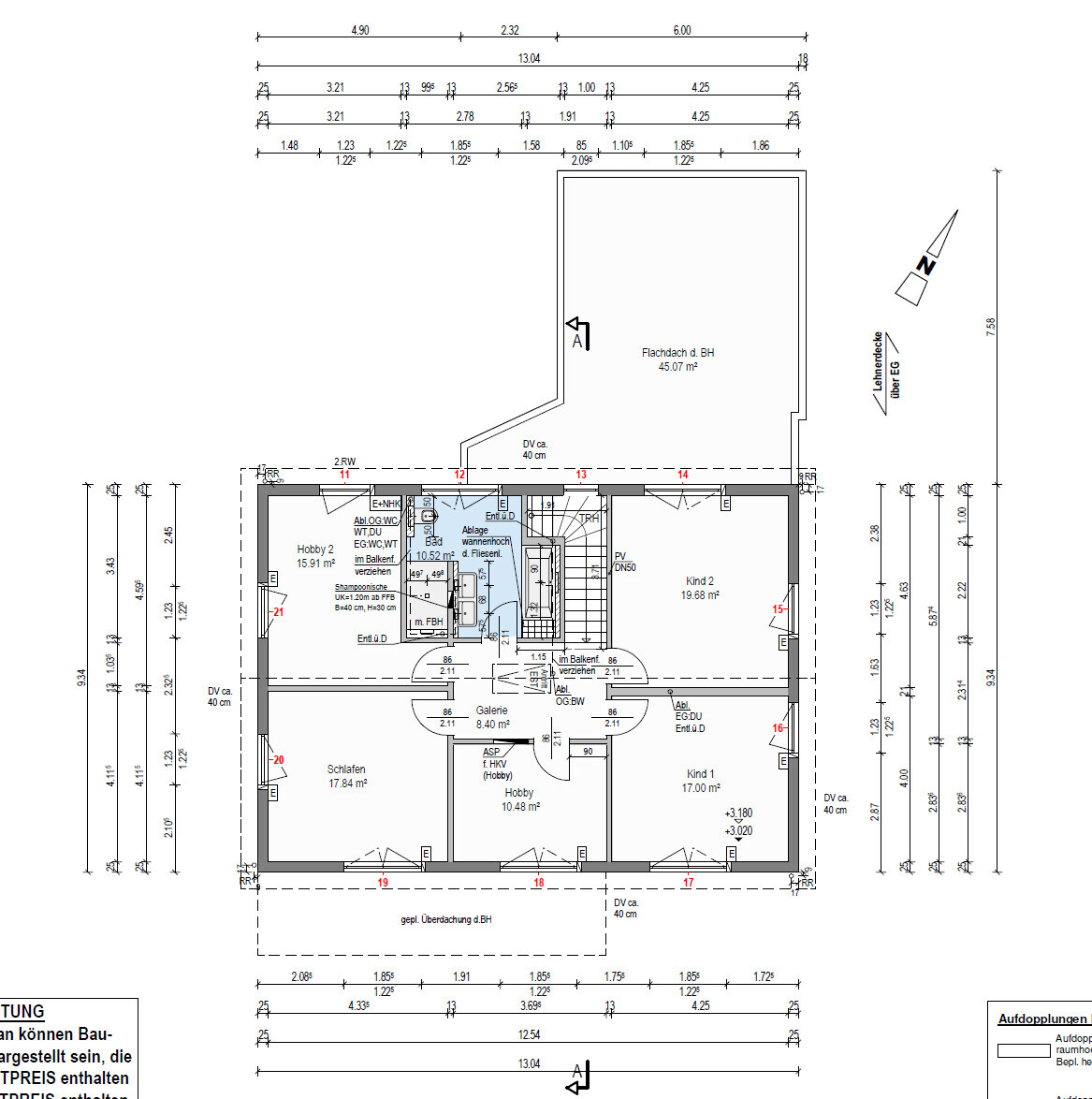
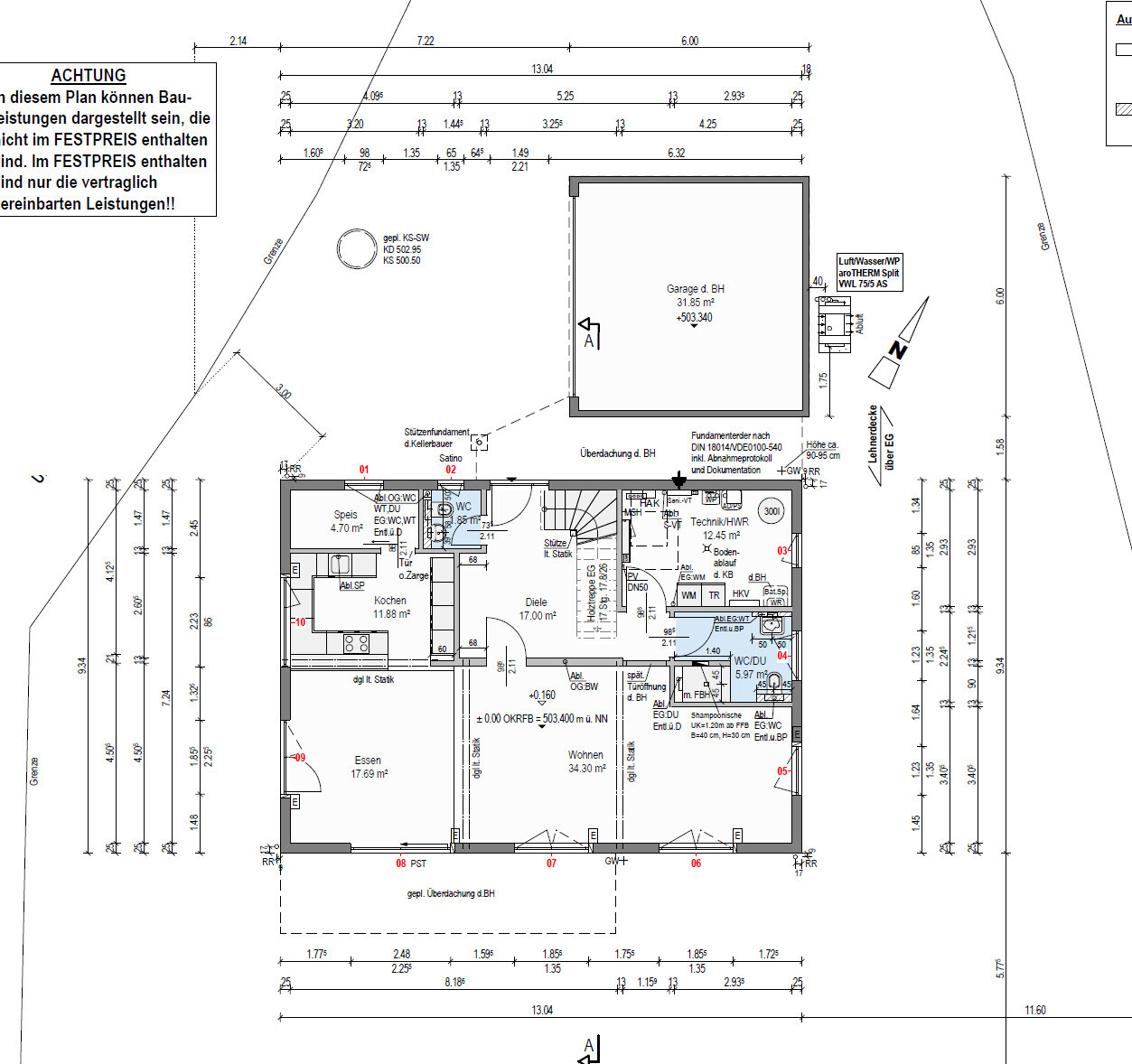
First, a few details about the build itself. The plan is for an Efficiency House 55 with about 200 sqm (2,150 sq ft) of living space. I am attaching the plans as well. A floor heating system is planned for all rooms except the pantry and technical room. Four people will live in the house. I would describe our usage habits as normal or average. At the moment, nobody spends 30 minutes straight in the shower. The bathtub is currently used about every two weeks. Of course, this may change as my children get older. Temperature-wise, the bedroom is kept rather cool. The living room is around 20–21°C (68–70°F). The bathroom is naturally a bit warmer, and at least the upstairs bathroom will have a towel radiator.
Lehner Haus offers two heat pump providers: Vaillant and Viessmann. Currently, the price includes a Vaillant Arotherm Split 105/5 AS, a 300-liter (79 gallon) hot water storage tank, and a compact buffer tank VWZ MPS40. A complete heating load calculation is not yet available. However, a rough preliminary estimate by the company indicated that the heating system is oversized and that a 75/5 AS or 85/5 AS would likely be sufficient. They also recommended switching from the aroTherm Split to an aroTherm Plus. Lehner Haus’s current recommendation is a Vaillant aroTherm Plus 75/6 A S2.
Here, I am uncertain whether this will be sufficient, and I also wonder why a much larger heat pump was originally offered. In various online posts, I read that heat pumps are sometimes undersized, causing inefficient operation because they have to run at "high load." But I also see the opposite advice that heat pumps should not be planned too large. As a layperson, it is also difficult for me to compare which heat pump is better (Split or Plus). As far as I understand, the Plus model is more efficient and quieter. But is it worth the extra cost? And does Viessmann maybe offer comparable cheaper units or better models for the same price? Viessmann also won at Stiftung Warentest in the current issue. Of course, only Lehner Haus can tell me the final price.
Removing the heat pump from Lehner Haus’s scope of work is unfortunately not an option for me, since I would then have to exclude both the underfloor heating and the entire plumbing installation as well (it’s apparently the same team).
Could you possibly help me here and give recommendations on what the right choice is? I need to make a final decision at the beginning of November.
Many thanks,
Best regards,
ToBu1991
I am currently working with the company Lehner Haus from Heidenheim to build my prefabricated timber-frame house. During the plan review, the topic of which air-to-water heat pump to use came up. I tried to get some information beforehand, but I would still appreciate hearing your opinions.
First, a few details about the build itself. The plan is for an Efficiency House 55 with about 200 sqm (2,150 sq ft) of living space. I am attaching the plans as well. A floor heating system is planned for all rooms except the pantry and technical room. Four people will live in the house. I would describe our usage habits as normal or average. At the moment, nobody spends 30 minutes straight in the shower. The bathtub is currently used about every two weeks. Of course, this may change as my children get older. Temperature-wise, the bedroom is kept rather cool. The living room is around 20–21°C (68–70°F). The bathroom is naturally a bit warmer, and at least the upstairs bathroom will have a towel radiator.
Lehner Haus offers two heat pump providers: Vaillant and Viessmann. Currently, the price includes a Vaillant Arotherm Split 105/5 AS, a 300-liter (79 gallon) hot water storage tank, and a compact buffer tank VWZ MPS40. A complete heating load calculation is not yet available. However, a rough preliminary estimate by the company indicated that the heating system is oversized and that a 75/5 AS or 85/5 AS would likely be sufficient. They also recommended switching from the aroTherm Split to an aroTherm Plus. Lehner Haus’s current recommendation is a Vaillant aroTherm Plus 75/6 A S2.
Here, I am uncertain whether this will be sufficient, and I also wonder why a much larger heat pump was originally offered. In various online posts, I read that heat pumps are sometimes undersized, causing inefficient operation because they have to run at "high load." But I also see the opposite advice that heat pumps should not be planned too large. As a layperson, it is also difficult for me to compare which heat pump is better (Split or Plus). As far as I understand, the Plus model is more efficient and quieter. But is it worth the extra cost? And does Viessmann maybe offer comparable cheaper units or better models for the same price? Viessmann also won at Stiftung Warentest in the current issue. Of course, only Lehner Haus can tell me the final price.
Removing the heat pump from Lehner Haus’s scope of work is unfortunately not an option for me, since I would then have to exclude both the underfloor heating and the entire plumbing installation as well (it’s apparently the same team).
Could you possibly help me here and give recommendations on what the right choice is? I need to make a final decision at the beginning of November.
Many thanks,
Best regards,
ToBu1991

KarstenausNRW schrieb:
That’s clear to me. But for new builds, I don’t need a heat pump designed for a 55°C (131°F) supply temperature—those are specifically made for older buildings or renovations. A “standard” heat pump is enough for me. I personally also prefer monoblock units, and I have installed two myself.
Otherwise, see [ATTACH alt="waermepumpe-fuer-neubau-einfamilienhaus-effizienzhaus-55-642151-1.png"]82043[/ATTACH]They also make those in smaller sizes. I don’t understand why they market it that way. For example, a 3.5 kW air-to-water heat pump makes no sense at all in an older building, yet it’s still marketed for that purpose.
As long as it’s up to about 7 kW, it works pretty well. However, I would question the heating load calculations. For our KfW 55 house with 200 m² (2,150 sq ft) of heated living space, the calculation showed that a 5 kW version would have been sufficient—but that would no longer qualify for funding under BAFA.
Hello everyone,
this topic has been ongoing for a while, but the house construction company has finally provided us with the heating load calculation.
The company now recommends the Vaillant Arotherm Split VWL 75/5 AS.
Do you think this is sufficient, or do you see any major errors in the calculation or the selection?
Somehow, I can't upload the file (it says the file type is not allowed). I hope the link works.
Many thanks
this topic has been ongoing for a while, but the house construction company has finally provided us with the heating load calculation.
The company now recommends the Vaillant Arotherm Split VWL 75/5 AS.
Do you think this is sufficient, or do you see any major errors in the calculation or the selection?
Somehow, I can't upload the file (it says the file type is not allowed). I hope the link works.
Many thanks
R
RotorMotor27 May 2024 22:03Is no ventilation being installed at all?
Why choose a split system instead of a heat pump?
Do the room temperatures in the calculation match your preferences?
If yes, you should go for a 55.
Why choose a split system instead of a heat pump?
Do the room temperatures in the calculation match your preferences?
If yes, you should go for a 55.
RotorMotor schrieb:
Is there no ventilation installed at all?
Why choose Split instead of Plus?
Do the room temperatures in the calculation match your preferences?
If yes, you should go with the 55. Hello RotorMotor,
No, ventilation is not planned.
The Split was chosen based on previous posts in this thread. The Plus model seems more suited for renovations due to the higher flow temperature.
After reviewing, I would expect the living room temperatures to be around 21 degrees instead of 20 degrees. Unfortunately, no one asked us about this.
According to your statement that the 55 should be sufficient, the 75 with the higher temperatures should fit as well, right?
Best regards, ToBu1991
R
RotorMotor28 May 2024 09:46ToBu1991 schrieb:
No ventilation is planned. That's a shame.
ToBu1991 schrieb:
The split was chosen based on the previous posts in this thread. The Plus is probably intended more for modernization due to the higher supply temperature. I think you misunderstood something.
In my view, the Plus is simply the more modern and better unit.
Better/more modern refrigerant, more efficient, and more flexible later on if the unit needs to be replaced, etc.
ToBu1991 schrieb:
After reviewing, I would consider the room temperatures to be around 21 degrees instead of 20. Unfortunately, no one asked us about this. It's a pity no one asked or brought that up.
But an extra degree doesn’t make much of a difference.
ToBu1991 schrieb:
Based on what you said, if the 55 model should be sufficient, then the 75 with the higher temperatures should fit, right? That would need to be recalculated. However, I strongly believe the 75 is still significantly oversized and will short-cycle.
With proper planning and hydraulic design, I would still recommend the 55.
Similar topics