
Dear heat pump experts and experienced home builders,
I would like to better understand what heat pump capacity we actually need.
Our project:
2 full floors
No basement
148 sqm (1,593 sq ft)
KFW55 standard
In our energy demand calculation, a 6 kW air-to-water heat pump is recommended.
However, the heating load calculation in the plan specifies an 8 kW air-to-air heat pump.
Both calculations seem to follow a standard procedure, as this is a developer project.
Which figures in both documents should I focus on?
To me, 8 kW seems quite high, but this is just a feeling formed by reading here in the forum.
The underfloor heating is already installed, also standard, and the screed has been curing for 4 weeks, waiting for the system to be heated up.
But there is no heat pump installed yet.
The builder would credit us €15,000 if we handle the purchase and installation of the heat pump ourselves.
All these questions are overwhelming us.
Is this even possible? Can we choose a different model or manufacturer?
Is it worthwhile, is €15,000 a reasonable amount?
Is 6 kW enough? ...
We need solid information to stand our ground with the builder.
Help!
Thanks!
I would like to better understand what heat pump capacity we actually need.
Our project:
2 full floors
No basement
148 sqm (1,593 sq ft)
KFW55 standard
In our energy demand calculation, a 6 kW air-to-water heat pump is recommended.
However, the heating load calculation in the plan specifies an 8 kW air-to-air heat pump.
Both calculations seem to follow a standard procedure, as this is a developer project.
Which figures in both documents should I focus on?
To me, 8 kW seems quite high, but this is just a feeling formed by reading here in the forum.
The underfloor heating is already installed, also standard, and the screed has been curing for 4 weeks, waiting for the system to be heated up.
But there is no heat pump installed yet.
The builder would credit us €15,000 if we handle the purchase and installation of the heat pump ourselves.
All these questions are overwhelming us.
Is this even possible? Can we choose a different model or manufacturer?
Is it worthwhile, is €15,000 a reasonable amount?
Is 6 kW enough? ...
We need solid information to stand our ground with the builder.
Help!
Thanks!

parcus schrieb:
Monovalent heat pumps are often far superior to split systems, but German manufacturers have missed this trend. Are you confusing monovalent operation/design of a heat pump with the difference between monoblock and split heat pumps?

Thank you for the suggestions.
I’m currently trying to read up on and understand some of the topics
so that I can make an informed decision.
1. Heating Load
I assume that the heating load calculation from the MEP (mechanical, electrical, plumbing) office that we have is correct.
(Using the data known to the MEP planner at that time)
Standard heating load: 5115 W
Normalized heating load: 6233 W (includes a warm-up surcharge of 1118 W on top of the standard heating load)
2. Improvement of the Building Envelope
Our heating load is probably somewhat lower because we upgraded the front door from double glazing to triple glazing. The MEP planning assumed a U-value of 1.5 for the door before this upgrade. Now, the two fixed glazed side panels have a U-value (Ug) of 0.6 (glass), and the door panel has a U-value (Ug) of 0.8.
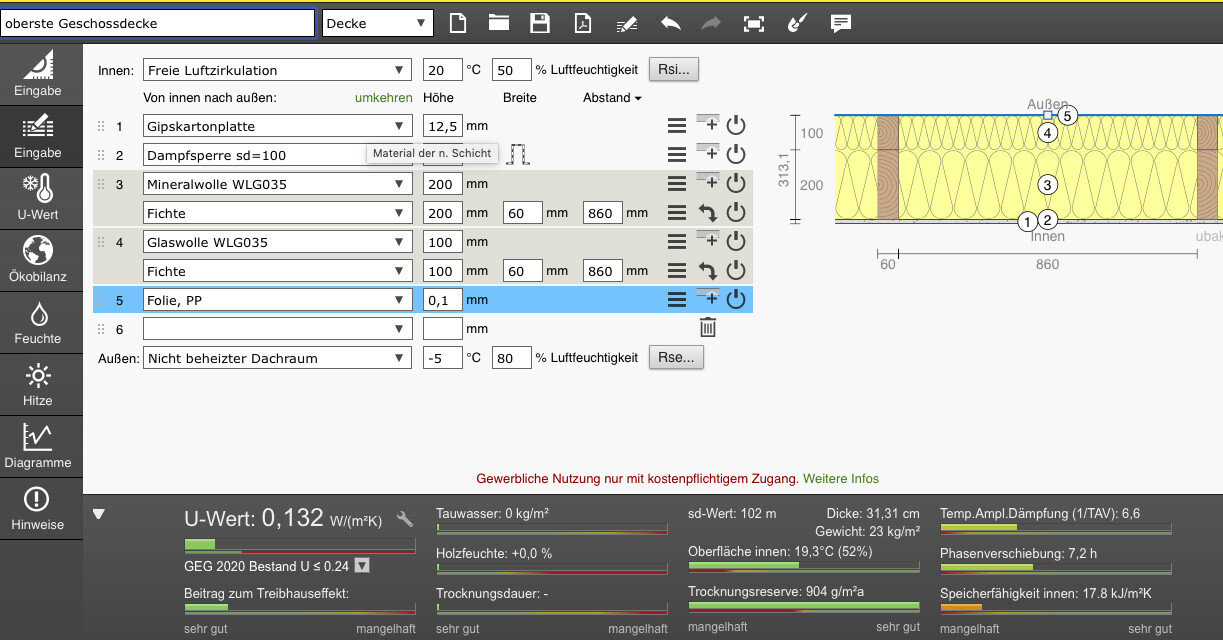
Additionally, we plan to insulate the top floor ceiling further. Above the existing ceiling (gypsum board, vapor retarder, 20 cm mineral wool with a thermal conductivity of 0.035 W/mK, spruce beams), which leads to the unheated attic (used for storage), we will add 10 cm mineral wool with the same thermal conductivity. Material has been ordered. According to Ubakus, this reduces the U-value from 0.194 to 0.132. The heating load calculation assumed a U-value of 0.210, likely including thermal bridges. The attic hatch is also still there. Nonetheless, the U-value will likely be less than 0.210 in the future.
[IMG alt="Screenshot 2022-12-11 at 11.49.44.png"]https://www.hausbau-forum.de/data/attachments/76/76182-e9d40a7d676d49270c27df85da07d2ae.jpg[/IMG]
3. Design of the Underfloor Heating
We cannot change the pipes anymore. The pipes are installed, and the screed is in place.
We do not know the exact lengths of the individual heating circuits. The pipe spacing is rather clear: 15 cm (6 inches), slightly less in the bathrooms.
Heating circuits:
Ground floor
- 1 guest toilet
- 1 utility room
- 1 hallway
- 1 guest room
- 3 circuits for open-plan kitchen, dining, living area
Upper floor
- 1 bathroom
- 1 corridor
- 1 bedroom
- 1 office
- 1 child’s room
- 1 hobby room
The toilet and bathroom each have an electric supplementary heater.
4. Refrigerant Lines
The outdoor and indoor units of the heat pump are not planned to be wall-to-wall. (Due to acoustical and layout reasons.)
From the utility room, refrigerant lines run in the screed through the bathroom to the exterior wall. This is probably about 6 m (20 feet) of refrigerant lines total, considering vertical offsets in the wall and the indoor unit.
Because of this, is a monoblock system no longer possible?
5. Ventilation
We do not have mechanical ventilation; we open the windows for airing.
6. Planned Heat Pump
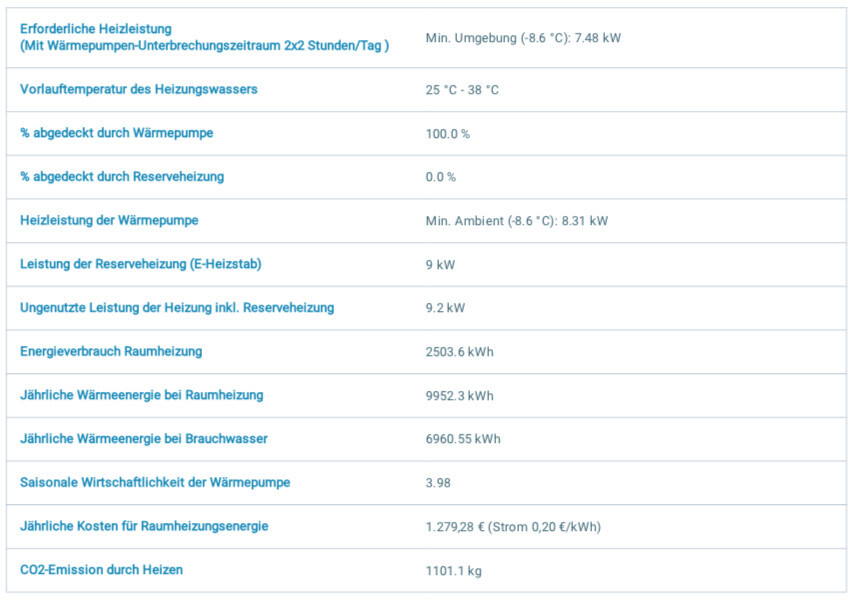
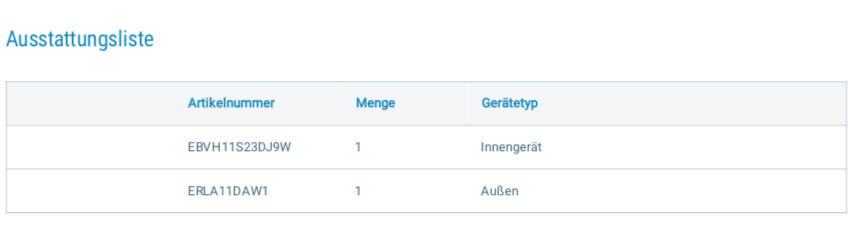
The planned heat pump seems to be sized as a monovalent system, and the MEP planner used something called the “Heating Solutions Navigator” to arrive at 11 kW.
[IMG alt="Heating.png"]https://www.hausbau-forum.de/data/attachments/76/76183-6d34e9489a63f5085cfa6ae15de41c38.jpg[/IMG]
[IMG alt="Heating-Solution.png"]https://www.hausbau-forum.de/data/attachments/76/76184-7f5a4fe835de9e9061d67ca1c7f86c24.jpg[/IMG]
From the 5.1 kW, they get 7.48 kW (somehow) as the required heating capacity—well, domestic hot water still needs to be added to the heating load—then 8.31 kW as the heat pump’s heating capacity at -8.6°C (16°F) minimum ambient temperature (whatever that means),
and finally select the next available heat pump size of 11 kW from Daikin.
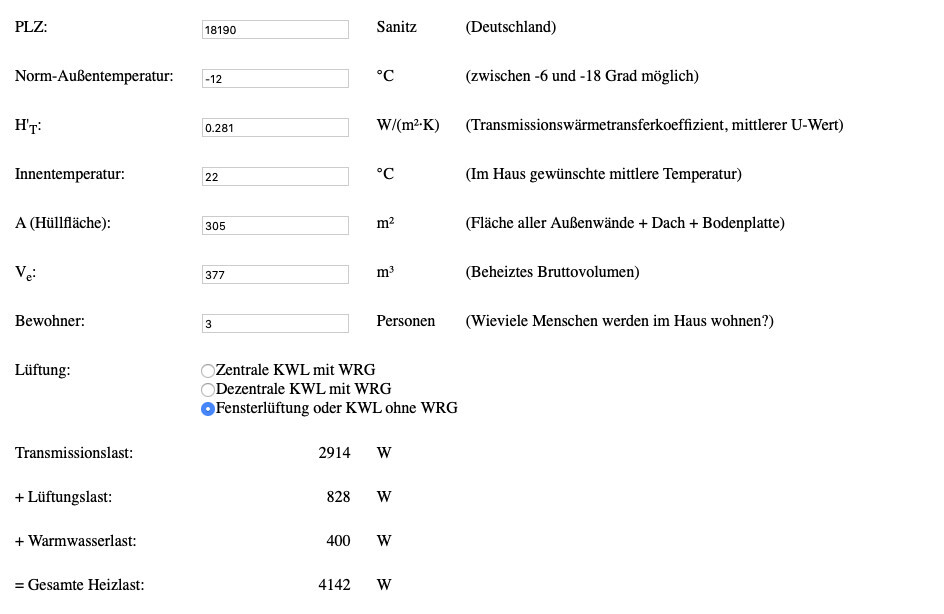
Here is a comparison from an online tool that was recommended:
[IMG alt="Screenshot 2022-12-11 at 12.48.42.png"]https://www.hausbau-forum.de/data/attachments/76/76186-0b6121745680be44dba7b2f2be0471bd.jpg[/IMG]
I only found the overall heat transfer coefficient (U-value) in the Building Energy Act documentation.
The envelope area and heated gross volume were taken from the MEP plans.
22°C (72°F) is perfectly comfortable for us.
6. Decision?
I’m not an expert, but I would think that a 6 kW system would be well-sized.
We cannot optimize the heating circuits any further, so maybe a 4 kW system would be too small.
The Daikin unit has a 180 L (48 gallon) domestic hot water tank.
There are 3 of us; if we count a 1 kW domestic hot water load instead of 400 W, because the tank is a bit small, we end up close to 5 kW.
Am I thinking about this correctly, or am I missing something?
Thank you all.
I’m currently trying to read up on and understand some of the topics
so that I can make an informed decision.
1. Heating Load
I assume that the heating load calculation from the MEP (mechanical, electrical, plumbing) office that we have is correct.
(Using the data known to the MEP planner at that time)
Standard heating load: 5115 W
Normalized heating load: 6233 W (includes a warm-up surcharge of 1118 W on top of the standard heating load)
2. Improvement of the Building Envelope
Our heating load is probably somewhat lower because we upgraded the front door from double glazing to triple glazing. The MEP planning assumed a U-value of 1.5 for the door before this upgrade. Now, the two fixed glazed side panels have a U-value (Ug) of 0.6 (glass), and the door panel has a U-value (Ug) of 0.8.
Additionally, we plan to insulate the top floor ceiling further. Above the existing ceiling (gypsum board, vapor retarder, 20 cm mineral wool with a thermal conductivity of 0.035 W/mK, spruce beams), which leads to the unheated attic (used for storage), we will add 10 cm mineral wool with the same thermal conductivity. Material has been ordered. According to Ubakus, this reduces the U-value from 0.194 to 0.132. The heating load calculation assumed a U-value of 0.210, likely including thermal bridges. The attic hatch is also still there. Nonetheless, the U-value will likely be less than 0.210 in the future.
[IMG alt="Screenshot 2022-12-11 at 11.49.44.png"]https://www.hausbau-forum.de/data/attachments/76/76182-e9d40a7d676d49270c27df85da07d2ae.jpg[/IMG]
3. Design of the Underfloor Heating
We cannot change the pipes anymore. The pipes are installed, and the screed is in place.
We do not know the exact lengths of the individual heating circuits. The pipe spacing is rather clear: 15 cm (6 inches), slightly less in the bathrooms.
Heating circuits:
Ground floor
- 1 guest toilet
- 1 utility room
- 1 hallway
- 1 guest room
- 3 circuits for open-plan kitchen, dining, living area
Upper floor
- 1 bathroom
- 1 corridor
- 1 bedroom
- 1 office
- 1 child’s room
- 1 hobby room
The toilet and bathroom each have an electric supplementary heater.
4. Refrigerant Lines
The outdoor and indoor units of the heat pump are not planned to be wall-to-wall. (Due to acoustical and layout reasons.)
From the utility room, refrigerant lines run in the screed through the bathroom to the exterior wall. This is probably about 6 m (20 feet) of refrigerant lines total, considering vertical offsets in the wall and the indoor unit.
Because of this, is a monoblock system no longer possible?
5. Ventilation
We do not have mechanical ventilation; we open the windows for airing.
6. Planned Heat Pump
The planned heat pump seems to be sized as a monovalent system, and the MEP planner used something called the “Heating Solutions Navigator” to arrive at 11 kW.
[IMG alt="Heating.png"]https://www.hausbau-forum.de/data/attachments/76/76183-6d34e9489a63f5085cfa6ae15de41c38.jpg[/IMG]
[IMG alt="Heating-Solution.png"]https://www.hausbau-forum.de/data/attachments/76/76184-7f5a4fe835de9e9061d67ca1c7f86c24.jpg[/IMG]
From the 5.1 kW, they get 7.48 kW (somehow) as the required heating capacity—well, domestic hot water still needs to be added to the heating load—then 8.31 kW as the heat pump’s heating capacity at -8.6°C (16°F) minimum ambient temperature (whatever that means),
and finally select the next available heat pump size of 11 kW from Daikin.
Here is a comparison from an online tool that was recommended:
[IMG alt="Screenshot 2022-12-11 at 12.48.42.png"]https://www.hausbau-forum.de/data/attachments/76/76186-0b6121745680be44dba7b2f2be0471bd.jpg[/IMG]
I only found the overall heat transfer coefficient (U-value) in the Building Energy Act documentation.
The envelope area and heated gross volume were taken from the MEP plans.
22°C (72°F) is perfectly comfortable for us.
6. Decision?
I’m not an expert, but I would think that a 6 kW system would be well-sized.
We cannot optimize the heating circuits any further, so maybe a 4 kW system would be too small.
The Daikin unit has a 180 L (48 gallon) domestic hot water tank.
There are 3 of us; if we count a 1 kW domestic hot water load instead of 400 W, because the tank is a bit small, we end up close to 5 kW.
Am I thinking about this correctly, or am I missing something?
Thank you all.
Daniel-Sp schrieb:
A well-designed heat pump and underfloor heating system do not require a stratified storage tank. The heat pump should supply the underfloor heating directly.
The high flow rates of a heat pump are not always compatible with the proper function of a stratified storage tank.
Thermostatic radiator valves (TRVs) should of course be removed in this case. How this all connects, and whether we open the TRVs and adjust the flow rates directly, we will see once everything is installed. We will keep that in mind. At least the hallway and foyer in our home don’t have any TRVs, for some reason, so we have to regulate the flow rate directly at the manifold anyway.
Daniel-Sp, I am referring to modern single-source systems; in this case, the volume of underfloor heating alone is not sufficient, as also stated by the manufacturers.
(Examples include Daikin, Panasonic, Lambda, ...) Hot water is, of course, supplied via a domestic hot water station.
face26 Single-source refers to the heat source—here only one—so the bivalence point is not relevant in our climate zones.
wp.seeker The pipe lengths to each room should be included in the HVAC calculation, which is why it is called room heat load. This means that the heat load for systems like underfloor heating and the hydraulic balancing are determined for each individual room. U-values for interior walls, interior wall assemblies, etc., are also considered.
For a KfW55 standard building, a ventilation system is mandatory, as well as a blower door test and hydraulic balancing.
The U-values to achieve KfW55-level energy savings cannot be as poor as you have suggested.
(Examples include Daikin, Panasonic, Lambda, ...) Hot water is, of course, supplied via a domestic hot water station.
face26 Single-source refers to the heat source—here only one—so the bivalence point is not relevant in our climate zones.
wp.seeker The pipe lengths to each room should be included in the HVAC calculation, which is why it is called room heat load. This means that the heat load for systems like underfloor heating and the hydraulic balancing are determined for each individual room. U-values for interior walls, interior wall assemblies, etc., are also considered.
For a KfW55 standard building, a ventilation system is mandatory, as well as a blower door test and hydraulic balancing.
The U-values to achieve KfW55-level energy savings cannot be as poor as you have suggested.
parcus schrieb:
Daniel-Sp, I’m talking about modern monovalent systems; here, the volume of underfloor heating alone is not sufficient, which is also confirmed by manufacturers. (Daikin, Panasonic, Lambda, etc.) Domestic hot water is naturally supplied via a fresh water station.
face26 monovalent refers to the heat source, in this case a single one, so the bivalence point is not relevant in our climate zone.
wp.seeker the pipe lengths should be specified for each room in the technical building equipment (TBE) calculation, which is why it’s called room heating load. That means the heating load, like for underfloor heating and the hydraulic balancing, is determined for each room. U-values of interior walls, interior composite structures, etc.
For a KfW55 standard, a ventilation system is mandatory, as well as a Blower Door Test and hydraulic balancing.
The U-values for KfW55 thermal insulation can’t be as poor as you stated.
Well, I don’t know, maybe I just don’t understand you, but some things you say are hard for me to follow.
What volume exactly is supposed to be insufficient for a monovalent system? You make it sound as if there are heat pumps that are monovalent by the manufacturer’s definition and others that are not.
I know what monovalent means. Still, the way you describe it is at least ambiguous to me.
Whether a system is monovalent or not does not depend on whether it’s a monoblock or a split system. You mentioned the latter term.
The difference between monovalent and bivalent systems is simply whether there is one or two heat sources, as you already noted. Naturally, in our climate zone you will find sufficiently sized heat pumps that fully cover the heating load even in cold regions. The question is whether it always makes sense. You see that in this case here. If the heating load calculation includes a safety margin multiplied by five times, then naturally a higher heating load comes out.
Now, of course, I could just say, “Let’s take the bigger heat pump.” That’s exactly what happened here. You could also say it’s designed bivalently, meaning that above a certain temperature, for example -10°C (14°F), the heat pump can no longer provide the full heating capacity calculated by the heating engineer. For this case, the heat pump includes a backup option.
The electric heating element. In practice, it probably never switches on. For the reasons mentioned. If it does, then maybe for three days every four years or so. That barely makes a difference.
By the way, monovalent and bivalent should not be confused with the idea that heat pumps do not work at certain subzero temperatures. That might have been true in the past. I know those stories. They still persist in people’s minds. When we planned our system, some people said to me “what if it gets colder than -10°C (14°F), then heat pumps don’t work anymore.” That is no longer true today. However, the maximum heating output usually decreases as temperatures drop. That is documented with performance curves and data.
A specific example: I have an IDM ILM 2-7. By common understanding, it should deliver 7 kW heating capacity. It actually does, even more or less, but never mind. Below -8°C (18°F) the output slowly decreases, so at our design temperature it only delivers about 5.8 kW. (I don’t remember the exact number.) The heating engineer calculated just under 7 kW (including some safety margins). According to classic logic, the next larger heat pump model should have been selected. That would have been the ILM 4-13. Another heating engineer would have installed that size (another manufacturer was also in the offer, but the size was similar). On paper, our heating engineer designed the system bivalently, and included the electric heating element as support at temperatures around -9°C (16°F).
We have lived in this house for over two years. It has been colder at times. The electric heater never switched on. It also never actually got that cold.
And to return to @parcus: I don’t know why you make such claims, and what monovalent has to do with any volume.
There are various hydraulic circuits. IDM, for example, also offers ones with a direct heating circuit (and is not the only manufacturer doing so). You don’t necessarily need a buffer tank. Of course, it must be planned correctly. Either without an electric reheating element or with enough non-regulated circuits.
A fresh water station is great, we have one too, but saying it’s “naturally” required is a subjective opinion. It’s not strictly necessary.
Also, I wasn’t aware that a ventilation system is mandatory for KfW55. Of course, it’s easier to meet the standard with it, but it was also possible to build without it before—has that changed?
Similar topics