
Hello everyone,
some background on my questions:
I am currently exploring the possibility of converting our house from a gas heating system to a heat pump. It might sound completely crazy for a house that is just under 7 years old, but this could be funded and financed as an “energy renovation project” together with a photovoltaic system through KFW 261. That could actually make it economically very attractive.
I am still in the evaluation phase and have started initial discussions with heating and solar experts.
This immediately raised some questions for me, because the first offers are quite contradictory to the principles I often see discussed here in the forum:
The insulation level of the house is about KFW 55 standard; however, the overall standard was not met back then due to the gas heating system. The heating demand is around 12,000-13,000 kWh for a total of 270 square meters (2,900 square feet). There is underfloor heating throughout, including the basement.
Best regards,
Andreas
some background on my questions:
I am currently exploring the possibility of converting our house from a gas heating system to a heat pump. It might sound completely crazy for a house that is just under 7 years old, but this could be funded and financed as an “energy renovation project” together with a photovoltaic system through KFW 261. That could actually make it economically very attractive.
I am still in the evaluation phase and have started initial discussions with heating and solar experts.
This immediately raised some questions for me, because the first offers are quite contradictory to the principles I often see discussed here in the forum:
- Buffer tank (heating water) – Question: What exactly is the purpose of this and when does it make sense? So far, no seller has been able to clearly answer this, although the technical answer is simple: it should act as a hysteresis to reduce short cycling of the heat pump. The general idea is understandable, but I don’t really see how 100 liters (35 gallons) of buffer tank help when just the volume of my underfloor heating system already exceeds 200 liters (70 gallons), plus the large mass of screed acting as thermal storage. The current gas heating system works fine without a heating buffer tank.
- Heat pump capacity and modulation – the first quotes naturally come with absurdly oversized heat pumps because they only consider the total heated area of 270 square meters (2,900 square feet). When I point out that 12 or even 16 kW seems excessive, the answer is always: “It can modulate down from 3 to 12 kW.” That’s fine, but exactly this modulation is often warned against. So question: why is modulating down performance considered a problem? Is this the short cycling that people warn about? Technically, modulation means the entire system, including the compressor and all components, runs slower. But then the question arises how efficient it still is.
The insulation level of the house is about KFW 55 standard; however, the overall standard was not met back then due to the gas heating system. The heating demand is around 12,000-13,000 kWh for a total of 270 square meters (2,900 square feet). There is underfloor heating throughout, including the basement.
Best regards,
Andreas
 KoalasAreCute15 Oct 2023 16:43
OWLer schrieb:
Not that. But manufacturers usually specify the maximum output, not the minimum output or maximum throttling.At least for ours, they have that listed there (as far as I have correctly interpreted it).
Hello,
Yesterday morning I checked the temperatures. The outside temperature was around zero degrees Celsius (32°F), the flow temperature was 33°C (91°F), and the return temperature was just below 28°C (82°F). You can’t really read these gauges precisely. So, the temperature difference of nearly 10 degrees, as calculated in the heating load, probably doesn’t apply here...
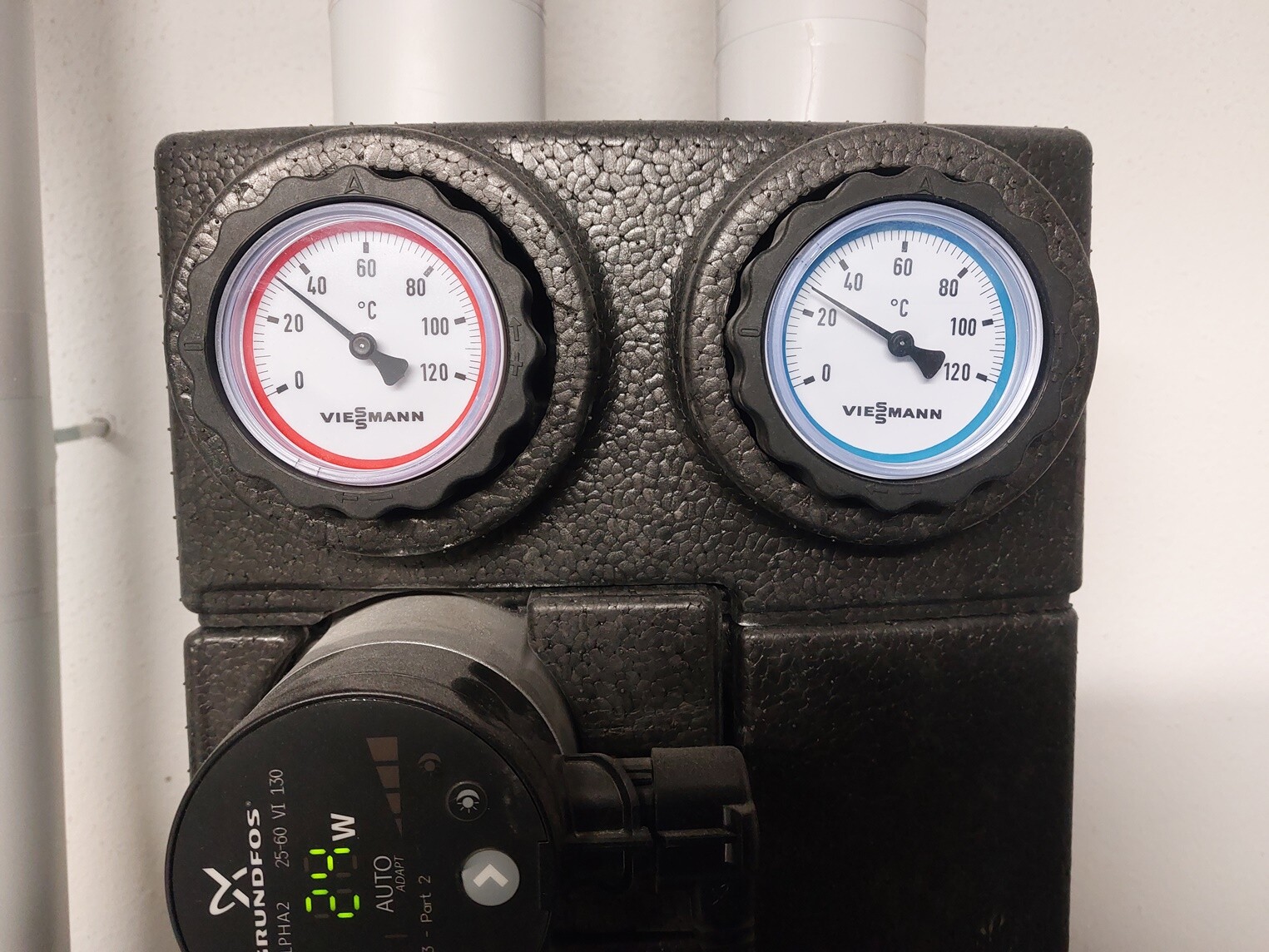
Best regards,
Andreas
Yesterday morning I checked the temperatures. The outside temperature was around zero degrees Celsius (32°F), the flow temperature was 33°C (91°F), and the return temperature was just below 28°C (82°F). You can’t really read these gauges precisely. So, the temperature difference of nearly 10 degrees, as calculated in the heating load, probably doesn’t apply here...
Best regards,
Andreas
R
RotorMotor4 Nov 2023 16:10It depends on your showering and bathing habits. Is a circulation system installed? A fresh water system?
One advantage of a larger storage tank is that the temperature can be lowered enough to always have sufficient hot water available while also ensuring daily circulation. Lower temperatures have a significant impact on the COP of the heat pump. To compare: my heat pump achieves a COP of 5.5-6 for heating water, but only about 2 at the highest hot water temperature setting (56°C (133°F)). I have a 300-liter (79-gallon) tank and currently set it to 42°C (108°F).
Similar topics