
Our house was completed at the end of 2005. At that time, the regulations regarding thermal insulation were certainly not as strict as they are today, yet I still find the insulation to be, in my opinion, completely excessive.
A few weeks ago, when the mornings were still pleasantly cool, I tried ventilating the ground floor by cross-ventilation to lower the temperature to 20°C (68°F). After closing all the windows, it took less than an hour for the temperature to rise back up to 24.4°C (76°F). It goes without saying that
- all the heating systems were turned off
- such temperatures are not healthy over the long term.
The insulation craze is especially noticeable in the attic, where temperatures of 30°C (86°F) under similar outdoor conditions are common.
After careful consideration, I recently had an inverter air conditioning unit installed in the attic (I work exclusively from home), which has definitely greatly improved the living comfort.
However, to what extent this is compatible with the fundamentally good idea of reducing energy costs—especially considering the expected rise in peak temperatures due to climate change—is something I still wonder about...
Are there other ways to lower the basic indoor temperature to a healthy level (21-22°C / 70-72°F)?
P.S.: There are plenty of search results when looking up “insulation madness”... it makes you wonder if someone suspects something.
A few weeks ago, when the mornings were still pleasantly cool, I tried ventilating the ground floor by cross-ventilation to lower the temperature to 20°C (68°F). After closing all the windows, it took less than an hour for the temperature to rise back up to 24.4°C (76°F). It goes without saying that
- all the heating systems were turned off
- such temperatures are not healthy over the long term.
The insulation craze is especially noticeable in the attic, where temperatures of 30°C (86°F) under similar outdoor conditions are common.
After careful consideration, I recently had an inverter air conditioning unit installed in the attic (I work exclusively from home), which has definitely greatly improved the living comfort.
However, to what extent this is compatible with the fundamentally good idea of reducing energy costs—especially considering the expected rise in peak temperatures due to climate change—is something I still wonder about...
Are there other ways to lower the basic indoor temperature to a healthy level (21-22°C / 70-72°F)?
P.S.: There are plenty of search results when looking up “insulation madness”... it makes you wonder if someone suspects something.

W
WilhelmRo31 Jul 2018 11:42Mycraft schrieb:
The cool air at Steffen’s place comes from the air conditioning. The mechanical ventilation system only causes minor disturbances. Okay, let me ask differently: is the air conditioner located in the living room and does it cool all the rooms? In other words, is it visibly installed like this:
Because I think this type of air conditioning is more room-specific rather than whole-house.
Best regards
S
Steffen8031 Jul 2018 11:44WilhelmRo schrieb:
Okay, let me ask differently: is the air conditioner in the living room cooling all the rooms? Meaning, visibly:
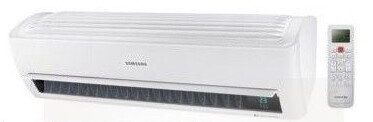
Because I find this type of air conditioner is more room-specific rather than whole-house.
Best regardsExactly. There are also attractive models like this from Daikin. We have installed Daikin units in the living room, bedroom, office, and hallway.
How it is done is up to you. You can also use ceiling cassette units, ducted systems, and wall-mounted consoles.
However, the simplest wall units are usually the most affordable.
Almost every type of air conditioning is room-based. It is almost always a setup consisting of multiple smaller indoor units.
However, the simplest wall units are usually the most affordable.
WilhelmRo schrieb:
Because I find this type of air conditioning to be more room-based than house-based.
Almost every type of air conditioning is room-based. It is almost always a setup consisting of multiple smaller indoor units.
W
WilhelmRo31 Jul 2018 12:06Mycraft schrieb:
Almost every type of air conditioning system is room-specific. It is almost always made up of several smaller indoor units. And this is exactly where I thought:
Why not combine the ventilation system with the air conditioning? That way, it would be house-specific. So the air conditioner somewhere behind the intake to cool the air and then send it into the house 🙂
Similar topics