
ᐅ Slope stabilization / retaining height over 1.30 m / house built in a "cut" or excavation site
Created on: 17 Mar 2015 08:43
W
WildThing
Hello everyone,
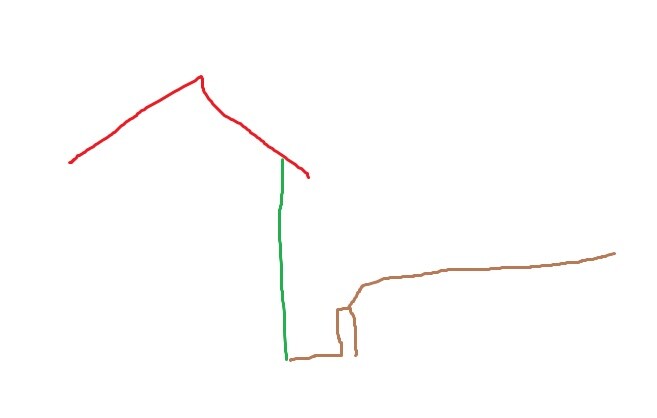
After our house was staked out and a layout frame was set up, we realized that our beautiful architectural drawing doesn’t quite match reality. At the rear of the ground floor, we are about 1.30 m (4.3 ft) lower than the natural terrain level of the slope.
Therefore, we need a "trench" behind the house followed by a retaining wall or parapet to create a level garden area at the top. Our structural builder suggested using either L-shaped concrete blocks or gabions, with drainage installed beneath. We are currently leaning towards gabions since they look a bit nicer than the concrete L-blocks.
I made a simple sketch: green represents the house wall, brown the trench, retaining wall, and the terrain.
What other cost-effective solutions are there?
And could this "trench setup" cause any issues, like moisture or groundwater problems?
Best regards
After our house was staked out and a layout frame was set up, we realized that our beautiful architectural drawing doesn’t quite match reality. At the rear of the ground floor, we are about 1.30 m (4.3 ft) lower than the natural terrain level of the slope.
Therefore, we need a "trench" behind the house followed by a retaining wall or parapet to create a level garden area at the top. Our structural builder suggested using either L-shaped concrete blocks or gabions, with drainage installed beneath. We are currently leaning towards gabions since they look a bit nicer than the concrete L-blocks.
I made a simple sketch: green represents the house wall, brown the trench, retaining wall, and the terrain.
What other cost-effective solutions are there?
And could this "trench setup" cause any issues, like moisture or groundwater problems?
Best regards
 blockhauspower18 Mar 2015 16:30
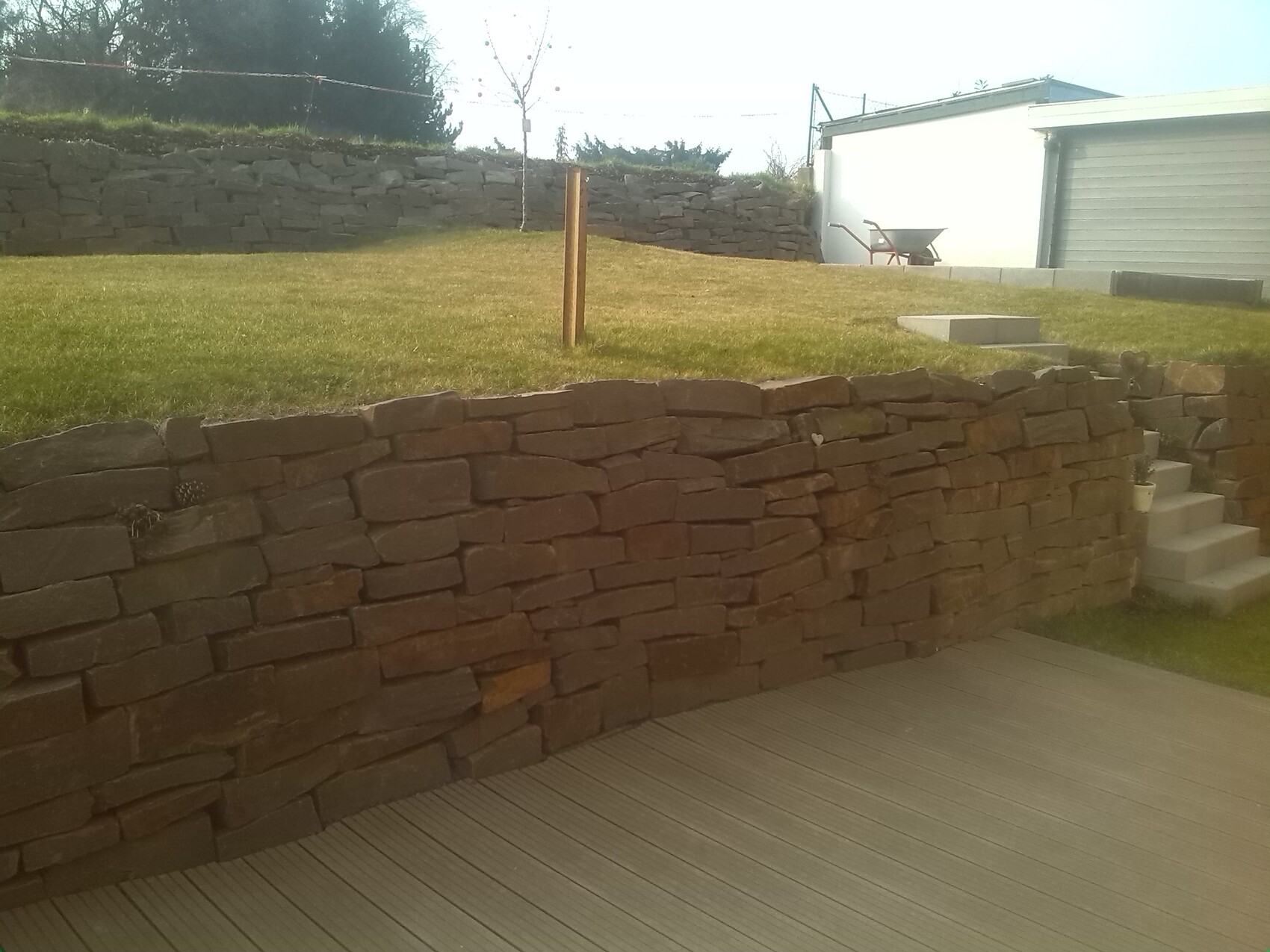
Hello, we reinforced our terrace plot with a dry stone wall. If you are a bit skilled at puzzle-like work, it is not difficult.
Best regards
Best regards

WildThing schrieb:
- I can’t tell you the exact distance. I think he mentioned about 1.50 m (5 feet). (but we can still decide that during construction)
There are advantages – but also some disadvantages.
Advantage – You can hide some things there that don’t necessarily have to be on display. Trash bins, bike racks (possibly even covered), etc.
Disadvantage 1 – You need to be careful that your ditch doesn’t turn into a “dumping spot.” The “out of sight, out of mind” principle – “We’ll just put it there for now, nobody will see it.”
Disadvantage 2 – Even if you have windows there, the rooms might always feel somewhat dark.
WildThing schrieb:
- Yes, we wondered about that as well. :-/ Of course, it was a topic during planning about a year ago, and he drew a sloped embankment, but I think he didn’t consider that according to the plan the plot is even longer, while the slope ends sooner and turns into a steep bank. So, he miscalculated the angle and probably thought the final elevation of our plot was a few meters further on. (And we didn’t think of it either…)
We called him over on Monday as well. He responded casually that he knew we would have to cut into the slope here, possibly even more steeply. For us, the drawing always looked “relatively” level on the plan, so we pictured it differently.
“Plum”
Of course, as a builder you should critically review the plan and better ask more questions than too few. However, being a layperson, you might not be able to fully assess the site conditions. Therefore, in my opinion, the architect should have pointed this out more clearly.
He knew it – apparently you didn’t.
WildThing schrieb:
- The plan has already been approved, and we’re about to start building. The foundation pit will be excavated on Friday. We don’t want to build the ground floor into the slope because we have big windows at the back providing light to the stairwell. They also bring light to the basement stairwell. If they ended up underground, that wouldn’t work anymore.
When staking out on Saturday, we briefly considered scrapping everything and redoing the plan, but since it’s not just time but also money, lost work for the shell builder, contracts, etc., we decided against it and just have to make it work.
If everything happens on such short notice, it’s naturally difficult to change plans. Besides, as you wrote elsewhere, the basement is already in the ground – it would be unfortunate if the ground floor also had to be built below ground level.
Still, the architect should have explored alternatives together with you. I’ve also noticed in my area that architects often rely on their usual go-to solutions (“I’ve always done it this way, so I’ll do it again”) and pick a less-than-ideal proposal from their drawer. On our street, besides us, only one other builder uses the area above the embankment. Everyone else (some with architects as well) excavated the slope at the back and then built a retaining wall to support the excavated ground. And – as mentioned before – everyone looks at a wall when sitting on their terrace.
I hope you won’t regret this rather unwanted area in the future. You put so much time, effort, and money into your “dream home.”
blockhauspower schrieb:
Hello, we secured our terrace plot with a dry stone wall. If you're a bit handy with puzzle-like work, it's not difficult.
RegardsLooks good.
Will this wall hold up to earth pressure in the long term? I guess it probably depends on the soil conditions?
blockhauspower18 Mar 2015 18:43It has definitely held up for 2 years now.

f-pNo schrieb:
Disadvantage 1 – You have to be careful that your trench doesn’t turn into a real "messy corner." The idea being – out of sight, out of mind. "We’ll just put it there for now – nobody will see it."
Disadvantage 2 – Even if you have windows there, the rooms can still end up somewhat gloomy. The "good" thing about it is that at the back we only have the stairwell windows and the bathroom window, and since it’s the north side, thankfully the light situation isn’t too bad. Otherwise, we really would have had to reconsider and maybe redesign.
f-pNo schrieb:
So in my opinion, the architect should have pointed this out more clearly. It was clear to him – apparently not to you. We agree with that, but unfortunately the damage is already done! My advice to anyone building a house on a sloped lot is to have the contour lines precisely drawn in and to double-check them several times! If we had known that around the back of the house we wouldn’t get any "flat" garden space up to the house wall, we probably would have planned differently. We had imagined having a “play lawn” behind the house for soccer and badminton for the kids, and in front the slope with nice flower beds and natural stone steps, etc.
f-pNo schrieb:
I hope you won’t be annoyed by this somewhat unwanted area in the future. You invest a lot of time, effort, and money into your "dream home." Thank you! I hope so too. Honestly, the back area doesn’t bother me so much anymore. What I find almost more frustrating is that now towards the neighbor we are looking at a slope where there will probably be steps or something. The neighbor’s land on the right side of our house is, of course, much higher (about 1.40 m (4.6 ft) higher), and from our kitchen patio door we are 1.40 m (4.6 ft) lower at the front corner of the house.
@blockhauspower That really looks beautiful. Did you do any special reinforcement behind the wall beforehand? And did you actually do it yourselves? Do you need to "bond" it with mortar or how does it work? That must take several days… (For us it would be at least 11 meters (36 feet) or more)
blockhauspower19 Mar 2015 16:02Hello and thank you.
We have a foundation under the wall, where a mat was connected, and behind it about 80 cm (31 inches) has been backfilled with concrete. See attachment. Yes, we did everything ourselves except for the foundation, which was done together with the excavation. The stones are laid dry, without mortar, and backfilled progressively.
Yes, it took several days, and yes, the stones are very heavy. For us, it is on two levels, each 15 m (49 feet), so 30 m (98 feet) in total, about 1.50 m (5 feet) high.
Best regards
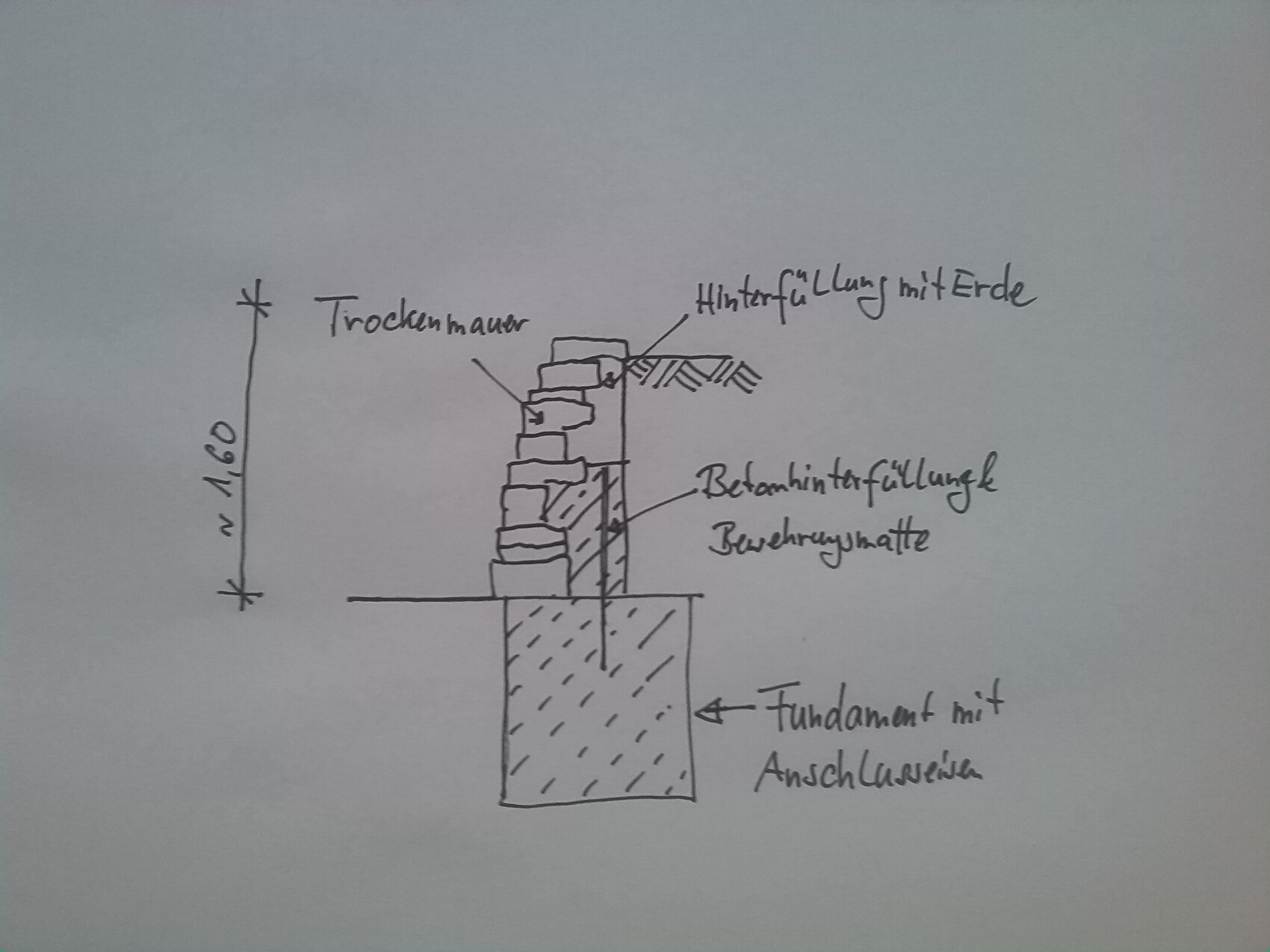
We have a foundation under the wall, where a mat was connected, and behind it about 80 cm (31 inches) has been backfilled with concrete. See attachment. Yes, we did everything ourselves except for the foundation, which was done together with the excavation. The stones are laid dry, without mortar, and backfilled progressively.
Yes, it took several days, and yes, the stones are very heavy. For us, it is on two levels, each 15 m (49 feet), so 30 m (98 feet) in total, about 1.50 m (5 feet) high.
Best regards
Similar topics