
C
ColeTrickle030 Jan 2023 08:12Hello everyone,
I hope someone can help me identify the growths on our basement walls shown in the photo.
The house was built in 1960 and has been fully renovated except for the basement. We haven’t done any work there.
Best regards
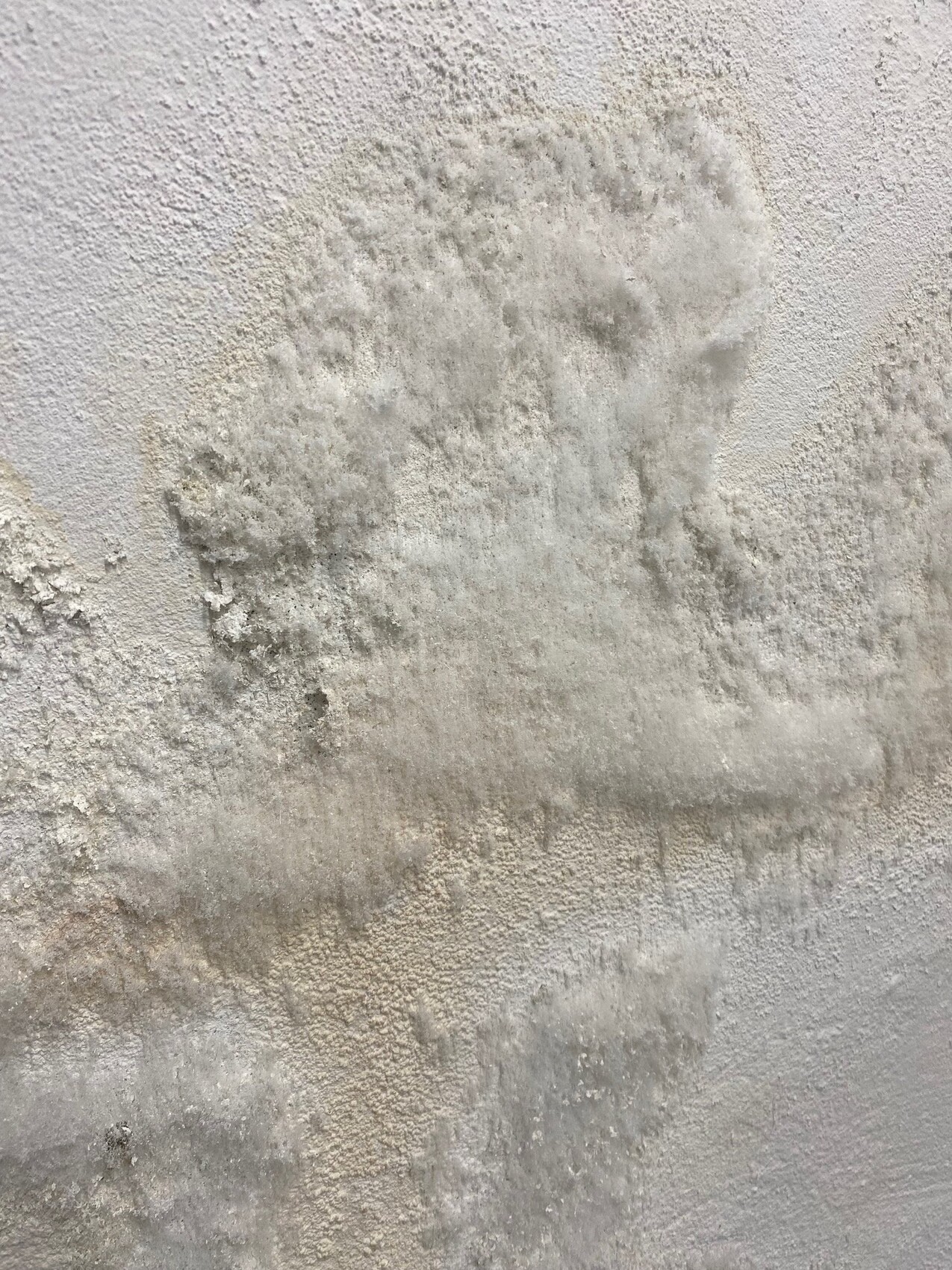
I hope someone can help me identify the growths on our basement walls shown in the photo.
The house was built in 1960 and has been fully renovated except for the basement. We haven’t done any work there.
Best regards
Oh my God... get out of the house immediately, close the doors, and call the police... it’s an alien!
… the alien is called salt efflorescence and is common in buildings of this age group.
It can have two causes, both of which are not critical—but also difficult to fix.
1. Basements of this building age are neither thermally insulated nor do they have a permanently waterproof coating on the outside against the soil. The bitumen thick coating applied about 60 years ago is now just a dark gray shadow, but with properly damp soil, the basement wall will also become damp. This moisture slowly moves through the wall and evaporates on the inside. In the process, salts from the concrete are washed to the surface. When the moisture evaporates, the salts remain and form these crystal-like efflorescences.
2. Basement walls are usually cooler than the outside air, especially in summer. Warm, moist air enters the basement and condenses on and inside the basement walls. During the colder seasons or when the indoor air is drier, the moisture evaporates from the wall again. Over time, these structures remain as a result.
Usually, both processes occur together.
Is this a problem?
No, not really. You should avoid storing baby clothes or similar items outside the heated basement (and even there, only if there is no oil heating). Otherwise, they may become musty or develop mold stains, depending on how damp the basement really is. The heating room is usually warmer. This is not mold, which typically appears black in basements.
What can you do?
1. Excavate around the basement wall, apply a new waterproofing membrane, install insulation, replace basement windows and light wells, replace the basement entrance door. This makes everything warmer and drier. Then seal the floor from the inside and insulate internally if necessary. Quite expensive for the added benefit.
2. Brush off the efflorescence and, if needed, apply a new lime paint—no sealing layers or similar, only lime- or silicate-based paint. Otherwise, you trap the moisture, and it will find another way out, either upwards or causing the layer to separate over time.
You will often find this phenomenon also referred to as “saltpeter.” This is factually incorrect, as it is not real saltpeter. That only occurs if someone has urinated extensively on the wall before—e.g., in cattle barns. Otherwise, it is simply various salts.
… the alien is called salt efflorescence and is common in buildings of this age group.
It can have two causes, both of which are not critical—but also difficult to fix.
1. Basements of this building age are neither thermally insulated nor do they have a permanently waterproof coating on the outside against the soil. The bitumen thick coating applied about 60 years ago is now just a dark gray shadow, but with properly damp soil, the basement wall will also become damp. This moisture slowly moves through the wall and evaporates on the inside. In the process, salts from the concrete are washed to the surface. When the moisture evaporates, the salts remain and form these crystal-like efflorescences.
2. Basement walls are usually cooler than the outside air, especially in summer. Warm, moist air enters the basement and condenses on and inside the basement walls. During the colder seasons or when the indoor air is drier, the moisture evaporates from the wall again. Over time, these structures remain as a result.
Usually, both processes occur together.
Is this a problem?
No, not really. You should avoid storing baby clothes or similar items outside the heated basement (and even there, only if there is no oil heating). Otherwise, they may become musty or develop mold stains, depending on how damp the basement really is. The heating room is usually warmer. This is not mold, which typically appears black in basements.
What can you do?
1. Excavate around the basement wall, apply a new waterproofing membrane, install insulation, replace basement windows and light wells, replace the basement entrance door. This makes everything warmer and drier. Then seal the floor from the inside and insulate internally if necessary. Quite expensive for the added benefit.
2. Brush off the efflorescence and, if needed, apply a new lime paint—no sealing layers or similar, only lime- or silicate-based paint. Otherwise, you trap the moisture, and it will find another way out, either upwards or causing the layer to separate over time.
You will often find this phenomenon also referred to as “saltpeter.” This is factually incorrect, as it is not real saltpeter. That only occurs if someone has urinated extensively on the wall before—e.g., in cattle barns. Otherwise, it is simply various salts.
C
ColeTrickle030 Jan 2023 08:26Forgot to write earlier... I assume—or hope—it is efflorescence caused by salt deposits. However, I would like to get a second opinion here. If that is the case, does anyone have any tips?
C
ColeTrickle030 Jan 2023 08:29dertill schrieb:
Oh my God... go straight outside, close the doors, and call the police... it’s an alien!
… the “alien” is actually salt efflorescence, which is common in buildings of this age.
There are two causes, both not critical but difficult to fix.
1. Basements from this era usually have neither thermal insulation nor a permanently waterproof coating on the exterior side against the soil. The bitumen thick coating applied around 60 years ago is now just a dark gray shadow. If the soil is quite damp, the basement wall will also become damp. This moisture slowly migrates through the wall and evaporates on the interior side. In the process, salts from the concrete are brought to the surface. When the moisture evaporates, these salts remain and form the crystalline efflorescence.
2. The basement walls are often cooler than the outside air, especially in summer. Warm, moist air enters the basement and condenses on and within the basement walls. In colder seasons, or when the indoor air is drier, the moisture evaporates from the wall again. This process also leaves these salt deposits behind over time.
Usually, both processes occur simultaneously.
Is this a problem?
No, not really. You should avoid storing baby clothes or similar items outside the heated basement (and even there only if no oil heating is present). Otherwise, they may develop a musty smell or mildew, depending on how damp the basement actually is. The heating room is usually warmer. This is not mold—that is usually black in basements.
What can you do?
1. Excavate outside the basement wall, apply new waterproofing, add insulation, replace basement windows and light wells, and replace the basement entrance door. This will result in a warmer and drier space. You can also waterproof and possibly insulate the floor from the inside. This is quite expensive for the added benefit.
2. Brush off the efflorescence and, if needed, apply new lime paint—do not use a sealing layer or similar, only lime or silicate paint. Otherwise, you will trap the moisture inside, which will find another way out—either upwards, or the coating will eventually detach. Thank you very much! I don’t plan to move out 😉 I just wanted some confirmation. Thanks so much for the detailed post!! I feel more reassured now and will definitely go with solution 2.
Since you can only edit your post for 4 minutes, here is an addition: In cases of locally severe efflorescence or moisture, a damaged rainwater pipe/downspout in front of the wall could also be the cause or might be contributing to the increased severity of the efflorescence.
 Winniefred30 Jan 2023 17:50
Yes, salt efflorescence. The rest has already been explained. We also have this everywhere in the basement where the basement walls are in contact with the soil. We replastered these walls with renovation plaster and painted them with silicate paint. The efflorescence naturally appears again, but the plaster can absorb quite a bit, which protects the masonry somewhat (this is also called sacrificial plaster; it doesn’t last forever and will need to be replaced eventually). I just sweep it off occasionally. Our house was built in 1921.
Be careful with old houses when excavating outside. Digging too deep can compromise the structural stability (for example, if the house doesn’t have a concrete slab). I’m not sure if that was still the case in the 1960s, but I just wanted to mention it.
Be careful with old houses when excavating outside. Digging too deep can compromise the structural stability (for example, if the house doesn’t have a concrete slab). I’m not sure if that was still the case in the 1960s, but I just wanted to mention it.
Similar topics