
Hello forum members,
My girlfriend and I are currently planning our house construction. Last week we received the final plan from our builder. Now it’s about the heating system.
We don’t have a heating load calculation yet, but I wanted to start looking into the heating topic because it’s very important to me.
You will quickly realize that I am quite a beginner when it comes to heating technology, so I am turning to you here. Please be a bit patient if I bring up the topic for the 1000th time or seem clueless.
Now to the basic data for our house:
- approximately 200 sqm (2150 sq ft) living area
- 900 sqm (9700 sq ft) plot of land
- no basement (a boiler room is planned)
- the goal is to achieve KfW Efficiency House 70 standard
- a tiled stove will be installed (for cozy/visual/personal reasons and also possibly for additional heating)
As I said, we don’t have a heating load calculation yet.
Our builder recommends an air-to-water heat pump with an integrated ventilation system from Stiebel Eltron.
Honestly, I find an integrated ventilation system quite appealing since we both work and can hardly ventilate during the day. I know we’re not building a passive house, but I think a ventilation system is still not a bad idea.
Does anyone have experience with such dual systems?
Are there integrated ventilation systems that can also humidify and dehumidify?
I’m thinking that if the ventilation system can’t do this, it might cause problems for the respiratory system, etc. In the end, we might have issues due to a lack of humidification and be stuck in a bad situation.
Would placing a small decorative fountain inside the house help in such a case?
We have already decided to go for a heat pump. Originally, we wanted a ground-source heat pump with horizontal collectors (the plot size should be sufficient). Through our builder, I have also looked a bit into air-source heat pumps.
He said we would need a heat pump with a heating capacity of 8-9 kW.
That seems a bit too much to me. Wouldn’t 6-7 kW be sufficient?
I am now totally torn between air-source and ground-source heat pumps...
It’s clear that ground-source is considerably more expensive upfront. At Stiebel Eltron, the ground-source heat pump for heating and domestic hot water including ventilation costs roughly €8,000, similar to the air-source heat pump. However, ground-source is more powerful and cheaper to run in terms of electricity. Although the increasingly mild winters also have a positive effect on the electricity consumption of the air-to-water heat pump.
Both should fit into our budget, but will either be cost-effective?
Would it possibly make sense to separate domestic hot water heating from the main system and instead install two collectors on the roof?
What were your reasons for choosing air-source or ground-source heat pumps?
Please help me with this decision, otherwise I might burn myself here.
Many thanks in advance
My girlfriend and I are currently planning our house construction. Last week we received the final plan from our builder. Now it’s about the heating system.
We don’t have a heating load calculation yet, but I wanted to start looking into the heating topic because it’s very important to me.
You will quickly realize that I am quite a beginner when it comes to heating technology, so I am turning to you here. Please be a bit patient if I bring up the topic for the 1000th time or seem clueless.
Now to the basic data for our house:
- approximately 200 sqm (2150 sq ft) living area
- 900 sqm (9700 sq ft) plot of land
- no basement (a boiler room is planned)
- the goal is to achieve KfW Efficiency House 70 standard
- a tiled stove will be installed (for cozy/visual/personal reasons and also possibly for additional heating)
As I said, we don’t have a heating load calculation yet.
Our builder recommends an air-to-water heat pump with an integrated ventilation system from Stiebel Eltron.
Honestly, I find an integrated ventilation system quite appealing since we both work and can hardly ventilate during the day. I know we’re not building a passive house, but I think a ventilation system is still not a bad idea.
Does anyone have experience with such dual systems?
Are there integrated ventilation systems that can also humidify and dehumidify?
I’m thinking that if the ventilation system can’t do this, it might cause problems for the respiratory system, etc. In the end, we might have issues due to a lack of humidification and be stuck in a bad situation.
Would placing a small decorative fountain inside the house help in such a case?
We have already decided to go for a heat pump. Originally, we wanted a ground-source heat pump with horizontal collectors (the plot size should be sufficient). Through our builder, I have also looked a bit into air-source heat pumps.
He said we would need a heat pump with a heating capacity of 8-9 kW.
That seems a bit too much to me. Wouldn’t 6-7 kW be sufficient?
I am now totally torn between air-source and ground-source heat pumps...
It’s clear that ground-source is considerably more expensive upfront. At Stiebel Eltron, the ground-source heat pump for heating and domestic hot water including ventilation costs roughly €8,000, similar to the air-source heat pump. However, ground-source is more powerful and cheaper to run in terms of electricity. Although the increasingly mild winters also have a positive effect on the electricity consumption of the air-to-water heat pump.
Both should fit into our budget, but will either be cost-effective?
Would it possibly make sense to separate domestic hot water heating from the main system and instead install two collectors on the roof?
What were your reasons for choosing air-source or ground-source heat pumps?
Please help me with this decision, otherwise I might burn myself here.
Many thanks in advance

So if you have enough space in your garden and the ground conditions are suitable, I would generally recommend a ground source heat pump. (Unless you really need to watch your budget…)
Air source heat pumps tend to be more expensive in terms of energy consumption, so ground source heat pumps are better in that regard. But it’s a tricky decision—you might want to read up a bit more on the pros and cons. Ground source systems also need to be installed properly to avoid issues like ground heaving.
What type of collector would it be? Trench collector? Surface collector?
Air source heat pumps tend to be more expensive in terms of energy consumption, so ground source heat pumps are better in that regard. But it’s a tricky decision—you might want to read up a bit more on the pros and cons. Ground source systems also need to be installed properly to avoid issues like ground heaving.
What type of collector would it be? Trench collector? Surface collector?
 M.Mustermann7 May 2015 23:16
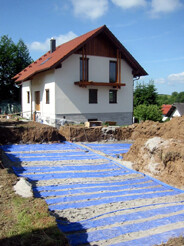
It is a flat plate collector, more precisely a Nibe compact absorber. The compact absorber consists of pre-assembled polypropylene mats with integrated capillaries.
 .
.
According to the offer, it requires 120-160 m² (1,292-1,722 sq ft).
According to the offer, it requires 120-160 m² (1,292-1,722 sq ft).
B
Bieber08158 May 2015 06:52M.Mustermann schrieb:
It is a surface collector In this case, I think you should proportionally account for the land price. Your use of the land area above the collectors is restricted. You should convert this restriction into a depreciation value and add it to the additional cost of 4,000 euros.
I would then choose the air-to-water heat pump. Maybe invest the 4,000 euros in insulation, keep it, or spend it on a vacation.
M
MeisterBob8 May 2015 09:26We built a KfW 55 energy-efficient house (LK NEW/WEN) with many floor-to-ceiling windows on the south side. Approximately 190 square meters (2,045 square feet) of living space are heated by a ground-source heat pump from Buderus (400 meters (1,312 feet) of piping and a 200-meter (656 feet) borehole). Currently, the heating system is running in summer mode (room temperature maintained at 21°C (70°F) solely through solar gain; shading provided by blinds if it gets too warm) and only activates for domestic hot water production. Electricity consumption currently ranges between 20 and 30 kWh during the week (peak/off-peak). I wouldn’t want to do anything differently and definitely would not choose an air-source heat pump.

Bieber0815 schrieb:
In this case, I believe you should partly take the land price into account. You are limited in your use of the land area above the collectors. This limitation should be converted into a loss of value and added to the additional cost of 4000 euros mentioned above.
I would then choose the air-to-water heat pump. Maybe invest the 4000 euros in insulation. Or keep it, or spend it on a holiday.For a lawn area, this doesn’t really matter—you’re not restricted in how you use the land and there is no loss of value. A lawn is just a lawn.
On the contrary, when selling a house with a modern ground-source heat pump system, you are more likely to have an advantage.
Investing 4000 euros in insulation? That’s definitely the right idea—but 4000 euros won’t get you very far. This applies especially to a prefab house.
We have boreholes. If we had had the collectors installed professionally (without doing it ourselves) for warranty reasons, the collectors would have been about 4000 euros cheaper than the boreholes. That’s why we chose the boreholes. Also, we have a sloping lot.
We live in a cold climate region of Germany, where there are longer and severe cold periods in winter. For just under 200 sqm (2150 sq ft) of heated or partly heated area (KFW70 standard) and a household of four people, our consumption in 2014 was just over 2000 kWh — including hot water and circulation pump.
Comparable air-source heat pumps in neighboring homes consumed significantly more here.
Maybe this serves as a helpful reference...
If you live in a milder region and have a passive house, of course, the situation changes accordingly.
Best regards
Similar topics