
ᐅ Floor plan design for a single-family house, 165 sqm, without a basement, on a 400 sqm plot
Created on: 10 Aug 2023 09:33
M
Maulwurfbau
At the request of 11ant, here is a post with the completed list ;-) Unfortunately, he still doesn’t have a crystal ball.
Providing all information possible/available at this point in time.
Development Plan / Restrictions
Plot size: 400 sqm (4300 sq ft)
Slope: No, and no means no!
Floor space index (FSI): 0.4
Floor area ratio (FAR): ?
Building envelope, building line and boundary: Yes, available.
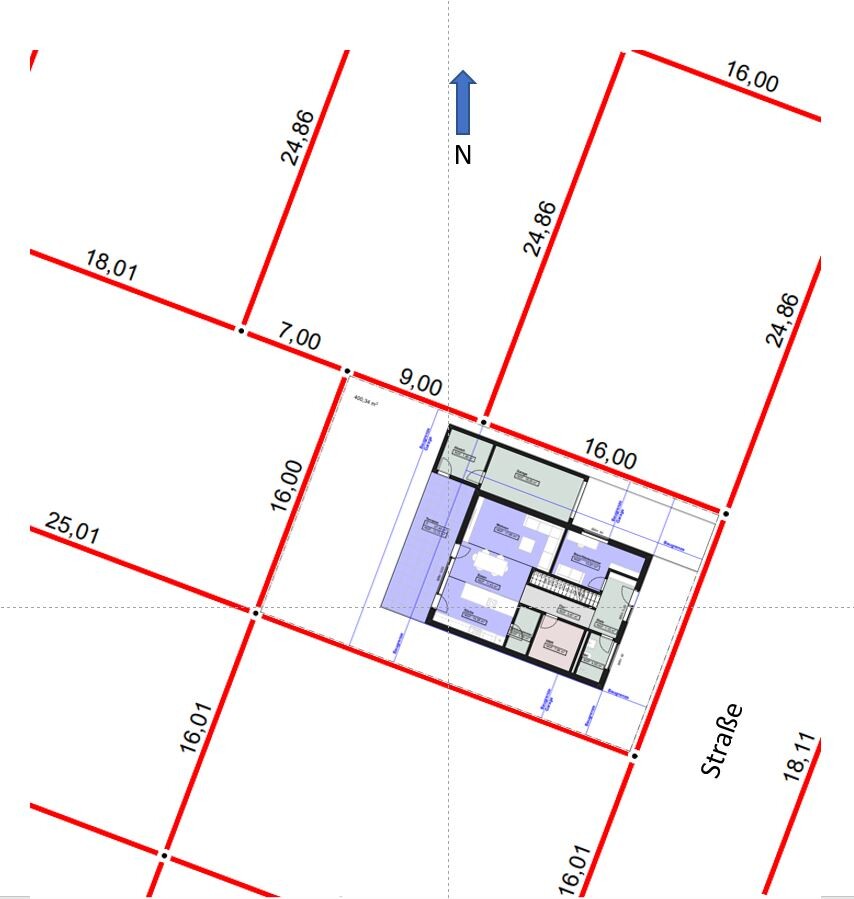
Edge development: Possible with garage.
Number of parking spaces: at least 1, preferably 2
Number of storeys: 1-2
Roof type: Gable roof (pitch minimum 31°, maximum 45°)
Architectural style: ??
Orientation: Gable end facing
Maximum heights / limits: Roof ridge 6-7 m (20-23 ft), eaves 9-12 m (30-39 ft)
Other requirements: No brick facades allowed. Driveway or space in front of garage at least 6 m (20 ft). Red roof tiles mandatory, light facade.
Homeowners’ Requirements
Architectural style, roof type, building type: Gable roof, fixed
Basement, storeys: 2 full storeys without basement
Number of occupants, age: 4 people (2 toddlers)
Space requirements on ground floor and upper floor:
Office: Family use or home office? Office of approx. 12 sqm (130 sq ft) is a must.
Guest bedrooms per year: Few
Open or closed architecture: ? Whatever that means.
Conservative or modern construction style: rather modern construction.
Open kitchen, cooking island: Open kitchen, possibly with cooking island
Number of dining seats: 6
Fireplace: NO
Music / stereo wall: Not planned, TV location is quite important.
Balcony, roof terrace: NO
Garage, carport: Garage desired. Carport with storage box also conceivable.
Utility garden, greenhouse: NO
Further wishes / special features / daily routine, preferably with reasons for choices:
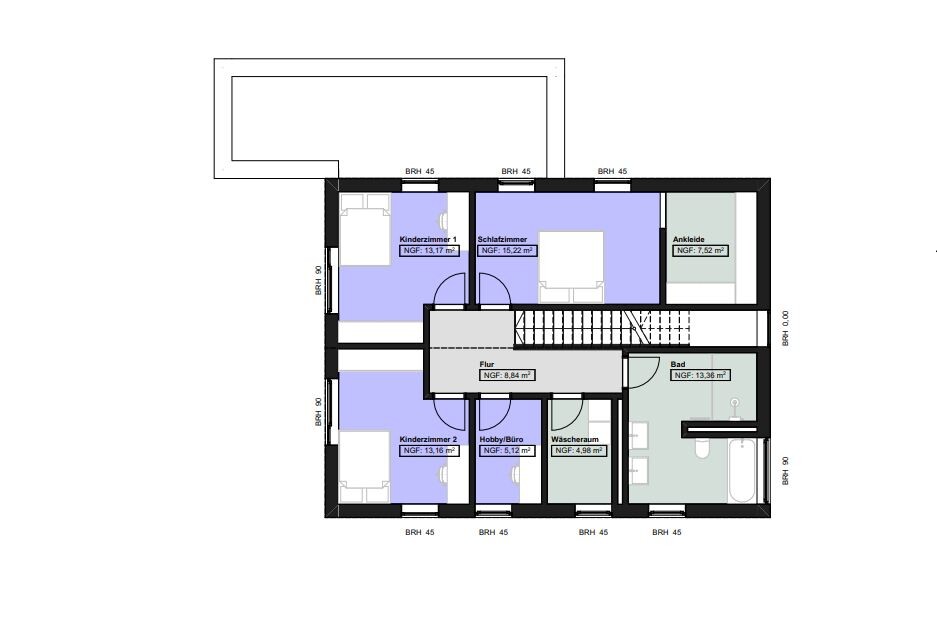
Laundry room on the upper floor. They want to do laundry where it is generated and where it must be returned clean. Anything else is a hassle, at least for us.
House Design
Who designed the plan: Architect
What do you particularly like? Why?
Everything we provided as basic information and what our daily life requires has been implemented.
We like the clear lines/structure.
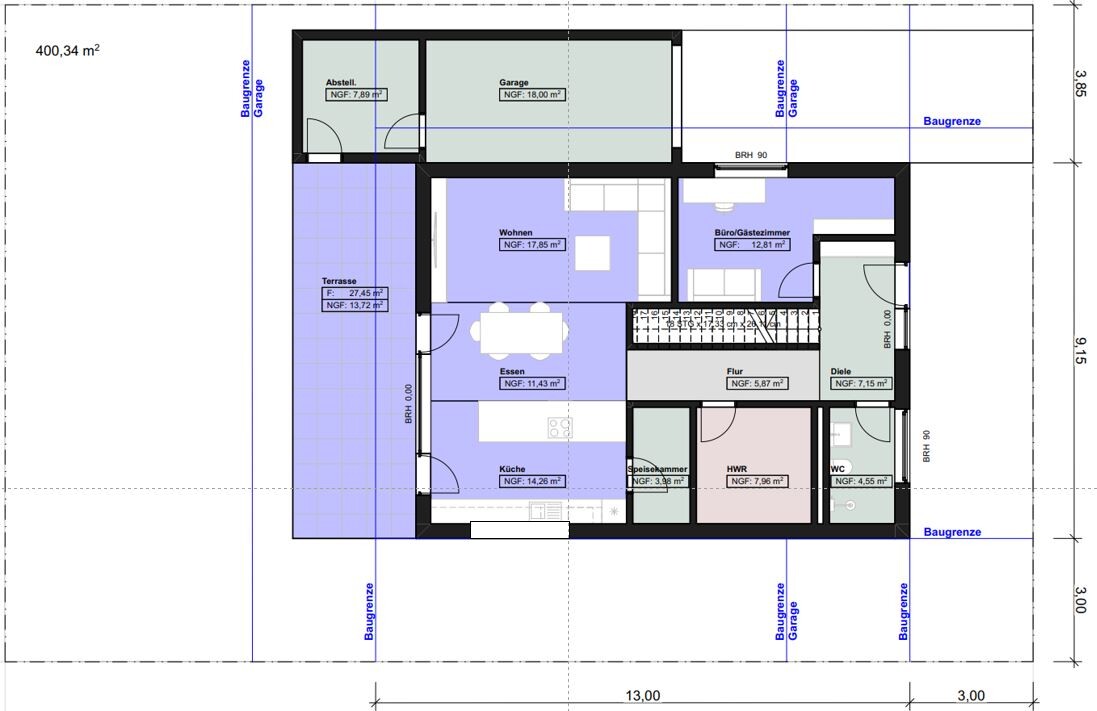
The open space in the hallway.
The connection/proximity of all rooms on ground and upper floors that need water/sewage. So no funny business with the bathroom upstairs in one corner and the utility room diagonally opposite on the ground floor. Personally, I like that.
No bay windows or other awkward extensions.
Laundry room upstairs where the washer and dryer are planned.
What don’t you like? Why?
The living room might be a bit too exposed for us. It could also be a cozy nook with TV without direct view of the kitchen. Cooking and eating together openly is liked; the living room could be a bit more separate. Currently, the floor plan shows it like a narrow, rather shadowy corner.
The somewhat narrow bedroom upstairs is not a dealbreaker but not 100% pleasing.
Price estimate according to architect/planner:
-
Personal price limit for the house, including fixtures and fittings:
500-575k
Preferred heating system:
Predefined, ground source heat pump with collector. Cold local heating network.
If you have to give up, which details/extras
-can you do without:
The small additional room for the father upstairs.
Garage, as mentioned carport also conceivable.
-can you not do without:
Office.
Storage box at garage or carport.
Children’s rooms.
Why is the design the way it is now? e.g.
The design turned out this way because the architect implemented our wishes and requirements almost 1:1. This preliminary layout resulted in this first version.
What do you consider particularly good or bad?
See what we like and what not. We don’t find anything particularly bad. Rather, not entirely optimal.
What is the most important/basic question about the floor plan in 130 characters?
Position garage flush with house or set back?
43.5 sqm (468 sq ft) + 4 sqm (43 sq ft) pantry sufficient as “all-purpose room”?
Same floor plan possibly mirrored? Then office on south side, sun all day, blinds always down. Same issue upstairs with bedroom in summer at least. Entrance farther from parking space.
The building method will be timber frame construction with a local timber builder.
This is a first sketch after clarifying needs/wishes with the architect.
Providing all information possible/available at this point in time.
Development Plan / Restrictions
Plot size: 400 sqm (4300 sq ft)
Slope: No, and no means no!
Floor space index (FSI): 0.4
Floor area ratio (FAR): ?
Building envelope, building line and boundary: Yes, available.
Edge development: Possible with garage.
Number of parking spaces: at least 1, preferably 2
Number of storeys: 1-2
Roof type: Gable roof (pitch minimum 31°, maximum 45°)
Architectural style: ??
Orientation: Gable end facing
Maximum heights / limits: Roof ridge 6-7 m (20-23 ft), eaves 9-12 m (30-39 ft)
Other requirements: No brick facades allowed. Driveway or space in front of garage at least 6 m (20 ft). Red roof tiles mandatory, light facade.
Homeowners’ Requirements
Architectural style, roof type, building type: Gable roof, fixed
Basement, storeys: 2 full storeys without basement
Number of occupants, age: 4 people (2 toddlers)
Space requirements on ground floor and upper floor:
Office: Family use or home office? Office of approx. 12 sqm (130 sq ft) is a must.
Guest bedrooms per year: Few
Open or closed architecture: ? Whatever that means.
Conservative or modern construction style: rather modern construction.
Open kitchen, cooking island: Open kitchen, possibly with cooking island
Number of dining seats: 6
Fireplace: NO
Music / stereo wall: Not planned, TV location is quite important.
Balcony, roof terrace: NO
Garage, carport: Garage desired. Carport with storage box also conceivable.
Utility garden, greenhouse: NO
Further wishes / special features / daily routine, preferably with reasons for choices:
Laundry room on the upper floor. They want to do laundry where it is generated and where it must be returned clean. Anything else is a hassle, at least for us.
House Design
Who designed the plan: Architect
What do you particularly like? Why?
Everything we provided as basic information and what our daily life requires has been implemented.
We like the clear lines/structure.
The open space in the hallway.
The connection/proximity of all rooms on ground and upper floors that need water/sewage. So no funny business with the bathroom upstairs in one corner and the utility room diagonally opposite on the ground floor. Personally, I like that.
No bay windows or other awkward extensions.
Laundry room upstairs where the washer and dryer are planned.
What don’t you like? Why?
The living room might be a bit too exposed for us. It could also be a cozy nook with TV without direct view of the kitchen. Cooking and eating together openly is liked; the living room could be a bit more separate. Currently, the floor plan shows it like a narrow, rather shadowy corner.
The somewhat narrow bedroom upstairs is not a dealbreaker but not 100% pleasing.
Price estimate according to architect/planner:
-
Personal price limit for the house, including fixtures and fittings:
500-575k
Preferred heating system:
Predefined, ground source heat pump with collector. Cold local heating network.
If you have to give up, which details/extras
-can you do without:
The small additional room for the father upstairs.
Garage, as mentioned carport also conceivable.
-can you not do without:
Office.
Storage box at garage or carport.
Children’s rooms.
Why is the design the way it is now? e.g.
The design turned out this way because the architect implemented our wishes and requirements almost 1:1. This preliminary layout resulted in this first version.
What do you consider particularly good or bad?
See what we like and what not. We don’t find anything particularly bad. Rather, not entirely optimal.
What is the most important/basic question about the floor plan in 130 characters?
Position garage flush with house or set back?
43.5 sqm (468 sq ft) + 4 sqm (43 sq ft) pantry sufficient as “all-purpose room”?
Same floor plan possibly mirrored? Then office on south side, sun all day, blinds always down. Same issue upstairs with bedroom in summer at least. Entrance farther from parking space.
The building method will be timber frame construction with a local timber builder.
This is a first sketch after clarifying needs/wishes with the architect.
M
Maulwurfbau10 Aug 2023 13:12An angle of 40° or not less than 40° is intended to maintain the proportions of house width to height within the structure.

Maulwurfbau schrieb:
The small extra room for dad on the upper floor ... is, in reality, just leftover floor plan space, just like the awkwardly furnished study.
Maulwurfbau schrieb:
The design turned out the way it is because the architect implemented our wishes and requirements almost 1:1. This is the initial floor plan draft. [...] The house is planned to be built with timber frame construction, using a local timber builder. Then you probably gave too many requirements. With this planner, I hardly see how the design could improve significantly, and under the condition of using a local timber builder, I don’t see any advantage either. While a local or regional general contractor is highly recommended for masonry construction, unfortunately, small timber craftsmen are often at a similar developmental stage as the well-known prefab home builders of fifty years ago.
The house would be 10m (33 ft) wide and, with the same floor area, one meter (3 ft) shorter, which would result in a better proportion, but it would still be borderline narrow for a single-flight straight staircase, which incidentally seems to be chosen here at the minimum width according to regulations (a four-meter (13 ft) claustrophobic tunnel for a merely quick floor transition, which the unplastered window does not compensate for). Hopefully, even a non-expert can see how much hallway space this produces. I would place the entrance where the study window currently is. "Laundry room" probably means the utility room, and "utility room" means the storage/technical room (?).
Find an independent architect, develop "Module A" with them, and during the waiting phase, openly explore which construction method is more suitable. With a roof pitch of 31°, you shouldn’t have to save excessively on the house width — still, I consider the 85 cm (33 inches) wasted space beside the garage to be nonsense. Still, please show the elevations to see how the planner envisions the windows (parapet height 45 cm (18 inches)) on the upper floor. One more question for the record: did you already have this design when you placed the placeholder model on the property?
https://www.instagram.com/11antgmxde/
https://www.linkedin.com/company/bauen-jetzt/
H
hanghaus202310 Aug 2023 13:5911ant schrieb:
One more question just to be sure: Did you already have this design when you placed the dummy on the plot?I hope not. I had already spent some time on it by then.
M
Maulwurfbau10 Aug 2023 14:3311ant schrieb:
... is in reality just a leftover floor plan area, like the awkwardly furnished study. Although we actually thought it could be used well. In my opinion, the corner in the office is ideal for a small filing area with space for a printer, while keeping the rest of the room clean and square.
11ant schrieb:
The house would be 10m (33 feet) wide, and with the same floor area, one meter (3 feet) shorter, it would be better proportioned, but still borderline narrow for a straight, single-flight staircase, which seems to have been chosen here to meet the minimum standard width (a four-meter (13 feet) claustrophobic tunnel for just quickly changing floors, the unfinishable window doesn’t compensate for that). And hopefully, anyone can see how much hallway space it creates. I would prefer the entrance where the current study window is. "Laundry room" probably refers to the utility room, and "utility room" means the mechanical room (?). Thanks, those are clear points.
What would be the alternative? An “unattractive” compact half-turn staircase?
The entrance point is a good suggestion.
Yes, the utility room (HAR). The mechanical room is downstairs, laundry upstairs.
Yes, yes, I already had the plan in the other thread, I just didn’t think it was relevant for the fundamental question here. Sorry if that annoyed you ;-)
M
Maulwurfbau10 Aug 2023 14:43Thanks, I’ll think about it. He probably already received too much information. However, I trust the carpenter quite a bit. He surely isn’t stuck with knowledge from 1970 :-D
Maulwurfbau schrieb:
Yes, yes, I already had the plan in the other thread, but I didn’t think it was relevant to the fundamental question. Sorry if that annoyed you ;-). Not annoyed, but the wastefulness is.
hanghaus2023 schrieb:
I hope not. I’ve already invested some time in this. It is, I’d say, “rude.”
And you have surely had the chance to “enjoy” the misjudgments of various questioners about the supposed irrelevance of essentials :-(
Maulwurfbau schrieb:
That’s a good point about the entrance. For example.
Maulwurfbau schrieb:
Which we actually thought we could make good use of. In my opinion, the corner in the office is perfect as a small filing nook with space for a printer, while the rest of the room stays unaffected and neatly square. Then just put the printer in the hobby room upstairs; that keeps you active. You can imagine your favorite Knut Buttnase word here yourself.
Maulwurfbau schrieb:
What would the alternative be? An "unattractive" compact half-turn staircase? A staircase’s job isn’t to obstruct the floor plan as much as possible.
Maulwurfbau schrieb:
Yes, utility room. Below is the technical room, above is laundry. Then the planner should just name the rooms functionally. One can hardly hope that the utility room is more than a placeholder here, but actually filled with realistic clutter (including clearance areas).
Maulwurfbau schrieb:
He probably already has too much info. The most common “foundation” of messed-up floor plans is too many wishes for the floor area available. Not least, straight-run stairs are literally a “stick in the spokes.”
Maulwurfbau schrieb:
But I trust the carpenter quite a bit. He’s definitely not stuck in 1970 :-D Of course, they’re “modern” in terms of installation levels, cellulose insulation, and so on. But in the shift from a small rural workshop to an industrial operation, they’re often at the same starting point as their “big role models” long ago. Cabinetmakers are much more advanced here than carpenters, even though both are “woodheads” ...
https://www.instagram.com/11antgmxde/
https://www.linkedin.com/company/bauen-jetzt/
Similar topics