
Hello everyone,
I am currently planning to add a roof extension to a multi-family building to create a nice home for myself.
Due to building regulations, part of the planned sloped roof must be constructed as a post-and-beam (mullion-transom) glass structure.
The reason is that the roof thickness in that area is only allowed to be 20cm (8 inches), which still provides enough clear ceiling height given the maximum permitted building height.
This glass roof will then transition into a glass facade, similar to a conservatory. It will be quite large, likely spanning the entire room width and about 2 meters (6.5 feet) deep.
The structure will span the entire side of the building, with all three bedrooms located underneath. Now I am wondering whether a sound-insulating, heavy triple-glazed laminated tempered glass configuration would be sufficient to adequately reduce rain noise, allowing for comfortable sleeping.
I understand that both the loudness and the sound of rain can be perceived very differently by individuals.
Perhaps there are opinions, experiences, or even actual observations on this topic.
Thank you all!
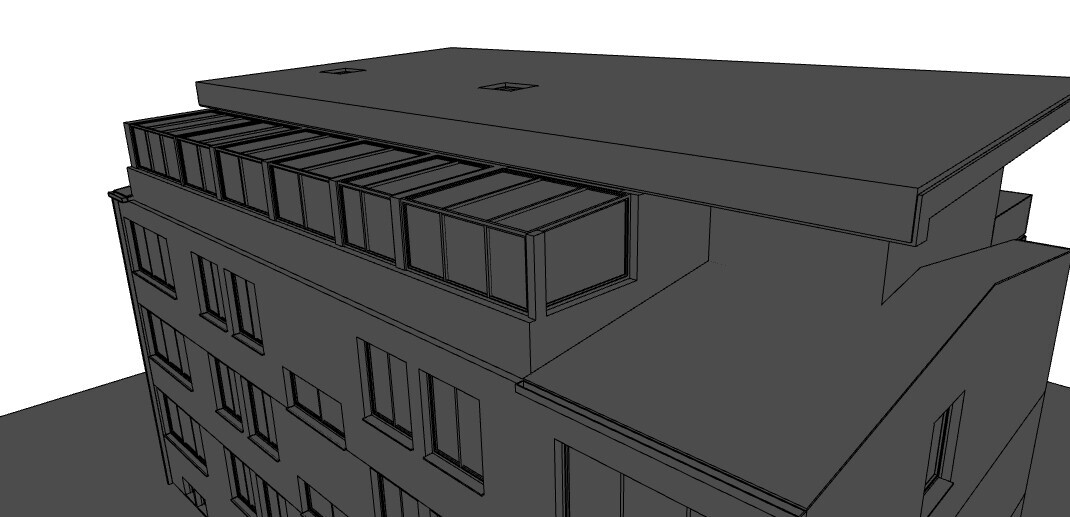
I am currently planning to add a roof extension to a multi-family building to create a nice home for myself.
Due to building regulations, part of the planned sloped roof must be constructed as a post-and-beam (mullion-transom) glass structure.
The reason is that the roof thickness in that area is only allowed to be 20cm (8 inches), which still provides enough clear ceiling height given the maximum permitted building height.
This glass roof will then transition into a glass facade, similar to a conservatory. It will be quite large, likely spanning the entire room width and about 2 meters (6.5 feet) deep.
The structure will span the entire side of the building, with all three bedrooms located underneath. Now I am wondering whether a sound-insulating, heavy triple-glazed laminated tempered glass configuration would be sufficient to adequately reduce rain noise, allowing for comfortable sleeping.
I understand that both the loudness and the sound of rain can be perceived very differently by individuals.
Perhaps there are opinions, experiences, or even actual observations on this topic.
Thank you all!
ecsmo_x schrieb:
I quickly did some research, and this seems to be a good option. Since you can hardly see the roof anyway, it probably isn’t too bad visually. What does "UK" mean? As Tolentino already mentioned, substructure.
If you want to go further in that direction, I can imagine two options:
1. Placing the sandwich panels on minimally sized wooden beams or (more likely) steel girders (depending on the span) and fixing them. Then I would consider leaving the substructure visible (wood looks good anyway, and steel girders can be treated accordingly), and also intentionally designing everything installed on the ceiling within the gaps as surface-mounted installations in an "industrial chic" style.
2. Another possibility would be a combination of cross-laminated timber panels (e.g., Ligno or similar) as the "substructure," topped with PIR/PUR insulation and aluminum sheet cladding. To my knowledge, the wooden ceiling panels are available starting at thicknesses of 90 mm (3.5 inches) or 130 mm (5 inches) with cavity (total thickness including the visible wood underside), and can span up to about 12 meters (39 feet). This should easily allow you to keep the total roof thickness around 25 to 30 cm (10 to 12 inches), and you can use the cavities inside the wooden roof elements as an "installation zone."
If you want to save another 10 cm (4 inches), you could of course combine option 2 with the vacuum insulation panels already mentioned, but their prices are quite extreme.
H
hanghaus202317 Nov 2023 12:02The roof pitch is so shallow that dirt tends to settle easily. I wouldn’t want that with glass. It’s somewhat manageable to clean on the ground floor, but almost impossible in the attic.
Show us the floor plan.
Show us the floor plan.