
Hello everyone,
In our home, the living room is separated from the kitchen/dining area by a glass balustrade that acts as a fall protection.
As shown in the picture, the wall will be built this way, with the TV mounted on the ceiling drop behind it. The glass balustrade will therefore be directly in the line of sight from the couch to the TV.
There will be no handrail on the glass.
Since I’m concerned that reflections from the TV screen might appear on the glass in the slightly dimmed room, we asked for an anti-reflective glass option.
Now we have received the offer, and they want an extra 750€ for the anti-reflective treatment. Is that normal?
I am wondering whether this is really necessary or if we could skip it.
Can someone give a recommendation on this?
I’m also questioning whether the laminated safety glass (LSG) needs to be made of 2 layers of 8mm (5/16 inch) tempered glass, or if 2 layers of 6mm (1/4 inch) would suffice and save some lead time.
Thanks for your help!
Best regards
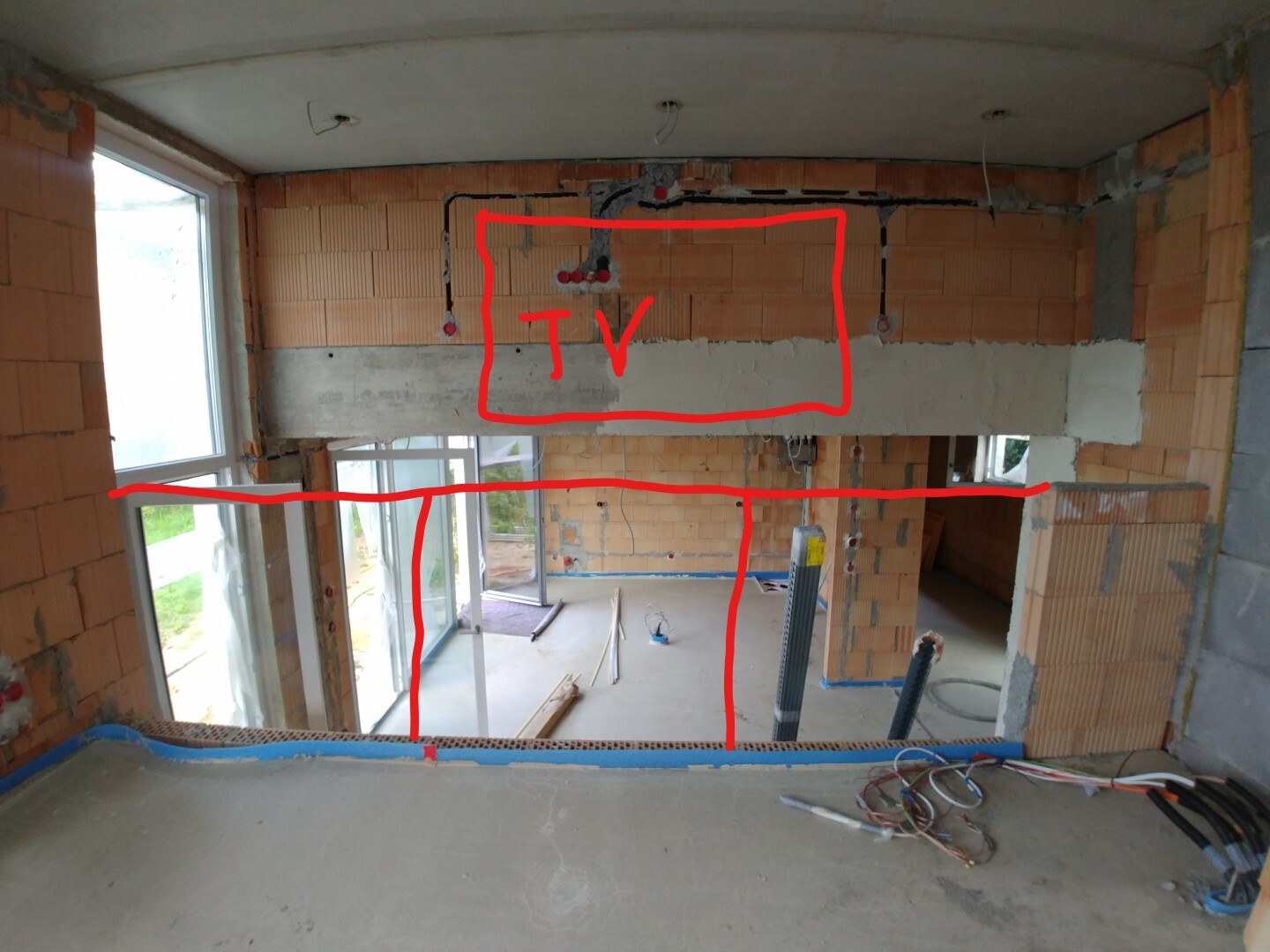
In our home, the living room is separated from the kitchen/dining area by a glass balustrade that acts as a fall protection.
As shown in the picture, the wall will be built this way, with the TV mounted on the ceiling drop behind it. The glass balustrade will therefore be directly in the line of sight from the couch to the TV.
There will be no handrail on the glass.
Since I’m concerned that reflections from the TV screen might appear on the glass in the slightly dimmed room, we asked for an anti-reflective glass option.
Now we have received the offer, and they want an extra 750€ for the anti-reflective treatment. Is that normal?
I am wondering whether this is really necessary or if we could skip it.
Can someone give a recommendation on this?
I’m also questioning whether the laminated safety glass (LSG) needs to be made of 2 layers of 8mm (5/16 inch) tempered glass, or if 2 layers of 6mm (1/4 inch) would suffice and save some lead time.
Thanks for your help!
Best regards
D
Deliverer12 Sep 2017 13:31A quick clarification:
Do you want to prevent reflections from the TV on the ground floor, or should there simply be no reflection at the spot where the photo was taken?
Regarding the price: if it is a true anti-reflective coating, something (I believe a metallic substance) is vapor-deposited and then hardened. I can imagine such prices being charged for that. It easily adds around €50 for eyeglass lenses.
If it is just frosted glass instead of clear glass (which also reflects less), then that price seems a bit steep.
Do you want to prevent reflections from the TV on the ground floor, or should there simply be no reflection at the spot where the photo was taken?
Regarding the price: if it is a true anti-reflective coating, something (I believe a metallic substance) is vapor-deposited and then hardened. I can imagine such prices being charged for that. It easily adds around €50 for eyeglass lenses.
If it is just frosted glass instead of clear glass (which also reflects less), then that price seems a bit steep.
When I’m standing in the kitchen downstairs, I don’t mind if the TV is reflected in the railing.
I just don’t want to be disturbed by any reflections or glare at the spot where the photo was taken—so while watching TV.
It would be proper anti-reflective treatment; frosted glass was never planned.
I just don’t want to be disturbed by any reflections or glare at the spot where the photo was taken—so while watching TV.
It would be proper anti-reflective treatment; frosted glass was never planned.
I have no idea about the prices, but is there really no other option for the TV? Always looking through a glass wall... that’s annoying, especially because the glass ends somewhere and you can always notice an edge in your field of vision... that wouldn’t work for me at all. Don’t you have any other place for the TV?
S
Steffen8012 Sep 2017 16:34Sure, cool... but very bold 🙂 watching TV through glass? I wonder if that works well...
Hold on, not through the glass. The railing is 1m high (3.3 feet), and the TV is mounted above it. It’s planned so that the sightline doesn’t go directly through the glass.
What I’m concerned about is whether the angle between the couch, the glass, and the TV might be just right—or rather wrong—for me to see any reflections of the TV image on the glass balustrade when I’m sitting on the couch.
Attached is a cross-section view to better illustrate what I mean. The red lines towards the couch simply represent the lines of sight to the TV’s top edge, bottom edge, and center.
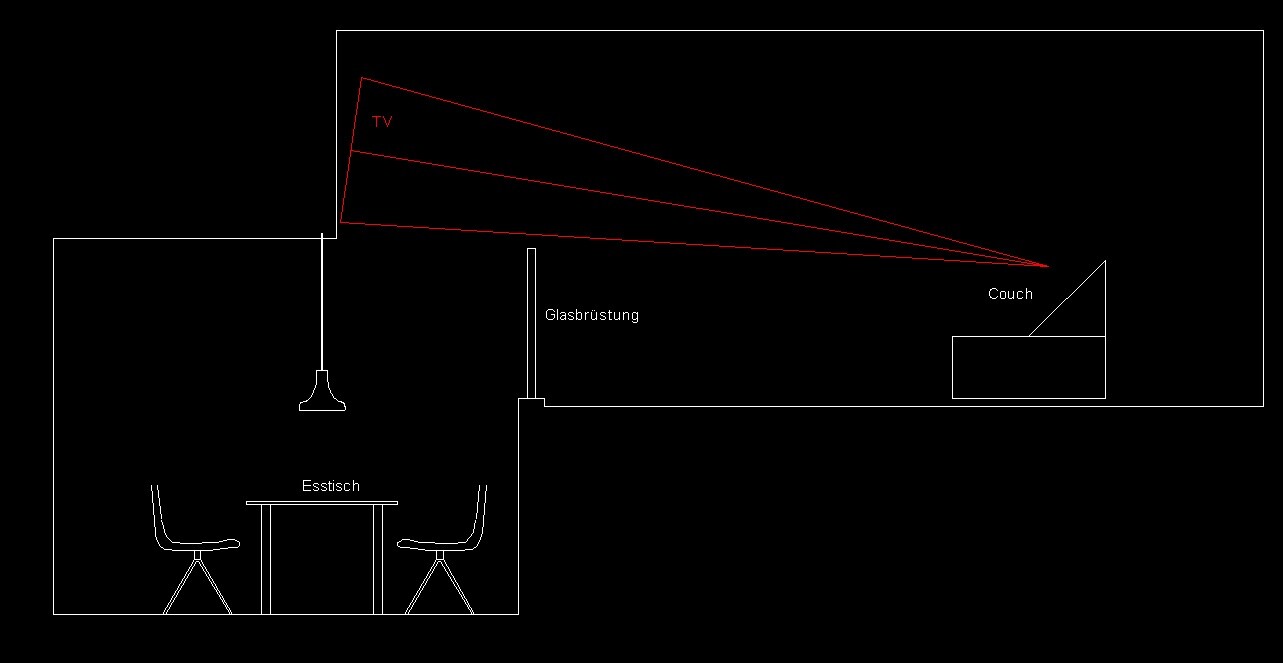
What I’m concerned about is whether the angle between the couch, the glass, and the TV might be just right—or rather wrong—for me to see any reflections of the TV image on the glass balustrade when I’m sitting on the couch.
Attached is a cross-section view to better illustrate what I mean. The red lines towards the couch simply represent the lines of sight to the TV’s top edge, bottom edge, and center.
Similar topics