
ᐅ Ground Source Heat Pump with Trench Collector or Borehole Probe
Created on: 20 Jan 2017 13:36
B
bitninjaHello,
I have already received great help here in the forum and am currently a bit overwhelmed.
Here are the key details. KfW55 house with 130 sqm (1400 sq ft) living space, 1.5 stories.
The plot faces south-west and measures 599 sqm (6445 sq ft), 22.8 m x 26 m (75 ft x 85 ft).
Ht (transmission) = 0.2345, A (building envelope area) = 381, Ve (heated volume) = 471.
Household of 4 people.
My calculated heating demand should be around 4300 kWh, but I have not yet received data from the heating company.
Soil analysis: topsoil up to 0.3 m (1 ft), silty fine sand SU 3-4 up to 0.6 m (2 ft), and glacial till SU 4, UL, very moist at 7 m (23 ft).
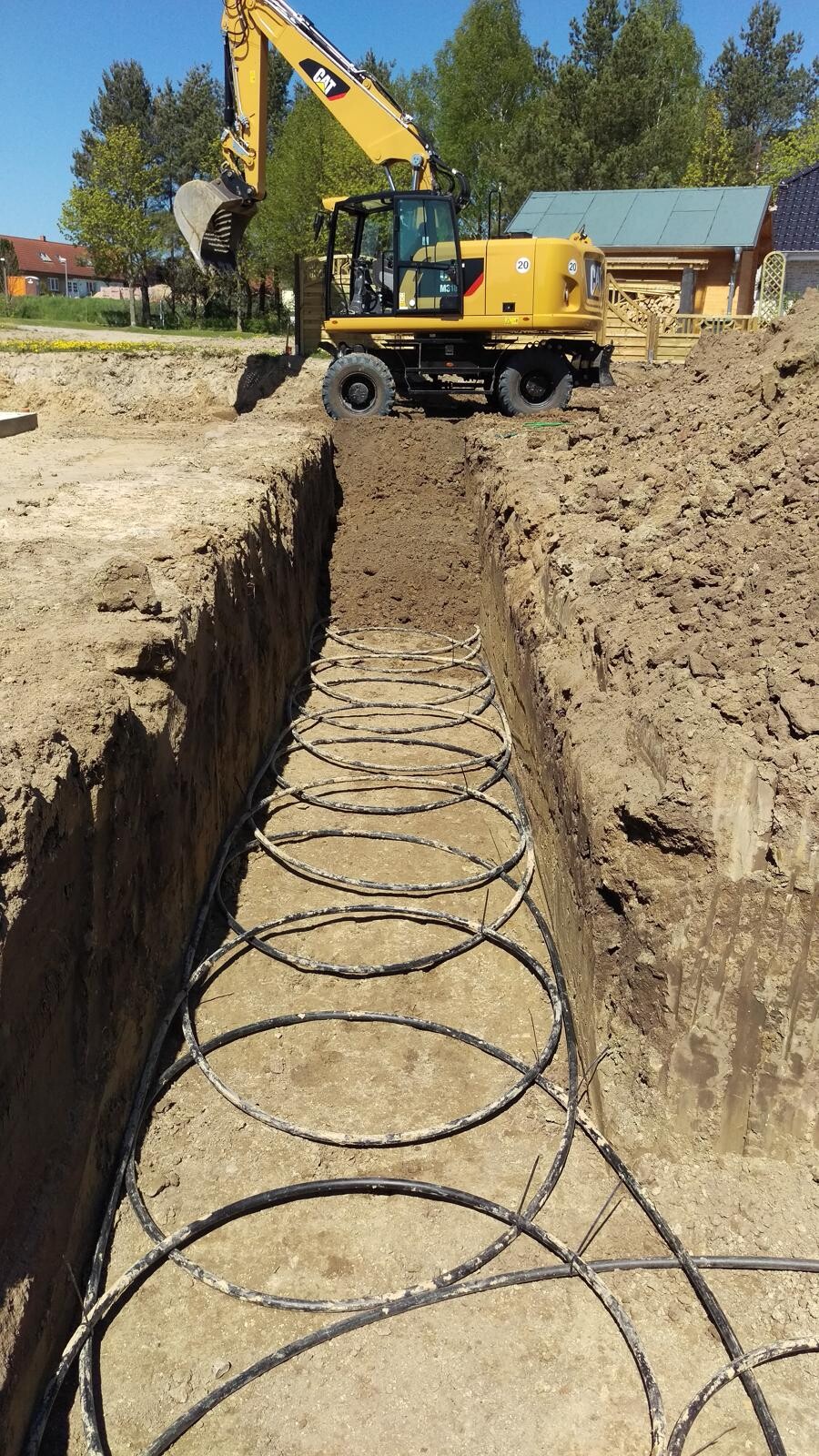
The plan was a ground-source heat pump with brine probe. The builder now says that 2 boreholes of 60 m (197 ft) each are required. This entails additional costs, whereas surface collectors would be free instead.
For me, probably only trench collectors would be an option, as I would like to have 2 or 3 trees and a vegetable garden. According to neighbors, a hedge is mandatory in the area.
1. I have heard that deep probes are no longer considered as good, and that surface collectors or trench collectors are more efficient because they do not require a circulation pump. Is that true?
2. Is drilling 2 boreholes of 60 m each feasible?
3. Can you recommend a heat pump manufacturer? The builder will probably choose a Vaillant flexoCompact, etc. I am leaning towards the Nibe F1155.
4. If using collectors, is it okay to have a tree with 2 m (6.5 ft) distance, or can a hedge be installed right above the collectors?
Thank you in advance for your help.
Best regards,
David
P.S. A rough sketch from me with trench collectors as an example.
I have already received great help here in the forum and am currently a bit overwhelmed.
Here are the key details. KfW55 house with 130 sqm (1400 sq ft) living space, 1.5 stories.
The plot faces south-west and measures 599 sqm (6445 sq ft), 22.8 m x 26 m (75 ft x 85 ft).
Ht (transmission) = 0.2345, A (building envelope area) = 381, Ve (heated volume) = 471.
Household of 4 people.
My calculated heating demand should be around 4300 kWh, but I have not yet received data from the heating company.
Soil analysis: topsoil up to 0.3 m (1 ft), silty fine sand SU 3-4 up to 0.6 m (2 ft), and glacial till SU 4, UL, very moist at 7 m (23 ft).
The plan was a ground-source heat pump with brine probe. The builder now says that 2 boreholes of 60 m (197 ft) each are required. This entails additional costs, whereas surface collectors would be free instead.
For me, probably only trench collectors would be an option, as I would like to have 2 or 3 trees and a vegetable garden. According to neighbors, a hedge is mandatory in the area.
1. I have heard that deep probes are no longer considered as good, and that surface collectors or trench collectors are more efficient because they do not require a circulation pump. Is that true?
2. Is drilling 2 boreholes of 60 m each feasible?
3. Can you recommend a heat pump manufacturer? The builder will probably choose a Vaillant flexoCompact, etc. I am leaning towards the Nibe F1155.
4. If using collectors, is it okay to have a tree with 2 m (6.5 ft) distance, or can a hedge be installed right above the collectors?
Thank you in advance for your help.
Best regards,
David
P.S. A rough sketch from me with trench collectors as an example.
We spoke with the developer today. Unfortunately, since we are tied to the developer, they are not giving us much flexibility.
We can either pay an additional €12,000 for a Vaillant brine/water heat pump with two boreholes of 50-60m (165-197 ft) each, or choose an air-to-water heat pump. The developer initially wanted to impose a Rotex system on us, but we managed to persuade them to consider some alternatives like Nibe, Vaillant, etc. It’s very unlikely that we will be able to get a Panasonic Geisha.
We are somewhat frustrated to be so dependent on the developer.
Any suggestions regarding air-to-water heat pumps would be appreciated.
We can either pay an additional €12,000 for a Vaillant brine/water heat pump with two boreholes of 50-60m (165-197 ft) each, or choose an air-to-water heat pump. The developer initially wanted to impose a Rotex system on us, but we managed to persuade them to consider some alternatives like Nibe, Vaillant, etc. It’s very unlikely that we will be able to get a Panasonic Geisha.
We are somewhat frustrated to be so dependent on the developer.
Any suggestions regarding air-to-water heat pumps would be appreciated.
bitninja schrieb:
We had a call with the home builder today. Unfortunately, since we are tied to this builder, they are not offering us much flexibility.
We can either pay an extra €12,000 for a Vaillant ground-source heat pump with two boreholes of 50-60 meters (165-197 feet) each, or choose an air-to-water heat pump. The builder initially wanted to impose a Rotex system on us, but we managed to convince them to consider some alternatives like Nibe, Vaillant, etc. We will most likely not be able to get the Panasonic Geisha.
We are a bit frustrated about being so dependent on the builder.
Any suggestions regarding air-to-water heat pumps would be appreciated.Hi, how did it turn out for you? I’m also looking for information on this, especially about trench collectors.

I have a 90m (295 ft) borehole, which is sized for 4kW cooling capacity (45W/m).
Your actual heating load is likely below 4kW; even if you assume 4.3kW, you’re at a cooling capacity of around 3.4kW, which is still oversized for a 90m (295 ft) borehole.
Two 60m (197 ft) boreholes is a crazy idea, unless you are not allowed to drill deeper than 60m (197 ft) on your property. The Nibe F1x55-6 heat pump would fit the heating load you mentioned.
(I will be installing the F1255-6PC in the next few weeks.)
My heating load according to DIN EN 12831 is 3.2kW plus hot water (0.4kW) equals 3.6kW. The planner said the actual heating load would probably be under 3kW, but due to the heating load calculation according to DIN, they ended up with a heat transfer coefficient (Ht) of 0.2 because of some general allowances.
According to the energy certificate (with detailed calculation of thermal bridges), my Ht is 0.185.
Ve = 722m³ (25515 ft³)
A = 504m² (5423 ft²)
An = 231m² (2487 ft²)
KfW40 standard.
Why???
I don’t know where you got that information, but why would a ring trench collector not need a circulation pump?
It needs one just like a deep borehole system.
A near-surface collector is more efficient for domestic hot water in summer but less effective during the coldest winter periods compared to a borehole.
For these reasons, I didn’t want a collector system:
- No possibility to do any work myself, so no savings
- Design freedom / conflicts with other underground lines
Therefore, I spent a one-time amount of 5000€ and have practically no loss in my garden, and hopefully I will enjoy peace of mind and stable temperatures for the next 40 years.
Your actual heating load is likely below 4kW; even if you assume 4.3kW, you’re at a cooling capacity of around 3.4kW, which is still oversized for a 90m (295 ft) borehole.
Two 60m (197 ft) boreholes is a crazy idea, unless you are not allowed to drill deeper than 60m (197 ft) on your property. The Nibe F1x55-6 heat pump would fit the heating load you mentioned.
(I will be installing the F1255-6PC in the next few weeks.)
My heating load according to DIN EN 12831 is 3.2kW plus hot water (0.4kW) equals 3.6kW. The planner said the actual heating load would probably be under 3kW, but due to the heating load calculation according to DIN, they ended up with a heat transfer coefficient (Ht) of 0.2 because of some general allowances.
According to the energy certificate (with detailed calculation of thermal bridges), my Ht is 0.185.
Ve = 722m³ (25515 ft³)
A = 504m² (5423 ft²)
An = 231m² (2487 ft²)
KfW40 standard.
bitninja schrieb:
We talked to the builder today. Unfortunately, since we are tied to the builder, they won’t give us any flexibility.
Why???
bitninja schrieb:
1. Now I’ve heard that the deep borehole might not be that good anymore and that a horizontal collector or trench collector is more efficient since it doesn’t require a circulation pump.
I don’t know where you got that information, but why would a ring trench collector not need a circulation pump?
It needs one just like a deep borehole system.
A near-surface collector is more efficient for domestic hot water in summer but less effective during the coldest winter periods compared to a borehole.
For these reasons, I didn’t want a collector system:
- No possibility to do any work myself, so no savings
- Design freedom / conflicts with other underground lines
Therefore, I spent a one-time amount of 5000€ and have practically no loss in my garden, and hopefully I will enjoy peace of mind and stable temperatures for the next 40 years.
Similar topics