
ᐅ Garden Path from the 1970s with Concrete Foundation – Was This Common?
Created on: 4 May 2021 19:39
U
ungültigHello everyone,
I hope this is the right place for my first question. If not, please feel free to move it to another forum.
We own a semi-detached house built in 1975 and would like to visually improve a straight garden path about 10 meters (33 feet) long and 1.20 meters (47 inches) wide through our front garden.
Currently, there are loose concrete paving slabs without any lateral edging stones. On one hand, the slabs look unattractive, and on the other hand, they constantly shift apart because there is no side restraint.
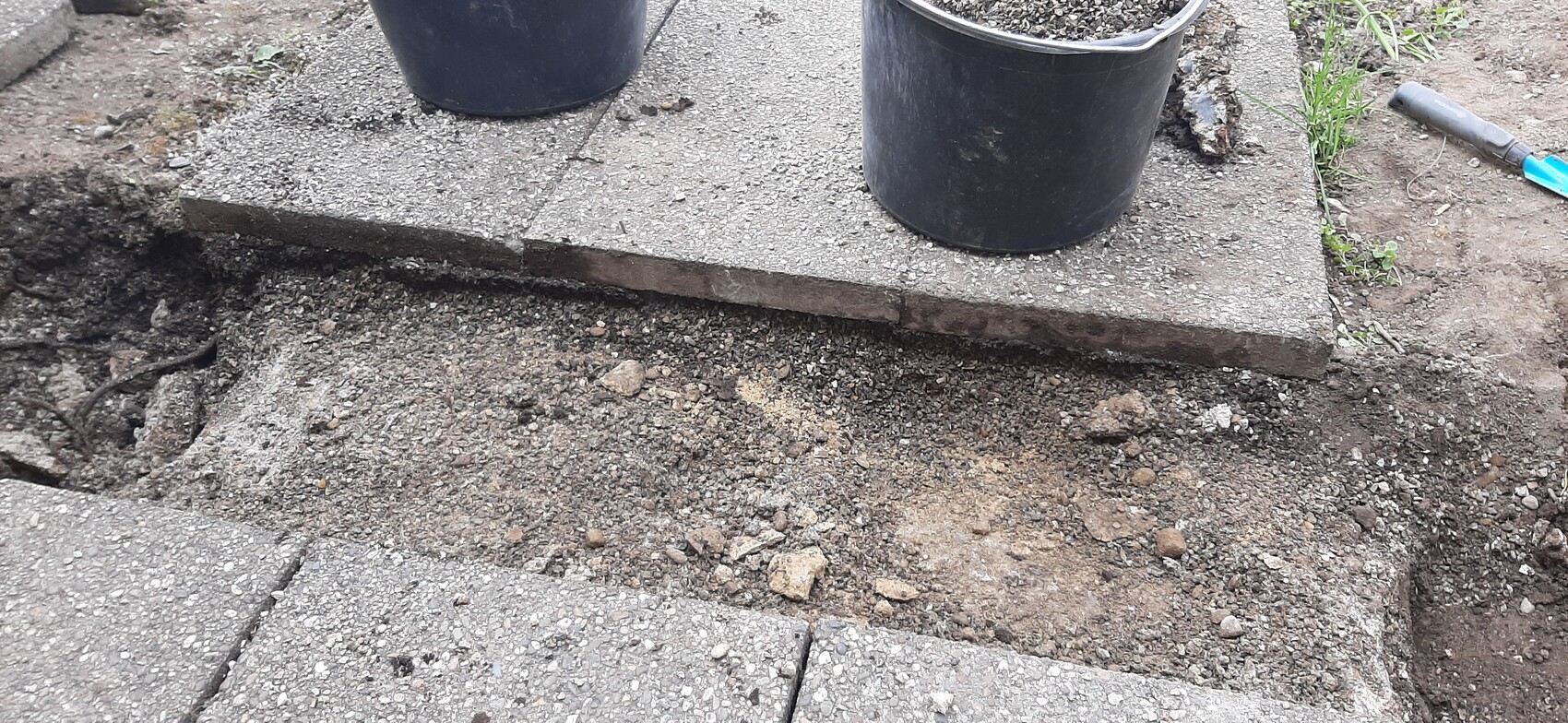
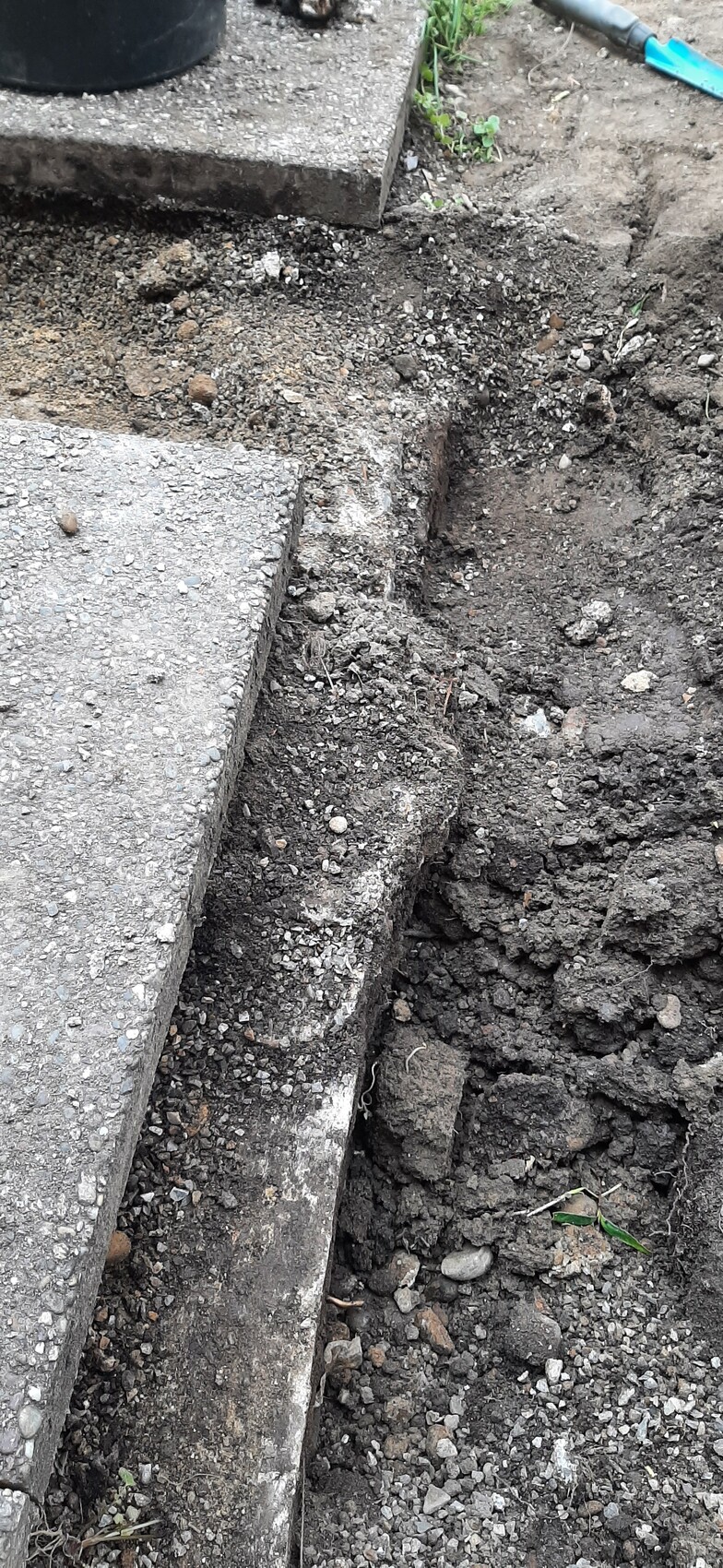
At first, we thought this would be no problem: dig out a section, install edging stones, lay a new base layer (gravel, crushed stone, etc.), and place nicer stones on top. However, after lifting the concrete slabs, we found a concrete foundation running the entire length of the path, estimated at least 15-20 cm (6-8 inches) thick. See the pictures below.
The foundation appears to be installed horizontally. From the house to the garden gate, a slope was created on the foundation. On the house side, there is about 12 cm (5 inches) of concrete mixed with gravel on top of the foundation (fairly easy to remove, partially crumbling). The concrete slabs then lie on the slope on approximately 2 cm (1 inch) of coarse crushed stone.
Strangely, the slabs are also slightly offset to one side on the foundation (overhanging on one side, not fully covering the foundation on the other side, see pictures).
Perhaps someone can answer the following questions:
Was this type of construction common in the 1970s? It seems like a huge effort for a garden path that is not designed for vehicle traffic. The foundation looks neatly formed and, based on its texture, more like reinforced concrete used in basement walls rather than a simple concrete bed for edging stones.
Could the foundation have a deeper purpose? For example, protection of cables or pipes? Is such an extensive foundation typical for a front garden of a single-family house? The water supply and sewer lines run below the foundation in the basement, but conveniently at about 1.5 meters (5 feet) deep. Electrical and communication lines do not appear to be under the foundation. Would there be anything special to consider regarding the surface if this foundation actually serves as a concrete channel for pipes or cables?
Has anyone renovated such a construction before? What kind of paving stones could be used instead of the 5 cm (2 inch) concrete slabs, and what would the base structure look like? Should we continue creating a slope with crushed stone underneath? Or would it be better to stick with slabs? Would the concrete need to be pre-treated or sealed? Probably not.
We also wanted to widen the path near the house at the steps and near the garden gate by the mailbox. How could a good transition be created laterally beside the concrete foundation to lay the surface over both the foundation and the adjacent soil? I would prefer to avoid adding more concrete to the property... on the other hand, the soil might settle quickly – or can this be sufficiently prevented by compacting with a tamper?
Thank you very much in advance for any tips and suggestions!
Best regards,
Volker
I hope this is the right place for my first question. If not, please feel free to move it to another forum.
We own a semi-detached house built in 1975 and would like to visually improve a straight garden path about 10 meters (33 feet) long and 1.20 meters (47 inches) wide through our front garden.
Currently, there are loose concrete paving slabs without any lateral edging stones. On one hand, the slabs look unattractive, and on the other hand, they constantly shift apart because there is no side restraint.
At first, we thought this would be no problem: dig out a section, install edging stones, lay a new base layer (gravel, crushed stone, etc.), and place nicer stones on top. However, after lifting the concrete slabs, we found a concrete foundation running the entire length of the path, estimated at least 15-20 cm (6-8 inches) thick. See the pictures below.
The foundation appears to be installed horizontally. From the house to the garden gate, a slope was created on the foundation. On the house side, there is about 12 cm (5 inches) of concrete mixed with gravel on top of the foundation (fairly easy to remove, partially crumbling). The concrete slabs then lie on the slope on approximately 2 cm (1 inch) of coarse crushed stone.
Strangely, the slabs are also slightly offset to one side on the foundation (overhanging on one side, not fully covering the foundation on the other side, see pictures).
Perhaps someone can answer the following questions:
Was this type of construction common in the 1970s? It seems like a huge effort for a garden path that is not designed for vehicle traffic. The foundation looks neatly formed and, based on its texture, more like reinforced concrete used in basement walls rather than a simple concrete bed for edging stones.
Could the foundation have a deeper purpose? For example, protection of cables or pipes? Is such an extensive foundation typical for a front garden of a single-family house? The water supply and sewer lines run below the foundation in the basement, but conveniently at about 1.5 meters (5 feet) deep. Electrical and communication lines do not appear to be under the foundation. Would there be anything special to consider regarding the surface if this foundation actually serves as a concrete channel for pipes or cables?
Has anyone renovated such a construction before? What kind of paving stones could be used instead of the 5 cm (2 inch) concrete slabs, and what would the base structure look like? Should we continue creating a slope with crushed stone underneath? Or would it be better to stick with slabs? Would the concrete need to be pre-treated or sealed? Probably not.
We also wanted to widen the path near the house at the steps and near the garden gate by the mailbox. How could a good transition be created laterally beside the concrete foundation to lay the surface over both the foundation and the adjacent soil? I would prefer to avoid adding more concrete to the property... on the other hand, the soil might settle quickly – or can this be sufficiently prevented by compacting with a tamper?
Thank you very much in advance for any tips and suggestions!
Best regards,
Volker
 HausiKlausi4 May 2021 23:09
ungültig schrieb:
Could the foundation have a deeper purpose?Usually not 🙂 The material was cheap and sturdy—you mix it, pour it, done. Interior floor tiles were laid on a 5cm (2 inches) thick bed of mortar that you can only remove with a rotary hammer and plenty of swearing. Entire courtyards were filled with concrete because it seemed practical at the time. In one case, in a small bathroom that was subdivided later in the 1980s, bricks were laid in double rows with mortar joints as thick as a child's arm as a wall (with an additional joint to ensure the wooden ceiling could bear the load). SEVEN! CUBIC METERS! OF MESS! So you won’t avoid swearing, hammering, and cleaning up the dirt. But afterward, it feels good!

I assume the concrete path was poured heavily during or shortly after the house construction and was used as a walkway for many years. After it was damaged, it was covered with exposed aggregate concrete slabs.
That was my grandpa’s approach and how he carried it out for paths, garage drives, stairs, and shed foundations.
When the concrete mixer arrived, he would frame his projects with boards in case there was leftover concrete.
Possible solutions would be to remove everything and start anew,
or keep the concrete path and cover it with a new layer.
That was my grandpa’s approach and how he carried it out for paths, garage drives, stairs, and shed foundations.
When the concrete mixer arrived, he would frame his projects with boards in case there was leftover concrete.
Possible solutions would be to remove everything and start anew,
or keep the concrete path and cover it with a new layer.
H
HilfeHilfe5 May 2021 07:08Yes, it’s the same at my parents’ place. Concrete paths everywhere. First, try gently breaking up the surface.
Good morning everyone,
thank you for your quick responses 🙂
I’m getting a similar impression here as well; we dealt with the thick-bed mortar and tiles in the kitchen...
The first option would certainly be the cleaner solution. But given the length and thickness of the path, I would need very heavy equipment. With just a rotary hammer, I’d probably be working for months 🙂. Maybe better to leave it in place. The transitions in the subfloor when widening the path are not ideal – perhaps just add a concrete layer underneath there as well... :p
Have a great day!
thank you for your quick responses 🙂
The stuff was cheap and sturdy – mix it, pour it in, done. Interior tiles were laid with a 5cm thick-bed mortar, which you can only remove with a rotary hammer and a lot of swearing, entire courtyards were filled with concrete because it seemed so practical.
I’m getting a similar impression here as well; we dealt with the thick-bed mortar and tiles in the kitchen...
Solutions would be to remove everything and start over, or leave the concrete path and cover it with a new layer
The first option would certainly be the cleaner solution. But given the length and thickness of the path, I would need very heavy equipment. With just a rotary hammer, I’d probably be working for months 🙂. Maybe better to leave it in place. The transitions in the subfloor when widening the path are not ideal – perhaps just add a concrete layer underneath there as well... :p
Have a great day!
Similar topics