
Hello everyone,
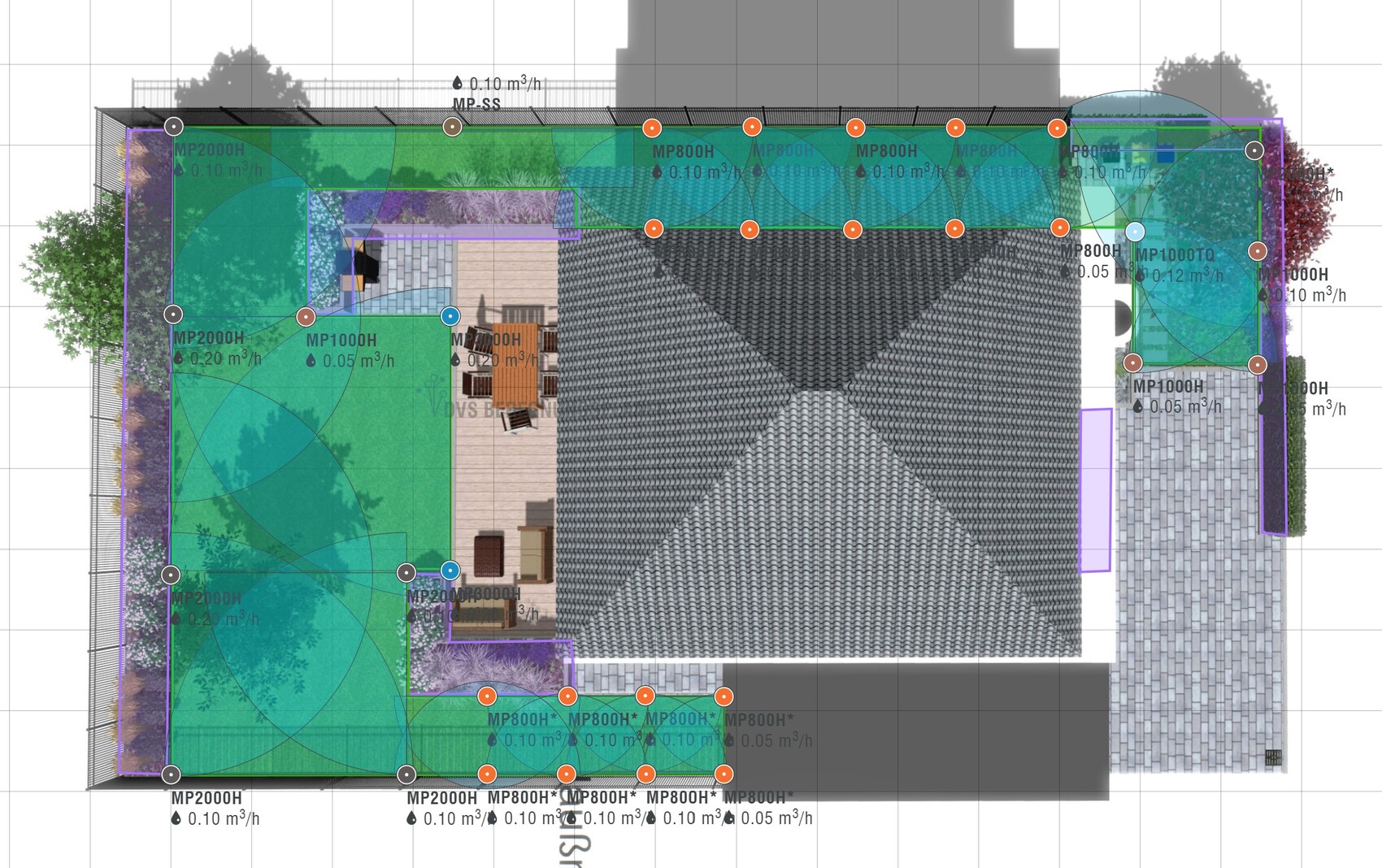
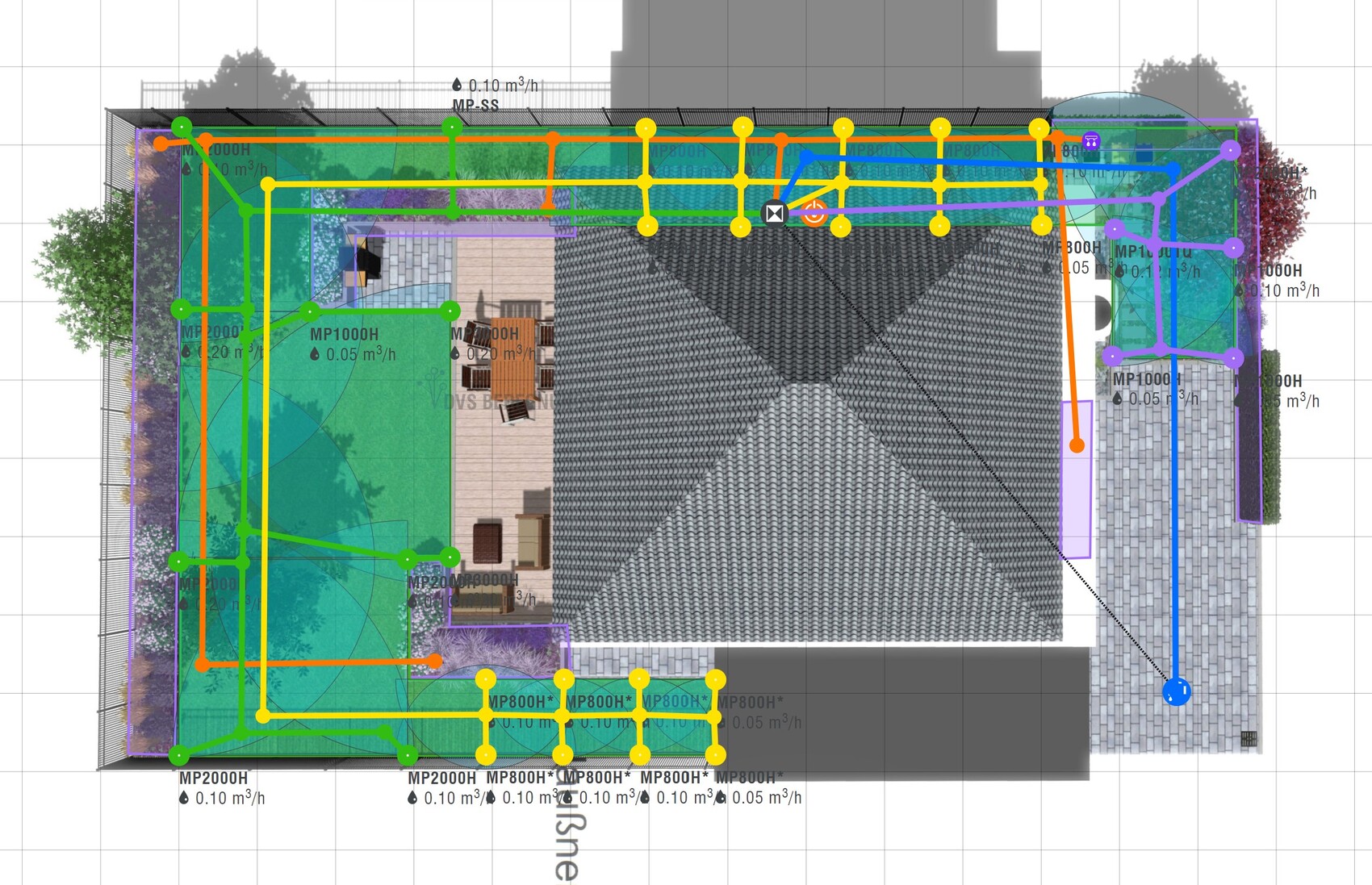
I have planned the garden irrigation system for our outdoor area and would like to ask for your feedback:
1. A 6,600-liter (1,743-gallon) cistern that will be used for irrigation.
2. The cistern is currently filled with rainwater. In the first expansion phase, it will also be filled with fresh water from the outdoor faucet, and next year a well will be drilled to fill the cistern. Of course, the cistern should only be refilled when it is empty and only with as much water as the irrigation requires. The rainwater should not be wasted.
3. For the pump, the Divertron 1200 will be used (4.8 bar (70 psi) and 5,700 liters per hour (1,505 gallons per hour)).
4. Unlike the initial plan, I want to use the Rain Bird R-VAN rotary sprinklers. The minimum radius is 2.4 meters (8 feet), whereas with Hunter I would have to use the MP800-H model, since the MP1000 starts at 2.8 meters (9 feet). I don’t need the extra reach of the Hunter, and the Rain Bird have lower flow rates, so I can save water. In any case, the sprinklers will be installed with MPR nozzles and pressure regulation.
5. Controller: Hunter Pro-HC or Rain Bird ESP-TM2 with Wi-Fi module.
6. Rain sensor and soil moisture sensor.
7. Outdoor water outlet is planned at the garden corner (not shown in the plan).
8. A drainage valve would be useful.
Questions:
i. Can I connect the Gardena rain sensor to the Hunter or Rain Bird controller?
ii. Where is the best place to install the drainage valve?
iii. I read that rotors should not be connected in series. Why is that?
iv. I am planning to dig a deep trench of 80 cm (31 inches) for the main line with 32 mm (1.25 inches) piping and connect the individual sprinklers from there. Good idea or not? The pump should provide enough pressure.
v. Should the pressure regulator for drip irrigation be installed directly at the manifold or only where necessary?
vi. In general, what do you think about the position of the sprinklers? A larger play structure with a sandbox will be added at the lower left.
vii. At the narrow section at the top, I planned strip sprinklers or would rotors be better?
viii. I divided the left area into 3 rectangles and aligned the sprinklers accordingly. Maybe it makes more sense to position 5 sprinklers on the left instead. That would be more than the triangle arrangement.
ix. Some sprinklers do not receive overlapping coverage. I can’t assess how critical this is. Ideally, there should be double coverage.
I have planned the garden irrigation system for our outdoor area and would like to ask for your feedback:
1. A 6,600-liter (1,743-gallon) cistern that will be used for irrigation.
2. The cistern is currently filled with rainwater. In the first expansion phase, it will also be filled with fresh water from the outdoor faucet, and next year a well will be drilled to fill the cistern. Of course, the cistern should only be refilled when it is empty and only with as much water as the irrigation requires. The rainwater should not be wasted.
3. For the pump, the Divertron 1200 will be used (4.8 bar (70 psi) and 5,700 liters per hour (1,505 gallons per hour)).
4. Unlike the initial plan, I want to use the Rain Bird R-VAN rotary sprinklers. The minimum radius is 2.4 meters (8 feet), whereas with Hunter I would have to use the MP800-H model, since the MP1000 starts at 2.8 meters (9 feet). I don’t need the extra reach of the Hunter, and the Rain Bird have lower flow rates, so I can save water. In any case, the sprinklers will be installed with MPR nozzles and pressure regulation.
5. Controller: Hunter Pro-HC or Rain Bird ESP-TM2 with Wi-Fi module.
6. Rain sensor and soil moisture sensor.
7. Outdoor water outlet is planned at the garden corner (not shown in the plan).
8. A drainage valve would be useful.
Questions:
i. Can I connect the Gardena rain sensor to the Hunter or Rain Bird controller?
ii. Where is the best place to install the drainage valve?
iii. I read that rotors should not be connected in series. Why is that?
iv. I am planning to dig a deep trench of 80 cm (31 inches) for the main line with 32 mm (1.25 inches) piping and connect the individual sprinklers from there. Good idea or not? The pump should provide enough pressure.
v. Should the pressure regulator for drip irrigation be installed directly at the manifold or only where necessary?
vi. In general, what do you think about the position of the sprinklers? A larger play structure with a sandbox will be added at the lower left.
vii. At the narrow section at the top, I planned strip sprinklers or would rotors be better?
viii. I divided the left area into 3 rectangles and aligned the sprinklers accordingly. Maybe it makes more sense to position 5 sprinklers on the left instead. That would be more than the triangle arrangement.
ix. Some sprinklers do not receive overlapping coverage. I can’t assess how critical this is. Ideally, there should be double coverage.
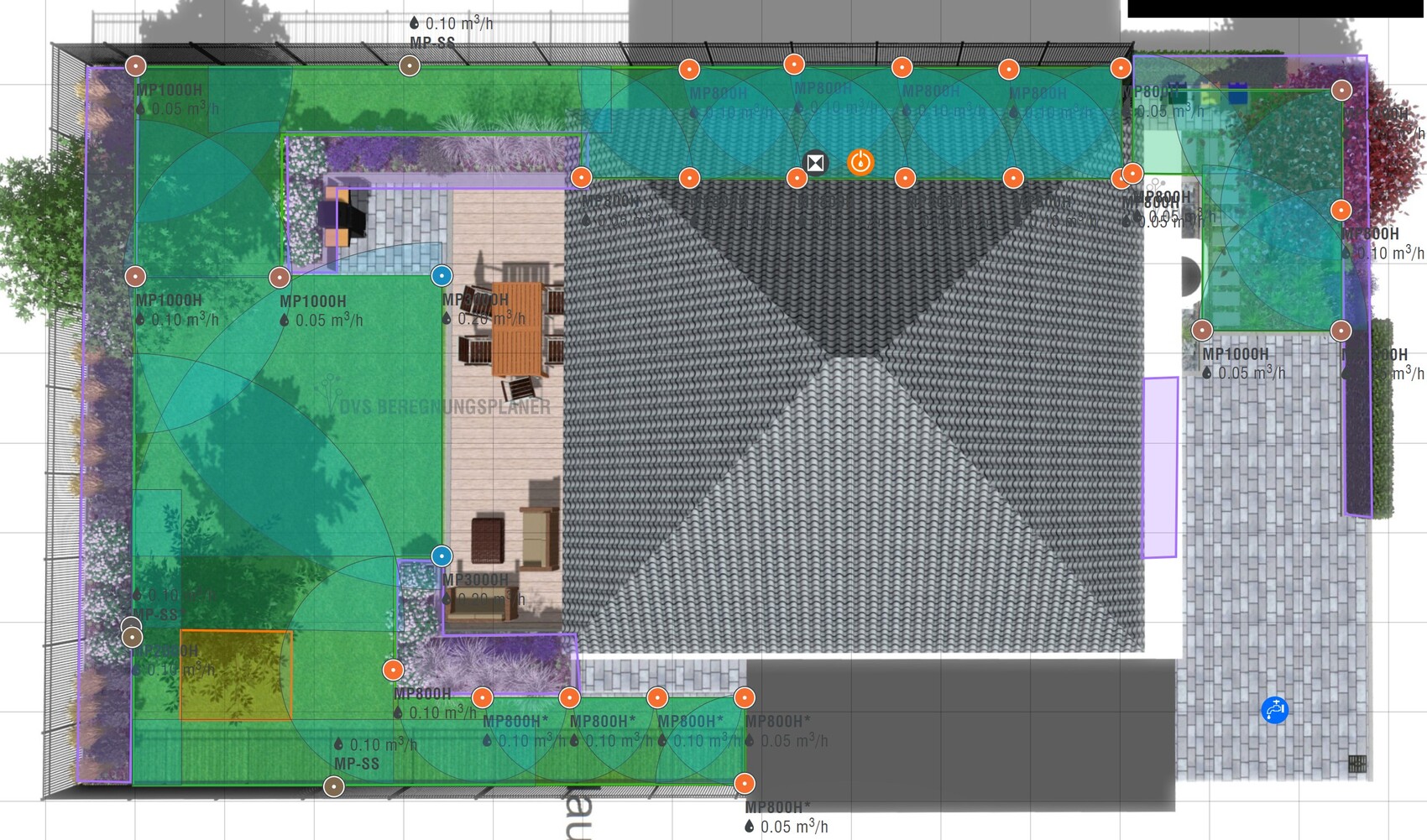
So, I have updated the plan and used the edge strip sprinklers to prevent the play tower from being watered or completely flooded.
I’m just not sure if this is the best solution. In theory, the sprinklers are designed for this purpose, but special solutions are always a bit tricky.
I also reduced the number of sprinklers in the lower area and now only water from one side. This does leave some small dry spots, but they are minimal.
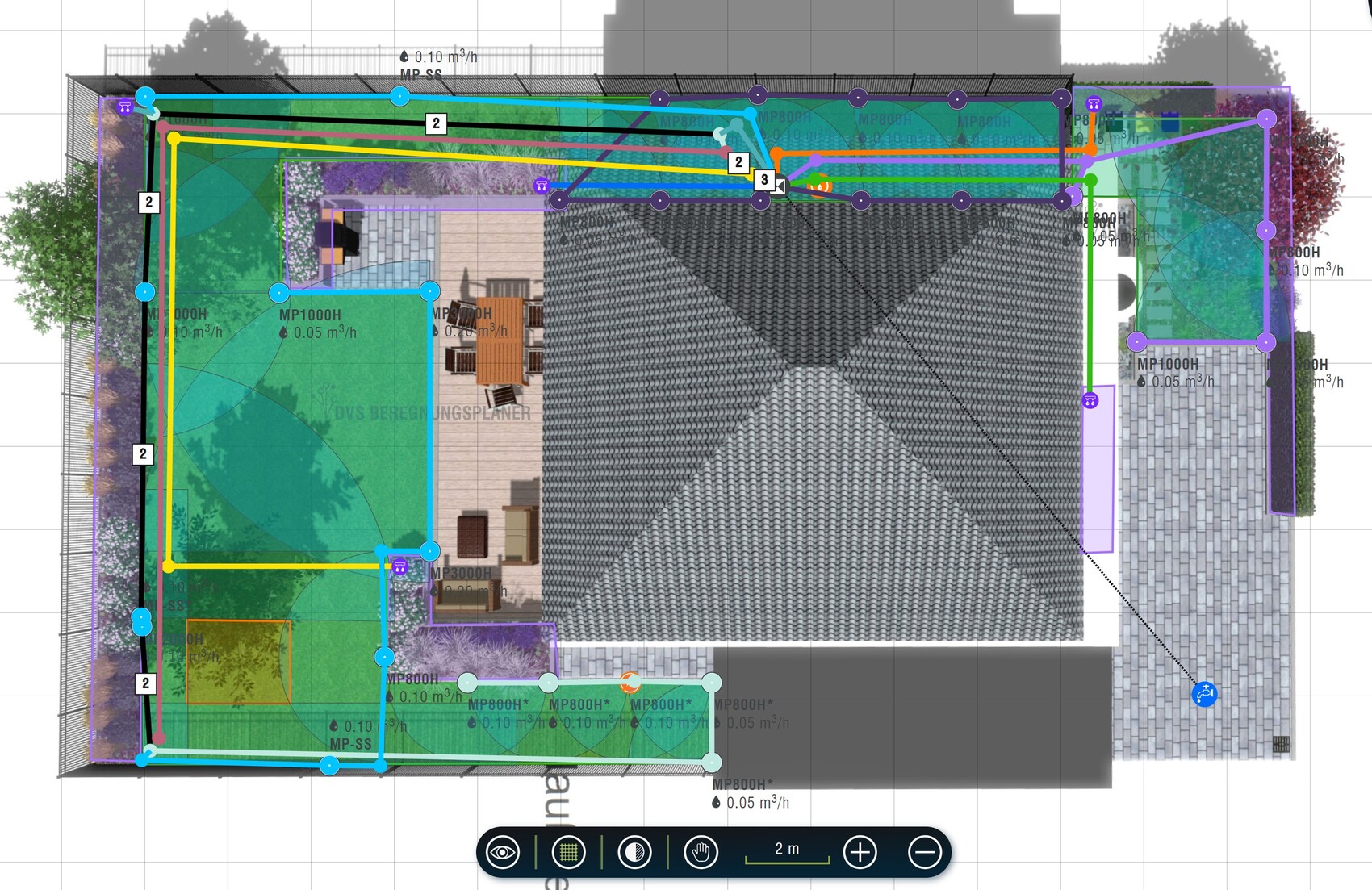
Currently, there are 10 zones since I water each bed separately. There are boxes for 10 valves, but then there is no room left if I want to expand. Hm…
And one more question about the filter box. Some recommend a filter box before the valves, but if I install a fine filter on the cistern pump float switch, that wouldn’t be necessary, right?
I’m just not sure if this is the best solution. In theory, the sprinklers are designed for this purpose, but special solutions are always a bit tricky.
I also reduced the number of sprinklers in the lower area and now only water from one side. This does leave some small dry spots, but they are minimal.
Currently, there are 10 zones since I water each bed separately. There are boxes for 10 valves, but then there is no room left if I want to expand. Hm…
And one more question about the filter box. Some recommend a filter box before the valves, but if I install a fine filter on the cistern pump float switch, that wouldn’t be necessary, right?

If your cistern pump has a fine filter, you don’t need an additional filter.
You could use two boxes, which results in shorter supply lines to the zones.
Expansion is always possible anyway. You can always connect another box behind the existing one.
You can safely use the strip sprinklers. They are proven to be reliable.
You could use two boxes, which results in shorter supply lines to the zones.
Expansion is always possible anyway. You can always connect another box behind the existing one.
You can safely use the strip sprinklers. They are proven to be reliable.
Thanks! I’m currently considering digging a pit and building walls to create space for a well, (filter), valves, meters, and other electronics. I could then install everything as a wall mount, and the robotic lawn mower would have space on top of the cover. I just need to figure out how to seal it properly so that the pipes can pass through, and the supply line would have to be a bit longer.
Do you have any experience with iron filters? Our water might have a high iron content, which causes unpleasant discoloration. So far, I haven’t found anything suitable.
Do you have any experience with iron filters? Our water might have a high iron content, which causes unpleasant discoloration. So far, I haven’t found anything suitable.
I thought you were referring more to iron particles. Backwash filters are good for that, just like in the house water supply line. They come with or without a pressure reducer. And even if it has one, you don’t have to use it.
The filter you mentioned is a pre-filter plus activated carbon.
The activated carbon gets used up quickly. It doesn’t make much sense.
Using an ion exchanger is possible but expensive.
Try to filter out the particles and leave the dissolved iron in the water.
The filter you mentioned is a pre-filter plus activated carbon.
The activated carbon gets used up quickly. It doesn’t make much sense.
Using an ion exchanger is possible but expensive.
Try to filter out the particles and leave the dissolved iron in the water.