
K
KlausBautHaus26 Sep 2023 09:32Hello everyone,
we are planning to get a garden shed and are currently working on the foundation. I have attached a picture of the shed as well as two sketches showing a top view and a cross-section of the foundation. Unlike in the picture, the second side of the extension will be closed. The shed and the beam underneath are made of spruce and will be painted.
For the foundation, we want to use six screw piles, each about 55cm (22 inches) long, which a structural engineer friend says should be sufficient for the load and wind forces of this approximately 700kg (1540 lbs) shed.
We plan to lay patio slabs as the floor, using a classic base layer of 20cm (8 inches) of gravel, 7cm (3 inches) of crushed stone, and then the slabs.
Around the shed, we want to put a gravel strip about 20cm (8 inches) wide as splash protection.
And now the exciting questions 🙂
1. Could the amount of gravel in the base be reduced since, for example, no water will get on the slabs thanks to the roof?
2. For cost reasons, I would like to avoid fixed edging (curbstones or aluminum strips) between the gravel strip and the surrounding soil. So the gravel and soil might mix a bit, but I don’t think that would be a big problem, right?
3. The patio slabs will be bounded by the beams. Where the extension is open at the front, I plan to use long curbstones, but I want to avoid embedding them in concrete as far as possible due to effort. I’ve read that they can also be stabilized well in soil or gravel without concrete. I hope this is true 🙂 I initially also thought about aluminum or stainless steel profiles, but those would have to be quite thick on top to avoid people cutting their feet if stepping on them... :\
4. The beams resting on the screw piles and supporting the shed will be in contact with the gravel. Is this okay or bad because of moisture? Otherwise, they could be raised about 1cm (0.4 inches) above the gravel so that the slabs still rest against them from the inside. Is that feasible or too fiddly?
Do you have any other interesting suggestions for me?
Thank you very much 🙂
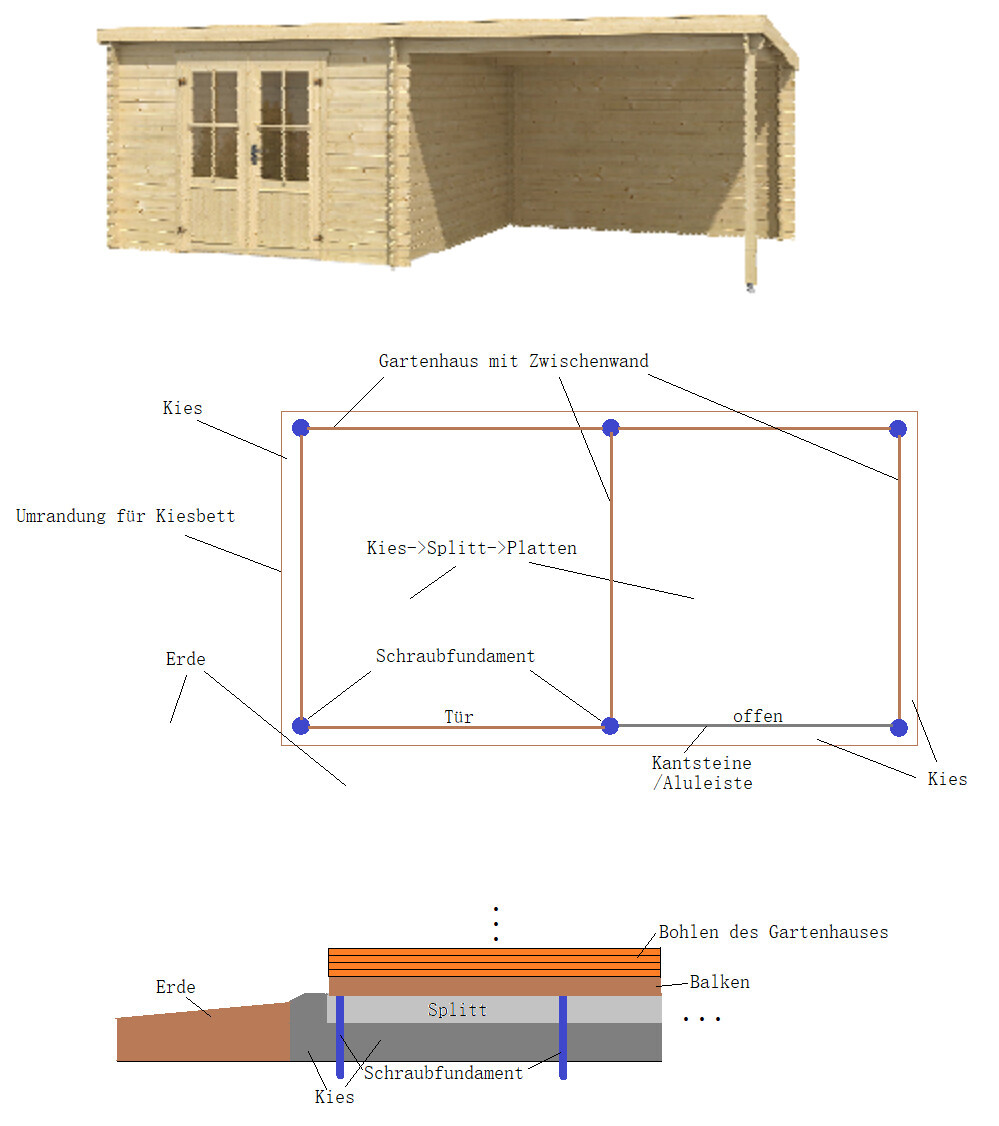
we are planning to get a garden shed and are currently working on the foundation. I have attached a picture of the shed as well as two sketches showing a top view and a cross-section of the foundation. Unlike in the picture, the second side of the extension will be closed. The shed and the beam underneath are made of spruce and will be painted.
For the foundation, we want to use six screw piles, each about 55cm (22 inches) long, which a structural engineer friend says should be sufficient for the load and wind forces of this approximately 700kg (1540 lbs) shed.
We plan to lay patio slabs as the floor, using a classic base layer of 20cm (8 inches) of gravel, 7cm (3 inches) of crushed stone, and then the slabs.
Around the shed, we want to put a gravel strip about 20cm (8 inches) wide as splash protection.
And now the exciting questions 🙂
1. Could the amount of gravel in the base be reduced since, for example, no water will get on the slabs thanks to the roof?
2. For cost reasons, I would like to avoid fixed edging (curbstones or aluminum strips) between the gravel strip and the surrounding soil. So the gravel and soil might mix a bit, but I don’t think that would be a big problem, right?
3. The patio slabs will be bounded by the beams. Where the extension is open at the front, I plan to use long curbstones, but I want to avoid embedding them in concrete as far as possible due to effort. I’ve read that they can also be stabilized well in soil or gravel without concrete. I hope this is true 🙂 I initially also thought about aluminum or stainless steel profiles, but those would have to be quite thick on top to avoid people cutting their feet if stepping on them... :\
4. The beams resting on the screw piles and supporting the shed will be in contact with the gravel. Is this okay or bad because of moisture? Otherwise, they could be raised about 1cm (0.4 inches) above the gravel so that the slabs still rest against them from the inside. Is that feasible or too fiddly?
Do you have any other interesting suggestions for me?
Thank you very much 🙂
W
WilderSueden26 Sep 2023 09:597cm (3 inches) of gravel seems like a lot to me. Usually, 3-5cm (1-2 inches) is used. It’s not entirely clear to me how you plan to combine screw foundations and slabs without conflicts at this point. According to the sketch, the beams also rest on the slabs, which means they will be exposed to moisture from below and rot. Painting alone is not enough. It would be more sensible to create a proper substructure with an air gap above the ground, and then install the flooring on top. In general, you should also expect that rainwater could flow over the slabs into the garden house.
Regarding your questions:
- I wouldn’t skimp on the substructure. 20cm (8 inches) is not much, and water can come from the sides as well. Especially in covered outdoor areas, it will rain more often.
- Gravel strips should always be bordered; otherwise, heavy rain will wash the strip away.
- You can stabilize edging stones in compacted crushed stone, but drainage gravel is typically 16-32mm (0.6-1.3 inches) and not easy to compact. In any case, you can hardly compact a narrow strip properly.
- See above.
Basically, your combination of screw foundations and slab flooring is neither fish nor fowl. If you’re already going through the trouble of installing slabs, you might as well make a proper slab foundation. Or, if using screw foundations, build a substructure and flooring that will float above the terrain.
PS: Under no circumstances use 28mm (1 inch) boards; it’s better to use 44-45mm (1.7-1.8 inches) planks with double tongue and groove.
Regarding your questions:
- I wouldn’t skimp on the substructure. 20cm (8 inches) is not much, and water can come from the sides as well. Especially in covered outdoor areas, it will rain more often.
- Gravel strips should always be bordered; otherwise, heavy rain will wash the strip away.
- You can stabilize edging stones in compacted crushed stone, but drainage gravel is typically 16-32mm (0.6-1.3 inches) and not easy to compact. In any case, you can hardly compact a narrow strip properly.
- See above.
Basically, your combination of screw foundations and slab flooring is neither fish nor fowl. If you’re already going through the trouble of installing slabs, you might as well make a proper slab foundation. Or, if using screw foundations, build a substructure and flooring that will float above the terrain.
PS: Under no circumstances use 28mm (1 inch) boards; it’s better to use 44-45mm (1.7-1.8 inches) planks with double tongue and groove.
Similar topics