
ᐅ Experience with garages built directly against the house wall?
Created on: 15 Jun 2024 03:43
P
prudi1986
Hello everyone,
we are in the process of planning our single-family house, and the construction is becoming more concrete. We plan to build the house using a timber frame construction method from a local supplier. It will be an urban villa with a roof overhang of 80 cm (31 inches). The plan is also to order a prefabricated garage from Rekers. So far, the garage is planned to be directly adjacent to the house wall, as shown in the drawing. This has the major advantage for us of optimal garden use on the east and south sides. The garage is positioned on the west side.
However, we are now unsure if this plan really makes sense, since when exiting the garage, you almost drive along the pathway to the front entrance. Additionally, we wanted to have a slightly larger step at the main entrance, but currently, I don’t know if that is still feasible. I have also read in several forums that there could be problems with waterproofing and settlement cracks in such a setup.
I would be very grateful if someone here has experience with this. In the end, it is our decision, but right now, it is difficult for me to visualize everything clearly.
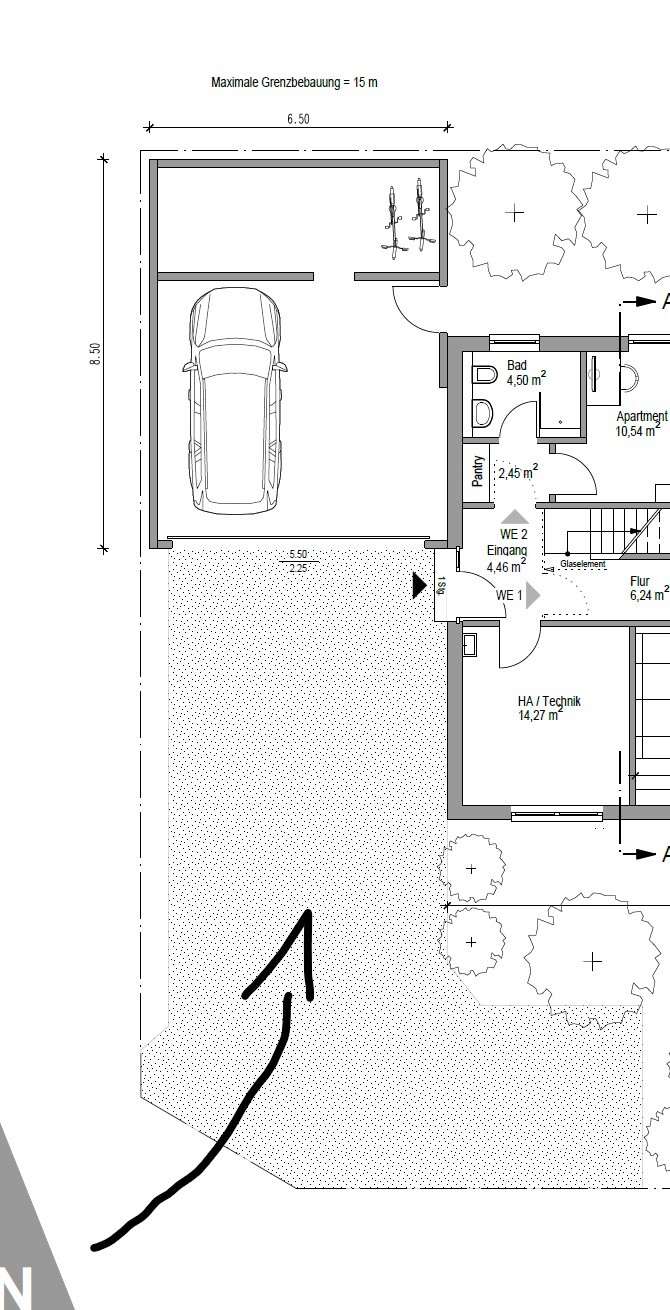
we are in the process of planning our single-family house, and the construction is becoming more concrete. We plan to build the house using a timber frame construction method from a local supplier. It will be an urban villa with a roof overhang of 80 cm (31 inches). The plan is also to order a prefabricated garage from Rekers. So far, the garage is planned to be directly adjacent to the house wall, as shown in the drawing. This has the major advantage for us of optimal garden use on the east and south sides. The garage is positioned on the west side.
However, we are now unsure if this plan really makes sense, since when exiting the garage, you almost drive along the pathway to the front entrance. Additionally, we wanted to have a slightly larger step at the main entrance, but currently, I don’t know if that is still feasible. I have also read in several forums that there could be problems with waterproofing and settlement cracks in such a setup.
I would be very grateful if someone here has experience with this. In the end, it is our decision, but right now, it is difficult for me to visualize everything clearly.
P
prudi198615 Jun 2024 13:50kbt09 schrieb:
If the intention is to store bicycles in the upper part of the plan, this should be carefully checked, including the access route to this storage area when there are two cars parked.
The exterior length is 850 cm (8.5 meters / 281.5 inches), so the interior length is probably a maximum of 800 cm (8 meters / 315 inches). For modern cars, you should plan for about 600 cm (6 meters / 236 inches) to have enough space to move around. Then only a narrow entrance to the bicycle storage area remains, so it’s worth testing how best to manage this. Hello,
thank you very much for your reply.
The garage is 650 cm (6.5 meters / 256 inches) wide. My wife drives a small car. In my opinion, that should be sufficient.
prudi1986 schrieb:
I don’t know the depth of the landing yet because it’s still hard to imagine everything.Then take a walk through a residential area and see what kind of landings people have. If you ask nicely, you might be allowed to take a closer look at some of the landings. Afterwards, have your desired landing drawn into the plan with the exact measurements. That way, you can see if it fits.prudi1986 schrieb:
The garage is 650 mm (25.6 inches) wide. My wife drives a small car. In my opinion, that should be sufficient.Just draw the second car to scale and consider how to get through the garage door (the first car is also important here). Then simulate the path between the cars to the door, and afterward, the parking of the bicycles. It needs to be practical and quick; otherwise, the bikes will end up everywhere except in the extension.A
Allthewayup23 Jun 2024 23:32We have already implemented something similar, just a bit smaller. By now, I would recommend building the garage with its own walls instead of extending the house’s floor slab through it. It’s better to consider the garage and the house as separate structures. Although this is somewhat more expensive, it has several advantages:
Sound decoupling – impact noise (garage door opening/closing isn’t heard inside the house)
Settlement cracks between house and garage are avoided
Energy loss (although minimal) through thermal bridging (even with thermal break connectors) is prevented
We don’t have a doorstep in front of the main entrance because we built it to be barrier-free. The driveway is only just under 4 m (13 feet) wide. In the old house, we had six steps up to the ground floor, and the bottom step was already quite worn from frequent contact with tires, etc. The driveway there was about 5 m (16 feet) wide. When parked too close, the door’s swing area was dangerously close to the steps.
Sound decoupling – impact noise (garage door opening/closing isn’t heard inside the house)
Settlement cracks between house and garage are avoided
Energy loss (although minimal) through thermal bridging (even with thermal break connectors) is prevented
We don’t have a doorstep in front of the main entrance because we built it to be barrier-free. The driveway is only just under 4 m (13 feet) wide. In the old house, we had six steps up to the ground floor, and the bottom step was already quite worn from frequent contact with tires, etc. The driveway there was about 5 m (16 feet) wide. When parked too close, the door’s swing area was dangerously close to the steps.
Similar topics