

Hello everyone,
Great forum here, I’ve already read quite a bit! I will post an introduction thread soon, I just need to get my bearings with all the great contributions!
I would like to gather some additional opinions on how best to design my floor structure.
The planned building is a storage room of nearly 110m² (1,184 sq ft)!
The footprint is rectangular, measuring 13.5m x 8.5m (44 ft x 28 ft)!
It will be used for storing vehicles and trailers, and it will be heated!
The existing structure will be demolished in the coming weeks, and the required area cleared. We have a high groundwater level; after digging 1.5m (5 ft), groundwater appears.
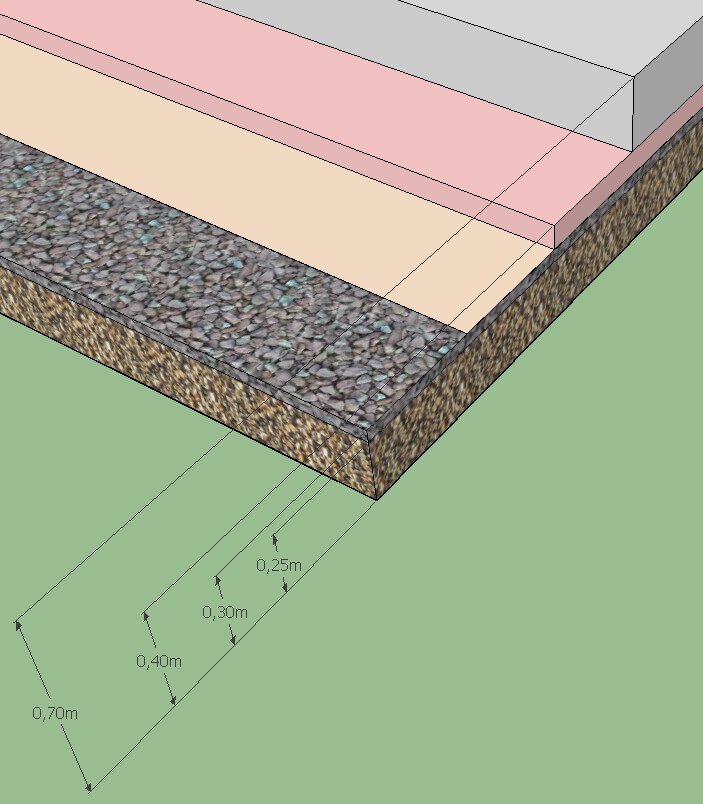
My current idea: I will excavate the entire area down to -70cm (-28 inches) level. The first 30cm (12 inches) will be filled with 0-63mm (0-2.5 inch) rolled gravel. On top, a finer, water-permeable layer with 0-32mm (0-1.25 inch) crushed stone will be applied. Then, I plan to lay a PE foil, and cover the entire area with 10cm (4 inches) XPS foam insulation boards. Above that, a 30cm (12 inches) thick concrete slab will be poured, which I will order as high-quality ready-mix concrete depending on your recommendations, possibly as a waterproof (WU) concrete slab if advised.
Here is the sketch:
I would appreciate your tips and experience regarding the slab under a storage hall / storage room!
On the slab, a vapor barrier using aluminum-laminated bitumen membrane will be installed against the wall; I plan to build the walls with 30cm (12 inches) concrete block formwork stone. The walls will be about 360cm (12 ft) high all around and insulated externally with 8cm (3 inches) rigid XPS foam boards. On top, there will be a foamed trapezoidal sheet metal roof weighing approximately 16kg/m² (3.3 lb/sq ft).
This is my current plan; the submission drawing has already been approved by the builder and is currently with the local authority for review before the building permit/planning permission hearing.
I need your experience regarding the floor construction!
Specifically, I am interested in the following:
Installation of underfloor heating – does the 120m² (1,292 sq ft) slab need to be equipped with expansion joints? If so, what are the requirements?
A 30cm (12 inches) concrete slab reinforced with double AQ50 steel mesh, or should I order fiber-reinforced concrete instead?
Is the floor assembly I proposed detailed enough, or is it undersized?
Thank you very much for your ideas,
best regards from Austria,
Robert
Great forum here, I’ve already read quite a bit! I will post an introduction thread soon, I just need to get my bearings with all the great contributions!
I would like to gather some additional opinions on how best to design my floor structure.
The planned building is a storage room of nearly 110m² (1,184 sq ft)!
The footprint is rectangular, measuring 13.5m x 8.5m (44 ft x 28 ft)!
It will be used for storing vehicles and trailers, and it will be heated!
The existing structure will be demolished in the coming weeks, and the required area cleared. We have a high groundwater level; after digging 1.5m (5 ft), groundwater appears.
My current idea: I will excavate the entire area down to -70cm (-28 inches) level. The first 30cm (12 inches) will be filled with 0-63mm (0-2.5 inch) rolled gravel. On top, a finer, water-permeable layer with 0-32mm (0-1.25 inch) crushed stone will be applied. Then, I plan to lay a PE foil, and cover the entire area with 10cm (4 inches) XPS foam insulation boards. Above that, a 30cm (12 inches) thick concrete slab will be poured, which I will order as high-quality ready-mix concrete depending on your recommendations, possibly as a waterproof (WU) concrete slab if advised.
Here is the sketch:
I would appreciate your tips and experience regarding the slab under a storage hall / storage room!
On the slab, a vapor barrier using aluminum-laminated bitumen membrane will be installed against the wall; I plan to build the walls with 30cm (12 inches) concrete block formwork stone. The walls will be about 360cm (12 ft) high all around and insulated externally with 8cm (3 inches) rigid XPS foam boards. On top, there will be a foamed trapezoidal sheet metal roof weighing approximately 16kg/m² (3.3 lb/sq ft).
This is my current plan; the submission drawing has already been approved by the builder and is currently with the local authority for review before the building permit/planning permission hearing.
I need your experience regarding the floor construction!
Specifically, I am interested in the following:
Installation of underfloor heating – does the 120m² (1,292 sq ft) slab need to be equipped with expansion joints? If so, what are the requirements?
A 30cm (12 inches) concrete slab reinforced with double AQ50 steel mesh, or should I order fiber-reinforced concrete instead?
Is the floor assembly I proposed detailed enough, or is it undersized?
Thank you very much for your ideas,
best regards from Austria,
Robert
B
Bieber081530 Sep 2016 06:28Your questions cannot be answered by non-experts, and this forum is mainly for and by non-experts. You really need a structural engineer or architect ...
I just wonder why anyone would want to heat a garage... classic cars? Luxury vehicles? A normal garage for regular cars that are used normally is better ventilated, not heated. I'm sure you know that.
I just wonder why anyone would want to heat a garage... classic cars? Luxury vehicles? A normal garage for regular cars that are used normally is better ventilated, not heated. I'm sure you know that.


Hi,
A heated screed area should not exceed 40 sqm (430 sq ft); beyond that, expansion joints are required.
A structural engineer must calculate the slab anyway. In industrial buildings, fiber-reinforced concrete is used a lot. However, it has the drawback that for supporting high point loads (roof columns, vehicle lifts, steel platforms for storage, etc.), you still need foundations integrated into the slab. In other words, you have to plan in advance where you want what, and then reinforce the slab accordingly. Without reinforcement, it usually only supports point loads of 15-20 kN, which is not sufficient for many applications.
The question of why one would want to heat a garage, however, is not unreasonable. If you occasionally want to work inside, I would recommend using those overhead water-to-air heat exchangers mounted on the ceiling. Also, section off the workspace and only heat that area as needed. Installing underfloor heating throughout the entire garage is quite over the top for this purpose.
Best regards,
Andreas
A heated screed area should not exceed 40 sqm (430 sq ft); beyond that, expansion joints are required.
A structural engineer must calculate the slab anyway. In industrial buildings, fiber-reinforced concrete is used a lot. However, it has the drawback that for supporting high point loads (roof columns, vehicle lifts, steel platforms for storage, etc.), you still need foundations integrated into the slab. In other words, you have to plan in advance where you want what, and then reinforce the slab accordingly. Without reinforcement, it usually only supports point loads of 15-20 kN, which is not sufficient for many applications.
The question of why one would want to heat a garage, however, is not unreasonable. If you occasionally want to work inside, I would recommend using those overhead water-to-air heat exchangers mounted on the ceiling. Also, section off the workspace and only heat that area as needed. Installing underfloor heating throughout the entire garage is quite over the top for this purpose.
Best regards,
Andreas
I’m not sure how it works in Austria, but as far as I know, a building designated and approved as a garage is not allowed to be used as a workshop or similar. In that case, additional requirements would need to be met.
And if a garage is fully heated, questions regarding its usage are likely to arise.
And if a garage is fully heated, questions regarding its usage are likely to arise.
Similar topics