
Hello everyone,
I have been a silent reader for quite some time. Thanks to this excellent forum, I have already found answers to some questions and gathered useful information.
Now the time has come that I have a few questions of my own.
To keep it brief, I will try to describe my problem as concisely as possible.
Since we built our house with a prefabricated house provider, the architect’s services naturally included only the house itself and the preparation of the building permit/planning permission application.
What we still lacked were the structural calculations and plans for the garage.
Unfortunately, as it turned out during the garage construction, we assigned these externally to the wrong party.
Due to a misunderstanding and difficult communication with the structural engineer, it was no longer possible during the pouring of the floor slab to form the recess for the connection to the driveway/the adjoining paving.
To avoid making this post too long, I will leave out this part for now. I can add more details later if relevant.*
On site, it might have been possible to “cut out” the already embedded reinforcing cages* at the required spot, but the shell builder declined to do so.
So the floor slab was constructed without a recess.
The connection/transition to the paving/driveway is exactly the problem now. As I have read here, some others face a similar problem.
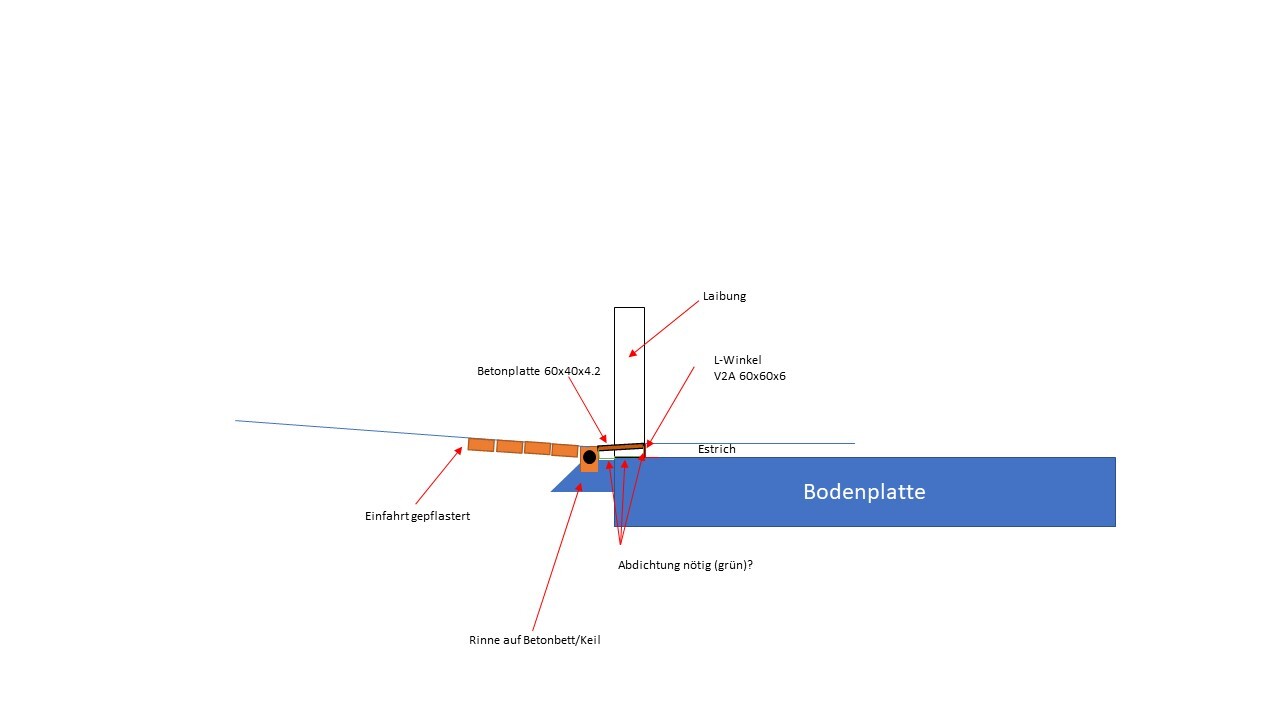
The driveway is already paved. A drainage channel is installed a few centimeters in front of the floor slab. For the height of the driveway/channel at this point, a floor build-up in the garage of 6cm (2.4 inches) screed (bonded screed without slope) was assumed. Due to the height requirements, the driveway already has a slope towards the garage. The channel is positioned so that there is a slight slope from the garage to the channel, regardless of how the transition will be solved.
Here is a list of possible solutions I have found so far (some partly from this forum):
- Extend the screed to the outer edge of the garage / lay granite slabs / cut paving stones in half and lay them in mortar (high effort) / fill with epoxy mortar / cover with metal sheet (of course fill the gap) / cut out the floor slab in this area (including reinforcement, very high effort)
Our preferred option (if possible, so I will go into more detail here):
Now some questions arise regarding this option:
Sorry for the long text. We just want to solve this as well as possible now.
Is this solution feasible considering some factors and correct execution?
For better understanding, I have attached a rough sketch.
I don’t want to extend this already very long text any further – but surely more questions will arise, also regarding screed, stainless steel angle, etc.
I look forward to your responses.
Many thanks in advance.
Best regards,
Paddy
I have been a silent reader for quite some time. Thanks to this excellent forum, I have already found answers to some questions and gathered useful information.
Now the time has come that I have a few questions of my own.
To keep it brief, I will try to describe my problem as concisely as possible.
Since we built our house with a prefabricated house provider, the architect’s services naturally included only the house itself and the preparation of the building permit/planning permission application.
What we still lacked were the structural calculations and plans for the garage.
Unfortunately, as it turned out during the garage construction, we assigned these externally to the wrong party.
Due to a misunderstanding and difficult communication with the structural engineer, it was no longer possible during the pouring of the floor slab to form the recess for the connection to the driveway/the adjoining paving.
To avoid making this post too long, I will leave out this part for now. I can add more details later if relevant.*
On site, it might have been possible to “cut out” the already embedded reinforcing cages* at the required spot, but the shell builder declined to do so.
So the floor slab was constructed without a recess.
The connection/transition to the paving/driveway is exactly the problem now. As I have read here, some others face a similar problem.
The driveway is already paved. A drainage channel is installed a few centimeters in front of the floor slab. For the height of the driveway/channel at this point, a floor build-up in the garage of 6cm (2.4 inches) screed (bonded screed without slope) was assumed. Due to the height requirements, the driveway already has a slope towards the garage. The channel is positioned so that there is a slight slope from the garage to the channel, regardless of how the transition will be solved.
Here is a list of possible solutions I have found so far (some partly from this forum):
- Extend the screed to the outer edge of the garage / lay granite slabs / cut paving stones in half and lay them in mortar (high effort) / fill with epoxy mortar / cover with metal sheet (of course fill the gap) / cut out the floor slab in this area (including reinforcement, very high effort)
Our preferred option (if possible, so I will go into more detail here):
- We still have concrete slabs (60 x 40 x 4cm (24 x 16 x 1.6 inches)) left from our terrace; these have the same color tone as our block steps and would fit the overall design aesthetically (a matter of taste).
- These would then be laid firmly bonded in mortar, just like the paving (except that the complex cutting in half would not be needed here), with appropriate joints (between the slabs, channel, and metal angle)
Now some questions arise regarding this option:
- If these slabs are laid firmly bonded on frost-resistant mortar or flexible adhesive (approx. 1–1.5cm (0.4–0.6 inches)), there would be air between the slabs and the floor slab underneath. Would they then have a chance for sufficient durability, etc.?
- Our mason friend says a “tray” should be created beforehand, meaning a mineral-based sealing from the channel up to the metal angle, and the slabs would be laid on this sealing. This would prevent the slabs from loosening due to water penetration. Does this sealing help? What exactly does it achieve? I mean, if I don’t grout the slabs waterproof (which would be possible due to the slight slope towards the channel), water would penetrate to the sealing and then probably remain “mostly” beneath the slabs?
- Do I have to seal the metal angle at all? Isn’t cement screed generally “unaffected” by water? Does water at the joint between the floor slab and screed actually occur? It is clear that the edge areas must be sealed and the screed surface treated (epoxy, concrete paint, tiles, etc.).
Sorry for the long text. We just want to solve this as well as possible now.
Is this solution feasible considering some factors and correct execution?
For better understanding, I have attached a rough sketch.
I don’t want to extend this already very long text any further – but surely more questions will arise, also regarding screed, stainless steel angle, etc.
I look forward to your responses.
Many thanks in advance.
Best regards,
Paddy
Similar topics