
W
Wassermann20 Feb 2022 19:55Good evening everyone,
I don’t have enough knowledge about foundations and groundworks to properly assess my situation.
The soil report states the following:
- Clay
- Good load-bearing capacity
- Poor permeability
- High frost susceptibility
Now regarding the different foundation options from the soil report:
1. Frost skirt AND bedding
The frost skirt (with slab) extends down to 1 meter (3.3 feet), and the bedding under the slab should be at least 70 cm (28 inches) of frost protection material.
2. Strip footings AND bedding
At least 1.2 meters (4 feet) deep (with slab). Bedding under the slab only 20 cm (8 inches).
My groundworks contractor proposes a third option, which has also been approved structurally:
3. Bedding only
Exclusive use of frost protection material under the slab to achieve a 1 meter (3.3 feet) deep foundation.
According to the structural engineer, a plate load test is required. This is not needed for options 1 and 2. He wants this test if the bedding is deeper than 0.9 meters (3 feet).
Now I’m a bit unsure which option is actually the most sensible.
All approaches seem possible and technically sound.
Could you help me understand the pros and cons of each?
Of course, I’m talking to the tradespeople, but independent opinions from you are usually more honest 🙂
Thanks!
I don’t have enough knowledge about foundations and groundworks to properly assess my situation.
The soil report states the following:
- Clay
- Good load-bearing capacity
- Poor permeability
- High frost susceptibility
Now regarding the different foundation options from the soil report:
1. Frost skirt AND bedding
The frost skirt (with slab) extends down to 1 meter (3.3 feet), and the bedding under the slab should be at least 70 cm (28 inches) of frost protection material.
2. Strip footings AND bedding
At least 1.2 meters (4 feet) deep (with slab). Bedding under the slab only 20 cm (8 inches).
My groundworks contractor proposes a third option, which has also been approved structurally:
3. Bedding only
Exclusive use of frost protection material under the slab to achieve a 1 meter (3.3 feet) deep foundation.
According to the structural engineer, a plate load test is required. This is not needed for options 1 and 2. He wants this test if the bedding is deeper than 0.9 meters (3 feet).
Now I’m a bit unsure which option is actually the most sensible.
All approaches seem possible and technically sound.
Could you help me understand the pros and cons of each?
Of course, I’m talking to the tradespeople, but independent opinions from you are usually more honest 🙂
Thanks!
W
WilderSueden20 Feb 2022 20:17The basic situation sounds similar to mine. Our soil is clayey, relatively waterproof (kf = 10^-7), and classified as F3. My foundation was laid only on gravel, but the insulation projects well beyond the concrete slab, thus forming a frost protection skirt:
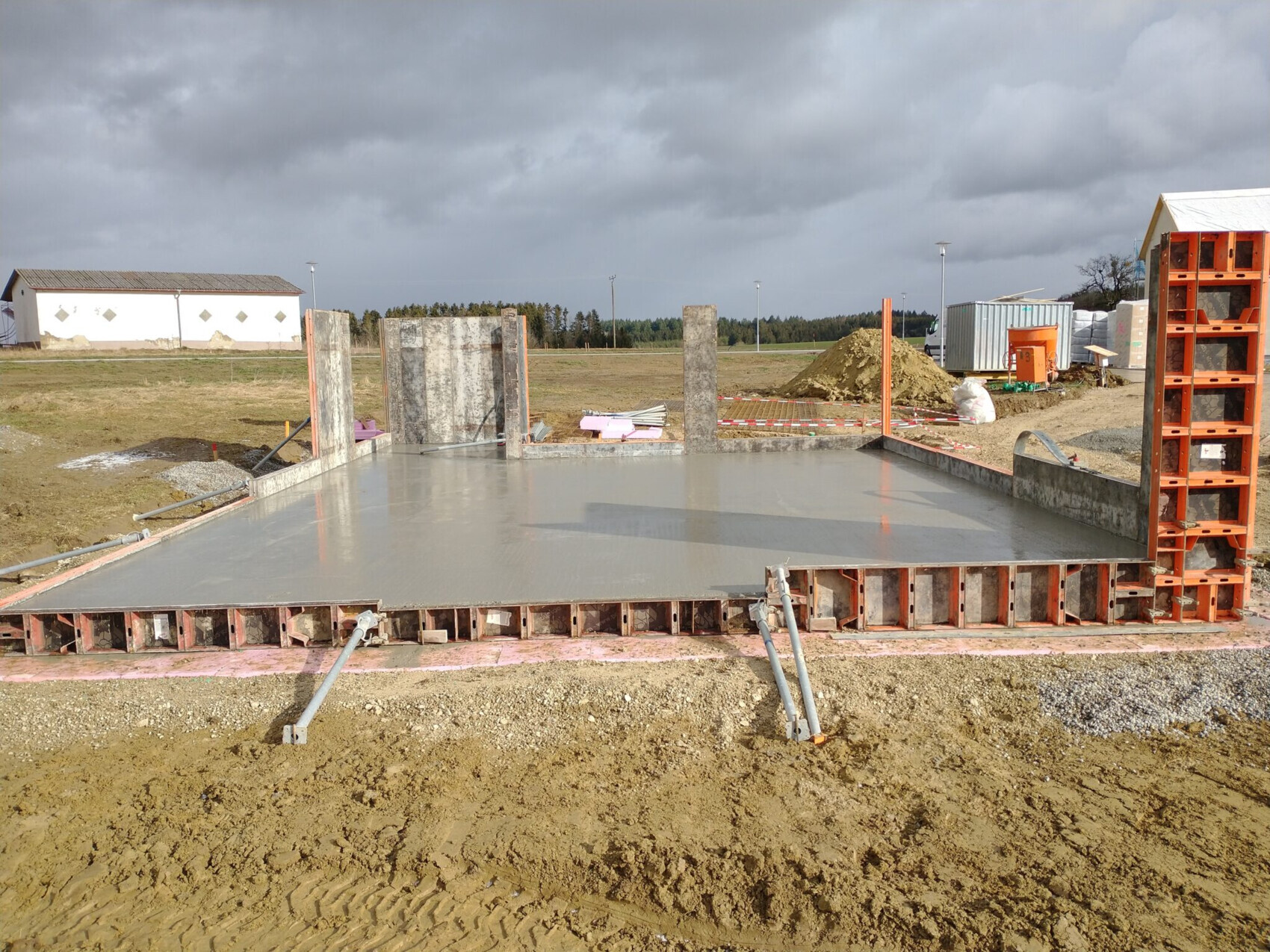
Beneath it is a standard layer of gravel, certainly not 70cm (28 inches) but more like knee-high at most. That’s why the proposed measures seem somewhat excessive to me.
Beneath it is a standard layer of gravel, certainly not 70cm (28 inches) but more like knee-high at most. That’s why the proposed measures seem somewhat excessive to me.
W
Wassermann20 Feb 2022 20:28Very similar to my situation: kf < 10(-8) m/s
Yes, I also have the impression that there is some redundancy here.
Hmm, maybe a professional has an opinion on this?
Yes, I also have the impression that there is some redundancy here.
Hmm, maybe a professional has an opinion on this?
Hello,
Option 1:
For the building’s stability, a base layer of 70 cm (28 inches) is required. The frost protection skirt (also known as a frost barrier) serves only to prevent frost damage and has no load-bearing function. Using frost protection material here is not wrong, but other well-compacted materials (e.g., construction debris RC 00/32 or 00/45) are, if permitted, more cost-effective and, in my opinion, better.
Option 2:
The foundation and load transfer are carried out via strip footings. These were designed by the structural engineer and must extend at least 1 m (39 inches) deep to also ensure frost protection. The 20 cm (8 inches) base layer serves only as a capillary-breaking layer.
This option removes the least amount of soil.
Option 3:
Instead of a frost protection skirt, frost-resistant material is used down to 1 m (39 inches) depth. According to option 1, 70 cm (28 inches) would be sufficient structurally. This means an additional 30 cm (12 inches) of safety in terms of foundation.
In my opinion, all three options are feasible without concerns. The responsible geotechnical expert would probably confirm this on request. Option 3 is likely the easiest, as the earthworks contractor can complete everything in one step and does not need to excavate separate skirts later.
Regards
Option 1:
For the building’s stability, a base layer of 70 cm (28 inches) is required. The frost protection skirt (also known as a frost barrier) serves only to prevent frost damage and has no load-bearing function. Using frost protection material here is not wrong, but other well-compacted materials (e.g., construction debris RC 00/32 or 00/45) are, if permitted, more cost-effective and, in my opinion, better.
Option 2:
The foundation and load transfer are carried out via strip footings. These were designed by the structural engineer and must extend at least 1 m (39 inches) deep to also ensure frost protection. The 20 cm (8 inches) base layer serves only as a capillary-breaking layer.
This option removes the least amount of soil.
Option 3:
Instead of a frost protection skirt, frost-resistant material is used down to 1 m (39 inches) depth. According to option 1, 70 cm (28 inches) would be sufficient structurally. This means an additional 30 cm (12 inches) of safety in terms of foundation.
In my opinion, all three options are feasible without concerns. The responsible geotechnical expert would probably confirm this on request. Option 3 is likely the easiest, as the earthworks contractor can complete everything in one step and does not need to excavate separate skirts later.
Regards
X
xMisterDx7 May 2022 13:34We had a similar recommendation with a foundation cushion as an option, but I definitely wanted a strip foundation...
With the cushion, you have gravel under the house, which is probably wrapped in some kind of geotextile. Who guarantees that the gravel will stay in place over the years?
You also have to be extremely careful with earthworks near the house, and so on.
I never quite understand why people want to save money on the foundation.
With the cushion, you have gravel under the house, which is probably wrapped in some kind of geotextile. Who guarantees that the gravel will stay in place over the years?
You also have to be extremely careful with earthworks near the house, and so on.
I never quite understand why people want to save money on the foundation.
Saving money on the foundation is not a bad thing. If I have three options that all work, I can compare the costs to find the most affordable one. There are so many factors influencing this that you can never say in general which option is the best and cheapest for the construction project.
It starts with the excavation. What is the soil like at my building site (soil surveyor)? Can I keep the soil on my property, or does it need to be removed? Is it contaminated? How much does the fill material cost (gravel/recycled material/frost protection)?
How much do concrete and steel cost for strip foundations?
What is the labor effort for each option?
Everything should be calculated, and then you usually see differences in the costs.
Of course, you shouldn’t save in the wrong places. For example, if the neighbor says he only installed gravel up to knee height, that doesn’t necessarily mean the same will work for all other houses. Every soil condition is unique!
Personally, I have no problem with foundations on a gravel base. Where else would the material go? If it’s wrapped in geotextile, it is usually only used on soft clay soils to provide extra stability. Otherwise, the area is backfilled with soil.
It starts with the excavation. What is the soil like at my building site (soil surveyor)? Can I keep the soil on my property, or does it need to be removed? Is it contaminated? How much does the fill material cost (gravel/recycled material/frost protection)?
How much do concrete and steel cost for strip foundations?
What is the labor effort for each option?
Everything should be calculated, and then you usually see differences in the costs.
Of course, you shouldn’t save in the wrong places. For example, if the neighbor says he only installed gravel up to knee height, that doesn’t necessarily mean the same will work for all other houses. Every soil condition is unique!
Personally, I have no problem with foundations on a gravel base. Where else would the material go? If it’s wrapped in geotextile, it is usually only used on soft clay soils to provide extra stability. Otherwise, the area is backfilled with soil.
Similar topics