
K
KarstenausNRW27 Oct 2023 13:08Manufacturers of heat pumps recommend a supply temperature of around 20°C (68°F) for the cooling function. At an air temperature of 25°C (77°F) and a relative humidity of 70%, the dew point is reached only at a temperature of 19°C (66°F). On average, the indoor relative humidity settles between 50% and 55%, so the dew point is not undershot.
The upper humidity limit of 65% should not be exceeded according to EN 814 T1 - T3 and DIN 1946.
Cooling via surface systems is part of a gentle tempering system, enabled by today’s excellent thermal insulation standards. High-quality thermal insulation and a floor heating system adapted for the additional cooling function ensure proper operation. When using surface systems for cooling, it is important to limit surface temperatures or water temperatures to avoid condensation. One option is to specify a minimum supply temperature. For floor heating systems, the minimum supply temperature should not be set below 18°C (64°F). In practice, for residential buildings during cooling operation, supply temperatures between 18°C and 20°C (64°F and 68°F) and return temperatures between 21°C and 23°C (70°F and 73°F) are typical.
Regarding dew point monitors—have you had any installed? This allows for a more "active" management of temperature.
The upper humidity limit of 65% should not be exceeded according to EN 814 T1 - T3 and DIN 1946.
Cooling via surface systems is part of a gentle tempering system, enabled by today’s excellent thermal insulation standards. High-quality thermal insulation and a floor heating system adapted for the additional cooling function ensure proper operation. When using surface systems for cooling, it is important to limit surface temperatures or water temperatures to avoid condensation. One option is to specify a minimum supply temperature. For floor heating systems, the minimum supply temperature should not be set below 18°C (64°F). In practice, for residential buildings during cooling operation, supply temperatures between 18°C and 20°C (64°F and 68°F) and return temperatures between 21°C and 23°C (70°F and 73°F) are typical.
Regarding dew point monitors—have you had any installed? This allows for a more "active" management of temperature.
@KarstenausNRW
Thank you for the response!
1) In my manual, an illustration shows a supply temperature of 8°; see image. (It is an Ecoforest Ecogeo Compact C3 3-12KW HTR EH)
2) For the dew point temperature of 19°, which must not be fallen below, is the supply temperature or the floor temperature decisive? In other words: Is it allowed for the supply temperature to be below 19° as long as the floor temperature is above 19°?
3) Can I tell by looking at the floor if the dew point has been undershot?
4) Regarding dew point monitors, I found the following in the manual; see image
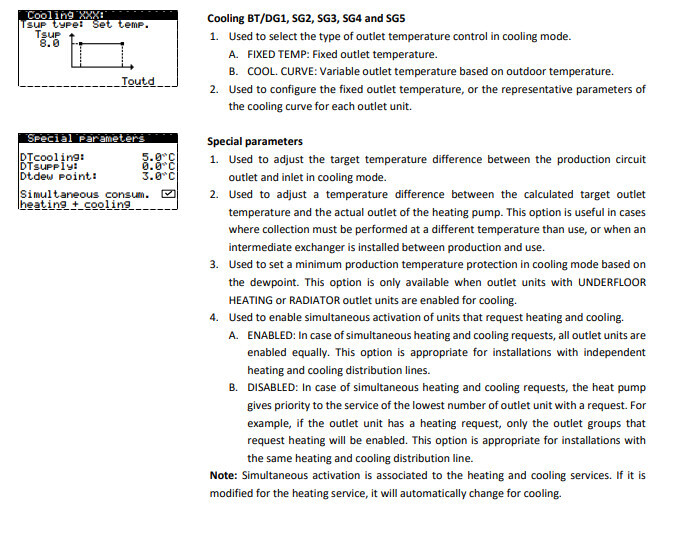
Thank you for the response!
1) In my manual, an illustration shows a supply temperature of 8°; see image. (It is an Ecoforest Ecogeo Compact C3 3-12KW HTR EH)
2) For the dew point temperature of 19°, which must not be fallen below, is the supply temperature or the floor temperature decisive? In other words: Is it allowed for the supply temperature to be below 19° as long as the floor temperature is above 19°?
3) Can I tell by looking at the floor if the dew point has been undershot?
4) Regarding dew point monitors, I found the following in the manual; see image
K
KarstenausNRW27 Oct 2023 13:54jx7 schrieb:
1) In my manual, there is an illustration showing a supply temperature of 8°; see the picture. (It is an Ecoforest Ecogeo Compact C3 3-12KW HTR EH) Take a bottle of beer out of the fridge in the middle of summer. Then you’ll understand what happens on and inside your floor.
jx7 schrieb:
2) For the dew point temperature of 19°, which must not be fallen below, is the supply temperature critical or the floor temperature? In other words: Is it allowed for the supply temperature to be below 19° as long as the floor temperature is above 19°? First of all, the floor temperature, since the moisture coming from the indoor air settles on or in the floor. In the end, it will be more or less the same, as the floor temperature tends to approach the supply temperature.
jx7 schrieb:
3) Will I notice on the floor if the dew point is undercut? No. It’s similar to old buildings. You only see the damp walls once there is mold or plaster crumbling off the walls in the basement.
jx7 schrieb:
4) Regarding the dew point monitor, I found the following in the manual; see the picture I’m not familiar with that. Were suitable sensors installed? Where is the measurement taken—only on the supply line or properly in the screed? How many sensors were installed?
From what I know from practical use in other unmentionable discussion groups (Geisha discussions), no user sets the supply temperature below 18 degrees. Generally, 18 to 20 degrees is used, without condensation issues. BUT: Many users then complain of “unpleasant” air, because although the rooms are cooled, the relative humidity rises significantly. So it’s basically like a cool sauna. Dehumidification is only possible with an air conditioner.
Personally, I ran 20 degrees in summer once but turned off the cooling again fairly quickly, since the summer didn’t really happen enough this year to justify it. There was enough electricity from photovoltaics. But since I also have wood flooring everywhere, I didn’t want to go any lower.
No dew point monitor is installed.
Similar topics