
J
Joachim7322 Nov 2015 18:38Hello!
We have the following problem and need some help: A year ago, we had the pitched roof of our house insulated by a professional roofing company. Now, condensation has repeatedly formed on the vapor barrier. Since nothing changed, not even when we adjusted the ventilation habits, I finally cut open the vapor barrier at one spot: A cold draft came towards me. In some places, there were gaps between the insulation boards; in others, the boards were compressed between the rafters (probably cut too large). A roofing underlayment, although listed on the invoice (and paid for by me), was not present. You could see the roof tiles through the gaps.
So the question is: What should be done? I’m an amateur, but I suspect that gaps and compression in the insulation boards are not okay. Does this need to be corrected? Or is it enough to spray insulating foam into the gaps and then reseal the vapor barrier?
And: How important is the roofing underlayment? That is, is it sufficient to request a refund from the roofing company for the amount charged but not installed? Or should something be done structurally?
Drywall and painting work are now nearly completed throughout, and the rooms are inhabited. If the underlayment is necessary, could it be installed from the outside of the roof? The roof area is about 74 sq m (800 sq ft).
I find the whole situation surprising because the master roofer company that also did the insulation work is considered very reputable.
Thanks in advance to everyone for your answers.
We have the following problem and need some help: A year ago, we had the pitched roof of our house insulated by a professional roofing company. Now, condensation has repeatedly formed on the vapor barrier. Since nothing changed, not even when we adjusted the ventilation habits, I finally cut open the vapor barrier at one spot: A cold draft came towards me. In some places, there were gaps between the insulation boards; in others, the boards were compressed between the rafters (probably cut too large). A roofing underlayment, although listed on the invoice (and paid for by me), was not present. You could see the roof tiles through the gaps.
So the question is: What should be done? I’m an amateur, but I suspect that gaps and compression in the insulation boards are not okay. Does this need to be corrected? Or is it enough to spray insulating foam into the gaps and then reseal the vapor barrier?
And: How important is the roofing underlayment? That is, is it sufficient to request a refund from the roofing company for the amount charged but not installed? Or should something be done structurally?
Drywall and painting work are now nearly completed throughout, and the rooms are inhabited. If the underlayment is necessary, could it be installed from the outside of the roof? The roof area is about 74 sq m (800 sq ft).
I find the whole situation surprising because the master roofer company that also did the insulation work is considered very reputable.
Thanks in advance to everyone for your answers.

Did the contractor plan the work themselves? Has it been officially inspected and approved by you after completion?
Otherwise, I would refuse acceptance here until the construction is described in detail and has been checked for building physics compliance:
- Insulation boards between the rafters are not common. Between-rafter insulation is always flexible and conforms to the rafter cavity. Insulation boards suggest EPS/XPS, which would be the wrong material in this case.
- There is definitely a lack of a vapor-permeable, windproof underlay or under-roof membrane, depending on the roof pitch and roofing material, serving as a second waterproof layer. This also prevents air from flowing behind or blowing through the insulation from the outside, which can significantly reduce the insulation performance. It must be installed. This can only be done from the outside.
- The insulation must, of course, be installed continuously without gaps.
The entire measure does not appear to have been carried out professionally. Certified tradespeople are not automatically a guarantee. Such construction work must always be designed, supervised, and approved by an independent party.
Otherwise, I would refuse acceptance here until the construction is described in detail and has been checked for building physics compliance:
- Insulation boards between the rafters are not common. Between-rafter insulation is always flexible and conforms to the rafter cavity. Insulation boards suggest EPS/XPS, which would be the wrong material in this case.
- There is definitely a lack of a vapor-permeable, windproof underlay or under-roof membrane, depending on the roof pitch and roofing material, serving as a second waterproof layer. This also prevents air from flowing behind or blowing through the insulation from the outside, which can significantly reduce the insulation performance. It must be installed. This can only be done from the outside.
- The insulation must, of course, be installed continuously without gaps.
The entire measure does not appear to have been carried out professionally. Certified tradespeople are not automatically a guarantee. Such construction work must always be designed, supervised, and approved by an independent party.
J
Joachim7322 Nov 2015 20:13Thank you for the quick and especially very helpful response!
“Insulation board” was the wrong term; what I meant was insulation wool cut into panels. – Actually, the company planned the work themselves and also specified an underlayment membrane. It was supposed to be installed on the inside of the rafters. The company also invoiced over 700 EUR for the underlayment membrane. Therefore, I was very surprised when I opened the vapor barrier today and saw a gap through which you could see the roof tiles directly (see photo). The inspection by the energy consultant has yet to take place, so this is my preliminary check and inquiry to get an idea of what to expect.
I put my hand into the gap; the tiles are lying directly on the insulation (with no spacing). If I’m seeing this correctly, the issue is clear: the roofing company must install the underlayment membrane afterward, and it must be done from above.
One last question: Could the insulation already have been damaged by the unprofessional work?
Thank you again very much for your help!
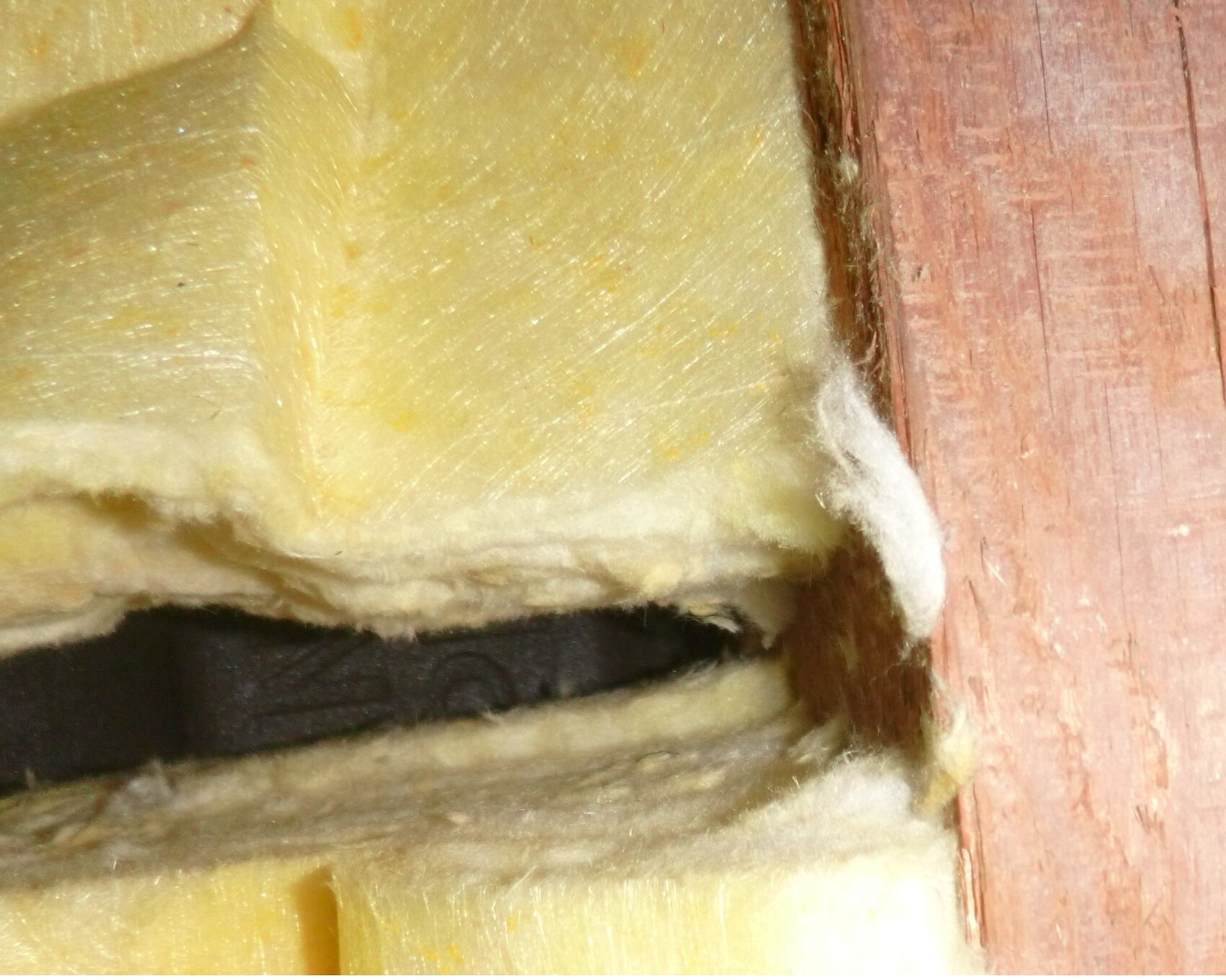
“Insulation board” was the wrong term; what I meant was insulation wool cut into panels. – Actually, the company planned the work themselves and also specified an underlayment membrane. It was supposed to be installed on the inside of the rafters. The company also invoiced over 700 EUR for the underlayment membrane. Therefore, I was very surprised when I opened the vapor barrier today and saw a gap through which you could see the roof tiles directly (see photo). The inspection by the energy consultant has yet to take place, so this is my preliminary check and inquiry to get an idea of what to expect.
I put my hand into the gap; the tiles are lying directly on the insulation (with no spacing). If I’m seeing this correctly, the issue is clear: the roofing company must install the underlayment membrane afterward, and it must be done from above.
One last question: Could the insulation already have been damaged by the unprofessional work?
Thank you again very much for your help!
It appears that there is only the battens on which the roof tiles rest. However, the so-called counter battens are missing; these are screwed directly onto the rafters in the direction of the rafters and create the ventilation layer beneath the roof covering. The underlay membrane is installed between the counter battens and the rafters. Without the ventilation layer and a second water-shedding layer, the insulation cannot simply be installed as is. The construction would then need to be vapor-tight from the inside, which in practice does not work reliably. The entire roof assembly should not have been built this way and would have needed a fundamentally different design.
If you want to keep the roof without adding a ventilation layer because you do not want to re-tile it, there are constructive “workarounds” to allow interior finishing. However, these solutions are more costly and must be planned from the outset in conjunction with the overall roof finishing situation. Have these details developed by an independent designer. Tradespeople are not planners.
The insulation that has already been installed may already have an increased moisture load and lost some of its insulating effectiveness. Glass or mineral wool only releases moisture through diffusion, not by capillary action. Therefore, drying takes longer. If drying cannot be awaited, the insulation may need to be replaced.
If you want to keep the roof without adding a ventilation layer because you do not want to re-tile it, there are constructive “workarounds” to allow interior finishing. However, these solutions are more costly and must be planned from the outset in conjunction with the overall roof finishing situation. Have these details developed by an independent designer. Tradespeople are not planners.
The insulation that has already been installed may already have an increased moisture load and lost some of its insulating effectiveness. Glass or mineral wool only releases moisture through diffusion, not by capillary action. Therefore, drying takes longer. If drying cannot be awaited, the insulation may need to be replaced.
Similar topics