

Hello everyone,
I hope this topic fits in this subforum; otherwise, please feel free to move it.
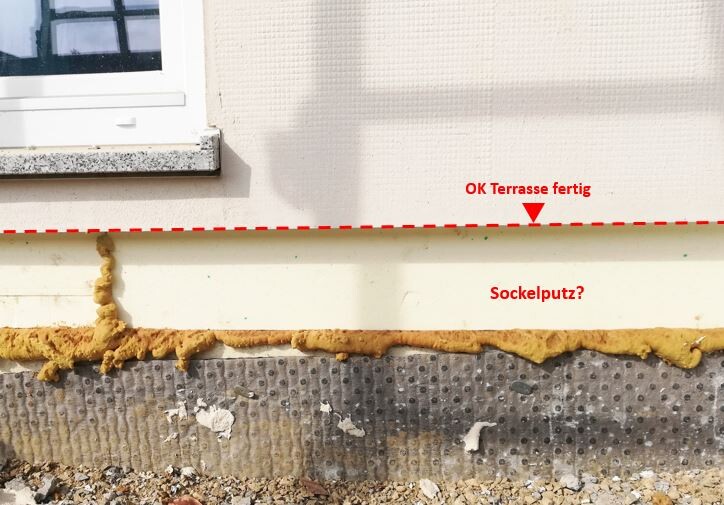
In the coming weeks, we will be preparing the terrace (a gravel base bed, on which sand and paving stones will be laid later). The top edge of the future terrace surface ends almost exactly at the edge where the ground floor insulation meets the basement insulation, see the photo below. Next week, the exterior plaster/paint will be applied over the ground floor insulation.
Our site manager said it is completely sufficient to cover the basement insulation with a dimpled membrane and then place the gravel/sand/paving stones "in front of" it. Only if it were above ground level would it need to be sealed with a base plaster, he said. Since the base plaster is invoiced separately by the general contractor, this is definitely not him trying to avoid extra cost or effort.
However, I keep reading everywhere about how important proper sealing of the base is, using sealing slurries/bitumen coatings, etc. Does this really not apply in a case like this?
The site manager explained it to us like this: beneath the existing dimpled membrane, there is no additional waterproofing, and since everything will later be below ground level, the same applies to the rest as well… If it matters, the basement is made of waterproof concrete (WU concrete).
Thank you very much for your input!!!
I hope this topic fits in this subforum; otherwise, please feel free to move it.
In the coming weeks, we will be preparing the terrace (a gravel base bed, on which sand and paving stones will be laid later). The top edge of the future terrace surface ends almost exactly at the edge where the ground floor insulation meets the basement insulation, see the photo below. Next week, the exterior plaster/paint will be applied over the ground floor insulation.
Our site manager said it is completely sufficient to cover the basement insulation with a dimpled membrane and then place the gravel/sand/paving stones "in front of" it. Only if it were above ground level would it need to be sealed with a base plaster, he said. Since the base plaster is invoiced separately by the general contractor, this is definitely not him trying to avoid extra cost or effort.
However, I keep reading everywhere about how important proper sealing of the base is, using sealing slurries/bitumen coatings, etc. Does this really not apply in a case like this?
The site manager explained it to us like this: beneath the existing dimpled membrane, there is no additional waterproofing, and since everything will later be below ground level, the same applies to the rest as well… If it matters, the basement is made of waterproof concrete (WU concrete).
Thank you very much for your input!!!
Let me explain:
Regular plaster absorbs moisture from the ground. For this reason, base plaster is used and applied about 20 cm (8 inches) above the finished floor level. However, this is not enough, so the joint must be sealed with bitumen or a similar material extending approximately 30 cm (12 inches) downwards. This applies, for example, to your terrace area. If you skip this step, your base plaster will eventually deteriorate and flake off, just like in thousands of other houses before yours, and eventually you will have to dig it all out and redo it. All because you tried to save about 100 euros on the bitumen coating!
Regular plaster absorbs moisture from the ground. For this reason, base plaster is used and applied about 20 cm (8 inches) above the finished floor level. However, this is not enough, so the joint must be sealed with bitumen or a similar material extending approximately 30 cm (12 inches) downwards. This applies, for example, to your terrace area. If you skip this step, your base plaster will eventually deteriorate and flake off, just like in thousands of other houses before yours, and eventually you will have to dig it all out and redo it. All because you tried to save about 100 euros on the bitumen coating!
Bookstar schrieb:
seal the transition with bitumen about 30cm (12 inches) downwards. This would apply to your terrace in this case.Thank you for the explanation @Bookstar.
So, to be on the safe side, the bitumen should be applied from the edge of the ground floor insulation about 30cm (12 inches) downward?
Also, the top render should not extend all the way to the edge, but the lower 20cm (8 inches) should be done as base render?
I can’t add any professional input, but yesterday my plasterer suggested that I should quickly apply a bitumen coating to the base that has just been exposed during the renovation. Better safe than sorry... some people would do it, others wouldn’t, since the old coating is still there.
For me, it’s clear that this is annoying extra work, but if moisture does get through, I’ll regret not doing it in bitumen. I’m not sure whether it’s important or not, but sealing against water can’t hurt. So I’ve decided to just go ahead and do it.
For me, it’s clear that this is annoying extra work, but if moisture does get through, I’ll regret not doing it in bitumen. I’m not sure whether it’s important or not, but sealing against water can’t hurt. So I’ve decided to just go ahead and do it.
Mbk84 schrieb:
Thank you for the explanation @Bookstar
So, to be on the safe side, the area from the edge of the ground floor insulation should be coated with bitumen about 30cm (12 inches) downwards?
Also, the top render should not extend all the way down to the edge, but the lower 20cm (8 inches) should be applied as a base or skirting render?Yes, that is exactly how it should be done.Similar topics