
ᐅ Fluid screed / floating screed - intermediate floor insulation
Created on: 21 Jul 2017 20:15
T
TimeeHello everyone,
We are currently building a prefabricated house (timber frame construction). The house and the basement are completed, the underfloor heating will be installed next week, and the flowing/screed floor will be laid the following week.
I have a question regarding the flowing/screed floor and the moisture that will result from it.
Since our house manufacturer (Schwabenhaus) does not offer counter battens, but we want to install LED spotlights later, we did not have the drywall (gypsum board) panels installed from the factory on the intermediate ceiling (ground floor to upper floor apartment) nor on the upper floor ceiling (upper floor to attic). We want to install counter battens first and then put up the panels. It’s unfortunate that Schwabenhaus does not offer counter battens.
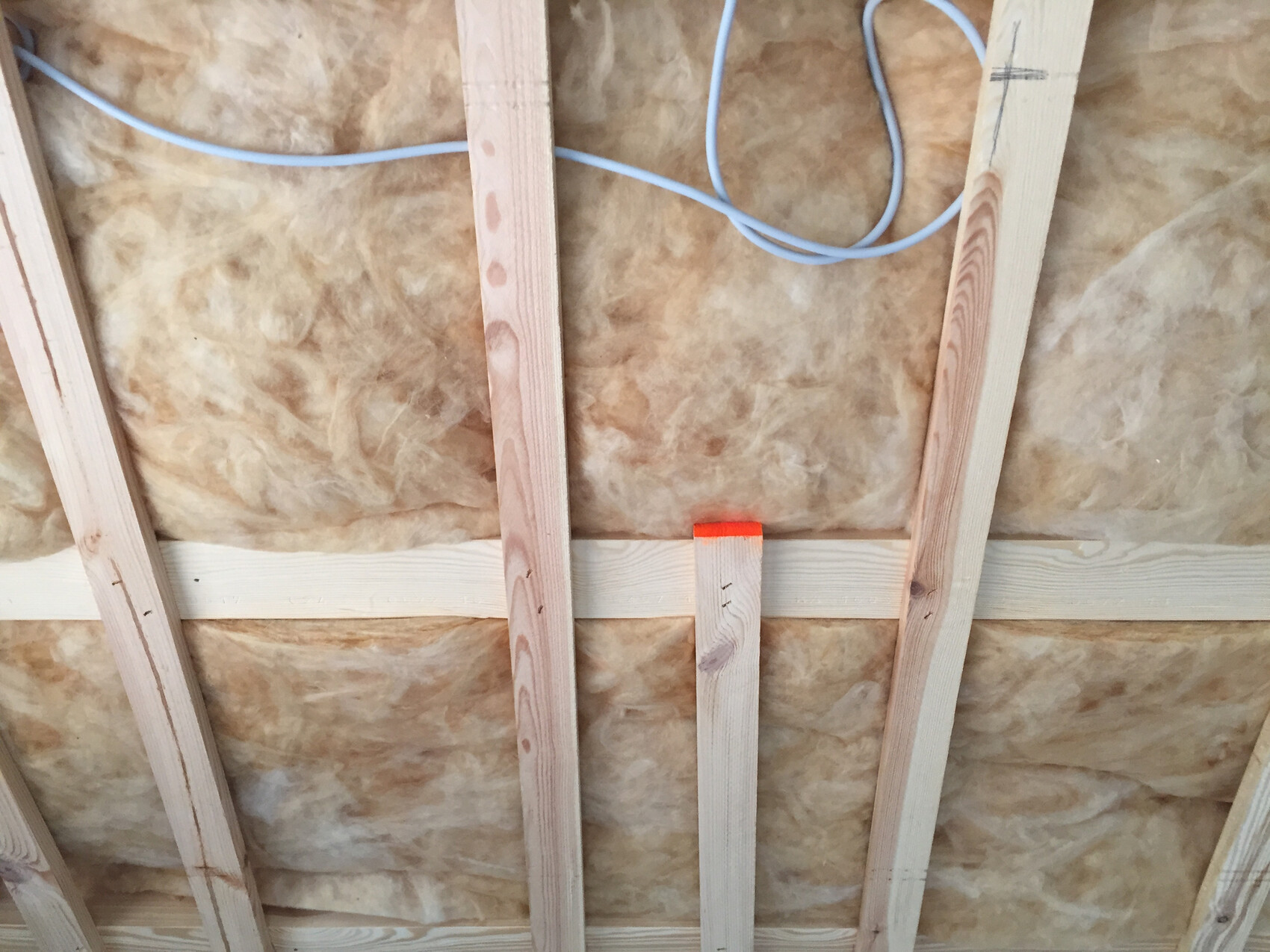
Now, when standing on the ground floor, you can see the ceiling battens and insulation between them (see picture). On the upper floor, there is a vapor retarder between the battens and the insulation, since this is the transition to the cold attic space.
When the screed is heated, moisture will be drawn into the ceiling and will be trapped there until we can ventilate. To prevent this, we considered protecting the ceiling with a foil, but then the water would likely drip back onto the screed and probably leave residues. Our site manager said we don’t need to do this because the moisture will also pass through the drywall panels and become trapped, although the panels allow less breathing. This is how every house is built.
Now we are unsure what to do because everyone says something different. I find quite a bit on Google, but most of it concerns moisture under the screed or damage to the drywall itself. None of it fits my problem.
Should we install foil around the insulation to protect it from moisture or not, since the screed will be ground down anyway and moisture in the insulation is apparently not an issue? Unfortunately, the house manufacturer contradicts themselves.
Can someone advise us?
P.S.: It is unfortunately too late to install a drywall ceiling before the screed is laid.
Thank you very much in advance!
We are currently building a prefabricated house (timber frame construction). The house and the basement are completed, the underfloor heating will be installed next week, and the flowing/screed floor will be laid the following week.
I have a question regarding the flowing/screed floor and the moisture that will result from it.
Since our house manufacturer (Schwabenhaus) does not offer counter battens, but we want to install LED spotlights later, we did not have the drywall (gypsum board) panels installed from the factory on the intermediate ceiling (ground floor to upper floor apartment) nor on the upper floor ceiling (upper floor to attic). We want to install counter battens first and then put up the panels. It’s unfortunate that Schwabenhaus does not offer counter battens.
Now, when standing on the ground floor, you can see the ceiling battens and insulation between them (see picture). On the upper floor, there is a vapor retarder between the battens and the insulation, since this is the transition to the cold attic space.
When the screed is heated, moisture will be drawn into the ceiling and will be trapped there until we can ventilate. To prevent this, we considered protecting the ceiling with a foil, but then the water would likely drip back onto the screed and probably leave residues. Our site manager said we don’t need to do this because the moisture will also pass through the drywall panels and become trapped, although the panels allow less breathing. This is how every house is built.
Now we are unsure what to do because everyone says something different. I find quite a bit on Google, but most of it concerns moisture under the screed or damage to the drywall itself. None of it fits my problem.
Should we install foil around the insulation to protect it from moisture or not, since the screed will be ground down anyway and moisture in the insulation is apparently not an issue? Unfortunately, the house manufacturer contradicts themselves.
Can someone advise us?
P.S.: It is unfortunately too late to install a drywall ceiling before the screed is laid.
Thank you very much in advance!
I think I made a mistake in my reasoning because of the noise. Droplets couldn’t form on the vapor barrier and drip down since water can’t condense on the barrier without a temperature difference of at least 14°C (25°F), which is necessary for moisture in the air to condense.
So, we’ll simply install a vapor barrier to prevent the insulation from becoming saturated and compressing. At least this way it’s protected, and the screed won’t be affected either.
If anyone has any comments, ideas, or experiences, please feel free to share =)
So, we’ll simply install a vapor barrier to prevent the insulation from becoming saturated and compressing. At least this way it’s protected, and the screed won’t be affected either.
If anyone has any comments, ideas, or experiences, please feel free to share =)
SOLUTION
We used Isover insulation (shown in the picture). This is a mineral wool made from stone.
We installed the mentioned foil to protect the insulation.
In case anyone else encounters this situation, here is a tip.
I spoke with the manufacturer (Isover, a brand of Raab Karcher), and they explained the following:
A foil is okay but not absolutely necessary.
Quote:
"The insulation can get damp but, because of the stone mineral, it doesn’t actually absorb moisture or draw it in. It does NOT get damaged and will release the moisture again when ventilated. The only thing that could happen is that the wool might fall down without protection due to the moisture. A battens system to prevent this would be beneficial. Using foil makes all of this even better!!! Above all, the foil has the advantage that, while air cannot circulate, no mold can form on the beams or the wool itself."
Yes, so now we have the foil, a large area is protected from mold, and the wool won’t fall down.
For about 3 hours of work, it’s tolerable and definitely better than increasing the risk of mold =)
In case someone else runs into this problem, now there is a documented solution, and you won’t have to spend hours googling like I did =)
Cheers, Tim
We used Isover insulation (shown in the picture). This is a mineral wool made from stone.
We installed the mentioned foil to protect the insulation.
In case anyone else encounters this situation, here is a tip.
I spoke with the manufacturer (Isover, a brand of Raab Karcher), and they explained the following:
A foil is okay but not absolutely necessary.
Quote:
"The insulation can get damp but, because of the stone mineral, it doesn’t actually absorb moisture or draw it in. It does NOT get damaged and will release the moisture again when ventilated. The only thing that could happen is that the wool might fall down without protection due to the moisture. A battens system to prevent this would be beneficial. Using foil makes all of this even better!!! Above all, the foil has the advantage that, while air cannot circulate, no mold can form on the beams or the wool itself."
Yes, so now we have the foil, a large area is protected from mold, and the wool won’t fall down.
For about 3 hours of work, it’s tolerable and definitely better than increasing the risk of mold =)
In case someone else runs into this problem, now there is a documented solution, and you won’t have to spend hours googling like I did =)
Cheers, Tim
Similar topics