
ᐅ Floor plans for a single-family house with a separate apartment, 280 m² on a compact 320 m² plot
Created on: 29 Aug 2022 11:51
M
medow1982
Hello everyone,
attached is our project with a request for suggestions for improvement, especially regarding the interior layout. The building permit application is currently in process, so please avoid complete redesign proposals for the building envelope, entrance, etc. Doors and walls can still be adjusted inside.
And yes, we are fully aware that this is a small constrained plot with limited garden space, but this is all we have here and we’re happy with it!
Development Plan/Restrictions
Plot size: 310 m2 (3,337 sq ft)
Number of parking spaces: 2
Number of floors: 1.5–2
Roof type: 45-degree gable roof
Orientation: SW
Additional requirements: Must be attached to neighbors and adapted accordingly. Changes to roof shape, knee wall height, number of floors, etc. are not possible!
Owners’ Requirements
Style, roof type, building type: Attached house, adapted to neighbors. This is restricted. Open floor plan. Flexible for aging occupants.
Basement, floors: Basement = self-contained apartment according to regional building codes, with separate entrance for permanent rental in the basement.
Number of occupants, ages: 2 adults + 2 children (4 and 1 year old), basement apartment: either 2 people or a shared office for 2 to max. 6 people
Space requirements on ground and upper floors: at least 120 m2 (1,292 sq ft). We have 165 m2 (1,776 sq ft) + 18 m2 (194 sq ft), so more than needed.
Office: Family use or home office? All three desired. One mixed-use room for home office and guests planned on the ground floor.
Guest sleepers per year: maximum 2, 1–3 times per year
Modern construction style
Open kitchen, kitchen island: possibly
Number of dining seats: 1
Fireplace: no
Balcony: yes, roof terrace: no due to neighbors
Garage, carport: no, only 2 parking spaces and storage rooms on the floors. One parking space will be realized with grass pavers and a sliding gate so that the garden visually appears larger.
House Design
Who designed the plan: 2 years of our own planning, final design approved by an architect as feasible.
- Planner from a construction company: yes
- Architect: yes
What do you particularly like? Why: We planned 3 separate living units so that we can live on the ground floor as we get older and the kids move upstairs or we can rent it out. A barrier-free ground floor was very important to us. In case of emergency, we can also rent out the ground and upper floors. Only the basement apartment is planned for rental; ground and upper floors for own use.
Estimated cost according to architect/planner: approx. 1 million €
Preferred heating system: Air-to-water heat pump, split system for cost reasons. 8 kWp solar system, 2 centralized ventilation systems. Basement made of concrete + Styrodur insulation, ground and upper floors with Poroton T7-MW 36.5 bricks. Soundproofing and increased living space were priorities, and unfortunately, we no longer qualify for KfW40+ funding. We simply didn’t have enough time for the KfW40+ NH standard because interest rates have risen sharply.
If you have to give up something, which details or expansions?
- Can give up: definitely the garage. We don’t own a car and use car sharing, which works well for the family. We can occasionally use a garage and shed on the neighboring property.
- Cannot give up: terrace, garden, balcony
Why is the design as it is now?
For example, standard design from planner? No, everything developed by us. Strong restrictions due to attachment to neighbors and limits on ridge height, roof shape, and height of the adjoining building. “Wish for” options are hardly possible here since the house must be attached to the neighbor.
Which wishes did the architect implement? Most of them.
What do you think makes it particularly good or bad? We have a very small plot and limited freedom in terms of shape, but in our opinion, we made the best of it. For cost reasons, we omitted Gutex insulation in the roof. We only have the attic peak, the bathroom, and one room with a sloping ceiling (knee wall height 1.38 m (4 ft 6 in)).
According to the site manager, this should not lead to extreme overheating, but we might still install it depending on feedback. The attic is open and connected to the ventilation system, so air in the basement will be mixed via the heat exchanger anyway. My parents also don’t have Gutex insulation in their prefab home from the 1980s, and yes, the attic gets quite warm but not over 35°C (95°F). We planned to compensate with blinds but are still unsure.
Additionally, we plan to convert the kitchen on the ground floor into a living room as we age and relocate the kitchen accordingly. Everything is optional, and planned with flexible plumbing. In the basement, we might still plan another room but are unsure of the location.
What is the most important/basic question about the floor plan in 130 characters?
Is the size of the bathroom and hallway sufficient, or should we have it adjusted?
In the basement, we will add a south-facing window on the left side to brighten the basement apartment. This will reduce privacy and garden space but should please the basement occupants.
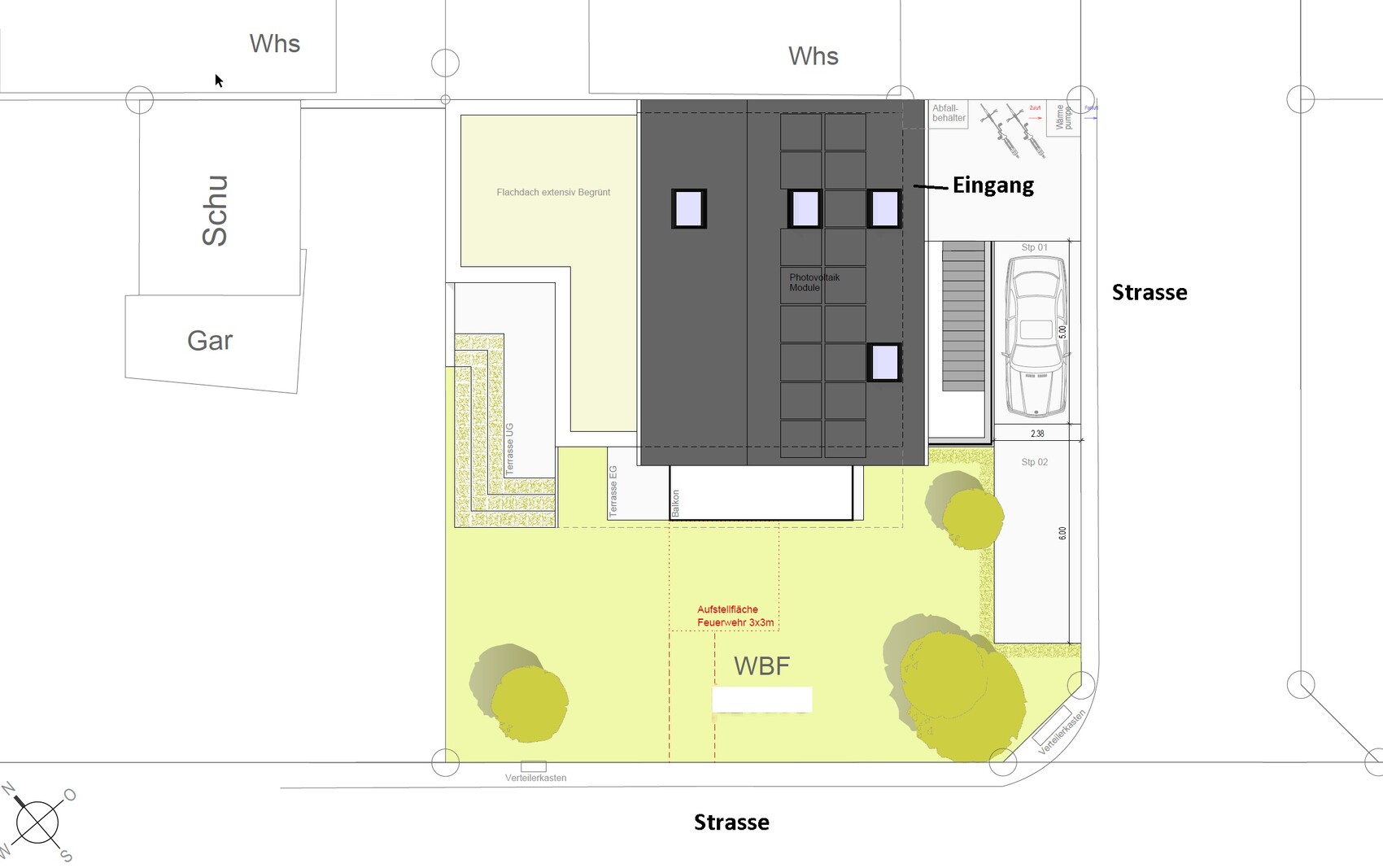

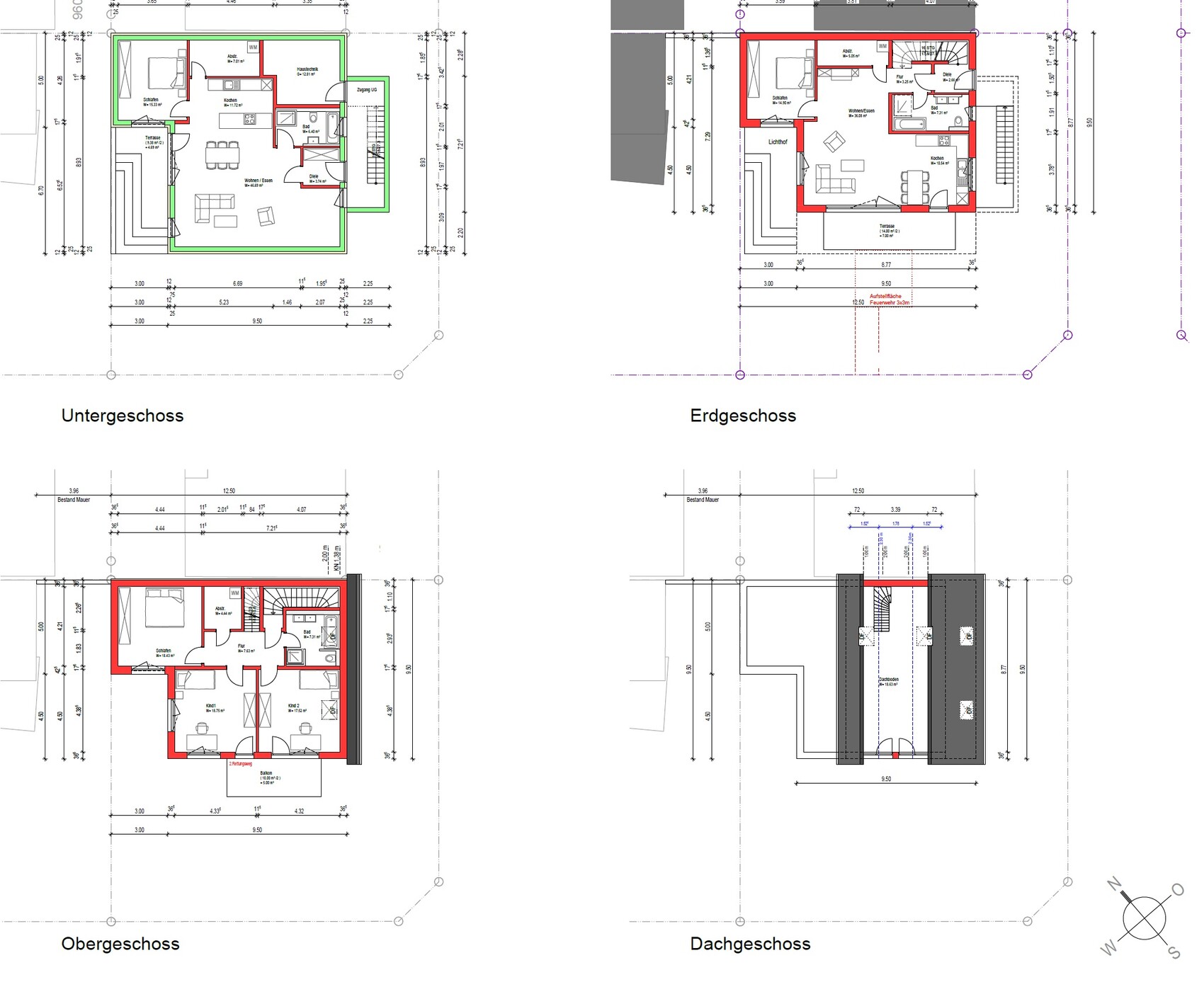
attached is our project with a request for suggestions for improvement, especially regarding the interior layout. The building permit application is currently in process, so please avoid complete redesign proposals for the building envelope, entrance, etc. Doors and walls can still be adjusted inside.
And yes, we are fully aware that this is a small constrained plot with limited garden space, but this is all we have here and we’re happy with it!
Development Plan/Restrictions
Plot size: 310 m2 (3,337 sq ft)
Number of parking spaces: 2
Number of floors: 1.5–2
Roof type: 45-degree gable roof
Orientation: SW
Additional requirements: Must be attached to neighbors and adapted accordingly. Changes to roof shape, knee wall height, number of floors, etc. are not possible!
Owners’ Requirements
Style, roof type, building type: Attached house, adapted to neighbors. This is restricted. Open floor plan. Flexible for aging occupants.
Basement, floors: Basement = self-contained apartment according to regional building codes, with separate entrance for permanent rental in the basement.
Number of occupants, ages: 2 adults + 2 children (4 and 1 year old), basement apartment: either 2 people or a shared office for 2 to max. 6 people
Space requirements on ground and upper floors: at least 120 m2 (1,292 sq ft). We have 165 m2 (1,776 sq ft) + 18 m2 (194 sq ft), so more than needed.
Office: Family use or home office? All three desired. One mixed-use room for home office and guests planned on the ground floor.
Guest sleepers per year: maximum 2, 1–3 times per year
Modern construction style
Open kitchen, kitchen island: possibly
Number of dining seats: 1
Fireplace: no
Balcony: yes, roof terrace: no due to neighbors
Garage, carport: no, only 2 parking spaces and storage rooms on the floors. One parking space will be realized with grass pavers and a sliding gate so that the garden visually appears larger.
House Design
Who designed the plan: 2 years of our own planning, final design approved by an architect as feasible.
- Planner from a construction company: yes
- Architect: yes
What do you particularly like? Why: We planned 3 separate living units so that we can live on the ground floor as we get older and the kids move upstairs or we can rent it out. A barrier-free ground floor was very important to us. In case of emergency, we can also rent out the ground and upper floors. Only the basement apartment is planned for rental; ground and upper floors for own use.
Estimated cost according to architect/planner: approx. 1 million €
Preferred heating system: Air-to-water heat pump, split system for cost reasons. 8 kWp solar system, 2 centralized ventilation systems. Basement made of concrete + Styrodur insulation, ground and upper floors with Poroton T7-MW 36.5 bricks. Soundproofing and increased living space were priorities, and unfortunately, we no longer qualify for KfW40+ funding. We simply didn’t have enough time for the KfW40+ NH standard because interest rates have risen sharply.
If you have to give up something, which details or expansions?
- Can give up: definitely the garage. We don’t own a car and use car sharing, which works well for the family. We can occasionally use a garage and shed on the neighboring property.
- Cannot give up: terrace, garden, balcony
Why is the design as it is now?
For example, standard design from planner? No, everything developed by us. Strong restrictions due to attachment to neighbors and limits on ridge height, roof shape, and height of the adjoining building. “Wish for” options are hardly possible here since the house must be attached to the neighbor.
Which wishes did the architect implement? Most of them.
What do you think makes it particularly good or bad? We have a very small plot and limited freedom in terms of shape, but in our opinion, we made the best of it. For cost reasons, we omitted Gutex insulation in the roof. We only have the attic peak, the bathroom, and one room with a sloping ceiling (knee wall height 1.38 m (4 ft 6 in)).
According to the site manager, this should not lead to extreme overheating, but we might still install it depending on feedback. The attic is open and connected to the ventilation system, so air in the basement will be mixed via the heat exchanger anyway. My parents also don’t have Gutex insulation in their prefab home from the 1980s, and yes, the attic gets quite warm but not over 35°C (95°F). We planned to compensate with blinds but are still unsure.
Additionally, we plan to convert the kitchen on the ground floor into a living room as we age and relocate the kitchen accordingly. Everything is optional, and planned with flexible plumbing. In the basement, we might still plan another room but are unsure of the location.
What is the most important/basic question about the floor plan in 130 characters?
Is the size of the bathroom and hallway sufficient, or should we have it adjusted?
In the basement, we will add a south-facing window on the left side to brighten the basement apartment. This will reduce privacy and garden space but should please the basement occupants.

medow1982 schrieb:
What’s wrong with planning a granny flat to make financial use of it? The usefulness of a granny flat has been discussed multiple times in the forum. Please use the search function. Ultimately, it is always a case-by-case decision depending on location, suitability of the plot, family needs, and so on. In your case, I mainly see disadvantages regarding land use because it is far too small for that, the suitability as an apartment due to lack of natural light, multiple uses including division into three separate units, and the current additional use as a clubhouse.
medow1982 schrieb:
How it is ultimately used doesn’t matter. The intended use significantly influences the design.
medow1982 schrieb:
Unfortunately, I scared the dogs here unnecessarily. Of course, it’s open who will move in, and the room layout is not fixed yet. We will decide that once the shell, which we are bound to, is approved. Sorry, but I find it hard to take such nonsense seriously considering an investment of 1 million.
medow1982 schrieb:
What’s wrong with putting the kitchen in the basement on the lower right in those dead corners? Lack of natural light. All windows next to the entrance stairs will only provide very weak, dim light. You keep forgetting that this is a basement with a wall and stairs in front of it. In addition, cars or bicycles—or whatever will be stored there—are parked upstairs simply because there are no alternative parking areas.
medow1982 schrieb:
We find the kitchen on the ground floor large enough. Of course, a large pantry will be added there. Where exactly? Just to clarify, you are planning a so-called open-plan kitchen—which integrates the dining area—in a house of well over 200sqm (over 2,150 sq ft). Nothing against open-plan kitchens—I also find them cozy. But space-wise, you are at the level of a 120sqm (1,300 sq ft) house here.
medow1982 schrieb:
You can already see that everyone expresses their own preferences here. Women will always recommend a walk-in closet, a separate laundry room, and a large bathroom, while men care more about the impressive features 🙂 I have seen nothing about a walk-in closet. If you want to dismiss the weak points as personal preferences—well, it’s not my million that’s being sunk here.
medow1982 schrieb:
Of course, you can plan a light well in the hallway and so on, but how often do you actually spend time in the hallway? … We also don’t really mind the toilet on the upper floor. As far as I know, no one complained about the upper floor. Why bring that up now?
medow1982 schrieb:
I admit you shouldn’t plan a bathroom next to the dining table, I agree. But I don’t see the supposed bad smell that supposedly follows you. Dirty diapers from children stink much more. That’s confusing and incoherent.
medow1982 schrieb:
The ground floor stairs along the exterior wall are fine, only the bathroom is not ideal. Of course, we would like an additional room on the ground floor later, but do we have to plan that now at the expense of natural light? Probably not. What are you trying to tell us?
medow1982 schrieb:
Option with the bedroom above the kitchen on the ground floor. But no one will be happy if the dishwasher runs upstairs in the evening. I thought you wanted to invest specifically in soundproofing? Or am I confusing you with someone else?
Sorry, but you are not zoning correctly: it negatively affects houses and apartment layouts when the route between the bedroom and bathroom is unnecessarily long, or when you have to pass through a living area to get there.
And why is this bad and not just an opinion?
… because a home is meant to provide residents with a private retreat where they can freely relax and have privacy.
This is not only about visibility through windows into neighboring apartments, but also about a secondary dwelling unit within the main apartment being disruptive. Additionally, there should be a dedicated retreat area for the family, which is not just a piece of furniture like a sofa, but a true space for withdrawal.
Before you focus on the purpose of rooms, consider shared utility lines (which nowadays can be routed flexibly, so a single shaft is no longer mandatory as in the past) and the multifunctionality of floors. However, the actual needs, purpose, and usability usually suffer from this multifunctionality (often only 40-50% instead of 80 or 100%), and you don’t see that.
50% means the goal is missed.
And why is this bad and not just an opinion?
… because a home is meant to provide residents with a private retreat where they can freely relax and have privacy.
This is not only about visibility through windows into neighboring apartments, but also about a secondary dwelling unit within the main apartment being disruptive. Additionally, there should be a dedicated retreat area for the family, which is not just a piece of furniture like a sofa, but a true space for withdrawal.
Before you focus on the purpose of rooms, consider shared utility lines (which nowadays can be routed flexibly, so a single shaft is no longer mandatory as in the past) and the multifunctionality of floors. However, the actual needs, purpose, and usability usually suffer from this multifunctionality (often only 40-50% instead of 80 or 100%), and you don’t see that.
50% means the goal is missed.
M
Myrna_Loy30 Aug 2022 10:09The problem is simply that your planning seems somewhat vague, yet at the same time, you appear to have a plan that serves to finance the entire project. After all, you have been planning for over two years. Naturally, there is a lot of personal investment involved. However, much of it falls into a gray area that contradicts common experience. For example, the parking situation is just one point. In our region, it has become standard to have two parking spaces per residential unit, and you can’t always just buy your way out of that. Some people here are wondering whether this shows a certain naivety or if you are trying to find loopholes to evade requirements while maximizing your own benefit. People are generally not willing to assist with that.
You are planning a granny flat for rental purposes, but actually, it is supposed to be your wife’s club office, rented out to the club. These are two completely different matters in terms of planning. Not to mention the approval process. One is a privileged form of uncomplicated rental, the other a commercial matter. Is the latter officially eligible for approval? The granny flat, as a living space, is unattractive due to the basement situation and minimal natural lighting, except for its location, which causes a tight housing market. What is realistically achievable in rent for a 100 sqm (1076 sq ft) basement apartment without its own parking space in this region? And what remains after taxes? How long do you need continuous rental income without losses before the basement apartment pays off? Or will the club be charged rent above the usual local rates? Commercial rentals are a different matter. They are just one tax audit away from causing problems—and you really shouldn’t build your financing on that.
On top of that, there are simply unattractive floor plans, which are not really dream home layouts, but compromises after compromises just to get the structure built. Then again, somehow not, because you plan to build and furnish the interior quite differently... Do you understand what I mean? There is no real way to make concrete suggestions or to engage meaningfully with the planning. For example, I find the kitchen and bathroom layouts neither attractive nor spacious—hardly even practical. On the upper floor, you wander back and forth between the bedroom and bathroom.
The basement living area with light wells will likely cost close to 250,000 euros (around $275,000). Is that really a sensible estimate, or would building without a basement be a better option? Then the ground floor layout could lean more toward a dream home. If you really want to build such a combination, you need an architect to make the concept work and to genuinely create long-term financial added value. This is not a DIY task to be cobbled together with a simple home design program.
You are planning a granny flat for rental purposes, but actually, it is supposed to be your wife’s club office, rented out to the club. These are two completely different matters in terms of planning. Not to mention the approval process. One is a privileged form of uncomplicated rental, the other a commercial matter. Is the latter officially eligible for approval? The granny flat, as a living space, is unattractive due to the basement situation and minimal natural lighting, except for its location, which causes a tight housing market. What is realistically achievable in rent for a 100 sqm (1076 sq ft) basement apartment without its own parking space in this region? And what remains after taxes? How long do you need continuous rental income without losses before the basement apartment pays off? Or will the club be charged rent above the usual local rates? Commercial rentals are a different matter. They are just one tax audit away from causing problems—and you really shouldn’t build your financing on that.
On top of that, there are simply unattractive floor plans, which are not really dream home layouts, but compromises after compromises just to get the structure built. Then again, somehow not, because you plan to build and furnish the interior quite differently... Do you understand what I mean? There is no real way to make concrete suggestions or to engage meaningfully with the planning. For example, I find the kitchen and bathroom layouts neither attractive nor spacious—hardly even practical. On the upper floor, you wander back and forth between the bedroom and bathroom.
The basement living area with light wells will likely cost close to 250,000 euros (around $275,000). Is that really a sensible estimate, or would building without a basement be a better option? Then the ground floor layout could lean more toward a dream home. If you really want to build such a combination, you need an architect to make the concept work and to genuinely create long-term financial added value. This is not a DIY task to be cobbled together with a simple home design program.
M
Myrna_Loy30 Aug 2022 10:31Actually, separate plans should be created for the three options.
Each of these scenarios requires different layouts for the lower ground floor, as well as the ground floor. It is possible to combine the requirements, but for that, you need a specialist planner—not just someone to check if the project is buildable.
- The basement is not available, as it contains a separate apartment rented by 1–2 persons. All living units must be fully usable and separable.
- The basement is not available, as the lower ground floor is used as a commercial unit by the association, with an open-plan office.
- The basement is available, as only part of the premises will be used temporarily for home office purposes.
Each of these scenarios requires different layouts for the lower ground floor, as well as the ground floor. It is possible to combine the requirements, but for that, you need a specialist planner—not just someone to check if the project is buildable.
Myrna_Loy schrieb:
Different plans should actually be created for the three options.
- The basement is not available, as it is a separate apartment rented to 1-2 people. All residential units must be practical and separable.
- The basement is not available because the lower ground floor is used as a commercial unit by the association with an open-plan office.
- The basement is available because only part of the space is used for temporary home office work.
Each of these options requires different layouts in the lower ground floor as well as in the ground floor. It is possible to combine the requirements, but for that you will need a professional planner—not just someone who checks whether it is buildable. Additionally:
- Ground floor and upper floor as one residential unit
- Ground floor and upper floor with 2 residential units
- Corresponding outdoor areas for each
Trying to combine these requirements inevitably leads to a collection of compromises. At that point, it barely has anything to do with a dream home anymore. Most likely, the property will be sold as a three-family house or fully rented out within a few years.
Similar topics