
Hello everyone,
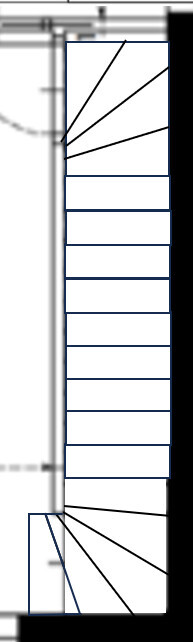
I have a floor plan here where the staircase has been designed with only two steps in the lower turn but three steps at the top. Does that make sense?
The floor-to-floor height is 3.15 m (10.3 ft) with 17 steps; the rest you can see in the drawings.
Would you build it like this, or would you do something differently under certain circumstances?
Thank you very much,
Mike

I have a floor plan here where the staircase has been designed with only two steps in the lower turn but three steps at the top. Does that make sense?
The floor-to-floor height is 3.15 m (10.3 ft) with 17 steps; the rest you can see in the drawings.
Would you build it like this, or would you do something differently under certain circumstances?
Thank you very much,
Mike
W
wiltshire21 Jan 2025 18:2211ant schrieb:
This common type of technical drawing can be misleading because non-experts often see only “one” staircase in it.touché! 11ant schrieb:
... from a first aid perspective, it is generally safer to trip when going upstairs rather than downstairs, because falling downstairs is more likely to result in injury.That was my reasoning: better to stand safely at the top and trip at the bottom than the other way around.
Contact2001 schrieb:
Thanks also for your quick response.
No, there is a staircase since there is no basement. The staircase would run straight and end inside the shower. In the drawing, there is a line in the staircase. It seems they use different drawing symbols in Italy (/ Ticino?).
https://www.instagram.com/11antgmxde/
https://www.linkedin.com/company/bauen-jetzt/
Contact2001 schrieb:
No, it is a staircase.If the upper floor is actually planned like this, then you have an issue with the staircase because the stairwell opening is not large enough. You will lose headroom. @kbt09H
hanghaus202321 Jan 2025 21:4818 steps are drawn. The rise is 17.5 cm (7 inches). The walking line is approximately 5.3 m (17 feet 5 inches). Dividing 5.3 m by 17 gives a tread length of 30.5 cm (12 inches). It is best to divide this evenly.
ypg schrieb:
You lose headroom.Do you mean because the drawing of the upper floor looks like the red-outlined area of the stairwell is covered by the ceiling from the upper floor? Unfortunately, it’s not possible to determine this exactly, since the orientation and scales don’t quite match.There would then be 5 steps out of 18, corresponding to 87.5 cm (34.4 inches) of height taken from the clear room height.
Yes, that could become very critical with the overbuild on the upper floor. The question is what is supposed to be in that area... upper floor rotated and area also marked in red.
C
Contact200122 Jan 2025 13:39kbt09 schrieb:
You mean because the first floor plan looks like the red-outlined area of the stairwell is covered by the ceiling from the first floor above? Unfortunately, it’s not possible to determine exactly since the orientation and scales don’t match.
[ATTACH alt="grundriss-treppenplanung-stufen-in-der-wendung-680826-1.png"]90108[/ATTACH]
It would then be 5 steps out of 18 = 87.5 cm (34.4 inches) height, which reduces the clear room height.
Yes, that could be very critical with the overbuild on the first floor. The question is what is intended in that area... first floor rotated and area also marked in red.
[ATTACH width="304px" alt="grundriss-treppenplanung-stufen-in-der-wendung-680826-2.png"]90109[/ATTACH] This is a stepped area: the lower half has standard floor height, the upper half is about 1–1.3 m (3.3–4.3 ft) high, basically a landing. This is not visible in this drawing. The headroom clearance is sufficient.
Similar topics