
Hello everyone,
We are planning to build in the near future and have already reserved the plot. Unfortunately, there is no access road yet, and we have not chosen a builder yet.
We would really appreciate your help and feedback.
Zoning Plan / Restrictions
Plot size: 816m² (9850 sq ft)
Slope: no
Site coverage ratio: 0.3
Floor area ratio: -
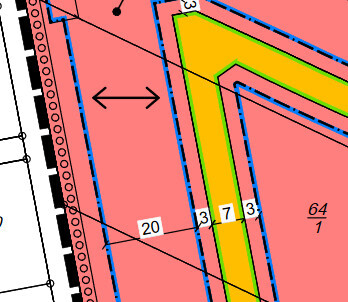
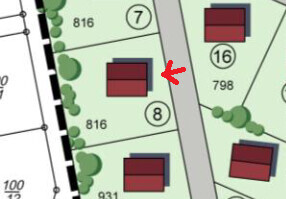
Building envelope, building line and boundary: see image
Edge development:
Number of parking spaces: 2
Number of floors: max. 1 full floor
Roof type: "[...] only pitched roofs with slopes between 18° and 48° permitted. Barrel and (half) arched roofs are not permitted. Shed roofs are only allowed if built as double-pitched roofs with slopes in opposite directions. Offset roof surfaces are allowed."
Architectural style
Orientation: ridge from west to east
Maximum heights / limits: max. building height = 9.5m (31 ft)
Other requirements
Owners’ requirements
Style, roof form, building type: We want a kind of gable roof; everything else is quite flexible
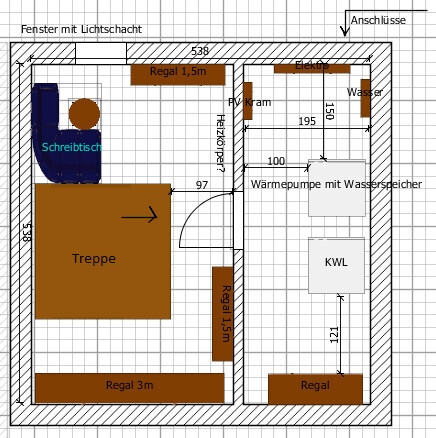
Basement, floors: Partial basement for technical equipment, office, and storage. Preferably fully underground so no stairs in front of the entrance
Number of occupants, ages: Expected 4 (2 adults in their mid-30s, 2 children under 4)
Room requirements on ground floor and upper floor:
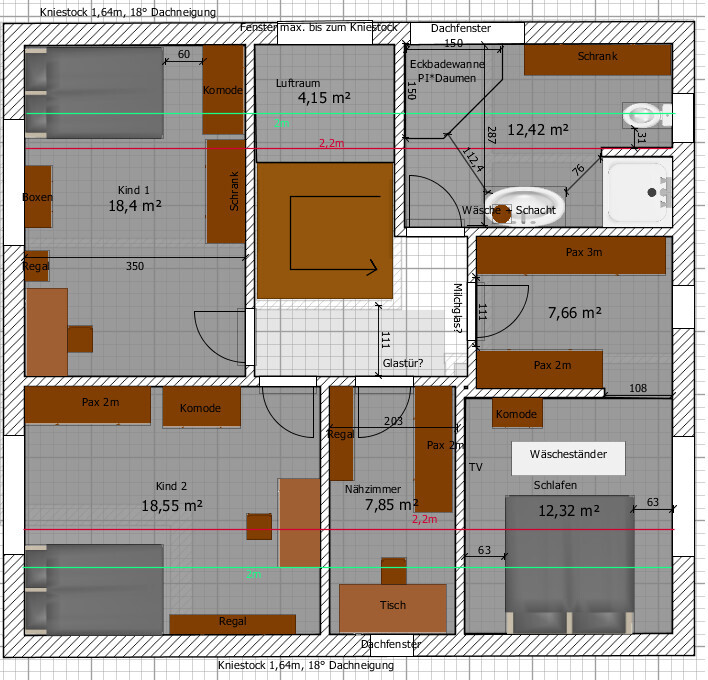
Upper floor: large children’s rooms, decent main bathroom, preferably with a walk-in closet;
Ground floor: moderately large kitchen, bathroom with shower, utility room with space for storage
Office: also for home office
Guests per year: about 5 visits with 2 guests each
Open or closed layout: rather open
Conservative or modern architecture: doesn’t matter
Open kitchen, kitchen island: open
Number of dining seats: 1 table for 6, or 8 if squeezing together
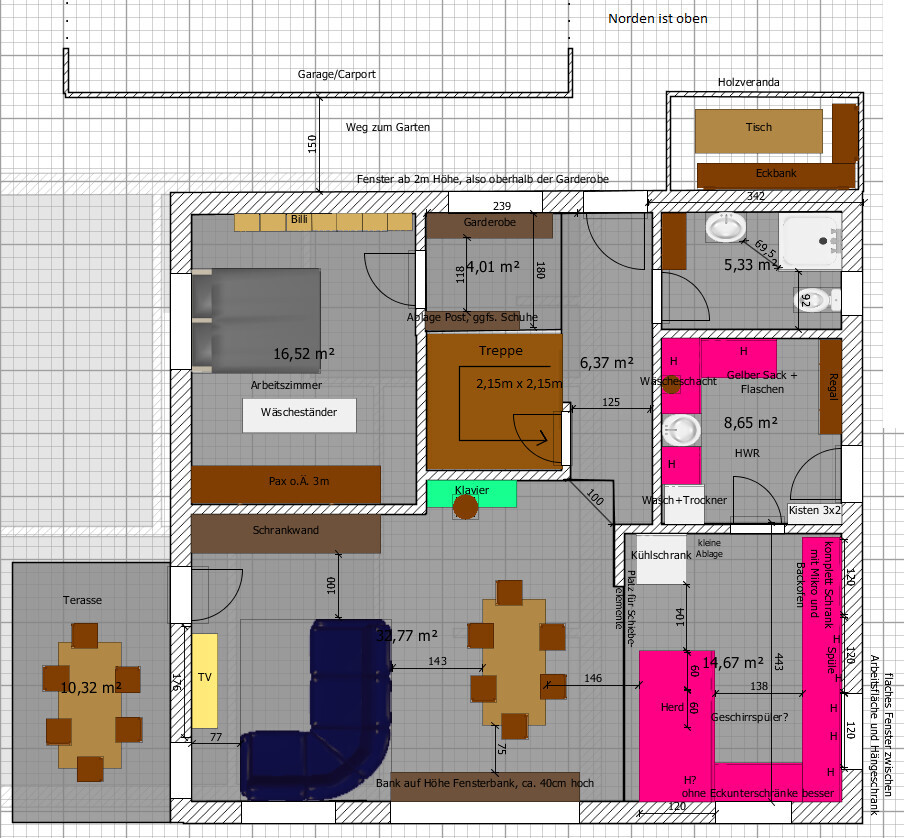
Fireplace: possibly later an ethanol wall fireplace (where the piano currently stands)
Music/stereo wall: no
Balcony, roof terrace: no
Garage, carport: yes
Vegetable garden, greenhouse: small vegetable garden
Additional wishes / special needs / daily routine, including reasons for preferences
House design
Who created the design:
- Do-it-yourself, partially based on builders' designs
What do you especially like? Why? I am basically happy with every room.
What do you dislike? Why? The bathroom on the upper floor is a bit tight? With only 1 full floor and 1.64m (5 ft 4 in) knee wall height and a resulting 18° roof slope, we wouldn’t have usable attic space :\
Price estimate according to architect/designer:
Personal price limit for the house, including fittings: 300,000
Preferred heating system: geothermal
If you have to skip anything, which details/extras
- can you live without: sewing room; basement if there is an adequate solution for technical equipment and storage
- cannot do without: shower on ground floor, enough space in kitchen and utility room
Why is the design the way it is? For example:
Studied hundreds of floor plans and adapted the layout to the plot and our needs/preferences
What is the most important/basic question about the floor plan, summarized in 130 characters?
Is the house design reasonably feasible or are there major issues / deal breakers?
Is it okay to show such a design to various builders and ask for a rough cost estimate?
Many thanks in advance to all hardworking helpers
We are planning to build in the near future and have already reserved the plot. Unfortunately, there is no access road yet, and we have not chosen a builder yet.
We would really appreciate your help and feedback.
Zoning Plan / Restrictions
Plot size: 816m² (9850 sq ft)
Slope: no
Site coverage ratio: 0.3
Floor area ratio: -
Building envelope, building line and boundary: see image
Edge development:
Number of parking spaces: 2
Number of floors: max. 1 full floor
Roof type: "[...] only pitched roofs with slopes between 18° and 48° permitted. Barrel and (half) arched roofs are not permitted. Shed roofs are only allowed if built as double-pitched roofs with slopes in opposite directions. Offset roof surfaces are allowed."
Architectural style
Orientation: ridge from west to east
Maximum heights / limits: max. building height = 9.5m (31 ft)
Other requirements
Owners’ requirements
Style, roof form, building type: We want a kind of gable roof; everything else is quite flexible
Basement, floors: Partial basement for technical equipment, office, and storage. Preferably fully underground so no stairs in front of the entrance
Number of occupants, ages: Expected 4 (2 adults in their mid-30s, 2 children under 4)
Room requirements on ground floor and upper floor:
Upper floor: large children’s rooms, decent main bathroom, preferably with a walk-in closet;
Ground floor: moderately large kitchen, bathroom with shower, utility room with space for storage
Office: also for home office
Guests per year: about 5 visits with 2 guests each
Open or closed layout: rather open
Conservative or modern architecture: doesn’t matter
Open kitchen, kitchen island: open
Number of dining seats: 1 table for 6, or 8 if squeezing together
Fireplace: possibly later an ethanol wall fireplace (where the piano currently stands)
Music/stereo wall: no
Balcony, roof terrace: no
Garage, carport: yes
Vegetable garden, greenhouse: small vegetable garden
Additional wishes / special needs / daily routine, including reasons for preferences
House design
Who created the design:
- Do-it-yourself, partially based on builders' designs
What do you especially like? Why? I am basically happy with every room.
What do you dislike? Why? The bathroom on the upper floor is a bit tight? With only 1 full floor and 1.64m (5 ft 4 in) knee wall height and a resulting 18° roof slope, we wouldn’t have usable attic space :\
Price estimate according to architect/designer:
Personal price limit for the house, including fittings: 300,000
Preferred heating system: geothermal
If you have to skip anything, which details/extras
- can you live without: sewing room; basement if there is an adequate solution for technical equipment and storage
- cannot do without: shower on ground floor, enough space in kitchen and utility room
Why is the design the way it is? For example:
Studied hundreds of floor plans and adapted the layout to the plot and our needs/preferences
What is the most important/basic question about the floor plan, summarized in 130 characters?
Is the house design reasonably feasible or are there major issues / deal breakers?
Is it okay to show such a design to various builders and ask for a rough cost estimate?
Many thanks in advance to all hardworking helpers
Well, in your first post you mentioned that your budget is 300k including fixtures and fittings. Even if landscaping and site work are not included, that budget is clearly exceeded given the size of the house. Now you write that, "if necessary," you could spend more. Would that mean 100k to 200k more, depending on what you originally included in the house costs?
Regarding the floor plan, yes, I find the living room uncomfortable because it is too small and cramped. Overall, it seems unbalanced to me. The study and children’s rooms are very large at the expense of other rooms (the bedroom is also quite tight). Will the sewing room be used often enough that it cannot be accommodated in the study?
What kind of affordable basement is this actually, and what’s the catch? Or, what costs are included and what isn’t?
Regarding the floor plan, yes, I find the living room uncomfortable because it is too small and cramped. Overall, it seems unbalanced to me. The study and children’s rooms are very large at the expense of other rooms (the bedroom is also quite tight). Will the sewing room be used often enough that it cannot be accommodated in the study?
What kind of affordable basement is this actually, and what’s the catch? Or, what costs are included and what isn’t?

Ysop*** schrieb:
Regarding the floor plan, yes, I find the living room uncomfortable because it is too small and cramped. Overall, I think it lacks balance. From the floor plan, I only picked out the staircase situation as a striking detail, in the last-ditch hope that this hint might open the original poster’s eyes to the fact that the planning maturity still leaves much to be desired. Overall, I don’t consider the plan to be of a quality suitable for discussion. To me, it looks like one of the typical first attempts at sketching a little on electronic graph paper with millimeter precision. As so often, it is impossible for anyone except the draftsman to tell how the dimensions of the depicted house were derived – worse: apparently the staircase is taken from a prefabricated partial basement model and then used as decoration, with the above-ground ground floor, which is larger than the basement, draped around it. The "result" is both too tight and too large and is therefore not even suitable for the intended initial price requests.
Ysop*** schrieb:
What kind of inexpensive basement is that, and what’s the catch? In other words, what is included in the costs and what isn’t? I suspect this prefabricated partial basement (not to be confused with a modular basement) is a “mini basement” (called a “technology box” by Knecht), which is specifically offered for property price conditions in places like Stuttgart and Munich. It is an underground utility room that can optionally be built over by the house, whereby in the latter case, instead of having its own ceiling, the house’s “slab” is essentially laid above what is otherwise a “basement-free” house. In terms of price per square meter, these mini basements are almost classic Pyrrhic victories. When integrated under a house, they often fail to save costs compared to full basements.
https://www.instagram.com/11antgmxde/
https://www.linkedin.com/company/bauen-jetzt/
Ysop*** schrieb:
What kind of cheap basement is this actually? As @11ant says, basically it’s a windowless space—just a room buried underground and topped with a single-family house above. For mechanical equipment. I find basements already a bit off-putting, but a bunker like that, I wouldn’t want to enter at all. And what about forced ventilation? Where does the dry air from the dehumidifier go? And then adding a living space down there too, when there are already enough rooms... all tiny rooms doubled up, 3 workspaces, 2 utility rooms, just because each room on its own is unsatisfactory. Okay, the study and children’s rooms aren’t small, but somewhere above it says: the rooms don’t relate well to each other.
K
KlausBautHaus4 Nov 2020 22:31ypg schrieb:
All these offsets in the interior walls: I wonder how the ceiling sections are supposed to be properly supported there. The entrance to the open-plan area, which actually isn’t really there but results from a faulty Tetris, does not create a pleasant spatial feeling.By "offsets," you mean the corners to the left of the piano and refrigerator, I assume. Those could easily be removed. I’m happy to receive specific suggestions.ypg schrieb:
The upper windows reach about 220cm (87 inches) ceiling height. None of your windows work because they are all around the 2-meter (6 ft 7 in) range.Great, thanks. These can easily be resized and moved without causing issues with the furniture. In the bathroom, a shallower window might be an option.ypg schrieb:
Even the cramped utility room doesn’t make life easier.I moved the utility room entrance to the hallway, opposite the other door. That would make the space more accessible and give me more room for cabinets on the kitchen wall.ypg schrieb:
Who needs a 16sqm (172 sqft) office and then a tiny sewing room of just 8sqm (86 sqft)? That’s almost 24sqm (258 sqft) of “nice to have,” just poorly allocated.Actually, that room is still incorrectly labeled as "office" in the floor plan. It’s sized a bit larger because it’s intended for multiple uses: as a guest room, storage for miscellaneous items, a place where the kids could possibly set up a train without cluttering their bedrooms, and as a bedroom in old age when climbing stairs becomes difficult. It can easily be reduced to fix the offset and enlarge the living room. The sewing room is intended for occasional use when she wants to sew undisturbed, probably in the evening when the kids are in bed (might have noise considerations). Surely, she wouldn’t want children in the sewing room who might steal needles or mess things up. Currently, she sews in the office/guest room, and it’s already annoying to have to pack away all the materials constantly. That’s why there is a separate small room.ypg schrieb:
The basement is mostly stairs. A 10sqm (108 sqft) single-level daylight extension is much more valuable than a dark room like that.Well, about one-sixth of the basement is stairs. We do need storage, especially if the attic option falls through. But I understand the point if you’re generally not a fan of basements.ypg schrieb:
Cost driver. Stick to straightforward design and simple construction.You mean I should accept a lower knee wall to save cost, right?11ant schrieb:
If you don’t dislike the Country House 142 too much, why not use that model as a starting point to tell us specifically what you would like to change.Good idea, I might do that in a separate thread.11ant schrieb:
I don’t understand why you want to combine a knee wall height of 1.64m (5 ft 4 in) with the lowest permitted roof pitch from your local building regulations/planning permission.Well, I want the knee wall as high as possible. But we are only allowed one full-story. According to the Lower Saxony Building Code, a clear height over 2.2m (7 ft 3 in) on the upper floor can exist on no more than two-thirds of the footprint of the ground floor (if that sentence is unclear, I can quote the original text). From that, I can determine horizontally where the 2.2m (7 ft 3 in) height is reached on each side. From that point, I go up to the outer wall with the lowest allowed roof pitch (18°), resulting in a knee wall around 1.64m (5 ft 4 in) high. The downside is that the attic space at that pitch is practically nonexistent. That’s why I’m considering making the roof steeper starting at the 2.2m height point to create usable attic space.11ant schrieb:
Not only for the attic, but also for the living space underneath the sloping roof, that creates space that can be described as "more dead than alive," to put it mildly: not really usable.??? Sorry, I really don’t get that sentence. Any single-family house with only one full-story and no excessive open space has roof slopes. Is the space under the slopes really “more dead than alive”?11ant schrieb:
I don’t understand how you plan to construct your curious hipped roof with progressive pitch—maybe you could sketch it out?I’m attaching a sketch. There’s nothing particularly curious about it, though.11ant schrieb:
Why choose a hipped roof at all and not a gable roof, which is more space- and cost-efficient?I want a gable roof, but I mentioned that I’ve occasionally seen hipped roofs of this type.11ant schrieb:
It seems like your thoughts are a dozen “Eureka” hopes, but nobody except you and perhaps a few experienced forum members like Yvonne and myself can grasp them. Can anyone here "translate" the OP’s reasoning (or tell me what I’d have to smoke for it to make sense)? I’d be happy to help if I could get a grip on it…Seriously?Ysop*** schrieb:
Would 100,000 to 200,000 more (depending on what you included in the house costs) be possible?We could probably talk about over 400,000 for the house. However, this floor plan doesn’t seem particularly “practical.” I’m going to look more closely at proven layouts.Ysop*** schrieb:
What kind of affordable basement is that, and what’s the catch? What costs are included, and what are not?The basement is called TechnoSafe by Glatthaar. The pricing information came from my builder uncle. I can’t say more about it at the moment.ypg schrieb:
What about forced ventilation? Where does the dry air from the dehumidifier go then?We are planning a controlled mechanical ventilation system; possibly the basement would be included. Our condenser dryer would be placed on the ground floor in the utility room.Similar topics