
ᐅ Single-family house floor plan, 230 sqm of living space, east-facing slope, Bauhaus style
Created on: 24 Aug 2022 13:42
R
RoterPapagei
Development Plan / Restrictions
Plot size: 610 sqm (about 15 x 40 m) rectangular
Slope: East-facing slope, approximately 28% gradient. Road downhill. The house is planned to be positioned in the upper third on the hill side (for privacy and view).
Floor area ratio: n.a. (no development plan)
Plot ratio: n.a.
Building window, building line and boundary: n.a.
Setbacks: presumably 2.50 meters (8 feet 2 inches) in all directions
Number of parking spaces: n.a.
Number of floors: n.a.
Roof type: n.a.
Architectural style: n.a.
Orientation: n.a.
Maximum heights / limits: n.a.
Other requirements: There is no formal development plan. However, the street features a variety of house types, so almost any architectural style should be possible.
Client Requirements
Architectural style, roof type, building type: Bauhaus style, preferred flat roof (possibly also shed roof)
Basement, floors: Basement integrated as a living space in the slope, with two floors above
Number of occupants, ages: Currently 3 persons, aged 33, 32, and an infant
Space requirements on ground floor (GF), upper floor (UF):
GF: kitchen, pantry with sink niche, living room, study, WC, entrance area with dressing room
UF: master bedroom with dressing room, two children’s rooms, bathroom, roof terrace
Basement: guest room, guest bathroom, study, laundry room, technical room, storage room, fitness room
Office: currently family use, potential home office in future
Overnight guests per year: parents-in-law visit frequently
Open or enclosed layout: open
Traditional or modern construction: modern
Open kitchen, kitchen island: open kitchen with island
Number of dining seats: one large dining table
Fireplace: preferred, as shown in the floor plan
Music/speaker wall: possibly in the living room
Balcony, roof terrace: roof terrace facing the valley (east side)
Garage, carport: double garage detached from the house, cut into the slope at the street
Utility garden, greenhouse: no
Other wishes / special features / daily routine, including reasons why something should or should not be: no ventilation system, no smart home, photovoltaic system
House Design
Who designed it: do-it-yourself
Living area: approx. 230 sqm (including half the roof terrace area)
Usable area: approx. 260 sqm
What do you like most and why? The overhangs to the east and south, the glass facades, the integration into the slope, the straight staircase, the long visual axis on the ground floor
What do you like least and why? Possibly the entrance area as it may be too small; living room may be too small
Estimated cost according to architect/designer: not available yet
Personal budget for house including equipment: n.a.
Preferred heating technology: air-to-water heat pump, underfloor heating
If you have to compromise, on which details / extensions
- which can you do without: overhangs if much more expensive, flat roof if much more expensive
- which you cannot give up: glass facades
Why is the design as it is now?
The floor plans are a first draft, completely self-developed, and intended as a starting point for discussion. The design is based on three main principles: slope orientation, cardinal directions, and plot shape. Because of the east-facing slope, the larger floor-to-ceiling glass facades and living and dining rooms on the ground floor, as well as the guest room in the basement, are positioned facing east (offering a nice view of the valley). To allow access to the outside from the kitchen and take advantage of sunlight, the kitchen on the ground floor is adjacent on the south side, also with large glass facades. Another idea was to create a long line of sight to the valley directly upon entering the house, which is why the entrance is positioned on the uphill side. Functional rooms (bathrooms, technical room, dressing room, pantry, etc.) are generally oriented uphill (to the west). All WCs are stacked to simplify plumbing. The two 1-meter (3 feet 3 inches) cantilevers are mainly aesthetic but also provide some shading and would be dispensable if needed. The original shape was a simple 10 x 10 m (33 x 33 feet) cube, but this version is preferred by my wife and me. The glass facades are not yet fixed in size and serve as rough guidelines; they could be slightly smaller if structural requirements demand it. The straight staircase may be a point of discussion, although I personally find it very appealing visually.
Regarding privacy and neighbors: downhill side is not relevant due to the slope. On the uphill side a neighboring house is adjacent, so no open facades are planned there. On the north and south sides, houses are located further up the street, with tall trees and shrubs in between. This provides almost complete privacy.
Please ignore the outdoor areas not attached to terraces in the floor plans, as these were only used for rough simulation of the slope.
What is the key question about the floor plan, summarized in 130 characters?
Is our design heading in the right direction, or are there major issues we have overlooked?
The plan is also intended to obtain initial cost comparisons from various companies for a similar house. We understand that an architect will need to be involved in further planning.
We are grateful for any feedback!
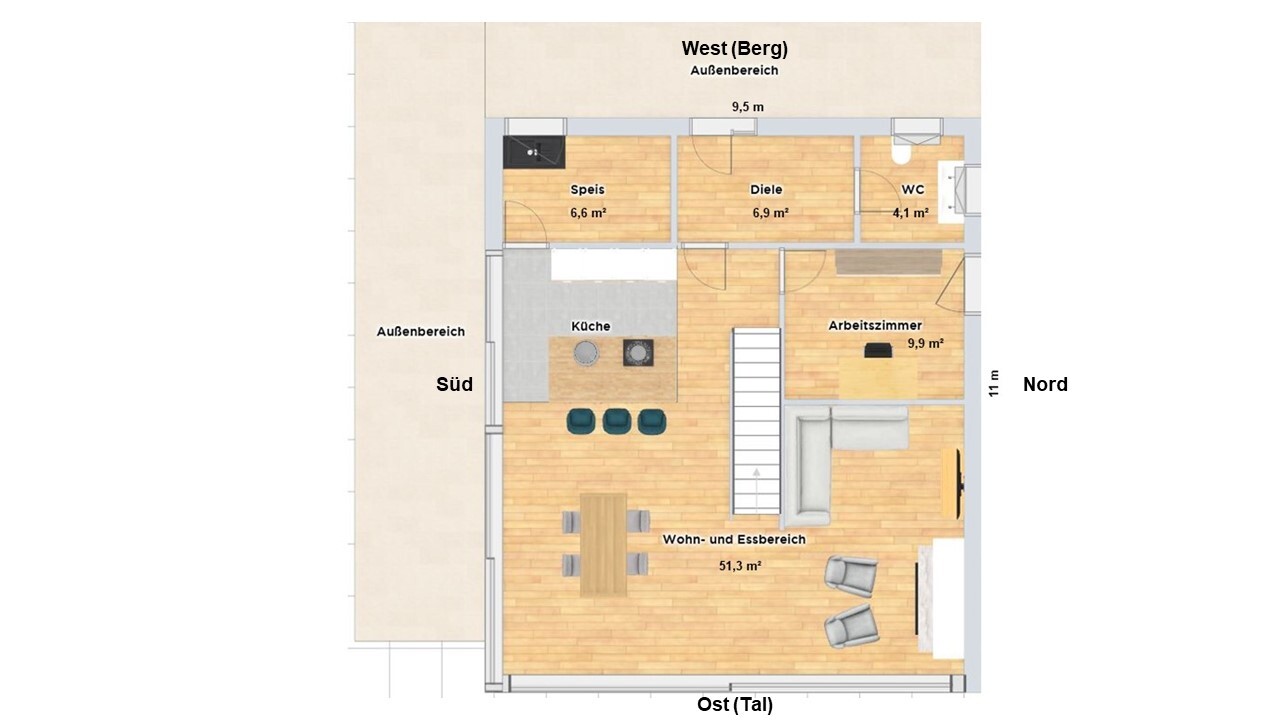
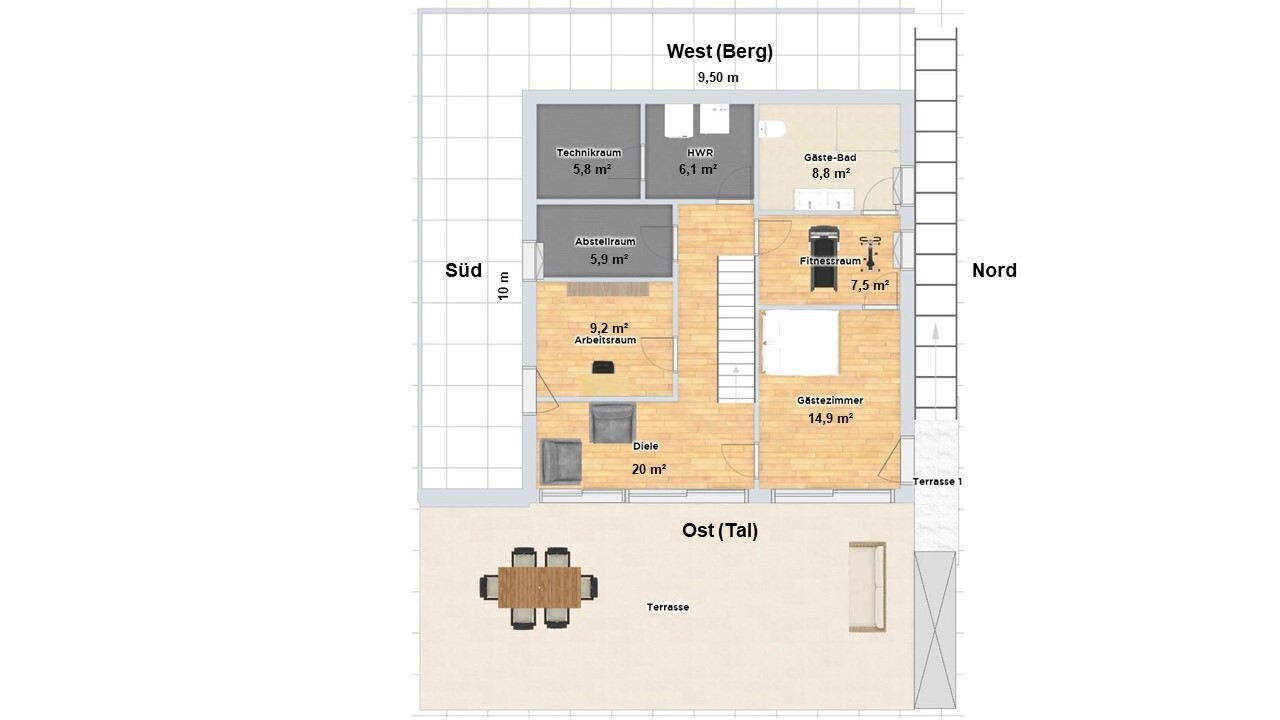
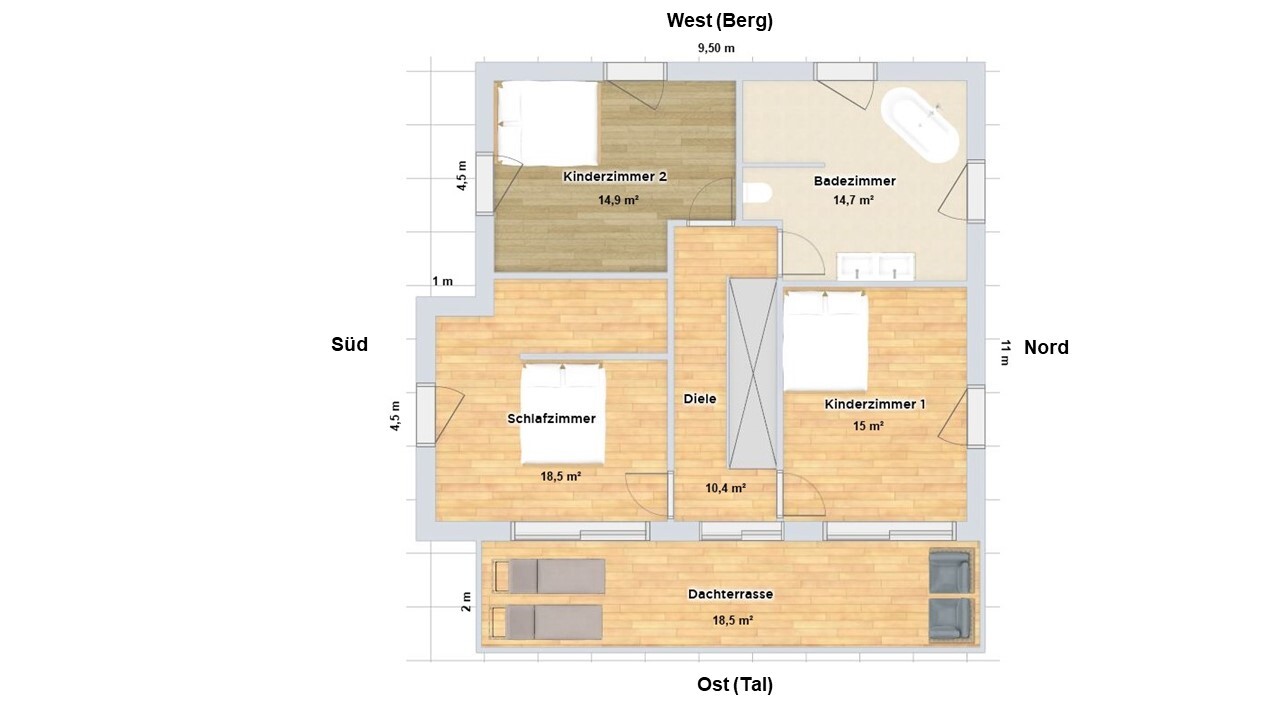
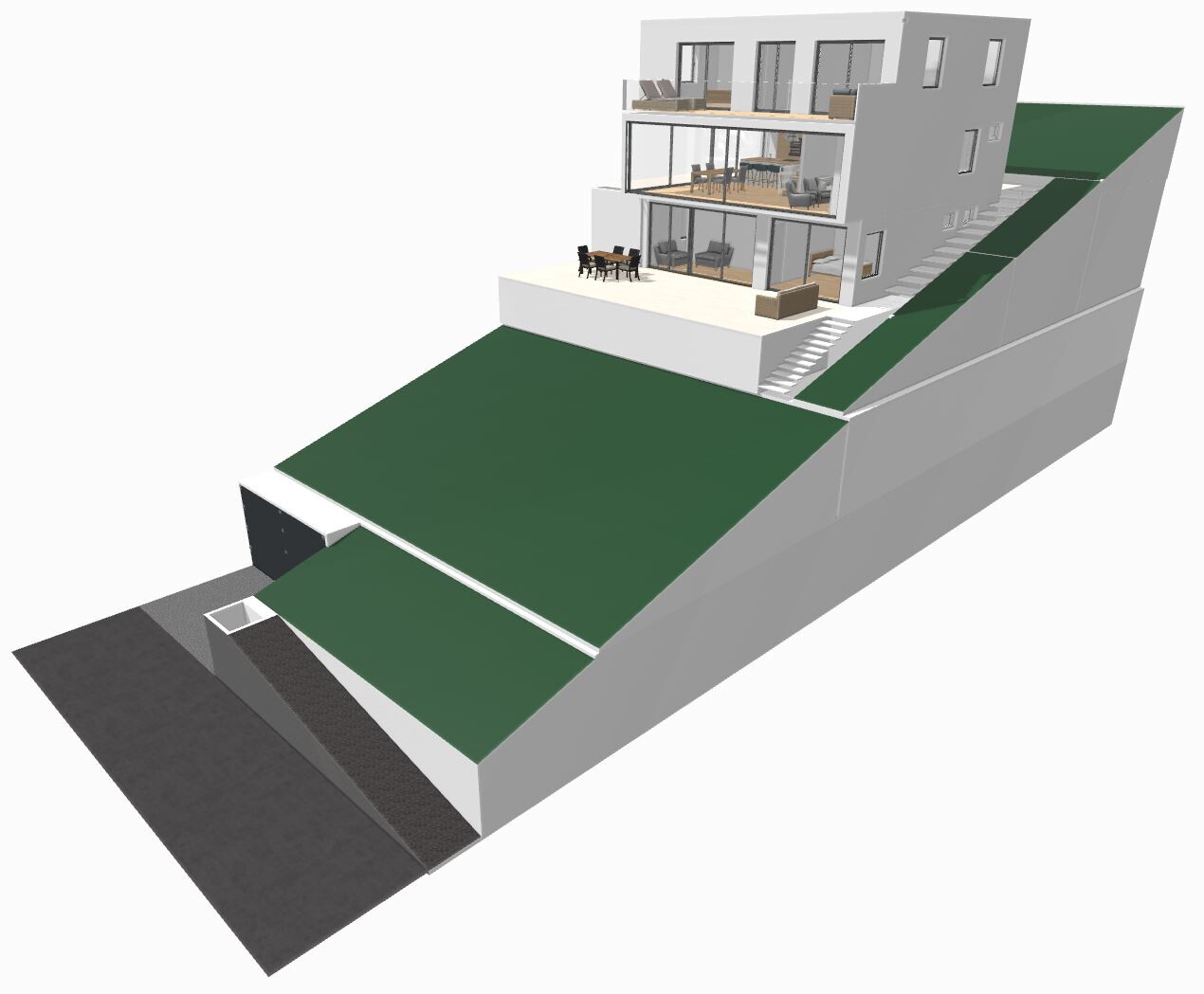
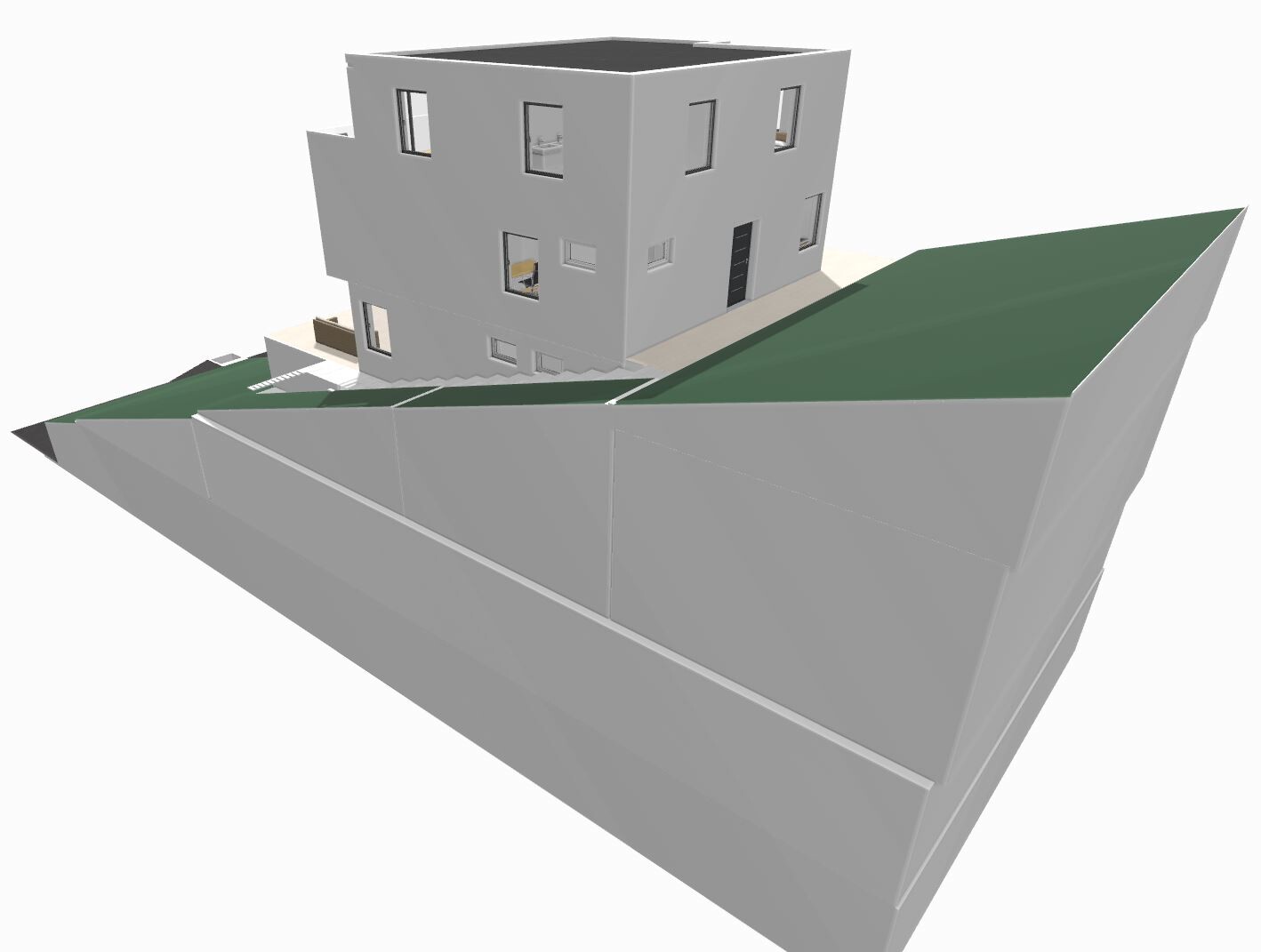

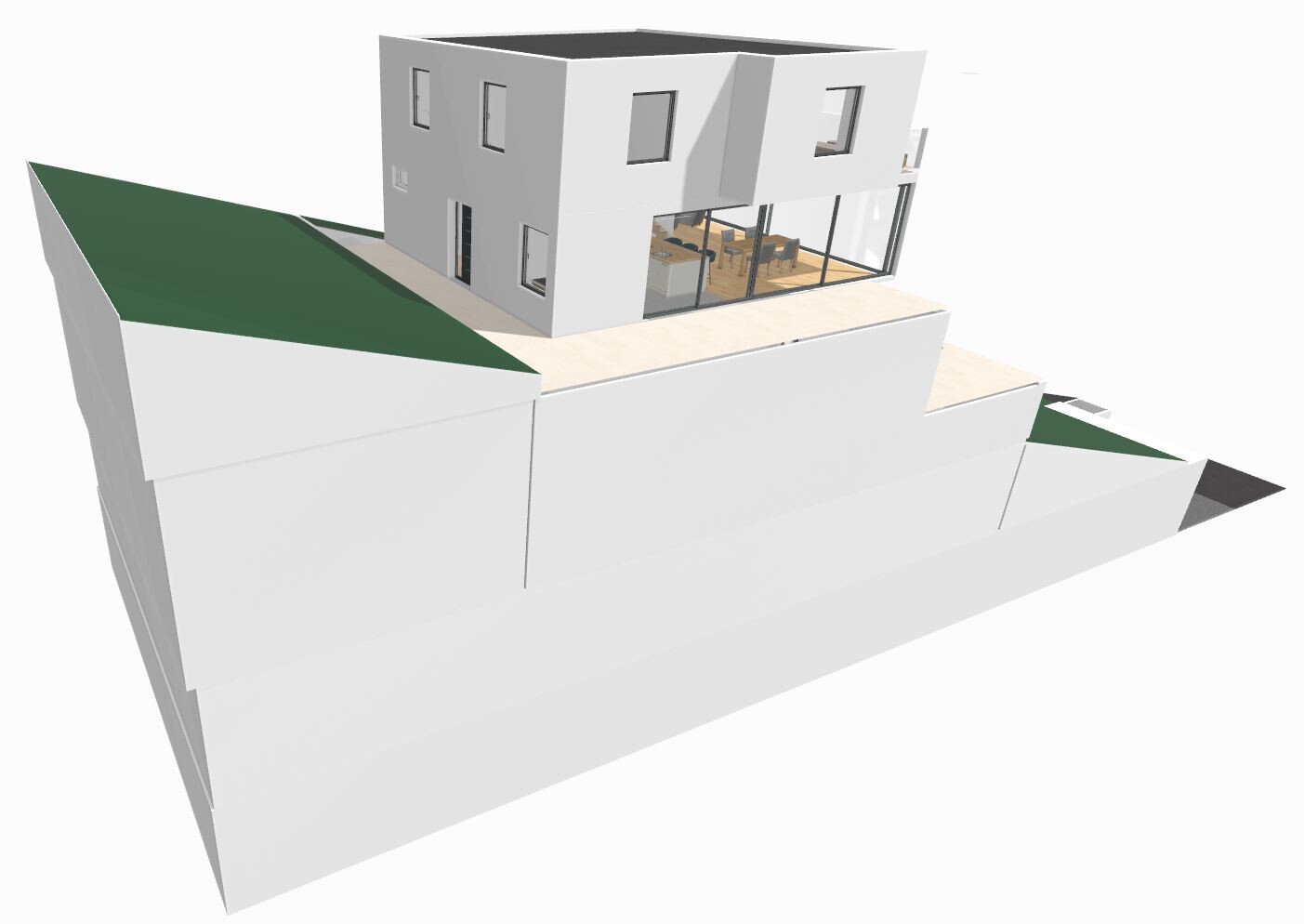
Plot size: 610 sqm (about 15 x 40 m) rectangular
Slope: East-facing slope, approximately 28% gradient. Road downhill. The house is planned to be positioned in the upper third on the hill side (for privacy and view).
Floor area ratio: n.a. (no development plan)
Plot ratio: n.a.
Building window, building line and boundary: n.a.
Setbacks: presumably 2.50 meters (8 feet 2 inches) in all directions
Number of parking spaces: n.a.
Number of floors: n.a.
Roof type: n.a.
Architectural style: n.a.
Orientation: n.a.
Maximum heights / limits: n.a.
Other requirements: There is no formal development plan. However, the street features a variety of house types, so almost any architectural style should be possible.
Client Requirements
Architectural style, roof type, building type: Bauhaus style, preferred flat roof (possibly also shed roof)
Basement, floors: Basement integrated as a living space in the slope, with two floors above
Number of occupants, ages: Currently 3 persons, aged 33, 32, and an infant
Space requirements on ground floor (GF), upper floor (UF):
GF: kitchen, pantry with sink niche, living room, study, WC, entrance area with dressing room
UF: master bedroom with dressing room, two children’s rooms, bathroom, roof terrace
Basement: guest room, guest bathroom, study, laundry room, technical room, storage room, fitness room
Office: currently family use, potential home office in future
Overnight guests per year: parents-in-law visit frequently
Open or enclosed layout: open
Traditional or modern construction: modern
Open kitchen, kitchen island: open kitchen with island
Number of dining seats: one large dining table
Fireplace: preferred, as shown in the floor plan
Music/speaker wall: possibly in the living room
Balcony, roof terrace: roof terrace facing the valley (east side)
Garage, carport: double garage detached from the house, cut into the slope at the street
Utility garden, greenhouse: no
Other wishes / special features / daily routine, including reasons why something should or should not be: no ventilation system, no smart home, photovoltaic system
House Design
Who designed it: do-it-yourself
Living area: approx. 230 sqm (including half the roof terrace area)
Usable area: approx. 260 sqm
What do you like most and why? The overhangs to the east and south, the glass facades, the integration into the slope, the straight staircase, the long visual axis on the ground floor
What do you like least and why? Possibly the entrance area as it may be too small; living room may be too small
Estimated cost according to architect/designer: not available yet
Personal budget for house including equipment: n.a.
Preferred heating technology: air-to-water heat pump, underfloor heating
If you have to compromise, on which details / extensions
- which can you do without: overhangs if much more expensive, flat roof if much more expensive
- which you cannot give up: glass facades
Why is the design as it is now?
The floor plans are a first draft, completely self-developed, and intended as a starting point for discussion. The design is based on three main principles: slope orientation, cardinal directions, and plot shape. Because of the east-facing slope, the larger floor-to-ceiling glass facades and living and dining rooms on the ground floor, as well as the guest room in the basement, are positioned facing east (offering a nice view of the valley). To allow access to the outside from the kitchen and take advantage of sunlight, the kitchen on the ground floor is adjacent on the south side, also with large glass facades. Another idea was to create a long line of sight to the valley directly upon entering the house, which is why the entrance is positioned on the uphill side. Functional rooms (bathrooms, technical room, dressing room, pantry, etc.) are generally oriented uphill (to the west). All WCs are stacked to simplify plumbing. The two 1-meter (3 feet 3 inches) cantilevers are mainly aesthetic but also provide some shading and would be dispensable if needed. The original shape was a simple 10 x 10 m (33 x 33 feet) cube, but this version is preferred by my wife and me. The glass facades are not yet fixed in size and serve as rough guidelines; they could be slightly smaller if structural requirements demand it. The straight staircase may be a point of discussion, although I personally find it very appealing visually.
Regarding privacy and neighbors: downhill side is not relevant due to the slope. On the uphill side a neighboring house is adjacent, so no open facades are planned there. On the north and south sides, houses are located further up the street, with tall trees and shrubs in between. This provides almost complete privacy.
Please ignore the outdoor areas not attached to terraces in the floor plans, as these were only used for rough simulation of the slope.
What is the key question about the floor plan, summarized in 130 characters?
Is our design heading in the right direction, or are there major issues we have overlooked?
The plan is also intended to obtain initial cost comparisons from various companies for a similar house. We understand that an architect will need to be involved in further planning.
We are grateful for any feedback!
RoterPapagei schrieb:
What you can afford and what you want to afford are two different things.Exactly. That’s why the question about the budget or calculation was included in the questionnaire, which unfortunately you didn’t address.RoterPapagei schrieb:
I think we would prefer not to spend more than 1 million on the house. Is that specific enough?That’s somewhat specific, see @borxx’s follow-up question.I mentioned earlier that you can calculate for yourself what is feasible. For me, the discussion about the 230 sqm (2,480 sq ft) or your approach is done. Many here feel the same, except for a few who still criticize your approach of the structurally complex million-dollar villa on a slope, which makes the villa even more expensive.
The design and visualization by @alles3d involves even more money. I don’t understand why someone would do this like a bad architect who ignores the client’s budget.
borxx schrieb:
Sorry for the silly question, just the house or the house including additional costs and a modeled plot of land and garage?Those are additional costs or they will apparently need to be subtracted from the budget. That doesn’t leave much room for major extras.A 26-degree slope is no joke—whether with or without a winding driveway. I’d say there’s not much left for a villa; it will be more like a conventional house.
borxx schrieb:
In your case, the difference can easily be much more than 200k.I don’t think you, @RoterPapagei, can get much more out of this thread unless you get precise numbers from professionals for the implementation. At least it’s clear that a plot with this slope is not suitable for a simply built dream house. A lot of the budget must go into additional construction costs and landscaping, funds that would be better spent on the house itself.R
RoterPapagei26 Aug 2022 14:00ypg schrieb:
Exactly. That’s why there was the question about the budget or cost estimate in the questionnaire, which unfortunately you didn’t address.
This is somewhat specific, see @borxx’s follow-up.
I mentioned earlier that you can calculate for yourself what is feasible. For me, the discussion about the 230sqm (2,480 sq ft) or your approach is over. For many others here as well, except for a few who still focus on your concept of the structurally complex luxury villa on a slope, which only makes the villa even more expensive.
With the design or rendering by @alles3d, it involves even more money. I don’t understand why anyone would do something like that, like a bad architect who ignores the client’s budget.
This is on top of that or apparently will have to be deducted from the budget. There won’t be much left for high-end extras. A 26-degree slope is no small matter – whether with or without a winding driveway. Let’s just say: not much remains for a villa, it will be more like a house.
I don’t think you can get much useful input from this thread from @RoterPapagei at the moment if you don’t get exact numbers for implementation from professionals. At least it can be said: a plot with this slope is not suitable for a straightforward wish house. A lot of budget has to go into additional building costs and landscaping, which you would rather invest in the house itself.More concretely: The house (just the house, as stated in my post, excluding earthworks) should not cost more than 1 million euros.
In any case, I want to sincerely thank alles3d and the others who are contributing constructively here and making suggestions. As mentioned before, the next step will be to consult a suitable architect. From my point of view, it’s never a mistake to exchange detailed information beforehand about the different possibilities and pros and cons of various designs. I have gained a lot from the posts here that I will take into account in further planning.
R
RoterPapagei26 Aug 2022 14:05borxx schrieb:
Sorry for the possibly obvious question, is the price for the house alone or does it include additional costs, as well as the modeled plot and garage? In your case, the difference can easily be well over $200,000. Do you have a soil report or at least some rough idea from neighbors about the type of soil? Because if there’s any decomposed rock present, all excavation cost estimates can be drastically affected. Is a pool part of the plan?
Are there only hedges or shrubs to the south, or are there tall trees that block all the light?
In the current design, the proportions don’t quite fit yet, but several wishes can be identified, such as a pantry, walk-in closet, separation of utility room and technical room. I would rethink it once more. Yes, we have kindly received a current soil report from a direct neighbor upon request. It shows (as far as we can judge) good structural conditions, so no decomposed rock (:.
A pool is not an issue.
There is one tree to the south, otherwise only shrubs. Depending on the positioning, there should still be enough light entering.
Thanks for your opinion on the proportions! I agree with that.
R
RoterPapagei26 Aug 2022 14:26alles3d schrieb:
Everything here is a bit more detailed. The floor plans are oriented to the north. The fitness room has been removed, but that also works in the guest room.
The facade has, in my opinion, the maximum window area. If I knew the surroundings better, I could probably distribute the windows more effectively. We would have liked the balcony on the upper floor to be much larger, but it should be enough for a few chairs or an outdoor shower.
If the children's rooms become smaller and the staircase is moved accordingly, the master area can be made even more luxurious. I have now examined the floor plans more closely. Thanks again for that!
My wife insists, for safety reasons, that the children's rooms must not have direct access to the outside (please don’t question this 🙂). I did not know that until now. Otherwise, I really like the layout!
A few basic questions:
1) Positioning the main entrance door centrally at the bottom is advantageous because a) it reduces the ascent and b) it allows the hallway and cloakroom to be located in the “less attractive” basement, thereby providing maximum space on the ground floor for living and dining areas. Are there other reasons for this as well?
2) Considering the size and space requirements (approximately 230 sqm (2,474 sq ft) of living space), is having a separate fitness room generally not recommended?
3) In the floor plan, the technical and utility rooms are now located on the hillside side, as in my original draft. This was cited as one of many criticisms of my "design." Is this purely a cost-related issue, or are there other significant reasons to place these rooms on the valley side instead?
RoterPapagei schrieb:
I have now taken a closer look at the floor plans. Thanks again for that!
My wife insists on positioning the children's rooms without direct access to the outside for safety reasons (please don’t question this 🙂). I didn’t know that until now. Otherwise, I really like the layout!
A few general questions:
1) Placing the front door centrally at the bottom is advantageous because a) of the reduced stairs to climb and b) the opportunity to locate the hallway and cloakroom in the “less attractive” basement, thus maximizing the space on the ground floor for living and dining areas. Are there any other reasons?
2) Is having a separate fitness room generally not recommended given the size and space requirements (around 230 sqm (2,474 sq ft) of living space)?
3) In the floor plan, the utility and housekeeping room is now located on the hillside, as in my draft. This was one of the many criticisms of my “draft.” Is this purely a cost-related issue, or are there other significant reasons to place these rooms rather on the valley-facing side? Hello @RoterPapagei, it was fun. I first tried to incorporate your wishes into a building. Whether it is financially feasible, only your architect can say for sure.
0. If that’s not acceptable, I would move the house out of the hillside again (closer to the street). That way, you save a lot of excavation and money, which has already been clearly pointed out here.
1. a and b are my reasons. Centrally placed because then I have two reasonably sized rooms on either side of the entrance and the shortest distance to the staircase.
2. I wasn’t able to place the fitness room properly in the basement. But if you remove the balcony from the upper floor (this also saves money and simplifies the building envelope) and make the bathroom a bit smaller, then the fitness room can be located where the balcony was. I actually like that quite a bit.
3. I didn’t read that as an issue; I don’t see a problem there. But I’m happy to be corrected on this point.
If the wall facing the street is high enough, you should have sufficient privacy.
We also have a technical room on the hillside side. But you need the ducting for supply and exhaust air on the floor above. Here, it is boxed in with a frame of approximately 60cm x 250cm (24 inches x 98 inches).
We once had a user with a hillside house with a steep slope and terraces. I can’t find the thread. I believe it was exposed concrete. That would be very helpful for the original poster.
We once had a user with a hillside house with a steep slope and terraces. I can’t find the thread. I believe it was exposed concrete. That would be very helpful for the original poster.
Similar topics