
ᐅ Single-family house floor plan, 2 full stories, approximately 180 m², on a 600 m² plot of land
Created on: 6 Oct 2021 00:29
M
Masterle25
Hello dear members,
like most others, I have also been quietly following along for quite some time. There are many great pieces of advice here.
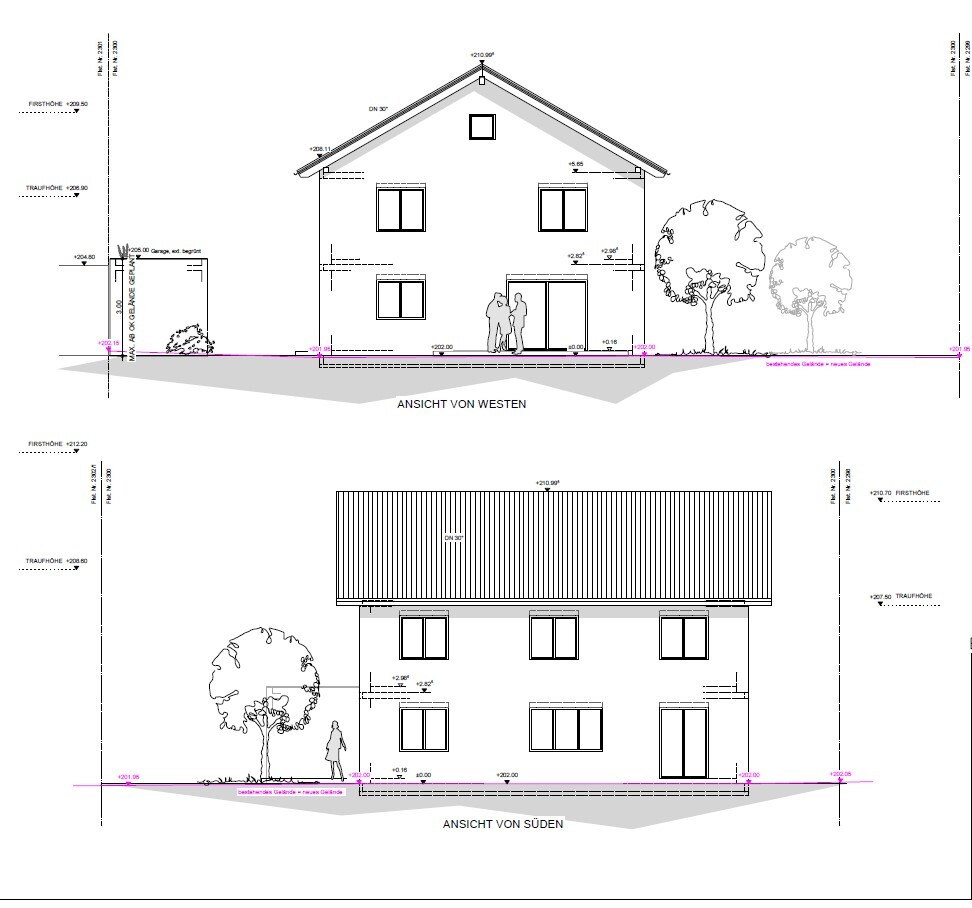
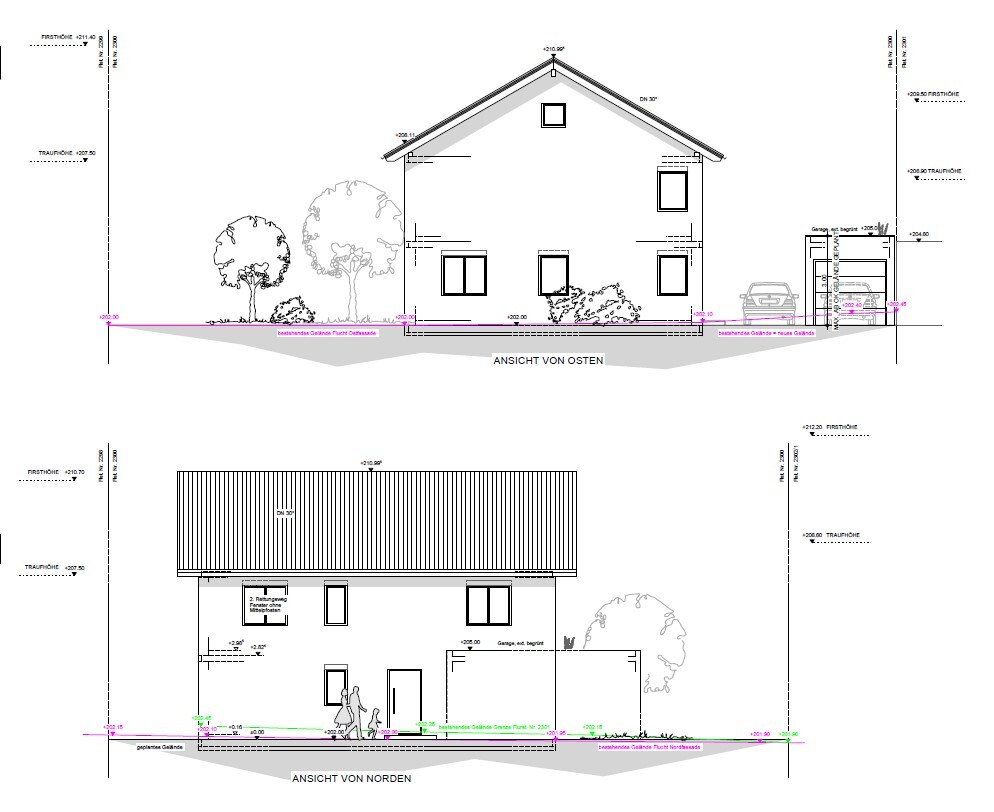
The building application has been submitted, and the exterior dimensions as well as the number of windows are fixed. Positioning is still negotiable in consultation, though only to a limited extent. Inside, we basically still have almost all options. The general contractor (GC) is a local family business and has been operating for over 20 years. They are consistently found in the surrounding new development areas, along with two other GCs, and their reputation is quite remarkable. (In fact, we spent quite some time interviewing the newly settled homeowners around us... *g*) One GC was excluded because of the building method (exclusively KfW 40+ standard), and another after submitting a proposal. The process so far has taken about 10 months, starting with graph paper, heating technology, necessary rooms, house positioning, and so on. There are great guides on this topic in the forum!
So, I hope these words were inviting enough to read through the list of questions. If I have forgotten anything, please let me know. I look forward to your feedback, critical comments are also welcome!
Development plan / Restrictions
No development plan
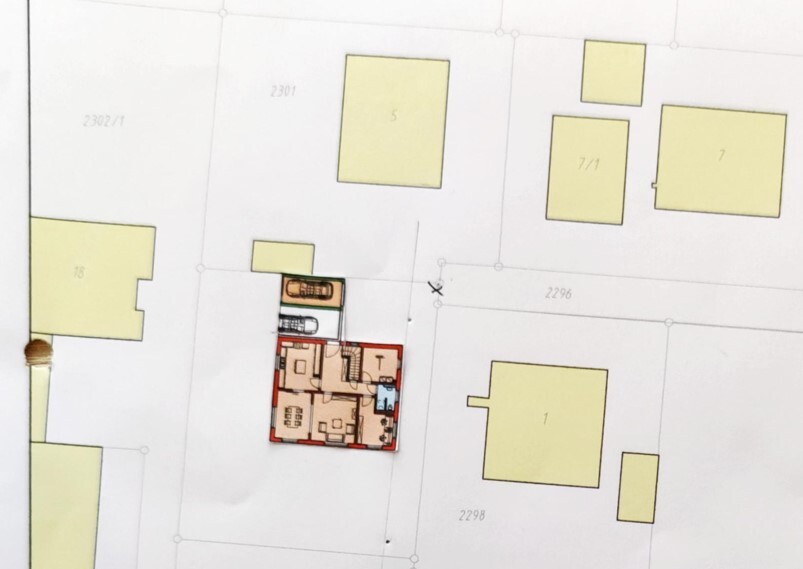
Plot size – 598 sqm (6,435 sq ft)
Slope – no
Floor area ratio – 0.3
Building window, building line and boundary – 3 m (10 feet) distance on all sides
Other stipulations – orientation aligned with neighboring buildings
The building project, including documents, has already been approved by the relevant building authority.
Homeowners’ requirements
Style, roof type, building type – gable roof / 30° pitch facing south with a 10 kWp photovoltaic system, KfW 55 EE standard
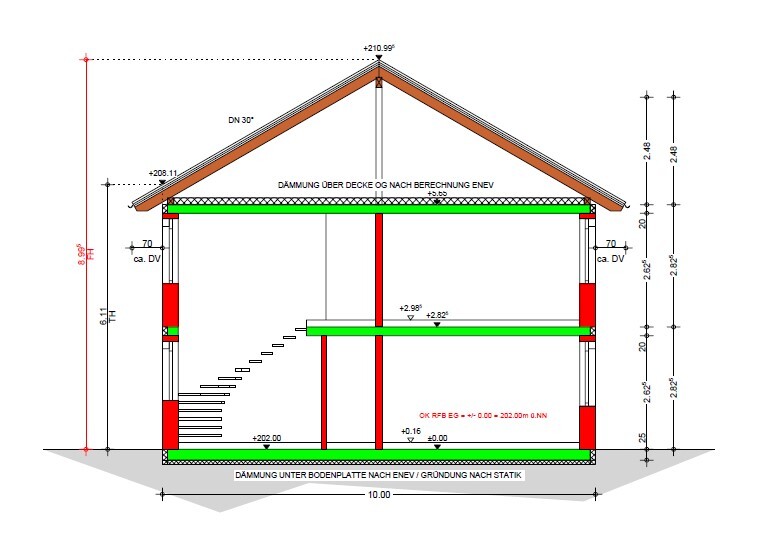
Basement, floors – slab-on-grade foundation, 2 full floors, unheated attic
Number of occupants, ages – currently 3 people, planned 4; ages 38, 35, 1
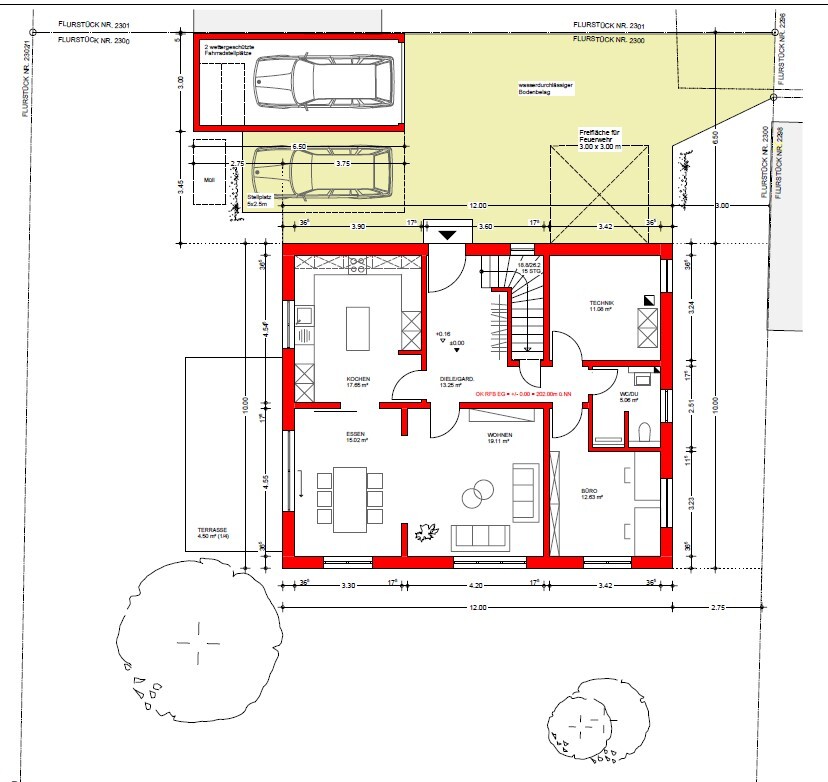
Space requirements on ground floor and upper floor – Ground floor: living/dining, closed kitchen, study/guest room, WC/bathroom, utility/technical room, guest WC including shower
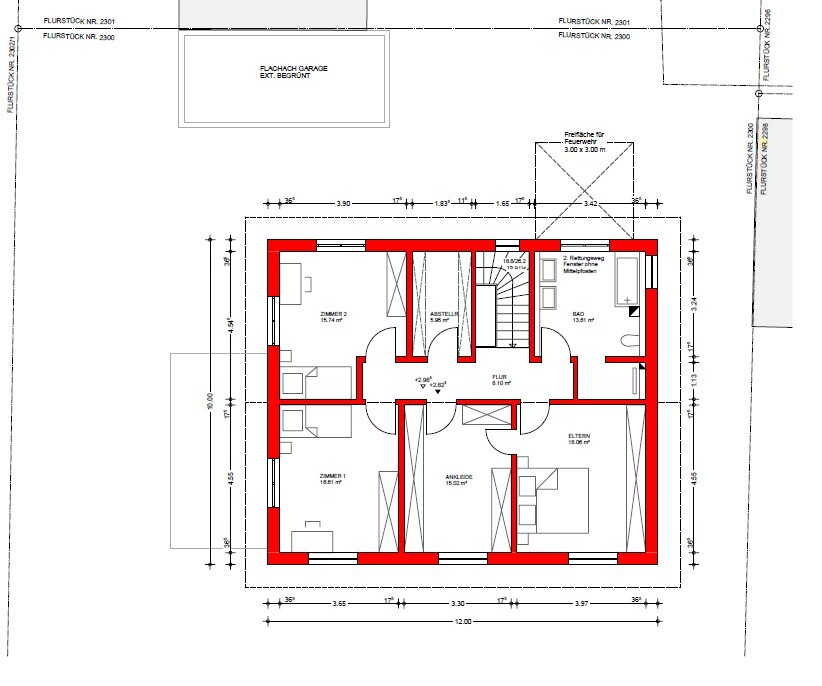
Upper floor: bedroom, dressing room (emergency room if 3rd child), 2 children’s rooms, bathroom
Office: 2 home office workstations
Guests per year: max. 5, excluding drunken friends, who usually make do with the couch *g*
Open or closed architecture: rather closed architecture
Conservative or modern construction: conservative
Open kitchen, island: closed kitchen, island only used as a workspace
Number of dining seats: 6
Fireplace: no
Music/speaker wall: TV wall
Balcony, roof terrace: none
Garage, carport: garage plus carport cover
House design
Who created the plan:
Planner from a construction company, based on our draft floor plan
What do you particularly like? Why? All necessary rooms are present in sufficient size
What do you not like? Why? Office entrance difficult to use, lack of space due to guest WC and living room widening
Fixed price: approx. 450,000€
Personal price limit for house, including fittings: 550,000€
Preferred heating technology: air-to-water heat pump + underfloor heating
If you had to give up something, which details/extensions:
- can give up: size of the dressing room
- cannot give up: office / two children’s rooms
Why did the design turn out like it is now?
Which wishes were implemented by the planner?
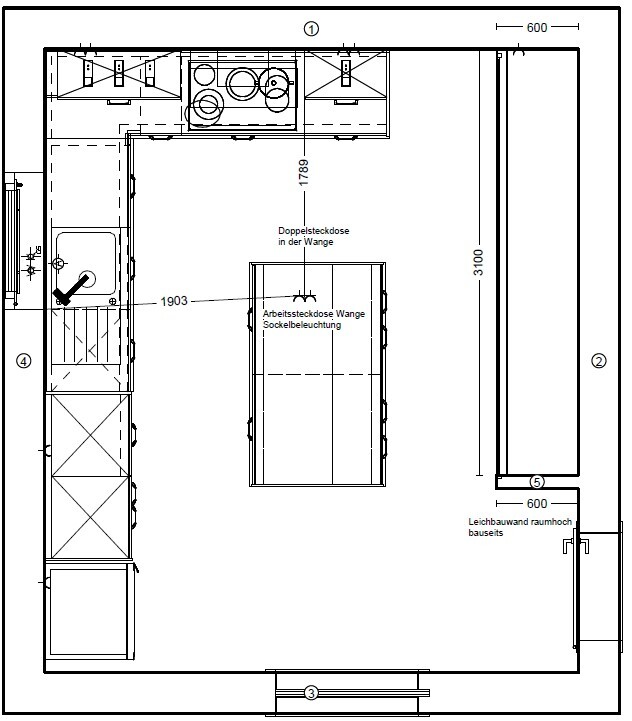
- We have already planned and commissioned the kitchen; floor plan adjusted accordingly (changes still possible)
We hesitated a long time over open vs. closed kitchen and, after deciding, debated for a long time over whether to have a pantry behind the kitchen front or not; it is now behind sliding elements on the right side (see attachment)
- Storage space under the stairs
- Bedroom window removed on the east side because of bedroom closet
- Living room widened due to TV wall and to gain space
What makes it particularly good or bad in your opinion?
All rooms are suitable for everyday use, and living on the ground floor later with minimal alterations is possible
What is the most important / fundamental question about the floor plan in 130 characters?
Are the individual rooms adequately lit? I have no sense of this at all. Any obvious flaws?
PS: North is at the top on the site plan as well as on both floor plans!
like most others, I have also been quietly following along for quite some time. There are many great pieces of advice here.
The building application has been submitted, and the exterior dimensions as well as the number of windows are fixed. Positioning is still negotiable in consultation, though only to a limited extent. Inside, we basically still have almost all options. The general contractor (GC) is a local family business and has been operating for over 20 years. They are consistently found in the surrounding new development areas, along with two other GCs, and their reputation is quite remarkable. (In fact, we spent quite some time interviewing the newly settled homeowners around us... *g*) One GC was excluded because of the building method (exclusively KfW 40+ standard), and another after submitting a proposal. The process so far has taken about 10 months, starting with graph paper, heating technology, necessary rooms, house positioning, and so on. There are great guides on this topic in the forum!
So, I hope these words were inviting enough to read through the list of questions. If I have forgotten anything, please let me know. I look forward to your feedback, critical comments are also welcome!
Development plan / Restrictions
No development plan
Plot size – 598 sqm (6,435 sq ft)
Slope – no
Floor area ratio – 0.3
Building window, building line and boundary – 3 m (10 feet) distance on all sides
Other stipulations – orientation aligned with neighboring buildings
The building project, including documents, has already been approved by the relevant building authority.
Homeowners’ requirements
Style, roof type, building type – gable roof / 30° pitch facing south with a 10 kWp photovoltaic system, KfW 55 EE standard
Basement, floors – slab-on-grade foundation, 2 full floors, unheated attic
Number of occupants, ages – currently 3 people, planned 4; ages 38, 35, 1
Space requirements on ground floor and upper floor – Ground floor: living/dining, closed kitchen, study/guest room, WC/bathroom, utility/technical room, guest WC including shower
Upper floor: bedroom, dressing room (emergency room if 3rd child), 2 children’s rooms, bathroom
Office: 2 home office workstations
Guests per year: max. 5, excluding drunken friends, who usually make do with the couch *g*
Open or closed architecture: rather closed architecture
Conservative or modern construction: conservative
Open kitchen, island: closed kitchen, island only used as a workspace
Number of dining seats: 6
Fireplace: no
Music/speaker wall: TV wall
Balcony, roof terrace: none
Garage, carport: garage plus carport cover
House design
Who created the plan:
Planner from a construction company, based on our draft floor plan
What do you particularly like? Why? All necessary rooms are present in sufficient size
What do you not like? Why? Office entrance difficult to use, lack of space due to guest WC and living room widening
Fixed price: approx. 450,000€
Personal price limit for house, including fittings: 550,000€
Preferred heating technology: air-to-water heat pump + underfloor heating
If you had to give up something, which details/extensions:
- can give up: size of the dressing room
- cannot give up: office / two children’s rooms
Why did the design turn out like it is now?
Which wishes were implemented by the planner?
- We have already planned and commissioned the kitchen; floor plan adjusted accordingly (changes still possible)
We hesitated a long time over open vs. closed kitchen and, after deciding, debated for a long time over whether to have a pantry behind the kitchen front or not; it is now behind sliding elements on the right side (see attachment)
- Storage space under the stairs
- Bedroom window removed on the east side because of bedroom closet
- Living room widened due to TV wall and to gain space
What makes it particularly good or bad in your opinion?
All rooms are suitable for everyday use, and living on the ground floor later with minimal alterations is possible
What is the most important / fundamental question about the floor plan in 130 characters?
Are the individual rooms adequately lit? I have no sense of this at all. Any obvious flaws?
PS: North is at the top on the site plan as well as on both floor plans!

Masterle25 schrieb:
This is the result of our preliminary planning and the suggested improvements from the draftsman/salesperson of the general contractor. Meanwhile, we are working with an architect from the general contractor who is also handling our building permit/planning permission application. The "botched pockets" do not affect approval; the architect will no longer correct them. She may notice them, but fixing them is not part of her job. She will have enough other tasks anyway, so these issues will probably remain in the working drawings.
Masterle25 schrieb:
Could you explain the consequences of the "botched pockets"? Nothing is fixed yet, after all. The dimensions are not detailed enough for me to precisely identify the botched pockets yet; currently, I cannot even count them. It’s possible their number remains limited. For example, on the wall behind the stove: 36.5 + 390 + 17.5 + x equals 444 + x cm (inches). If the door swing "x" is 6 cm (2.4 inches), it fits with whole bricks. "Nothing is fixed yet" unfortunately does not help, since the botched pockets are a planner’s and not a mason’s error. The mason has no choice but to improvise during construction: the lesser of two evils. But don’t worry—this will not seriously damage the house, and in the end you won’t see any impact. As a mason, however, I would curse my colleagues sitting in the office.
Nevertheless, I’m happy to answer your question about the consequences so you get an idea: when a mason builds a wall, they work from two fixed points toward each other—e.g., from a corner of the house toward a wall reveal (in the example above: the door reveal). So, first brick, second brick, third brick, last brick, second to last brick, third to last brick... always neatly with whole bricks, working efficiently. It gets tricky in the middle when the gap is not a whole brick length. 51 cm (20 inches) is no problem; that can be adjusted because the joint has enough tolerance in the interlocking profile. 52 cm (20.5 inches) is also manageable; then the mason adjusts twice. 49 cm (19 inches) is problematic; then they have to cut with a grinder. 48 cm (18.9 inches) is worse—too much for grinding, too little for sawing. So the mason cuts a bit more and fills the gap with mortar. You can be sure the mason will not prepare special insulating mortar just for that one joint; standard joint mortar will be used. This does not immediately cause cracks or mold issues, so no worries there. I don’t want to go through every possible combination, but there are also “unlucky wall dimensions” where the gaps are patched with leftover pieces. This regularly results in breaches of correct overlapping lengths (this term refers to how far two vertical joints of adjacent brick courses are deliberately not aligned to ensure stable bonding).
In conclusion: a small error, not a disaster. But on projects I supervise, something like this is still avoided.
https://www.instagram.com/11antgmxde/
https://www.linkedin.com/company/bauen-jetzt/
M
Masterle259 Oct 2021 17:2411ant schrieb:
But don’t worry about it; the house won’t suffer any significant damage from this, and in the end, you won’t even notice. As a bricklayer, I would curse my colleagues who slack off here.
Conclusion: minor workmanship issue, not a disaster, but in projects I oversee, something like this would still be avoided. Thank you for the very detailed explanation and for taking the time to write such an instructive post. I feel like you actually need to build the house twice to get it mostly right on the second try. At least now I know that choosing a turnkey build was the right decision, leaving the craftwork to those who really know what they’re doing. If I had known you offer construction consulting, I would definitely have reached out earlier! 😉 If you have any other critical thoughts on different topics, I’m all ears! 🙂
Masterle25 schrieb:
Thanks for the very detailed explanation and also for the time you put into such an educational post. I feel like you would actually need to build twice to get things almost mistake-free the second time around. You're welcome, I enjoy writing anyway ;-)
As the saying goes, you shouldn’t just build twice, but three times (once for an enemy, once for a friend, and only then for yourself). Most homeowners represented here (up to 40 years old) will build twice: once at the threshold of starting a full family, and a second time when they become a couple again and want to downsize their home, incorporating a lot of living experience into the new design.
Masterle25 schrieb:
If I had known you offer construction consulting, I definitely would have reached out earlier! 😉 If you have any other critical thoughts about different things, feel free to share! You’re still welcome to get in touch anytime; see the “Information” section in my profile. Also feel free to reach out about small stuff, like if you have detailed plans where you want to mark suspected shoddy workmanship spots for your expert to check.
https://www.instagram.com/11antgmxde/
https://www.linkedin.com/company/bauen-jetzt/
Question for the floor plan experts: Wouldn't it make sense to remove the door from the hallway to the living room? I see the advantage that the living room would be easier to furnish since the TV stand wouldn’t be so cramped at the edge, and it should also feel cozier if the living room is not a walk-through room. Or would the path from the sofa to the bathroom be too long then?
Glad you want to ask 🙂
miriam85 schrieb:
Question for the floor plan experts: Wouldn’t it make sense to remove the door from the hallway to the living room? I see the advantage that the living room would be easier to furnish,
miriam85 schrieb:In my view, this depends on personal use and habits. For a main passage, I don’t find the kitchen door easily accessible enough; the living room door can be kept closed, and it seems the kitchen is not intended as a passage area here.
if the living room is not a walk-through room?
miriam85 schrieb:I don’t see the sofa-to-bathroom path as something that needs to be considered—it’s a manageable single-family house, so walking a few steps through the rooms is normal. The path from the bedroom to the toilet would generally be more relevant as a consideration.
Or is the path from the sofa to the bathroom too long then?
Similar topics