
ᐅ Single-family house floor plan 110 m² – Ground floor + Upper floor – First draft room layout
Created on: 25 Aug 2021 08:40
R
ruebe87
Good morning,
we have now received the first draft of the interior layout for our single-family home from our planner, but we are not quite satisfied, as some of our requests were unfortunately not taken into account. Accordingly, we are disappointed because this will be a "life project" for us, and we feel somewhat let down.
It is a terraced house with a total area of 110m² (1,184 sq ft), divided into 2 floors of 55m² (592 sq ft) each. Additionally, there is a basement and an attic, although the attic cannot be used as living space.
In the basement, we want the kitchen and dining area on the south side, the living room further back, which can be closed off with a sliding door to create a potential retreat space. There should also be a small storage room for food and miscellaneous items as well as a guest toilet.
On the upper floor, there is a master bedroom of about 16m² (172 sq ft) with direct access to a large bathroom, two children's bedrooms, and a separate small bathroom.
In my opinion, shifting the staircase might be a good idea, but since we are not experts, we have fully relied on our planner so far.
Another meeting with him will take place in the next few days, and perhaps you have suggestions and input that we could bring up concretely.
Thank you very much in advance!
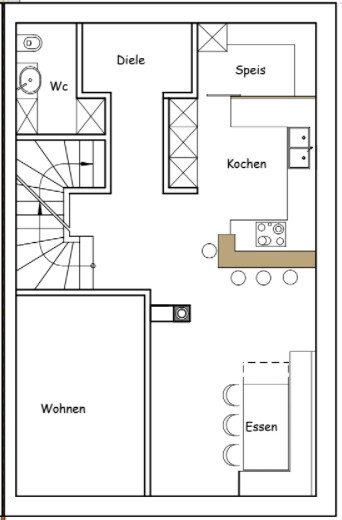
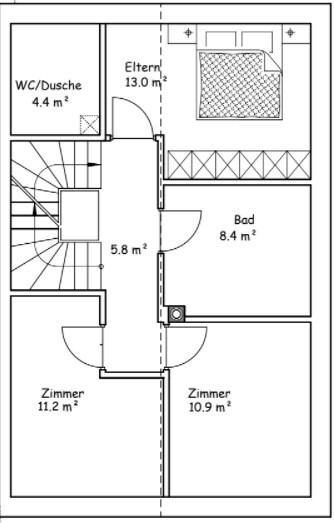
we have now received the first draft of the interior layout for our single-family home from our planner, but we are not quite satisfied, as some of our requests were unfortunately not taken into account. Accordingly, we are disappointed because this will be a "life project" for us, and we feel somewhat let down.
It is a terraced house with a total area of 110m² (1,184 sq ft), divided into 2 floors of 55m² (592 sq ft) each. Additionally, there is a basement and an attic, although the attic cannot be used as living space.
In the basement, we want the kitchen and dining area on the south side, the living room further back, which can be closed off with a sliding door to create a potential retreat space. There should also be a small storage room for food and miscellaneous items as well as a guest toilet.
On the upper floor, there is a master bedroom of about 16m² (172 sq ft) with direct access to a large bathroom, two children's bedrooms, and a separate small bathroom.
In my opinion, shifting the staircase might be a good idea, but since we are not experts, we have fully relied on our planner so far.
Another meeting with him will take place in the next few days, and perhaps you have suggestions and input that we could bring up concretely.
Thank you very much in advance!
ruebe87 schrieb:
I never said that I *wanted* to fit all of that in or insisted that it had to work somehow. Ok, we will drop the pantry. Ok, we will drop the second bathroom and make the children's rooms a bit larger instead. No problem. If your builder/architect didn’t tell you this, then we have now. In the end, it has reached you. You can try, but overall the design has to work. Maybe you could consider switching to a gas or ethanol fireplace instead?
ruebe87 schrieb:
Constructive criticism is always welcome, but I can’t do much with statements like "a 110 m² (1,184 sq ft) house is not a lifelong project but just a compromise." Yes, but why are there no answers about the basement, where the driveway will be located, how the strip of land on the east side is arranged, and whether windows can or will be installed on the east side? Without this information, you can’t make a proper suggestion—or do you see it differently, @ruebe87?
M
Myrna_Loy26 Aug 2021 09:28Open-plan living certainly provides a more spacious feel, but beyond a certain size, it can easily start to resemble what is common in studio apartments: a lack of storage space and places to put things. Zoning becomes extremely important then. Even if you say that storage is provided by the basement and attic, many items are best kept within reach but not always visible in the living area, especially when you have children in the household.
 Winniefred26 Aug 2021 09:30
Could you please explain in more detail the legal requirements regarding the room in the attic? This must be clearly defined. Would it be allowed to set up a play area for the children there, for example? I would like to take a closer look at this. The space must be useful for something. And from when can it be officially used as a living area?
We live in a 100m2 (1,076 sq ft) terraced house. It works perfectly for us. However, ours is spread over three levels, and our house has different exterior dimensions. We have a "large bathroom," which is still smaller than what most here consider a second bathroom, and on each floor there is a toilet with a washbasin.
In tighter spaces, simple layouts without complicated corners and focusing on what is really necessary help a lot. Compromises are unavoidable. But in return, you will have a house that doesn’t require excessive maintenance, has lower energy costs, and will still suit you when the children have moved out.
We live in a 100m2 (1,076 sq ft) terraced house. It works perfectly for us. However, ours is spread over three levels, and our house has different exterior dimensions. We have a "large bathroom," which is still smaller than what most here consider a second bathroom, and on each floor there is a toilet with a washbasin.
In tighter spaces, simple layouts without complicated corners and focusing on what is really necessary help a lot. Compromises are unavoidable. But in return, you will have a house that doesn’t require excessive maintenance, has lower energy costs, and will still suit you when the children have moved out.
M
Myrna_Loy26 Aug 2021 09:39It can also be helpful to look for living inspiration from other countries to get ideas on how to design small spaces. In many major cities, small floor plans are common, and small houses are widespread, for example, in the UK or the Netherlands. The currently popular furniture and living arrangements in Germany, often in minimalist beige, gray, and natural tones, tend to be quite bulky in terms of space requirements. I would suggest searching on Pinterest with keywords like small bathrooms, small bedrooms, small kitchens to perhaps move away from standard furnishings.
S
saralina8726 Aug 2021 09:56haydee schrieb:
@saralina87 don’t you have a house with similar dimensions, or am I mixing things up?
Yes, our house has very similar dimensions.If you’re interested, I can share our floor plan with you, @ruebe87?
H
hampshire26 Aug 2021 10:03Myrna_Loy schrieb:
Open-plan living certainly creates a more airy feel, but beyond a certain size, it easily slips into something reminiscent of a studio apartment. You end up with a lack of storage and nowhere to put things. That’s true. The more open you design the space, the more discipline is needed to keep belongings to a minimum. Otherwise, it will become constant clutter.
Myrna_Loy schrieb:
Zoning then becomes extremely important. Even if you say you have storage in the basement and attic, many items—especially with children in the household—need to be accessible in the living areas but not always visible. Very important! Children have different needs than adults. They require extra space—and there’s always something new, not just because of generous gifting from others, but also due to changing demands as they grow older. We didn’t consider this in our terraced house and frequently had an uncomfortable mess at home—like several of our neighbors, actually.
Winniefred schrieb:
In tighter spaces, simple floor plans without unnecessary nooks and focusing only on what’s truly essential help a lot. Yes, this is a good occasion to look at the Bauhaus style for inspiration. Few design movements have put the essentials so clearly at the forefront. Some figures from Bauhaus focused on the rational, functional use of space—for example, the brilliant and often overlooked architect Margarete Schütte-Lihotzky. It can be said that the Bauhaus school laid a crucial foundation for what we now call “modern.” (That it has become common to call every angular building with a flat roof “Bauhaus” is just as absurd as calling a station wagon “sporty”—pure marketing nonsense. I just couldn’t resist...)
Similar topics