
ᐅ Floor Plan Silverager New Single-Family House with Option to Upgrade to a Two-Family House
Created on: 15 Nov 2025 20:20
U
Underdog
Hello everyone,
As our planned construction project is gradually taking shape, I would like to share a first draft for discussion.
The plot is already secured, and we want to make full use of the space to maximize potential living area. Retirement is foreseeable for both of us, but after 28 years, we still want to build once more.
Our eldest daughter has made us grandparents twice over, and we often enjoy having the grandchildren stay during the day so their mother can go to work. Our younger daughter will be studying for about four more years and is planned to have her own space in the basement, which could later be converted into a guest room, office, etc. The plan includes a separate entrance via a generous lightwell, but with access to the ground floor (maximum of two living units).
The attic is not intended to be finished right away but will be designed for potential future development. Whether this will ever be implemented remains uncertain.
The ground floor should offer approximately 125 sqm (1,345 sq ft) within a 10x15m (33x49 ft) building envelope. The open kitchen/dining/living area should accommodate many guests, as we frequently host large family gatherings and groups of friends. The bathroom should be en suite, and the guest toilet should include a shower. A multipurpose room is planned as a utility/laundry room with direct access to the garden, serving as a mudroom with an integrated sink and/or washing machine. In emergencies, this room can also serve as a guest bedroom. This will be less necessary once the basement is available.
The ground floor is optimized for a couple without children but should also work well for families without needing to use the attic. The attic is designed to function as a fully independent living unit, which we consider important for maintaining property value.
Families with young children could use the utility room as a children's bedroom, while older children could occupy two bedrooms with a bathroom in the basement.
Our main request is constructive feedback on the draft. We like the ground floor layout so far but are open to improvements.
We haven’t spent much time on the attic plan yet; we find the concept acceptable for now. We do like the idea of accessing the attic via an external staircase, ensuring completely separate entrances for the attic and ground floor. If more information is needed, I am happy to provide it.
Development Plan / Restrictions
Plot size: 677 sqm (7,284 sq ft)
Slope: 1m (3 ft) decline from sidewalk to field path
Floor area ratio:
Floor space index:
Building envelope, building line, and boundary: Exact building envelope for garage and house as shown in the draft
Adjacent buildings: Gap site with similar neighboring plots on left and right, development plan
Parking spaces: Double garage
Number of floors: 1
Roof type: Gable roof
Style: Modern
Orientation: Sketch shows southwest at the top
Maximum heights/limits: Ridge line max 8m (26 ft) above ground floor level, side exterior walls max 4m (13 ft)
Additional requirements
Owners’ Requirements
Style, roof type, building type:
Basement, floors: Basement yes, attic planned but not to be finished
Number of occupants, ages: Couple nearing retirement on ground floor, daughter (with partner) in basement until end of studies in about 4 years
Space needs on ground floor and upper floor: approx. 125 sqm (1,345 sq ft) ground floor, potential about 100 sqm (1,076 sq ft) upper floor, approx. 60 sqm (646 sq ft) finished basement
Office: Family use or home office?
Number of overnight guests per year: about 2–3 times per year
Open or closed architecture: Open
Conservative or modern building style: Modern
Open kitchen, kitchen island: Yes
Number of dining seats: Many, at least for 8, preferably 12
Fireplace: Somewhat
Music/sound system: Large TV, but not a priority
Balcony, roof terrace: Balcony planned facing northwest, as this side overlooks open fields
Garage, carport: Double garage, wide covered side walkway to the main entrance, effectively functioning as a carport
Utility garden, greenhouse: Raised beds for herbs and various berries (for grandchildren)
Further wishes, special features, daily routine, including reasons for choices or exclusions
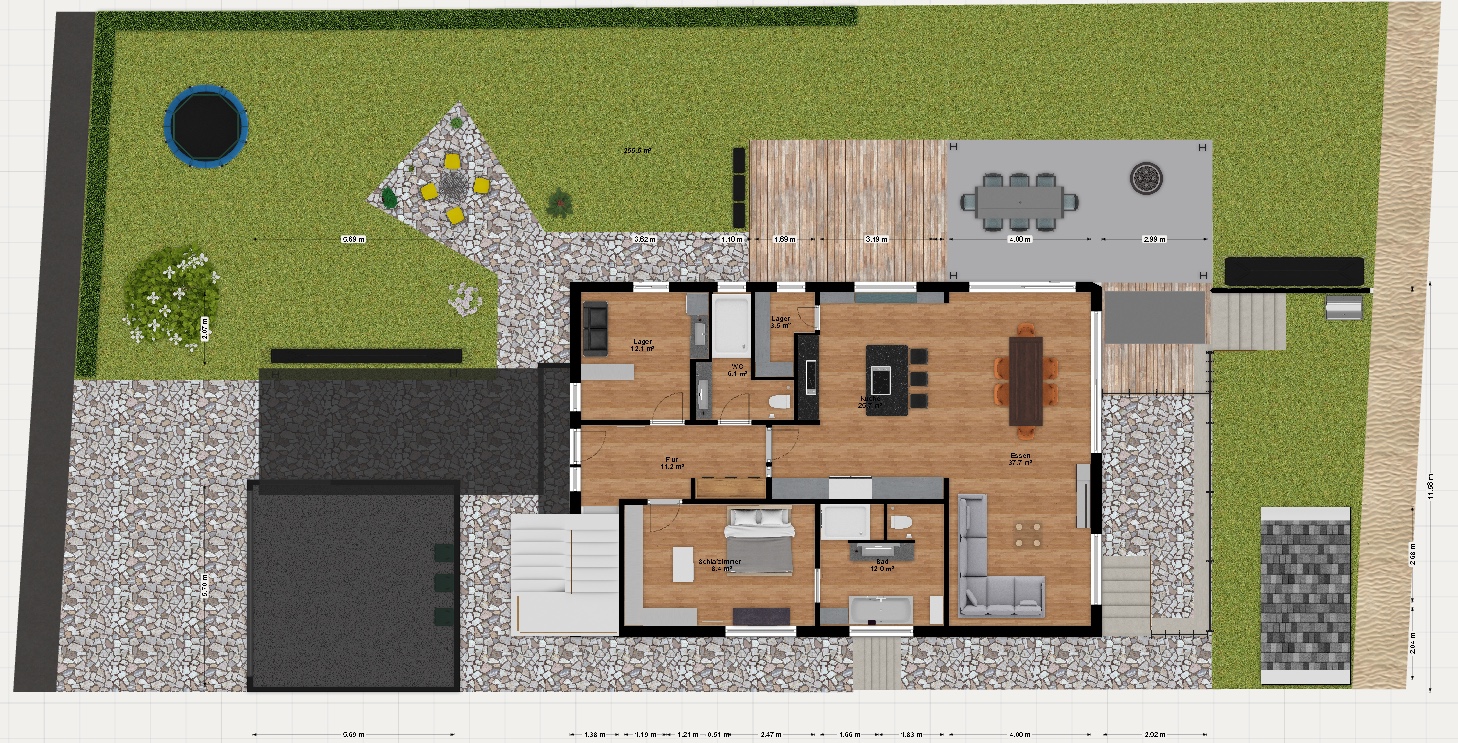
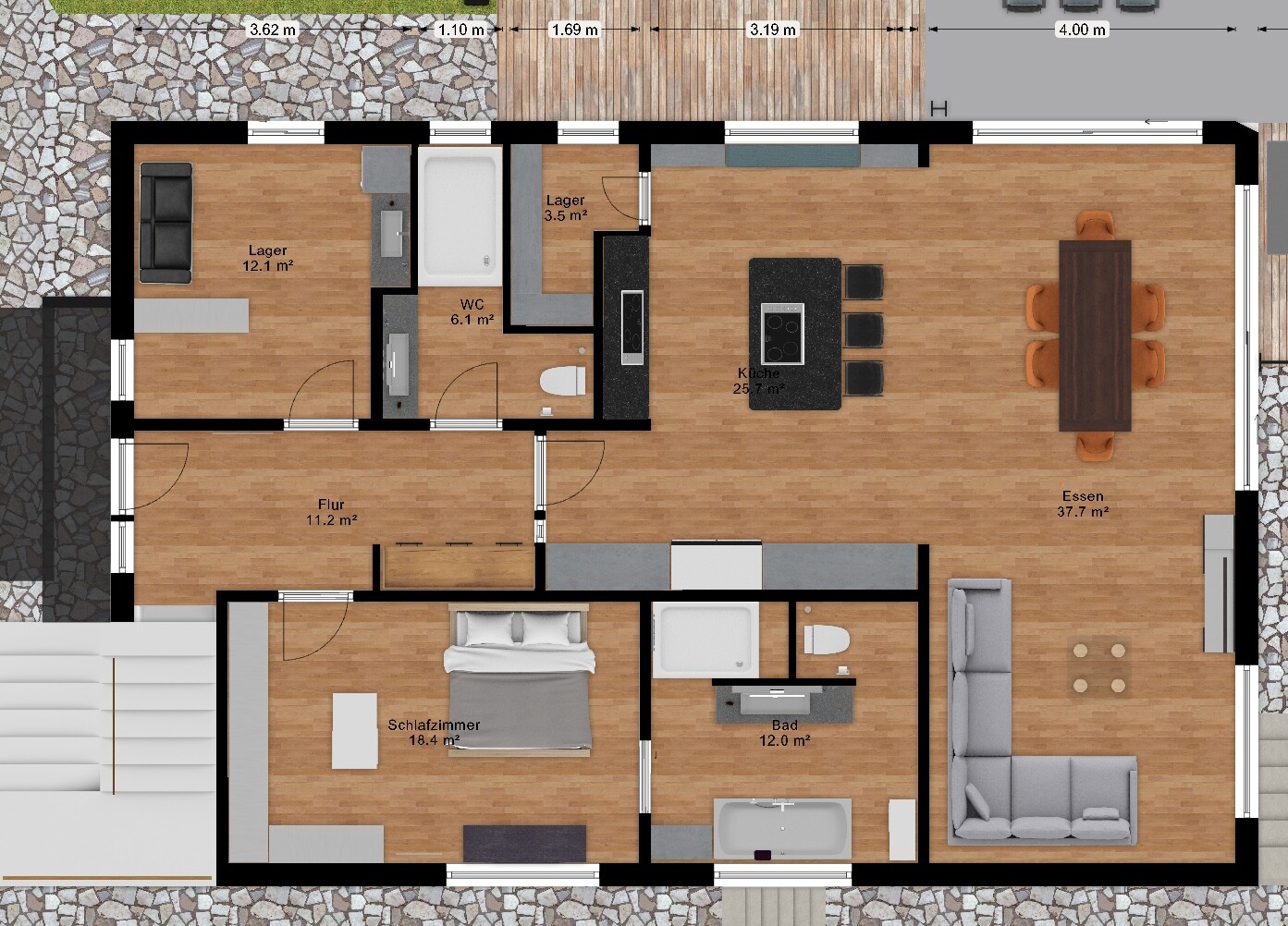
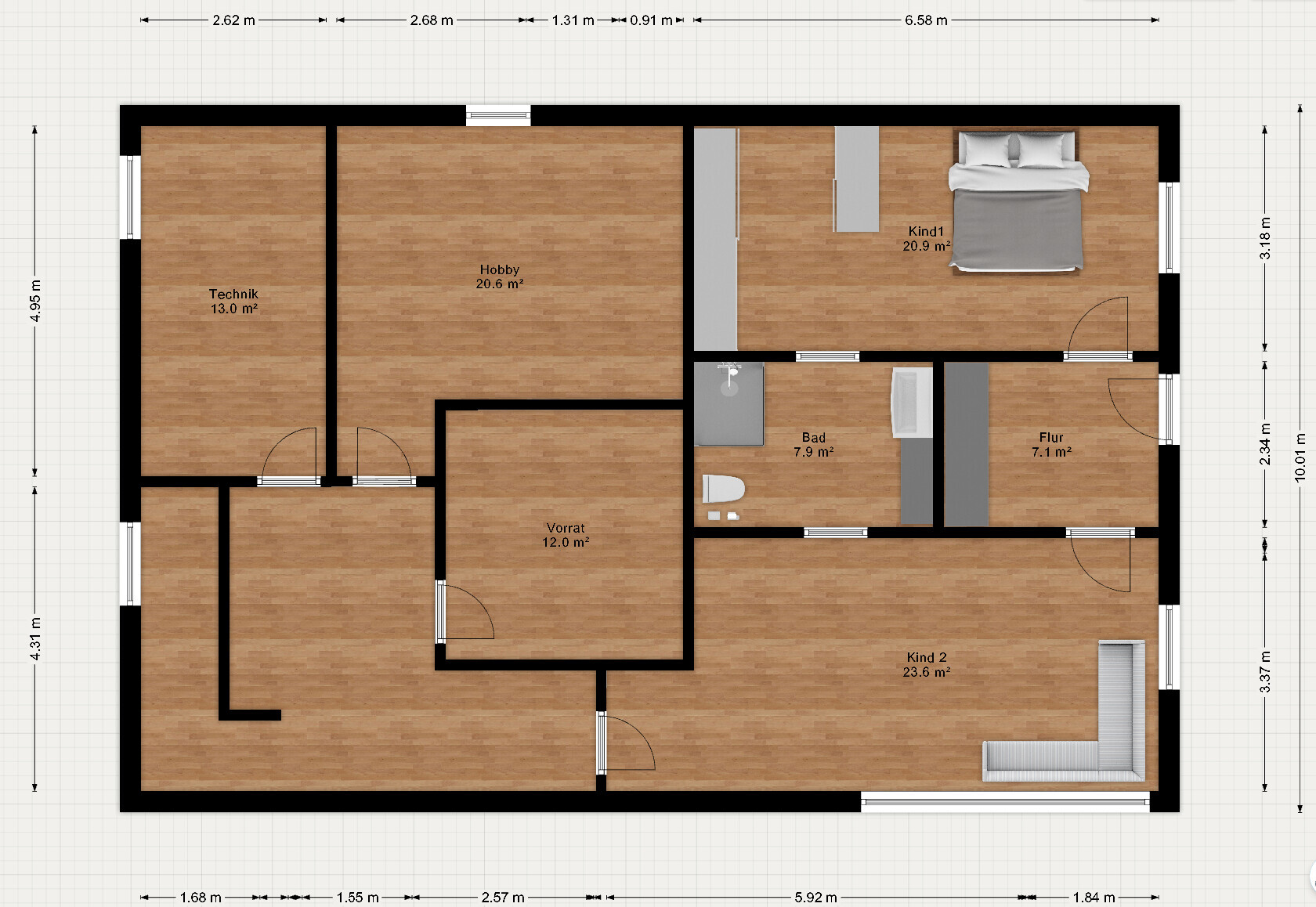
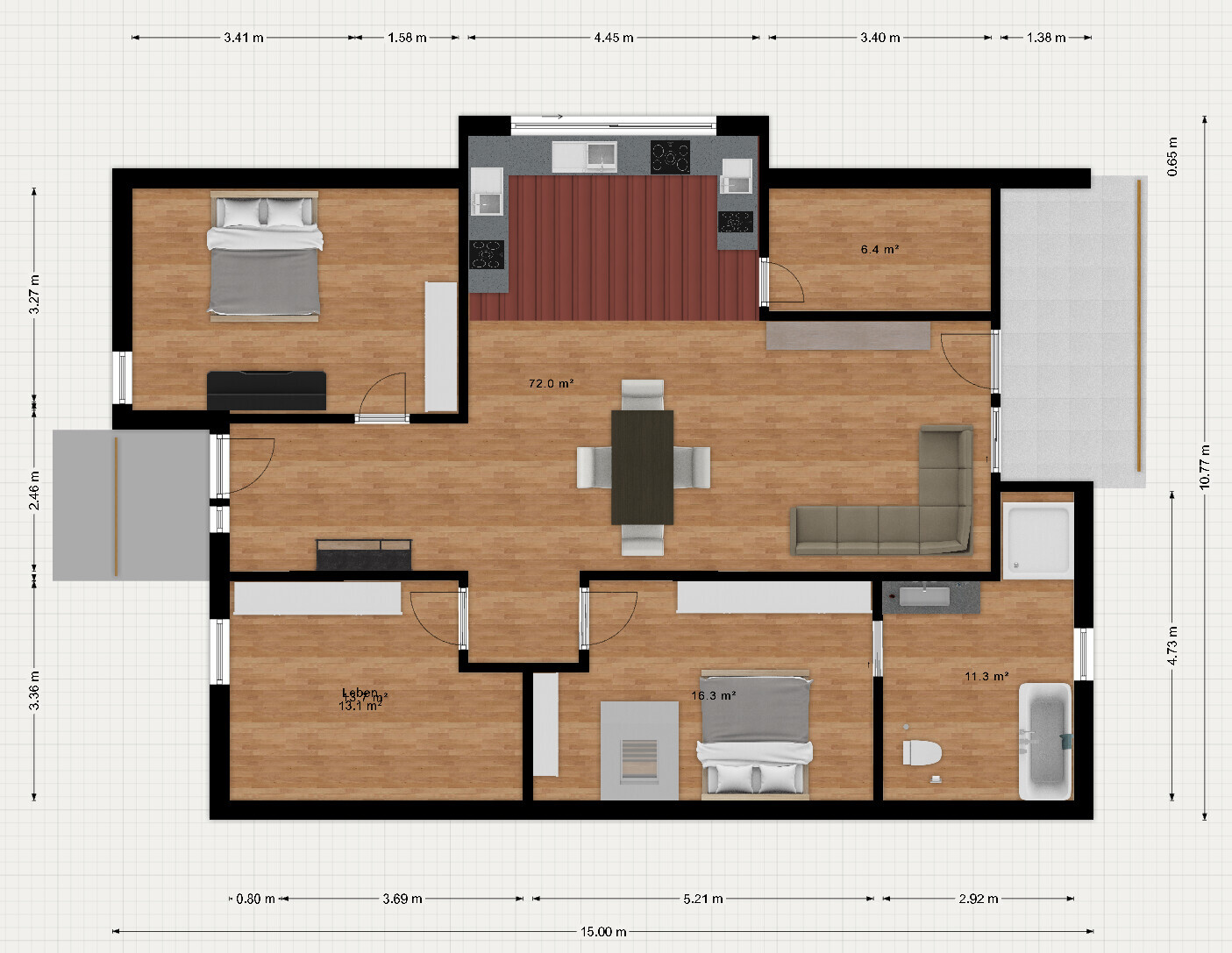
As our planned construction project is gradually taking shape, I would like to share a first draft for discussion.
The plot is already secured, and we want to make full use of the space to maximize potential living area. Retirement is foreseeable for both of us, but after 28 years, we still want to build once more.
Our eldest daughter has made us grandparents twice over, and we often enjoy having the grandchildren stay during the day so their mother can go to work. Our younger daughter will be studying for about four more years and is planned to have her own space in the basement, which could later be converted into a guest room, office, etc. The plan includes a separate entrance via a generous lightwell, but with access to the ground floor (maximum of two living units).
The attic is not intended to be finished right away but will be designed for potential future development. Whether this will ever be implemented remains uncertain.
The ground floor should offer approximately 125 sqm (1,345 sq ft) within a 10x15m (33x49 ft) building envelope. The open kitchen/dining/living area should accommodate many guests, as we frequently host large family gatherings and groups of friends. The bathroom should be en suite, and the guest toilet should include a shower. A multipurpose room is planned as a utility/laundry room with direct access to the garden, serving as a mudroom with an integrated sink and/or washing machine. In emergencies, this room can also serve as a guest bedroom. This will be less necessary once the basement is available.
The ground floor is optimized for a couple without children but should also work well for families without needing to use the attic. The attic is designed to function as a fully independent living unit, which we consider important for maintaining property value.
Families with young children could use the utility room as a children's bedroom, while older children could occupy two bedrooms with a bathroom in the basement.
Our main request is constructive feedback on the draft. We like the ground floor layout so far but are open to improvements.
We haven’t spent much time on the attic plan yet; we find the concept acceptable for now. We do like the idea of accessing the attic via an external staircase, ensuring completely separate entrances for the attic and ground floor. If more information is needed, I am happy to provide it.
Development Plan / Restrictions
Plot size: 677 sqm (7,284 sq ft)
Slope: 1m (3 ft) decline from sidewalk to field path
Floor area ratio:
Floor space index:
Building envelope, building line, and boundary: Exact building envelope for garage and house as shown in the draft
Adjacent buildings: Gap site with similar neighboring plots on left and right, development plan
Parking spaces: Double garage
Number of floors: 1
Roof type: Gable roof
Style: Modern
Orientation: Sketch shows southwest at the top
Maximum heights/limits: Ridge line max 8m (26 ft) above ground floor level, side exterior walls max 4m (13 ft)
Additional requirements
Owners’ Requirements
Style, roof type, building type:
Basement, floors: Basement yes, attic planned but not to be finished
Number of occupants, ages: Couple nearing retirement on ground floor, daughter (with partner) in basement until end of studies in about 4 years
Space needs on ground floor and upper floor: approx. 125 sqm (1,345 sq ft) ground floor, potential about 100 sqm (1,076 sq ft) upper floor, approx. 60 sqm (646 sq ft) finished basement
Office: Family use or home office?
Number of overnight guests per year: about 2–3 times per year
Open or closed architecture: Open
Conservative or modern building style: Modern
Open kitchen, kitchen island: Yes
Number of dining seats: Many, at least for 8, preferably 12
Fireplace: Somewhat
Music/sound system: Large TV, but not a priority
Balcony, roof terrace: Balcony planned facing northwest, as this side overlooks open fields
Garage, carport: Double garage, wide covered side walkway to the main entrance, effectively functioning as a carport
Utility garden, greenhouse: Raised beds for herbs and various berries (for grandchildren)
Further wishes, special features, daily routine, including reasons for choices or exclusions
Okay, I’ll start over. This morning I gave and answered many quotes, but then I realized that certain topics don’t really belong here—for example, questioning basic assumptions, challenging the amount of living space, or pointing out planning errors.
The fundamental rule in housebuilding is to incorporate your wishes as efficiently and attractively as possible. If it is still widely accepted among silver agers that a house without a basement is not really a house, then I personally question that mindset, the user’s perception, and their reflections. Someone in the silver-age group should have long recognized that needs change over time; that some things should perhaps be simpler or smaller than when you were younger, planning a nest for a growing family—when you don’t yet know where life’s long journey will take you, but you do know which areas should later be planned more comfortably.
Now, you had, correct me if I’m wrong, the desire to live all on one level. But this wasn’t achieved here because you included a basement in the plan. You argue using your adult child and the slope of the land. I think this is already a flawed assumption, because a small height difference in the terrain does not justify a basement; nor does a youth room or area justify one. Ultimately, you will be left with rooms you personally no longer need. You argue that the design supports resale value and the flexibility of children’s rooms, thus making it more economically attractive.
1. Let’s focus on your plan with your daughter: your daughter would have to walk around half the house to reach her entrance. She passes by your bedroom and bathroom. In summer, she has direct access to your garden. So, if she ever lives independently, she is below your living room window. But she can also use the basement hallway and an enclosed basement staircase up to the ground floor. Yes, you can now see this and better understand your design.
2. Focusing on resale to a family with two small children later: they would have to use a narrow, uncomfortable basement staircase to care for their two toddlers. Not only that, but the outside door to the courtyard can be locked for safety, yet you have to pass through one child’s bedroom to get to the other. This makes the house—or rather, the ground floor apartment—less attractive for families.
3. Considering resale to a middle-aged couple without children: the basement might be just right for them—perhaps as an office or for a guest staying for a longer period. Still, the basement access here is both a visual and perceived barrier: that basement staircase is far from what you want in a house where you intend to use the basement as additional living space. You can’t gloss over this. Even bungalows from the 1960s had much more inviting basement access. Then there is a staircase outside the house, which could be used for a second apartment. Economically, this could be an option for a couple or family to rent out and receive income. But then you’d also need to finish the attic. That means fronting the costs in addition to the initial house financing. I question whether a couple today dreams of borrowing an extra $200,000 (later more expensive) just to have tenants living above them.
In conclusion: the utility is not as well thought out as you imagine.
In principle, living space is zoned. The more family members or units involved, the more difficult it becomes. The goal is to achieve as much privacy as possible, but also communal space. Within a family, this usually works well: there is a common living area; the more children, the more it tends to be separated; private space is in bedrooms or larger planned hobby rooms, TV rooms, and offices. Problems arise with multigenerational or multi-unit arrangements involving outdoor areas, which are usually optimally separated. If there are split levels (as the architect planned), or if levels result naturally, then these are zoned with different garden areas. So, if you see the southwest area as your garden, the adjacent “apartment,” whether fictitious below or above, should be located differently. The architect also didn’t succeed here with the attic/the loggia. You’ve basically tangled your rear area in your plan.
“Could be, could be, but then…”
If you yourself don’t want this “but,” or see it even worse, then the “could be” isn’t really an option, right?
You forget, based on your example: both halves of your semi-detached houses are built; only one is unfinished.
Certainly. Why not? These are single-family houses, mostly standard models designed for four people but very livable with two (plus guests). Whether or not a bungalow has an extra room in the attic: you can simply live on the ground floor. It should be noted that many people aged 60+ are still able to climb stairs and even enjoy changing floors. Usually, people tend to move upward toward the light, that is, the finished attic space, provided it is well insulated by today’s standards. Even if the basement is fitted out as living space, the lack of a view outside towards the sky can affect mood negatively. Since the roof is already in place and the basement is often more expensive and more complicated to build due to foundation work, most people prefer the attic conversion. Therefore, many do not actually desire “living on one level.” But there are also young people who want this. Ultimately, it is a nice-to-have, but for some a must-have due to early physical limitations at an age when they do not yet consider assisted living.
“Living on one level” was your wish, and I think, at your age—60+—with your plot of land and your budget, you can realize this wonderfully.
For now, I’ll stop here, since I see more posts have already been made.
You tell me why the bedroom is planned as a pass-through room. Basically, bathrooms are avoided at the back of the house. Not only is the walk to the toilet long, but it also disturbs anyone with a different sleeping pattern. If a caregiver is involved, privacy is completely compromised.
The fundamental rule in housebuilding is to incorporate your wishes as efficiently and attractively as possible. If it is still widely accepted among silver agers that a house without a basement is not really a house, then I personally question that mindset, the user’s perception, and their reflections. Someone in the silver-age group should have long recognized that needs change over time; that some things should perhaps be simpler or smaller than when you were younger, planning a nest for a growing family—when you don’t yet know where life’s long journey will take you, but you do know which areas should later be planned more comfortably.
Now, you had, correct me if I’m wrong, the desire to live all on one level. But this wasn’t achieved here because you included a basement in the plan. You argue using your adult child and the slope of the land. I think this is already a flawed assumption, because a small height difference in the terrain does not justify a basement; nor does a youth room or area justify one. Ultimately, you will be left with rooms you personally no longer need. You argue that the design supports resale value and the flexibility of children’s rooms, thus making it more economically attractive.
1. Let’s focus on your plan with your daughter: your daughter would have to walk around half the house to reach her entrance. She passes by your bedroom and bathroom. In summer, she has direct access to your garden. So, if she ever lives independently, she is below your living room window. But she can also use the basement hallway and an enclosed basement staircase up to the ground floor. Yes, you can now see this and better understand your design.
2. Focusing on resale to a family with two small children later: they would have to use a narrow, uncomfortable basement staircase to care for their two toddlers. Not only that, but the outside door to the courtyard can be locked for safety, yet you have to pass through one child’s bedroom to get to the other. This makes the house—or rather, the ground floor apartment—less attractive for families.
3. Considering resale to a middle-aged couple without children: the basement might be just right for them—perhaps as an office or for a guest staying for a longer period. Still, the basement access here is both a visual and perceived barrier: that basement staircase is far from what you want in a house where you intend to use the basement as additional living space. You can’t gloss over this. Even bungalows from the 1960s had much more inviting basement access. Then there is a staircase outside the house, which could be used for a second apartment. Economically, this could be an option for a couple or family to rent out and receive income. But then you’d also need to finish the attic. That means fronting the costs in addition to the initial house financing. I question whether a couple today dreams of borrowing an extra $200,000 (later more expensive) just to have tenants living above them.
In conclusion: the utility is not as well thought out as you imagine.
In principle, living space is zoned. The more family members or units involved, the more difficult it becomes. The goal is to achieve as much privacy as possible, but also communal space. Within a family, this usually works well: there is a common living area; the more children, the more it tends to be separated; private space is in bedrooms or larger planned hobby rooms, TV rooms, and offices. Problems arise with multigenerational or multi-unit arrangements involving outdoor areas, which are usually optimally separated. If there are split levels (as the architect planned), or if levels result naturally, then these are zoned with different garden areas. So, if you see the southwest area as your garden, the adjacent “apartment,” whether fictitious below or above, should be located differently. The architect also didn’t succeed here with the attic/the loggia. You’ve basically tangled your rear area in your plan.
Underdog schrieb:
The staircase to the upper floor could also be accommodated here inside the house if the adjacent rooms were made a bit smaller. But then you wouldn’t have a true separation into separate apartments.
Underdog schrieb:
Bedrooms could be made smaller.
“Could be, could be, but then…”
If you yourself don’t want this “but,” or see it even worse, then the “could be” isn’t really an option, right?
Underdog schrieb:
A semi-detached house with the second half completely missing has no aesthetic character.
You forget, based on your example: both halves of your semi-detached houses are built; only one is unfinished.
Underdog schrieb:
Are the mentioned 60+ houses also usable differently? A finished attic space doesn’t sound like living on one level.
Certainly. Why not? These are single-family houses, mostly standard models designed for four people but very livable with two (plus guests). Whether or not a bungalow has an extra room in the attic: you can simply live on the ground floor. It should be noted that many people aged 60+ are still able to climb stairs and even enjoy changing floors. Usually, people tend to move upward toward the light, that is, the finished attic space, provided it is well insulated by today’s standards. Even if the basement is fitted out as living space, the lack of a view outside towards the sky can affect mood negatively. Since the roof is already in place and the basement is often more expensive and more complicated to build due to foundation work, most people prefer the attic conversion. Therefore, many do not actually desire “living on one level.” But there are also young people who want this. Ultimately, it is a nice-to-have, but for some a must-have due to early physical limitations at an age when they do not yet consider assisted living.
“Living on one level” was your wish, and I think, at your age—60+—with your plot of land and your budget, you can realize this wonderfully.
For now, I’ll stop here, since I see more posts have already been made.
Underdog schrieb:
What do you mean by “through room”?
You tell me why the bedroom is planned as a pass-through room. Basically, bathrooms are avoided at the back of the house. Not only is the walk to the toilet long, but it also disturbs anyone with a different sleeping pattern. If a caregiver is involved, privacy is completely compromised.
ypg, thank you for the contribution! This is the level at which we can discuss.
I have already said that I am willing to completely rethink the approach.
This probably means reducing the built-up area by 20-25% and using two floors.
The basement should still remain but without a separate flat or basement apartment expansion.
This eliminates all the complex connections and will be more cost-effective.
If someone could provide a similarly quick cost estimate as at the beginning, I would appreciate it.
I have already said that I am willing to completely rethink the approach.
This probably means reducing the built-up area by 20-25% and using two floors.
The basement should still remain but without a separate flat or basement apartment expansion.
This eliminates all the complex connections and will be more cost-effective.
If someone could provide a similarly quick cost estimate as at the beginning, I would appreciate it.
Underdog schrieb:
It is meant to be a house for silver agers. I’m familiar with the term "silverback," but from what age does one count as a "silver ager," and what does it mean in detail? Unfortunately, I can’t relate much to these generalizations because I know people in every age group who have completely different perspectives, lifestyles, and wishes; age alone says very little about that.
Underdog schrieb:
I can understand downsizing, but more so from around 80. That’s a mindset that someone can hold or develop personally, and it’s not really a matter of understanding one way or the other. Downsizing or, more accurately, focusing on what is truly necessary means shedding excess baggage for many people, which then frees up energy to focus on what they really enjoy.
Underdog schrieb:
Strange, this isn’t a conversation about house building. That’s not true!
I actually see a lot of effort from the people here. Those who have been here longer know that fundamental aspects such as personal needs, budget, and individual life situation must first be clearly defined. Whether the garage is on the left or right side is often not that important. So I don’t fully understand why you would object when people of similar age or older share their own situations or opinions, possibly to offer one or two new perspectives that you might not have within your own, usually closed thought circle.
Of course, everyone can only present their very own story because they only know that one in detail. It’s unfortunate that you misunderstand this and fear someone here wants to impose their lifestyle on you; your life path truly doesn’t matter to anyone here. No one knows you or will ever get to know you.
Underdog schrieb:
Does everyone just defend their own lifestyle models? No, people just explain them to you and share the thoughts behind them, which I would rather see as kindness, not proselytizing.
Underdog schrieb:
Is that the purpose of the forum? Yes, absolutely ALSO — at least that’s my opinion!
The previous comments clearly show that your current plan still has quite a few significant weaknesses. If I were you, I would respond differently to participation here and answer the respective questions as well... No one wants to harm you in any way.
N
nordanney16 Nov 2025 17:53Underdog schrieb:
If anyone wants to make a quick cost estimate similar to the initial oneThe calculation doesn’t change; the plot doesn’t cost anything. 3,000€/m² (approximately 279$/ft²) of living space. Plus basement (70,000–100,000€), additional construction costs, garage, and landscaping.
If you build your house with 200 m² (2,150 ft²) of living space in the end, you should be just under one million euros.
Underdog schrieb:
ypg, thank you very much for the post! This is the level at which discussion is possible. Thanks. Yes, people tend to easily impose their own views or way of life here. This might seem a bit odd from the questioner’s perspective, who expected a completely different discussion, but it is basically well intended.
Besides, it also offers the chance to reflect on whether one is really on the right track.
Underdog schrieb:
I said in between that I am willing to completely rethink the approach.
This probably means reducing the built-up area (20–25%) and going for two levels.
The basement should stay, but without finishing it as a separate apartment. I will come back to that later.
Arauki11 schrieb:
From when to when is someone considered a "Silverager" and what exactly does it mean? I must admit I had to look it up too. I know the term "Best Ager." Others speak of Silver or Gold. Generally, it can be agreed that it refers to active, modern older adults starting from 50 or 60 years of age.
nordanney schrieb:
The calculation doesn’t change with the plot.
3,000€/sqm of living space. Plus basement (70–100k) and additional construction costs. And garage. And exterior landscaping. Earlier, you calculated differently: that was quite close. I had split the basement into living and utility areas. However, I calculated with 3,300€/sqm because the 3,000€ usually only applies to a standard rectangular house, which I don’t see here.
Also, the roof should be at least half finished, meaning windows, loggia, and all necessary installations included. Plus planning and permit that lay the foundation for future finishes or expansion.
Now some quotes related to my concerns that made me pause:
Underdog schrieb:
we want to use the area to get as much living space as possible, at least potentially. Underdog schrieb:
but still provide decent living space. Why?
I already said it before: people have needs and want to see and live them in their own home.
What drives you to generate "as much living space as possible"?
I don’t read any plans about you or one of the adult children moving in.
Instead, one has to read that…
Underdog schrieb:
The attic should not be finished but pre-planned. Whether it will ever be realized is uncertain. Underdog schrieb:
The attic should be able to function as a completely independent living unit, which we believe is important for retaining value. Underdog schrieb:
Our preference for the exterior so far stems from the possibility of later turning it into a two-family house. ... but the expansion is actually not planned. Because why? For whom?
And that is the mistake: you are planning a mixed-up villa just for alleged value retention.
The result is a completely overbuilt house that fits no real target group. Money is spent just because it’s available.
Also, keep in mind: you will only maintain value if you avoid renovation backlogs. Renovations and modern fittings cost money, and the bank won’t finance anything in old age anymore.
So: don’t blow it all, you will need it.
Underdog schrieb:
I don’t want to give up the basement, and making something for the daughter is a must if it’s not planned on the ground floor. This is also twisted: the daughter needs a nice, comfortable space, that’s clear.
However, I would give the architect free rein to find the best solution.
I would question the forum: "Living on one level desired, but where to put the daughter who will still live with you for some years?"
Usually, there are smart ideas that do not take away the option of living on one level.
Underdog schrieb:
I just want to consider a scenario where I might have completely gone down the wrong path. Yep.
Underdog schrieb:
If 1.0 million for the house is not enough, then I have to take it seriously, but is that reason to build a castle in the air? And that’s the castle in the air I called the mixed-up villa.
Underdog schrieb:
Bedrooms and bathrooms go into the attic (too bad, living on one level is lost), where there should still be room for two children’s rooms or even a partial gallery. No, it doesn’t have to be like that at all!
Underdog schrieb:
Our main concern is constructive feedback on the design. Basically, quite a lot is already in this thread.
I actually find the ground floor not bad at all; it is well zoned, spacious, and livable.
And yes, even if you don’t understand it, the bathroom the planner designed is more pleasant and also offers help from a caregiver or – if necessary – wheelchair access in old age. The vanity has side lighting and the bathtub is comfortably built in. Your T-solution cannot do that. Nobody is eager to climb into a bathtub to clean the window.
The house is poor and inefficient in my eyes due to the stair arrangements, a very poor basement layout including a trapped children’s room, and a bathroom located in the middle of the floor. With the bathroom in the attic, you have a very poor drainage arrangement.
Structural issues have not been considered at all.
Underdog schrieb:
Eaves height max 4m (13 feet). And here I get stuck on the eaves height: how does the basement terrain affect this and does it ruin the knee wall height?
I would now consider the house and your basement wishes as follows:
- Possibly split-level, partial basement, lower the NW (northwest) by two steps, then add a second level at the front (entrance) for the daughter. Living area—including NW—above with open ceiling space.
If split-level is not preferred due to age: full or partial basement, ground floor barrier-free or even fully accessible as “living on one level,” conventional stair design up to the attic (30° angle without knee wall), daughter with two rooms and bathroom there, possibly again open ceiling space because that is just great.
If your daughter moves out then, the grandchildren, who will then be older, will enjoy the attic conversion and can watch stars with the telescope.
If you can no longer climb stairs for the grandchildren, they manage on their own or the worst-case of a second-to-last move occurs.
I would indeed try to plan two bedrooms with a central bathroom. The second bedroom could be used as a guest room or an ironing room. Storage I would plan more centrally. A shower toilet should also be wheelchair accessible.
N
nordanney16 Nov 2025 18:58ypg schrieb:
Earlier you calculated differently: that was quite accurate. I also split the basement into living and usable space. However, I used €3300/m² (approximately $307 per ft²), since the €3000 (about $280 per ft²) figure always refers only to a standard rectangular house, which I don’t see here.
Also, the roof should already be half finished, meaning windows, a loggia, and all the wiring installed. Including planning and permission (building permit / planning permission) that later establishes the basis for further expansion. Now the question was how the price changes if the attic becomes fully usable living space and the basement remains “just” a basement. In this respect, the plot cost doesn’t change at all. Whether you use 3.3k or 3k per square meter, in the end it doesn’t matter much. Ultimately, it will be the homeowner’s wishes (which certainly won’t keep construction cheap) that determine the exact price. But for a rough estimate, you and I come to comparable results 🙂. Whether it ends up being €889k (about $1.04 million) or maybe €937k (about $1.10 million) – no matter exactly what is included in those totals – this is sufficient for a first assessment of a developing project.
Similar topics