
ᐅ Floor Plan of Semi-Detached House – Bathroom and Laundry Room Layout Planning
Created on: 12 Dec 2023 22:36
K
Klinkerhof86
Hello,
we have a plot of land adjoining a neighboring house, where we plan to build a semi-detached house.
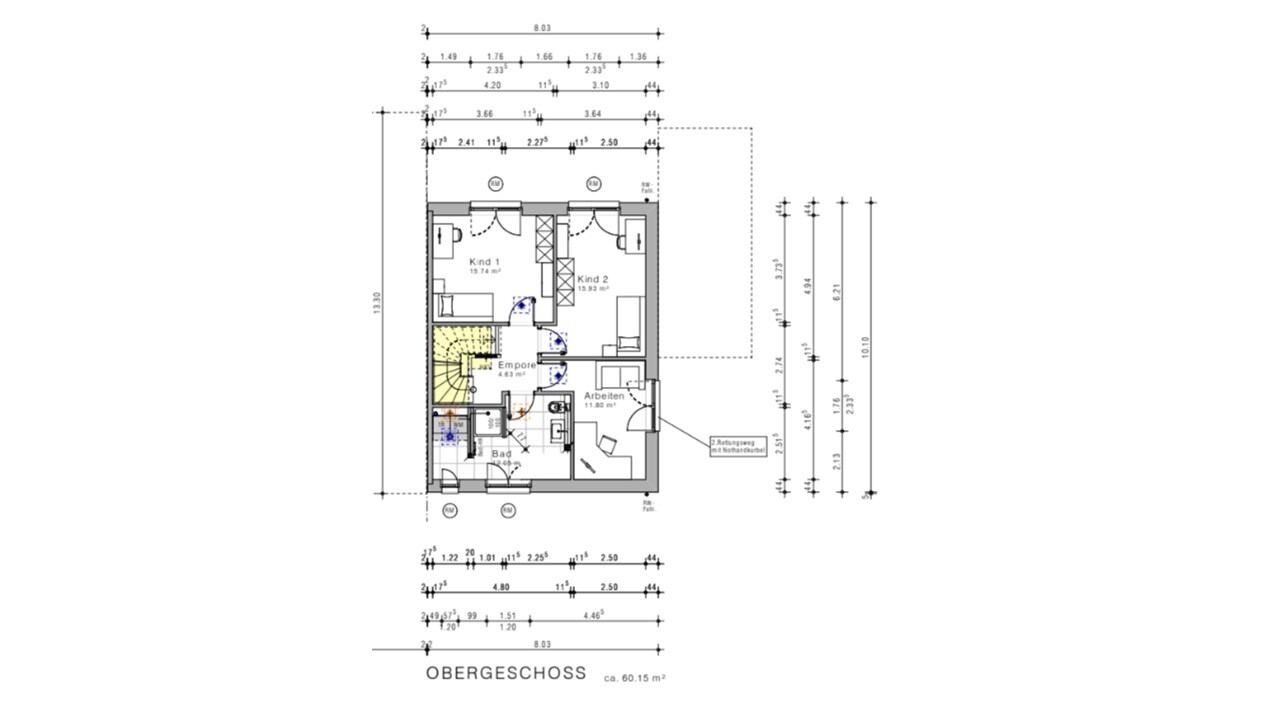
I am currently focusing on the bathrooms and would appreciate any feedback. I have explained the specific questions further below. In the attached floor plans, the latest changes are shown in red, which is why there is a gap in the upper floor where the old bathtub used to be.
Development Plan / Restrictions
Plot size: approx. 450sqm (4844 sq ft)
Slope: no
Site coverage ratio
Floor area ratio
Building envelope, building line and boundary
Edge development: carport/garage
Number of parking spaces
Number of floors: 2.5
Roof style: gable roof, 45 degrees
Design style
Orientation
Maximum heights / limits
Additional requirements: extension attached to an existing semi-detached house; total plot width: 11m (36 ft); therefore maximum house width 8m (26 ft) & building depth 10m (33 ft)
Client Requirements
Design style, roof shape, building type: roof form and size follow the neighbor’s
Basement, floors: no basement, 2 full floors, 1 attic floor
Number of occupants, ages: 4 (37, 36, 3, 0 years)
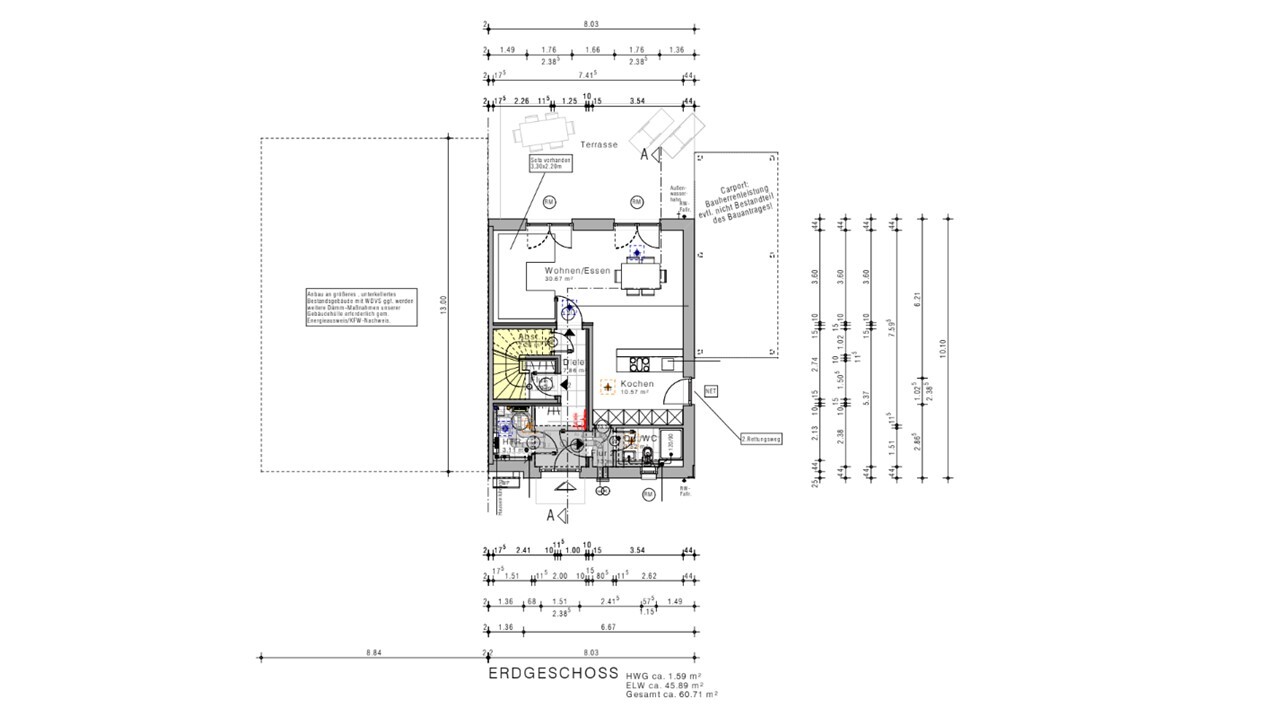
Space requirements on ground floor: dining/living/kitchen, utility room, guest bathroom, cloakroom
Upper floor (1st floor): 2 children’s bedrooms, office 1, bathroom plus laundry room
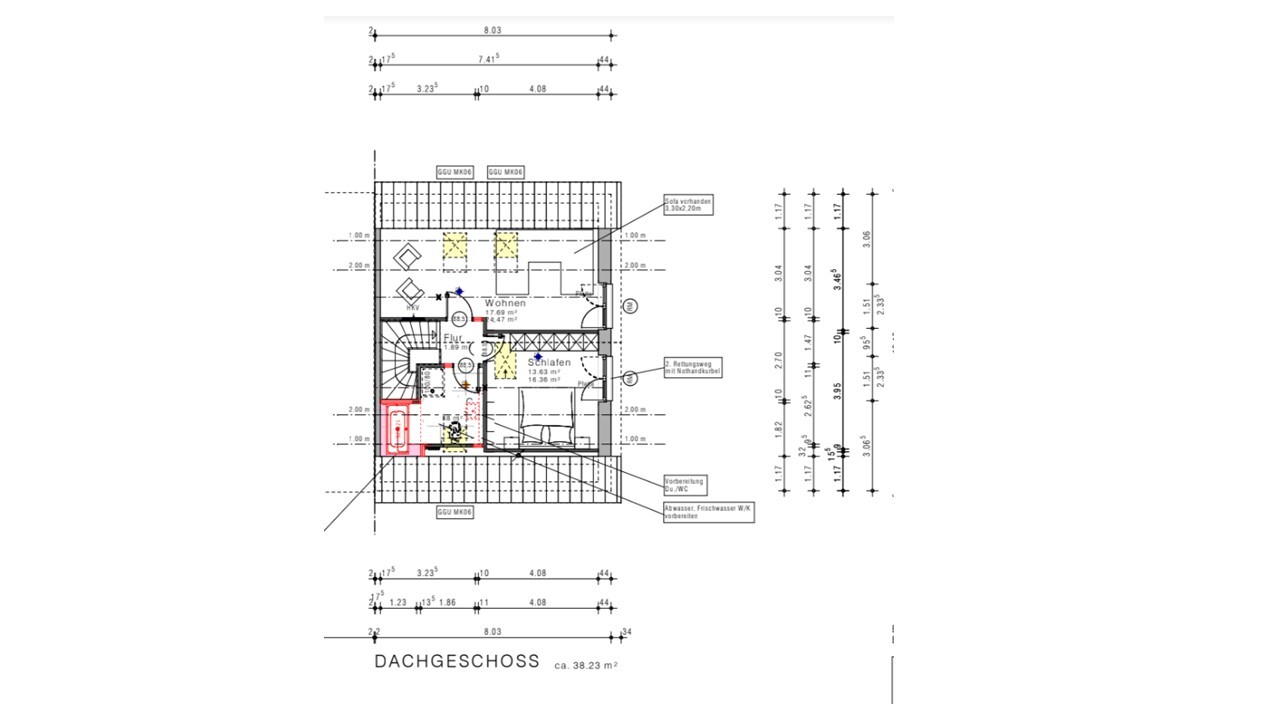
Attic floor: master bedroom, bathroom, office 2/guest room/second living area
Office: family use or home office? Both, 2x home offices needed
Number of overnight guests annually: various, 8–10
Open or closed architecture: mixed
Traditional or modern construction
Open kitchen, kitchen island: preferably a semi-detached island, even if the kitchen space is a bit tight
Number of dining seats: 6–8
Fireplace: no
Music/sound system wall
Balcony, roof terrace: terrace
Garage, carport: yes, also serving as basement substitute
Kitchen garden, greenhouse: no
Other wishes/special features/daily routine, including reasons for preferences or restrictions
House Design
Who designed it:
- Planner from a construction company: yes
What do you particularly like? Why?
Implementation of the ground floor, equally sized children’s rooms, the attic floor is also okay. -> Comments still welcome.
What don’t you like? Why?
The bathrooms on the upper and attic floors are still a work in progress.
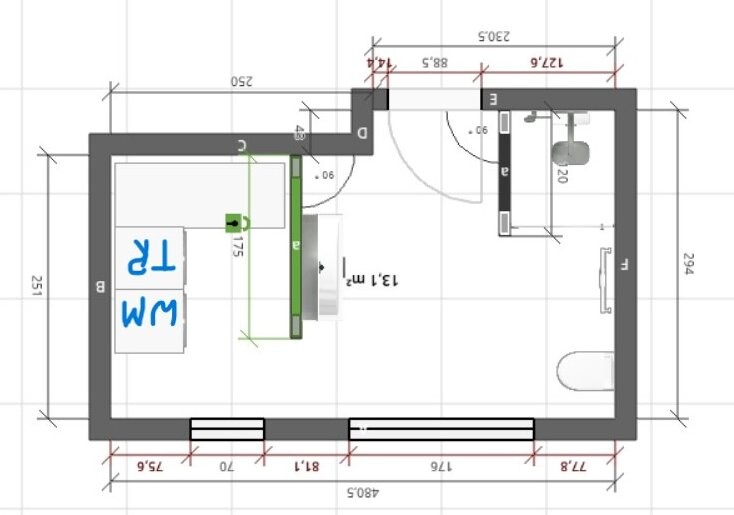
Laundry should be done on the upper floor, so a laundry area with privacy connected to the main bathroom is desired. Washer/dryer should be elevated, so preferably not placed under a window.
Several drafts have been made with passages at top and bottom of the plan. Current idea: move the bathtub to the attic floor, and use the gained space to widen the laundry room to 1.6m (5.2 ft) to allow some storage.
A separate DIY sketch from me is attached (without technical elements/pipes etc.).
In the attic floor the bathtub is planned under the sloped ceiling. Does this work from a spatial design perspective? Any other ideas for arranging the sanitary fixtures? Would you build the shower as drywall with a glass door or fully as a glass enclosure (more light but more cleaning)?
Another topic: What do you think about the kitchen and possible layout of furniture/semi-island?
If you had to give up, which details/features
- Could you give up:
- Could you not give up: completely omitting a bathtub is not preferred
Why did the design end up as it is now?
Our wishes were implemented by the planner over several iterations.
What do you think makes it especially good or bad:
For the relatively narrow plot and semi-detached house format, many fixed constraints leave little room to maneuver, but I still hope for creative solutions.
we have a plot of land adjoining a neighboring house, where we plan to build a semi-detached house.
I am currently focusing on the bathrooms and would appreciate any feedback. I have explained the specific questions further below. In the attached floor plans, the latest changes are shown in red, which is why there is a gap in the upper floor where the old bathtub used to be.
Development Plan / Restrictions
Plot size: approx. 450sqm (4844 sq ft)
Slope: no
Site coverage ratio
Floor area ratio
Building envelope, building line and boundary
Edge development: carport/garage
Number of parking spaces
Number of floors: 2.5
Roof style: gable roof, 45 degrees
Design style
Orientation
Maximum heights / limits
Additional requirements: extension attached to an existing semi-detached house; total plot width: 11m (36 ft); therefore maximum house width 8m (26 ft) & building depth 10m (33 ft)
Client Requirements
Design style, roof shape, building type: roof form and size follow the neighbor’s
Basement, floors: no basement, 2 full floors, 1 attic floor
Number of occupants, ages: 4 (37, 36, 3, 0 years)
Space requirements on ground floor: dining/living/kitchen, utility room, guest bathroom, cloakroom
Upper floor (1st floor): 2 children’s bedrooms, office 1, bathroom plus laundry room
Attic floor: master bedroom, bathroom, office 2/guest room/second living area
Office: family use or home office? Both, 2x home offices needed
Number of overnight guests annually: various, 8–10
Open or closed architecture: mixed
Traditional or modern construction
Open kitchen, kitchen island: preferably a semi-detached island, even if the kitchen space is a bit tight
Number of dining seats: 6–8
Fireplace: no
Music/sound system wall
Balcony, roof terrace: terrace
Garage, carport: yes, also serving as basement substitute
Kitchen garden, greenhouse: no
Other wishes/special features/daily routine, including reasons for preferences or restrictions
House Design
Who designed it:
- Planner from a construction company: yes
What do you particularly like? Why?
Implementation of the ground floor, equally sized children’s rooms, the attic floor is also okay. -> Comments still welcome.
What don’t you like? Why?
The bathrooms on the upper and attic floors are still a work in progress.
Laundry should be done on the upper floor, so a laundry area with privacy connected to the main bathroom is desired. Washer/dryer should be elevated, so preferably not placed under a window.
Several drafts have been made with passages at top and bottom of the plan. Current idea: move the bathtub to the attic floor, and use the gained space to widen the laundry room to 1.6m (5.2 ft) to allow some storage.
A separate DIY sketch from me is attached (without technical elements/pipes etc.).
In the attic floor the bathtub is planned under the sloped ceiling. Does this work from a spatial design perspective? Any other ideas for arranging the sanitary fixtures? Would you build the shower as drywall with a glass door or fully as a glass enclosure (more light but more cleaning)?
Another topic: What do you think about the kitchen and possible layout of furniture/semi-island?
If you had to give up, which details/features
- Could you give up:
- Could you not give up: completely omitting a bathtub is not preferred
Why did the design end up as it is now?
Our wishes were implemented by the planner over several iterations.
What do you think makes it especially good or bad:
For the relatively narrow plot and semi-detached house format, many fixed constraints leave little room to maneuver, but I still hope for creative solutions.

ypg schrieb:
Well, that’s why you look at options to see what can be done on an 8x10.No, not on 8x10 – I didn’t suggest following the neighboring half’s house profile without reason. Klinkerhof86 schrieb:
We are open to all suggestions, though we haven’t built often (never...).
One additional detail: We are working under the condition that the house can be used as two separate residential units (even if this is not currently planned). This means the technical room must be accessible separately; the ground floor could be separated as one dwelling unit (access to the guest bathroom would be possible through the kitchen and a small entrance area; an entrance door can be installed both in front of the stairwell and the living-dining area). These requirements are non-negotiable. So what is it – open or not? – with these restrictive conditions, I’m out. Take a look at "Missteps in Forward-Thinking House Planning" and "When Is It Time to Consider Building for Old Age?" (on "Building Now").
https://www.instagram.com/11antgmxde/
https://www.linkedin.com/company/bauen-jetzt/
H
HeimatBauer13 Dec 2023 14:58I also built the house with the requirement of separability in mind. That was quite a lot of work. Every floor basically needs EVERYTHING, and it also has to be fireproof separable. Based on the initial plan, I drew up a separate plan and had it approved – phew, that was a tricky bit and required several changes. For example, the ground floor is now designed to be as age-friendly as possible, which involved a thousand subtle aspects:
- General door width / maneuvering space for walkers and similar aids, especially in the bathroom
- Space and connections for a washing machine (currently perfectly used with a urinal, which was a great decision)
- Space for a future wheelchair ramp required relocating the basement window, which led to redesigning the utility connections and ultimately made it impossible to keep a tree in front of the house
- and countless others
So, separability is not something you can just do easily.
- General door width / maneuvering space for walkers and similar aids, especially in the bathroom
- Space and connections for a washing machine (currently perfectly used with a urinal, which was a great decision)
- Space for a future wheelchair ramp required relocating the basement window, which led to redesigning the utility connections and ultimately made it impossible to keep a tree in front of the house
- and countless others
So, separability is not something you can just do easily.
Klinkerhof86 schrieb:
Implementation of the ground floor, equally sized children’s rooms, the attic is also fine. -> Comments are still welcome. As far as I can tell without measurements: I would omit the door between the hallway/living room on the ground floor. The sofa wouldn’t fit there at all, would it? How would you watch TV that way? It is generally not a good idea to use the quiet area as a passage room. Also, short distances to the kitchen are necessary. So, a door opposite the staircase would be better, allowing furniture to be moved upstairs more easily. With such a closely positioned wall, that will be quite a challenge. I’m not a fan of entering the bathroom through those double doors. For the upper and attic floors, I’m missing the numbers—they’re not readable so far. Regarding the bathrooms, the two squares on the upper floor are unclear to me. Is the drawn utility room an additional option? When separating the floors into two separate living units, the ground floor is suitable either for a bedridden resident or a young single person.HeimatBauer schrieb:
I also built the house with the requirement that the sections be separable. That was a lot of work. Every floor simply needs EVERYTHING, and it must be fireproof separable as well. Based on the initial plan, I drew up the separated plan and got it approved—which was quite tricky and required several changes. So the ground floor is now designed to be as age-friendly as possible [...] Where is your house located here?
ypg schrieb:
It’s really bad practice to use the quiet area as a walkthrough room. I recently noticed that practically every sitcom relies on someone constantly walking across the scene ;-)
https://www.instagram.com/11antgmxde/
https://www.linkedin.com/company/bauen-jetzt/

I would say the bathrooms are one of your smaller issues. How do you plan to sit on the sofa under a roof slope less than 1 meter (3 feet) high? There seems to be a complete lack of spatial imagination, and the designer is probably already laughing at you. And where will the kitchen go for the upstairs unit? That cloakroom in the stairwell is also problematic. You can’t even access it properly behind the door.
The downstairs unit then has to go through the kitchen to reach the bathroom and probably sleeps right behind the apartment door. But at least they have the terrace all to themselves, while those upstairs are stuck under the slope, unable to go outside at all. There is no balcony.
Honestly, one can only hope you reconsider your priorities and start over.
The downstairs unit then has to go through the kitchen to reach the bathroom and probably sleeps right behind the apartment door. But at least they have the terrace all to themselves, while those upstairs are stuck under the slope, unable to go outside at all. There is no balcony.
Honestly, one can only hope you reconsider your priorities and start over.
What needs to be included in the utility room? I find the size too small because it’s not only about fitting the equipment, but you also need workspace to connect and maintain them. Additionally, there are "technical connection requirements," for example for the electrical meter cabinet, that must be complied with.
Similar topics