
ᐅ Layout Planning for a Semi-Detached House, Ground Floor Assessment
Created on: 11 Jan 2022 19:46
P
Peter_81Hello everyone,
Before our appointment with the general contractor, we already created a floor plan for our semi-detached house. The basic floor plan is based on a model home. We have only made minimal adjustments to the plan.
We want to plan the "detailed" floor plan, like window widths, with the general contractor. In this post, we want to gather your comments, ideas, and criticism.
So far, we have only sketched the ground floor. We will sketch the basement, upper, and attic floors once the ground floor is finalized.
The floors are divided as follows:
Basement = utility cellar
Upper floor = 2 large children's bedrooms + family bathroom
Attic floor = bedroom + dressing room + office + WC/bathroom
Development plan/restrictions
Plot size: 420 sqm (4520 sq ft)
Slope: no
Site occupancy index: 0.4
Floor area ratio: not specified
Number of parking spaces: garage + 1 parking space
Number of floors: 2.5
Roof type: gable roof
Style: semi-detached house
Orientation: southwest
Maximum heights/limits: eave height = 6.5 m (21 ft 4 in), ridge height = 10 m (32 ft 10 in)
Homeowners’ requirements
Style, roof type, building type
Utility cellar, 2.5 floors
Number of occupants: 2 adults + 2 children (6 and 8 years old)
Office: home office?
Overnight guests per year: negligible
Open layout
Modern construction
Open kitchen, no kitchen island, but L-shaped
Number of dining seats: 6
Fireplace: yes
Carport
House design
Who designed the plan:
- Self-planned, basic floor plan from a model home
What do you particularly like? Why?: large living room with corner doors/windows, "open" design
Preferred heating technology: air heat pump
Why is the design the way it is?
As a basis, a model home design was used. This was originally for a detached house and was adapted by us to a semi-detached house floor plan.
What is important to us is a large, open living room, a cloakroom near the entrance door, and a pantry on the ground floor.
What is the most important/basic question about the floor plan summarized in 130 characters?
- Kitchen: is there enough space for a kitchen with an island? Is there enough storage and work surface?
- Is the living and dining area not too "tight"?
- The first cloakroom is intended for storing shoes directly next to the entrance door. Alternatively, we may consider using this space as an extension of the pantry. In the cloakroom on the west side, there should be space for a wardrobe/dresser and coats.
We look forward to your ideas and comments 🙂
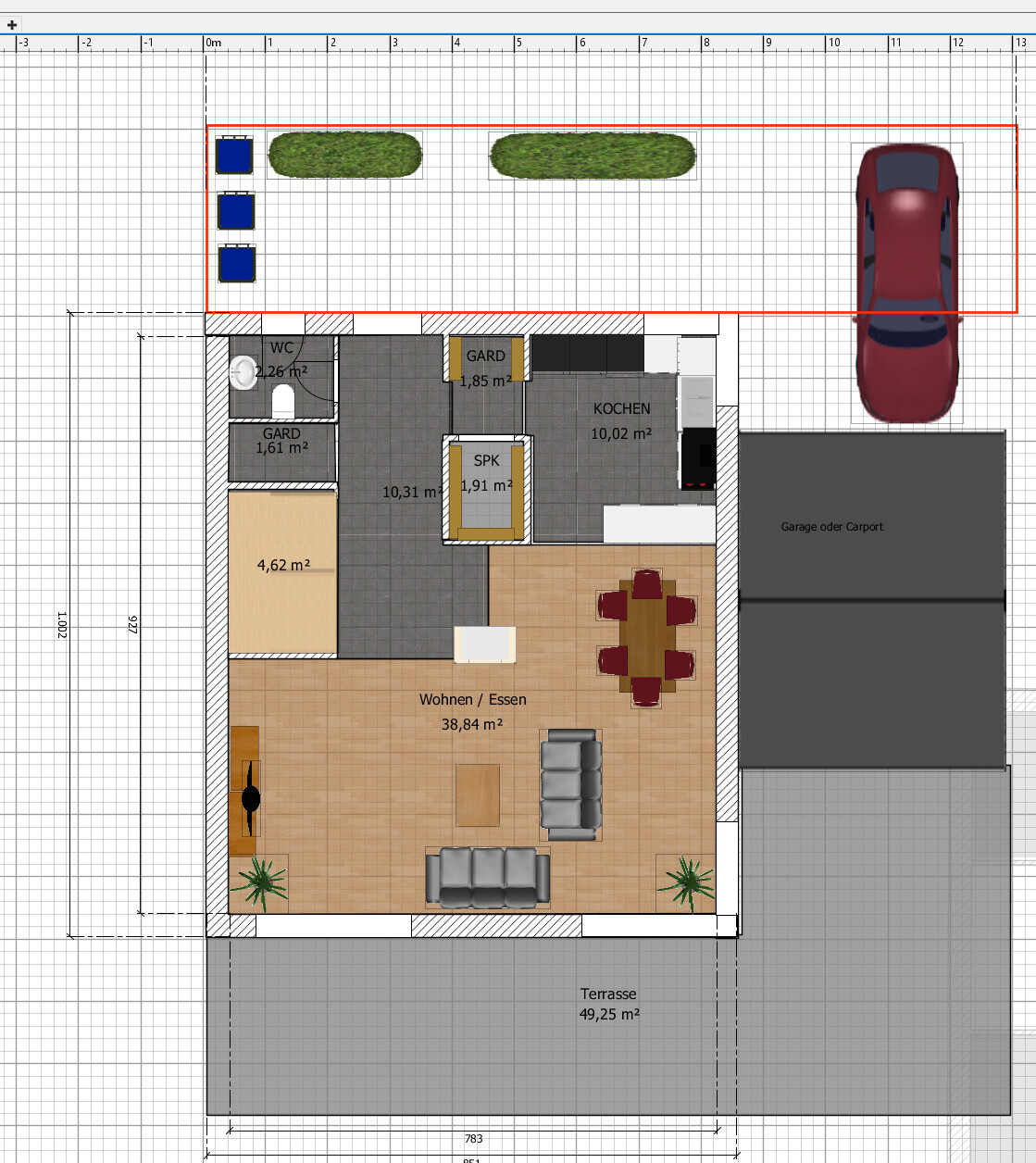
Before our appointment with the general contractor, we already created a floor plan for our semi-detached house. The basic floor plan is based on a model home. We have only made minimal adjustments to the plan.
We want to plan the "detailed" floor plan, like window widths, with the general contractor. In this post, we want to gather your comments, ideas, and criticism.
So far, we have only sketched the ground floor. We will sketch the basement, upper, and attic floors once the ground floor is finalized.
The floors are divided as follows:
Basement = utility cellar
Upper floor = 2 large children's bedrooms + family bathroom
Attic floor = bedroom + dressing room + office + WC/bathroom
Development plan/restrictions
Plot size: 420 sqm (4520 sq ft)
Slope: no
Site occupancy index: 0.4
Floor area ratio: not specified
Number of parking spaces: garage + 1 parking space
Number of floors: 2.5
Roof type: gable roof
Style: semi-detached house
Orientation: southwest
Maximum heights/limits: eave height = 6.5 m (21 ft 4 in), ridge height = 10 m (32 ft 10 in)
Homeowners’ requirements
Style, roof type, building type
Utility cellar, 2.5 floors
Number of occupants: 2 adults + 2 children (6 and 8 years old)
Office: home office?
Overnight guests per year: negligible
Open layout
Modern construction
Open kitchen, no kitchen island, but L-shaped
Number of dining seats: 6
Fireplace: yes
Carport
House design
Who designed the plan:
- Self-planned, basic floor plan from a model home
What do you particularly like? Why?: large living room with corner doors/windows, "open" design
Preferred heating technology: air heat pump
Why is the design the way it is?
As a basis, a model home design was used. This was originally for a detached house and was adapted by us to a semi-detached house floor plan.
What is important to us is a large, open living room, a cloakroom near the entrance door, and a pantry on the ground floor.
What is the most important/basic question about the floor plan summarized in 130 characters?
- Kitchen: is there enough space for a kitchen with an island? Is there enough storage and work surface?
- Is the living and dining area not too "tight"?
- The first cloakroom is intended for storing shoes directly next to the entrance door. Alternatively, we may consider using this space as an extension of the pantry. In the cloakroom on the west side, there should be space for a wardrobe/dresser and coats.
We look forward to your ideas and comments 🙂

Peter_81 schrieb:
A standard house design was used as the basis. It is for a single-family house and was modified by us into a duplex floor plan. By the way – just a warning: without a link! – what is the name of the house model?
Peter_81 schrieb:
At the moment, we have only sketched the ground floor. We will sketch the basement, upper floor, and attic only after the ground floor is finished. That is actually the opposite of the usual approach. Generally, the upper floor is the more challenging level. Amateur planners who start with the ground floor (the wording is somewhat redundant here, as professional planners wouldn’t work that way) often end up in dead ends.
https://www.instagram.com/11antgmxde/
https://www.linkedin.com/company/bauen-jetzt/
Structurally, the ceiling in the living area is a job for the metalworker; concrete is likely marginally necessary or even possible given the ceiling span.
- Interior walls are too thin, exterior walls are potentially actually thicker.
- The furniture scale doesn’t quite fit; a 2m (6.5 ft) wide sofa is rather a tight two-seater.
- The dining area is too cramped or the scale doesn’t match.
- The cloakroom and pantry are unusable, too small; the pantry door can’t even be opened.
- The cloakroom next to the toilet is a very deep cabinet.
- Kitchen cabinets should be planned with a depth of about 65cm (26 inches).
If the white block next to the sofa and dining table is intended to be the fireplace, then naturally a flue is also necessary on the upper floor. Otherwise, points like these have already been raised, as is often the case with the first attempt 😉
- Interior walls are too thin, exterior walls are potentially actually thicker.
- The furniture scale doesn’t quite fit; a 2m (6.5 ft) wide sofa is rather a tight two-seater.
- The dining area is too cramped or the scale doesn’t match.
- The cloakroom and pantry are unusable, too small; the pantry door can’t even be opened.
- The cloakroom next to the toilet is a very deep cabinet.
- Kitchen cabinets should be planned with a depth of about 65cm (26 inches).
If the white block next to the sofa and dining table is intended to be the fireplace, then naturally a flue is also necessary on the upper floor. Otherwise, points like these have already been raised, as is often the case with the first attempt 😉

The "section" of the wardrobe/pantry should ideally be changed first and should not be designed as a "short" passage to the kitchen. Three meters (10 feet) is not very long. Advantage: more space for placement, quieter… because the kitchen is currently too compact! There is too little workspace. This won’t work.
On the upper floor, the staircase location should work quite well, but a load-bearing wall will need to be placed "in the middle" on the ground floor.
On the upper floor, the staircase location should work quite well, but a load-bearing wall will need to be placed "in the middle" on the ground floor.
Similar topics