
ᐅ Floor Plan Options for a Single-Family Home, 130–150 sqm, 1.5 Stories, Hillside Location
Created on: 19 Feb 2022 15:35
J
jerimata
Development Plan / Restrictions
Plot size – 680 sqm (7319 sq ft)
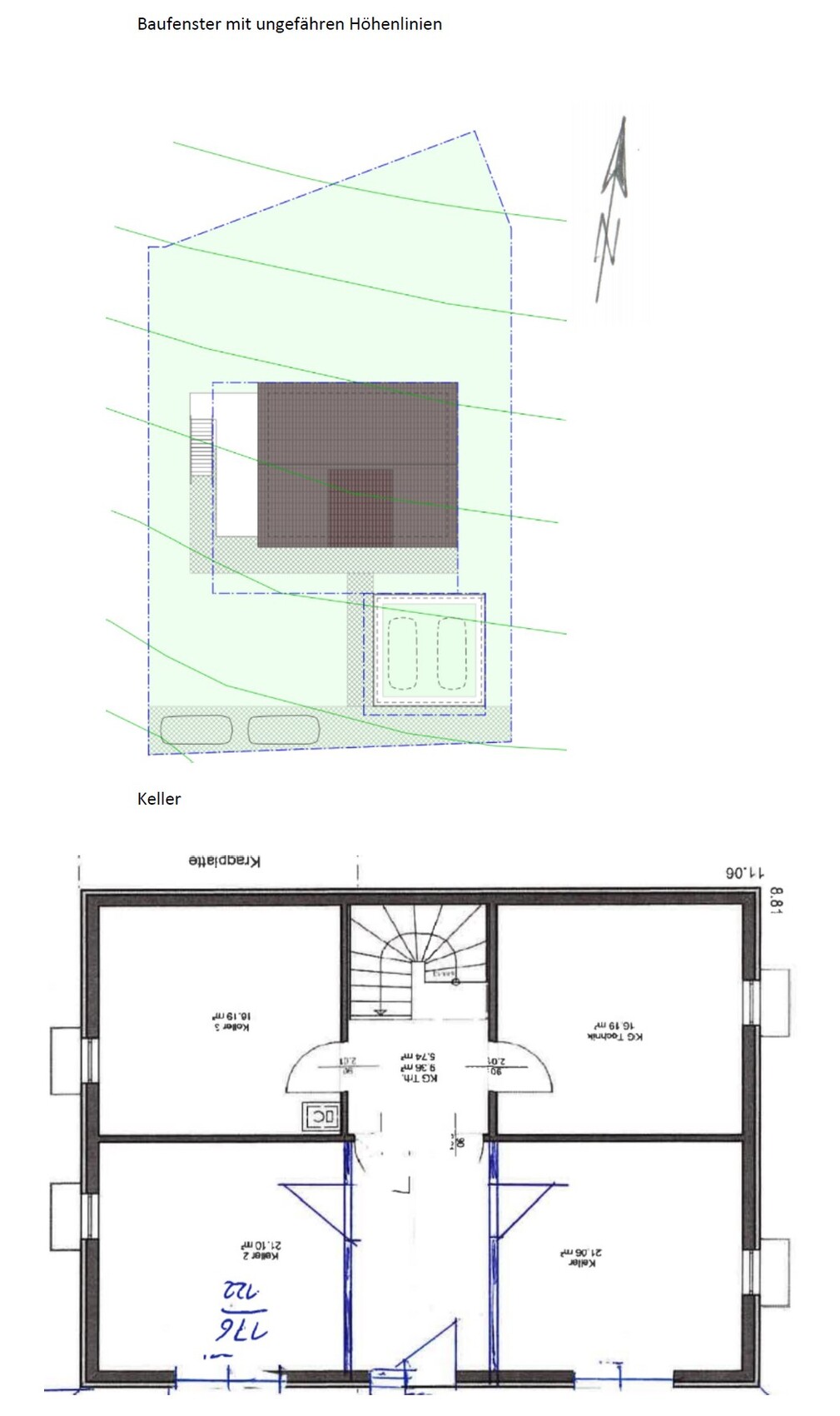
Slope – hillside location, approximately 1.5-2 m (5-6.5 ft) incline within the building envelope
Site coverage ratio – 0.3
Floor area ratio – 0.6
Building envelope, building line and boundary – see image
Adjacent buildings – none planned, neighboring lots undeveloped
Number of parking spaces – 2
Number of floors – 1.5 above basement
Roof type – gable roof with 33-43º pitch
Architectural style – traditional single-family house
Orientation – as per plan, facing south
Maximum heights/limits: ridge height 8.60 m (28.2 ft) measured from ground floor level
Additional requirements: fixed ridge orientation, ground floor height fixed with a 60 cm (24 inch) window
Client Requirements
Style, roof type, building type: gable roof, classic style, if possible untreated, weathering wood façade on ground and upper floors
Basement, floors: due to hillside location a basement with open southern side is suitable; other sensible options (stilts?) have not been suggested so far
Number of occupants, ages: 2 adults, planning for 3 children
Room requirements on ground and upper floors:
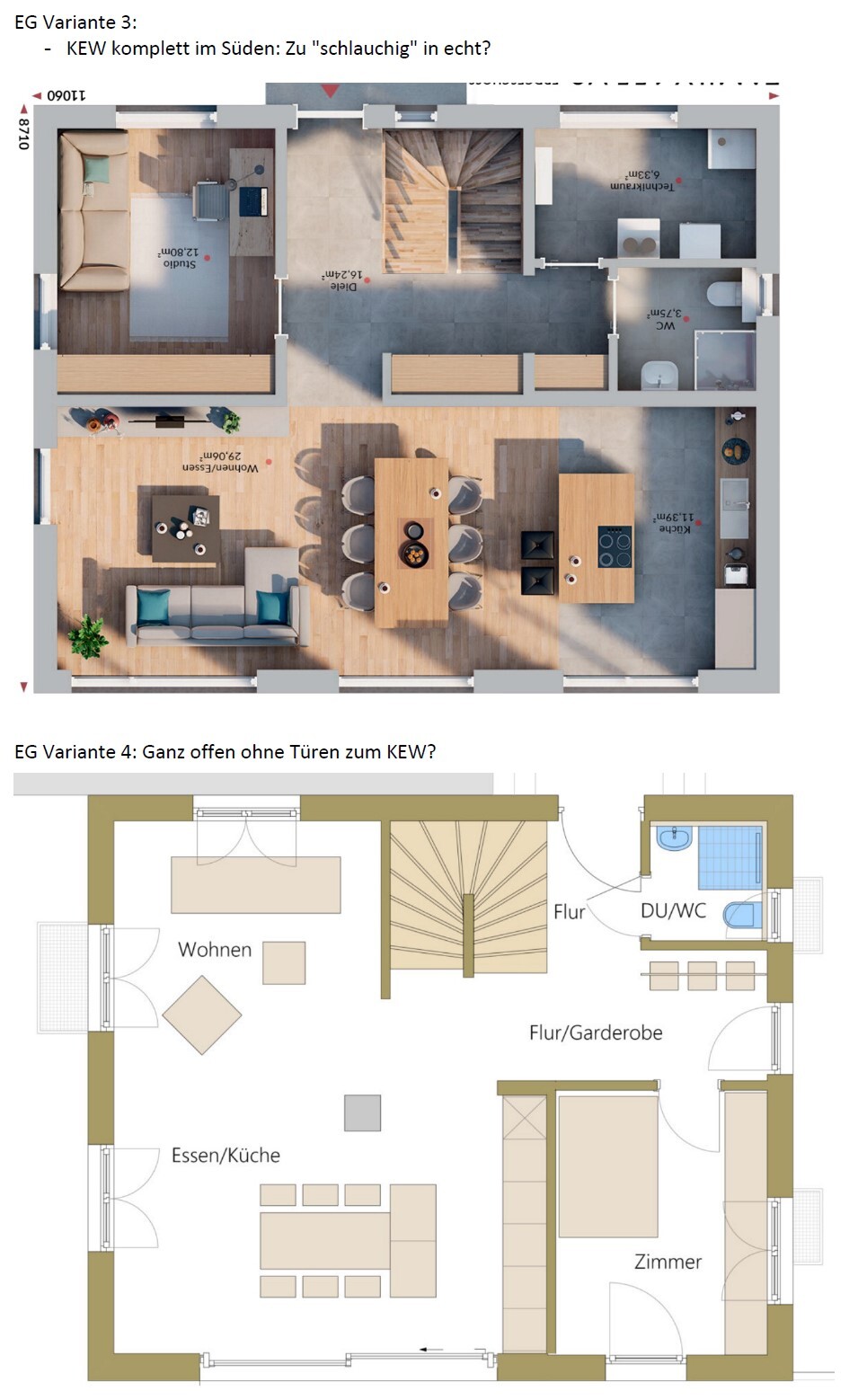
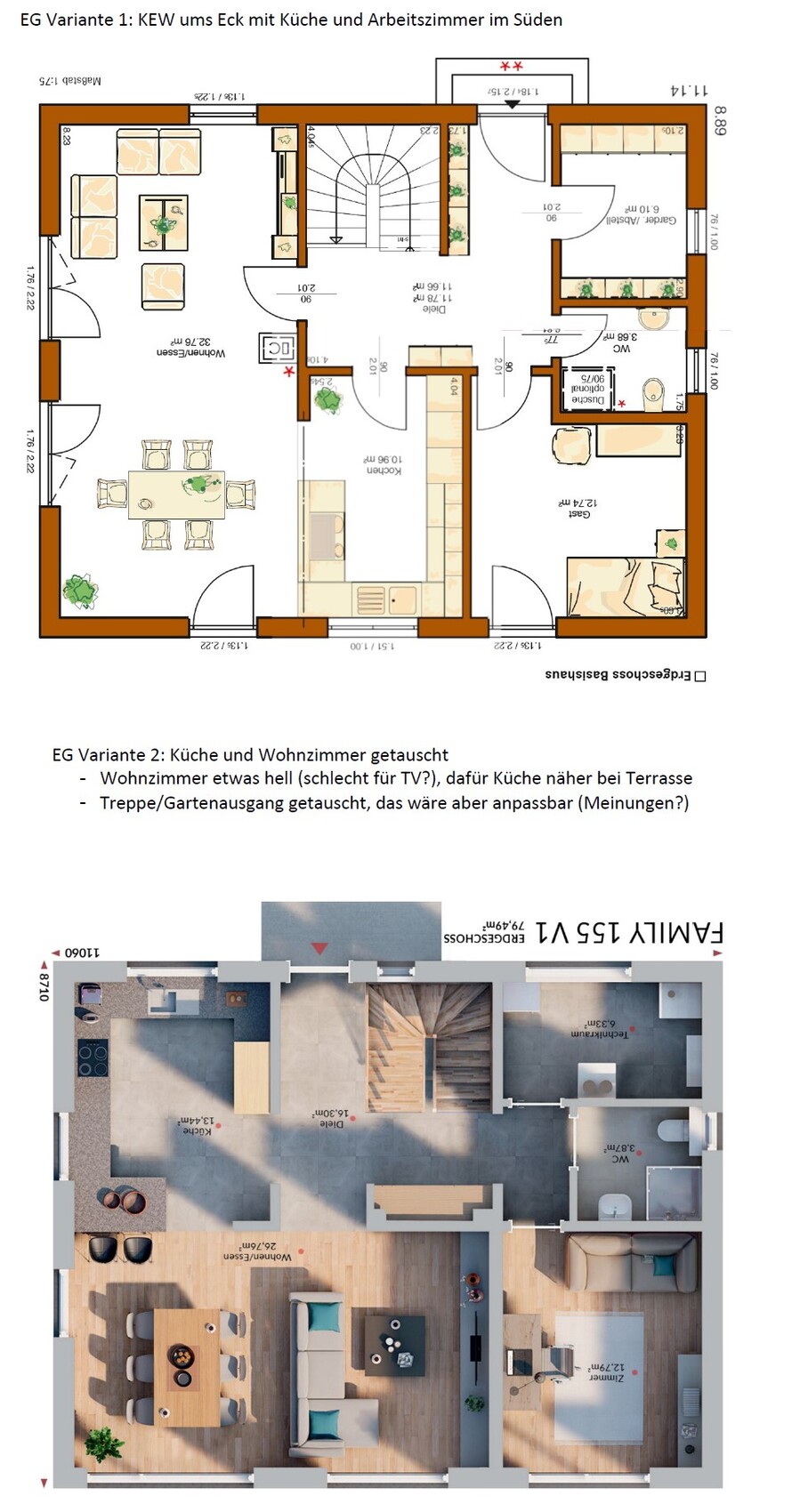
- Ground floor: open kitchen-dining-living area, guest WC with shower, office (can be moved upstairs if necessary), balcony/terrace on west side (mixed orientation due to slope)
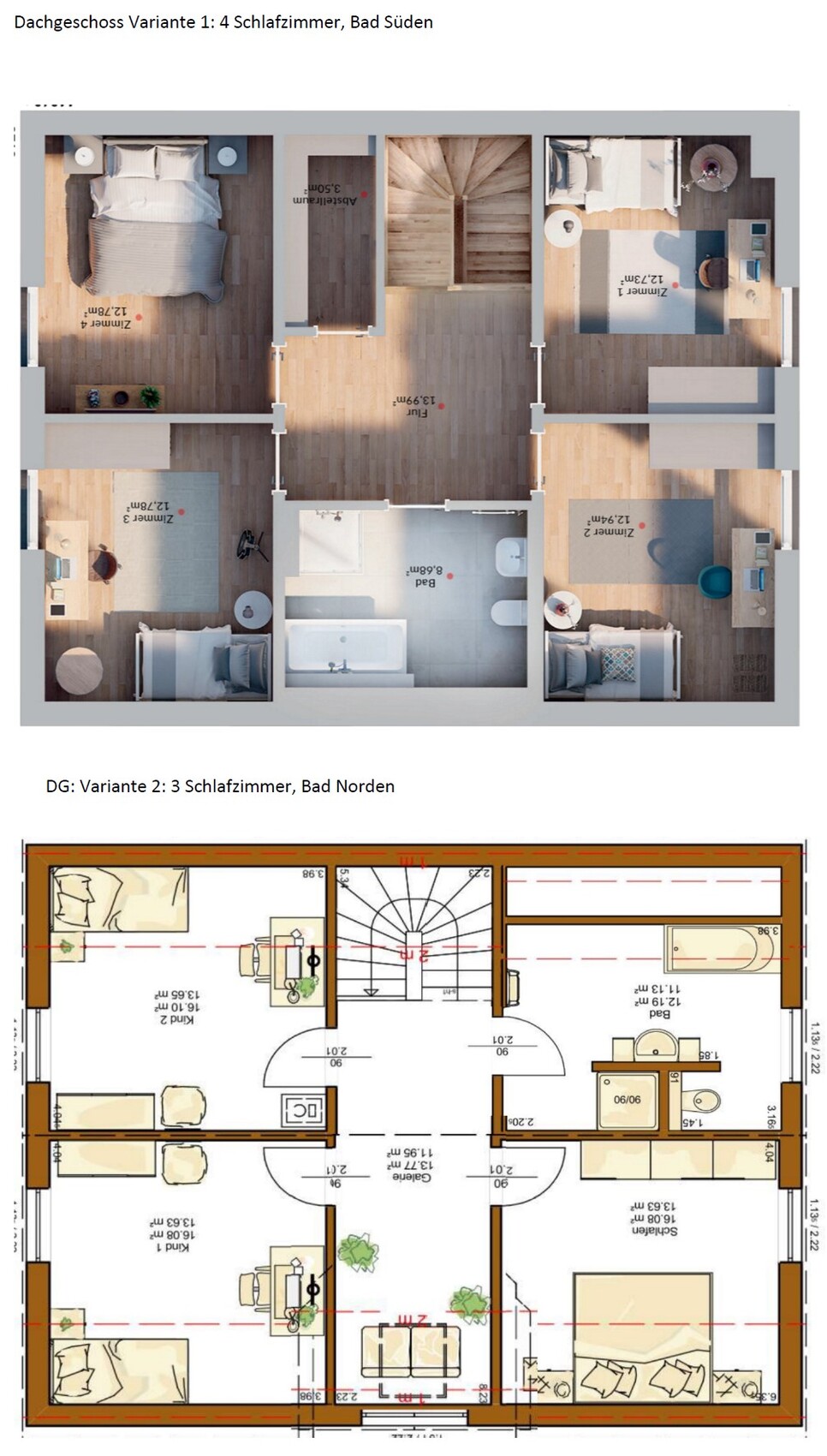
- Upper floor: 3 or 4 bedrooms, family bathroom (shower + bathtub)
- Basement: open to south, main entrance on south (front of house) with hallway, utility room, storage room, 2 rooms for expansion (hobby and/or youth room; if used as youth room, one fewer children’s bedroom upstairs could be planned)
Office use – home office
Guest accommodation per year – visitors expected occasionally, accommodated as needed
Open or closed architecture – open plan, no fully separated staircase
Conservative or modern style – not clear what that means; lots of wood (wooden beams) would be nice but usually too costly
Open kitchen, kitchen island – yes to both
Number of dining seats – 5+ (with temporary solutions acceptable for guests)
Fireplace – yes, on ground floor; aware it may be impractical
Music/home theater wall – TV wall starting from 2.6 m (8.5 ft) width
Balcony, roof terrace – balcony with terrace extension on west side planned
Garage, carport – double carport if visually suitable; garage probably better due to slope
Vegetable garden, greenhouse – basically, planned for the future
Additional wishes/special features/daily routine, reasons for choices or exclusions:
Since at least one person spends a lot of time in the office in the afternoon/evening, we envision it on the ground floor – currently this is the case, with open doors; kitchen noise and smells do not disturb but rather enhance the feeling of togetherness in the house. This also explains the wish for an open living-dining-kitchen area. One question is how much this area can or should be separated from the open staircase with walls and doors: marketing materials show it nicely, keeping children in "acoustic" proximity, but the practical benefit of at least one, instead of two doors between children’s rooms and living room is undeniable.
House Design
Planning by:
– planner from a construction company
– architect
– Do-it-Yourself
A mix of all three, with no finalized designs yet
What do you like most? Why?
Open living-dining-kitchen area, open staircase, entrance via basement – the living room is intended as a family lounge with acoustical and olfactory contact acceptable; entrance in basement avoids the annoying "walking around the house" and provides space for coats and shoes.
What don’t you like? Why?
Price estimate by architect/planner:
Between €350k and €550k for the house without basement depending on provider
Personal price limit for house including equipment:
Considering €100k for basement, €100k additional construction-related costs, then maximum €400k + €50k for equipment and some landscaping
Preferred heating technology:
Most financially reasonable: underfloor heating with near-surface geothermal heat would be nice but difficult without electric offers; therefore likely mainstream air-to-water heat pump.
If you have to give up something, which details/additions
– can be given up:
Office on the ground floor if this allows a larger living-dining-kitchen area – before all three children arrive, another solution might be found (possibly in basement).
Ground floor exit to north garden including mudroom area – could be omitted to save floor space, but is usually included in standard series houses anyway.
Pantry also dispensable – often the small utility room serves the purpose, which in our case is in the basement.
Possibly basement dispensable if there are reasonable alternatives.
– cannot be given up:
Fireplace. 🙂
Why has the design evolved as it is now?
A mix of many examples from various magazines, scaling back special requests after first cost estimates, room requirements...
What makes it particularly good or bad in your view?
Good: orientation to south/west, no need to walk around the house, main rooms with nice south-west exposure.
What is the most important/basic question about the floor plan in 130 characters?
Opinions and arguments on ground floor variants: Where should the office be, kitchen-dining area angular or linear, wall/door to kitchen-dining area?
Thank you very much for your honest feedback. If I should clarify or specify anything better, please just ask!
Plot size – 680 sqm (7319 sq ft)
Slope – hillside location, approximately 1.5-2 m (5-6.5 ft) incline within the building envelope
Site coverage ratio – 0.3
Floor area ratio – 0.6
Building envelope, building line and boundary – see image
Adjacent buildings – none planned, neighboring lots undeveloped
Number of parking spaces – 2
Number of floors – 1.5 above basement
Roof type – gable roof with 33-43º pitch
Architectural style – traditional single-family house
Orientation – as per plan, facing south
Maximum heights/limits: ridge height 8.60 m (28.2 ft) measured from ground floor level
Additional requirements: fixed ridge orientation, ground floor height fixed with a 60 cm (24 inch) window
Client Requirements
Style, roof type, building type: gable roof, classic style, if possible untreated, weathering wood façade on ground and upper floors
Basement, floors: due to hillside location a basement with open southern side is suitable; other sensible options (stilts?) have not been suggested so far
Number of occupants, ages: 2 adults, planning for 3 children
Room requirements on ground and upper floors:
- Ground floor: open kitchen-dining-living area, guest WC with shower, office (can be moved upstairs if necessary), balcony/terrace on west side (mixed orientation due to slope)
- Upper floor: 3 or 4 bedrooms, family bathroom (shower + bathtub)
- Basement: open to south, main entrance on south (front of house) with hallway, utility room, storage room, 2 rooms for expansion (hobby and/or youth room; if used as youth room, one fewer children’s bedroom upstairs could be planned)
Office use – home office
Guest accommodation per year – visitors expected occasionally, accommodated as needed
Open or closed architecture – open plan, no fully separated staircase
Conservative or modern style – not clear what that means; lots of wood (wooden beams) would be nice but usually too costly
Open kitchen, kitchen island – yes to both
Number of dining seats – 5+ (with temporary solutions acceptable for guests)
Fireplace – yes, on ground floor; aware it may be impractical
Music/home theater wall – TV wall starting from 2.6 m (8.5 ft) width
Balcony, roof terrace – balcony with terrace extension on west side planned
Garage, carport – double carport if visually suitable; garage probably better due to slope
Vegetable garden, greenhouse – basically, planned for the future
Additional wishes/special features/daily routine, reasons for choices or exclusions:
Since at least one person spends a lot of time in the office in the afternoon/evening, we envision it on the ground floor – currently this is the case, with open doors; kitchen noise and smells do not disturb but rather enhance the feeling of togetherness in the house. This also explains the wish for an open living-dining-kitchen area. One question is how much this area can or should be separated from the open staircase with walls and doors: marketing materials show it nicely, keeping children in "acoustic" proximity, but the practical benefit of at least one, instead of two doors between children’s rooms and living room is undeniable.
House Design
Planning by:
– planner from a construction company
– architect
– Do-it-Yourself
A mix of all three, with no finalized designs yet
What do you like most? Why?
Open living-dining-kitchen area, open staircase, entrance via basement – the living room is intended as a family lounge with acoustical and olfactory contact acceptable; entrance in basement avoids the annoying "walking around the house" and provides space for coats and shoes.
What don’t you like? Why?
Price estimate by architect/planner:
Between €350k and €550k for the house without basement depending on provider
Personal price limit for house including equipment:
Considering €100k for basement, €100k additional construction-related costs, then maximum €400k + €50k for equipment and some landscaping
Preferred heating technology:
Most financially reasonable: underfloor heating with near-surface geothermal heat would be nice but difficult without electric offers; therefore likely mainstream air-to-water heat pump.
If you have to give up something, which details/additions
– can be given up:
Office on the ground floor if this allows a larger living-dining-kitchen area – before all three children arrive, another solution might be found (possibly in basement).
Ground floor exit to north garden including mudroom area – could be omitted to save floor space, but is usually included in standard series houses anyway.
Pantry also dispensable – often the small utility room serves the purpose, which in our case is in the basement.
Possibly basement dispensable if there are reasonable alternatives.
– cannot be given up:
Fireplace. 🙂
Why has the design evolved as it is now?
A mix of many examples from various magazines, scaling back special requests after first cost estimates, room requirements...
What makes it particularly good or bad in your view?
Good: orientation to south/west, no need to walk around the house, main rooms with nice south-west exposure.
What is the most important/basic question about the floor plan in 130 characters?
Opinions and arguments on ground floor variants: Where should the office be, kitchen-dining area angular or linear, wall/door to kitchen-dining area?
Thank you very much for your honest feedback. If I should clarify or specify anything better, please just ask!
 askforafriend19 Feb 2022 23:49
I know so many people who raise beautiful hillside plots by 2 m (6.5 feet) – no idea why :/
WeLiveHaus can have wood cladding on the exterior, visible timber inside, and be built on a slope.
I find the floor plans confusing, and measurements are missing.
Still, why is the basement level not planned? Everything is squeezed into the 1.5 upper floors.
Why is there such a long access path going all the way around the house?
The budget for the landscaping is missing.
I consider the budget to be too tight.
I find the floor plans confusing, and measurements are missing.
Still, why is the basement level not planned? Everything is squeezed into the 1.5 upper floors.
Why is there such a long access path going all the way around the house?
The budget for the landscaping is missing.
I consider the budget to be too tight.
jerimata schrieb:
Option 2: Kitchen and living area swapped In the graphic caption, you mention placing the kitchen closer to the terrace (so all floor plans are oriented north?),
jerimata schrieb:
The terrace would be in the northwest (back left), accessed via a balcony – the walking distances may be similar, but in Option 2 the kitchen is directly next to the terrace (or at least faces it through the window), Is access from the south? It’s generally a good idea to place the kitchen next to the main terrace (for afternoon/evening use), and also have direct access from the kitchen.
More broadly, the overall layout with terraces as a house concept is somewhat unclear. Why is there still an entrance at the ground-floor level from the “back”?
Why not use the southern “basement” rooms, for example, as two nice children’s bedrooms?
Perhaps consider a garage more towards the southwest, so the roof could effectively serve as a southwest-facing terrace. Then, in the southeast part of the “basement level,” have two rooms, and technicians/utility rooms in the southwest.
Wow, thank you so much for the really helpful feedback, despite my apparently quite unclear information (I really want to try to improve, do you have an example of how something like this can be “done well”?).
Here are some responses to specific comments:
Preferred partners with minimal floor plan (60-65 sqm (645-700 sq ft) per floor): house only from 450k €.
Economy partners with more generous floor plan (70-80 sqm (750-860 sq ft) per floor): house only from 300/350k €.
Thanks so much again, we appreciate every input!
Here are some responses to specific comments:
11ant schrieb:I thought the elevation differences would be clearly visible on the building envelope map (1 line = 1 meter (3 feet)), even with a small house we easily have a 1.5 meter (5 feet) height difference, which definitely argues for a basement. Even if we only reached about 70-80% cost equivalence – we can and want to use the basement anyway.
I can’t say anything about that because I’m not familiar with your plot; for the rules see recently here: https://www.hausbau-forum.de/threads/grosses-Büro-oder-gleich-eine-einliegerwohnung.37736/#post-464293
11ant schrieb:I naively assumed that the wooden cladding was purely decorative without function (at most, it might save a bit during plastering if the experts do it), so there would be no risk of damage (it’s just “decoration”). For economy manufacturers, it would likely be attached on top of a normal plastered wall—but since cladding is always ventilated, the only weak point would be the fastening itself. I assumed this was standard work where nothing could go wrong, but if that’s not the case, I’ll gladly reconsider and adapt to your suggestion:
The timber frame panel manufacturers “can’t do that,” so the nominal surcharge (although quite generous by itself) is relatively negligible compared to the cost of building defects.
11ant schrieb:A real shame, but if the budget forces us toward economy options, that's probably how it has to be.
Another alternative would be to put such a “Maybach from Dacia” on the chopping block ;-)
askforafriend schrieb:How do you conclude that? For us, the plot should remain as natural as possible (including the garden following the natural slope). The terrace will likely be a kind of balcony-terrace hybrid that transitions alongside the house into the natural hillside. Near the house, it might be practical to make one or two meters (3-6 feet) flatter—for example, the cars in the carport/garage need level ground—but otherwise, we want everything to stay as natural as possible—if anything “natural” survives the excavation works at all 😉
I know so many people who build up steep plots by 2 meters (6 feet) – no idea why :/
haydee schrieb:I’ll take a closer look, thanks!
We live in a house with wooden cladding outside, exposed structural wood inside, and on a slope.
haydee schrieb:I thought dimensions were less important at this stage since it was mainly about the general arrangement of the rooms.
I find the floor plans confusing and missing dimensions.
haydee schrieb:Hmm, I’m not quite sure: nice (habitable) rooms in the basement are only conceivable on the lower, south-facing side—we have two important rooms planned there: hobby/sauna room and family extension (guest room and future third child/teen room or office if we save that space on the main floor). Sure, you could maybe add a third room facing south, but then we run into this issue:
Still, why isn’t the basement planned? Everything is squeezed into the 1.5 floors above.
haydee schrieb:We don’t have that at all: we approach the basement directly from the street (at the south side)—it can’t get any shorter. That’s why there’s a nice, spacious hallway in the middle of the basement, bright and without unnecessary walking distances to enter the house. We’re not fans of the “we walk all the way around the house to sneak in from the back” hillside design.
Why this long access path all around the house?
haydee schrieb:Yes, that’s a good question. We want to make as few changes to the plot as possible, but I think some parking spaces and probably also a retaining wall will be unavoidable. Whether the budget is too tight depends more than expected on the building partner – even if the estimates aren’t always accurate, it makes a difference whether I pay 300k or 450k just for the house (basement, exterior landscaping, and incidental costs are relatively independent of the specific builder, so I focus on the house price). Or is a house with basement, additional costs, and simple landscaping for a real 650k € (excluding land) really no longer realistic?
The budget for the exterior landscaping is missing.
Budget looks too tight.
kbt09 schrieb:Yes, or nearly so (in line with the compass needle on the building envelope drawing). There is also a terrace concept shown there.
You write in the graphic text that the kitchen should be closer to the terrace (so the floor plans are all north-oriented?),
kbt09 schrieb:The main entrance to the house in the basement is on the south side, the terrace access on the upper floor is on the west (we quickly gave up on a continuous balcony around the house for cost reasons 😉). Thanks, that is actually a practical point in favor of a kitchen in the northwest because it would be adjacent to the terrace. Direct access from the kitchen might be more valuable in everyday life than I initially thought—thanks for the tip, we’ll take that into account!
Access would be from the south? It’s always sensible to plan the kitchen close to the main terrace (used in the afternoon/evening), with direct access from the kitchen.
kbt09 schrieb:The access is basically “free” with the economy providers since these floor plans need to work without a basement. For us, it’s just a convenient exit to the main garden on the north side—we could do without it, or have automatically waived it for cost reasons with the expensive “preferred partners.” The rough problem is:
And generally, how the whole thing should look as a house with terraces is a bit unclear. Why any rear access on the main floor at all?
Preferred partners with minimal floor plan (60-65 sqm (645-700 sq ft) per floor): house only from 450k €.
Economy partners with more generous floor plan (70-80 sqm (750-860 sq ft) per floor): house only from 300/350k €.
kbt09 schrieb:Oh, looking back, I realize I didn’t specify the basement rooms on the drawing—the two “nice” basement rooms on the lower level are intended as living basement rooms: third kids’ room and hobby/sauna room.
Why not use the south-facing “basement rooms,” e.g., for 2 nice kids’ rooms?
kbt09 schrieb:We have considered that, but are hesitant about exceptions to the development plan: the eaves height would probably not be a problem, but the building envelope (including garage) would be another matter and likely not welcome. I can’t quite imagine the rooms layout; the technical area doesn’t necessarily have to be in the south and could conveniently stay somewhere in the north.
Maybe also a garage more on the southwest side, so the roof could be used as a southwest-facing terrace. On the southeast side of the “basement level,” then 2 rooms, and the technical area in the southwest.
Thanks so much again, we appreciate every input!
I see a staircase leading past the house, with a door and a cloakroom on the ground floor, but no cloakroom in the basement.
For me, the main entrance is by the cloakroom.
The plan shows only a basement in the cellar level, and depending on the version, there are 3 or 4 bedrooms located in the attic.
The terrace or balcony needs proper support. It might actually be better to have a terrace instead of a balcony, so you don’t end up with about a 1m (3ft) high open space underneath. Not much can grow there, and it’s difficult to maintain.
A play area, pool, or similar should be on level ground, and if the garden is on a slope, you can work with raised beds. However, everything is more complicated and expensive than on flat terrain. Plan for a driveway or path wide enough for a wheelbarrow, trailer, and similar equipment.
For me, the main entrance is by the cloakroom.
The plan shows only a basement in the cellar level, and depending on the version, there are 3 or 4 bedrooms located in the attic.
The terrace or balcony needs proper support. It might actually be better to have a terrace instead of a balcony, so you don’t end up with about a 1m (3ft) high open space underneath. Not much can grow there, and it’s difficult to maintain.
A play area, pool, or similar should be on level ground, and if the garden is on a slope, you can work with raised beds. However, everything is more complicated and expensive than on flat terrain. Plan for a driveway or path wide enough for a wheelbarrow, trailer, and similar equipment.
Similar topics