
ᐅ Floor Plan Optimization for a Single-Family Home on a Sloped Site, Single Story with Basement
Created on: 29 Nov 2020 10:42
N
NoSchnitzers
Hello everyone,
we would really appreciate your opinions on our floor plan. In general, we are quite happy with it. However, we are especially interested in your thoughts on the living floor. Specifically, the area with the master bedroom, children's room, and the bathroom. For example, in the bathroom there is currently no space to hang clothes that have been worn once or to place a laundry basket.
Development Plan/Restrictions
Plot size: 2262 sqm (2,4355 sq ft)
Slope: yes
Floor area ratio: 0.4
Plot ratio: 0.8
Building envelope, building line, and boundary: see images
Number of parking spaces: 4 (double garage, 2 on the street)
Number of floors: 2-2.5 (basement, ground floor, attic)
Roof type: staggered shed roofs (15° and 18°)
Orientation: northeast/southwest
Additional regulations: no formal development plan, slope rises away from the street
Owners’ Requirements
Style, roof shape, building type: relatively modern, staggered shed roof, single-family house
Basement, floors: 1 full floor + “half” basement (half embedded in the slope)
Number of people, ages: 2 (27 + 33), possibly 2 children planned
Space requirements on ground and upper floors:
Storage is in the basement and attic. The basement includes the technical room, workshop, and a granny flat. The upper floor has an open living area, a guest bathroom, a bathroom, 2 offices/children’s rooms, and the master bedroom. An attic is planned above the hallway and the “kitchen.”
Office:
Currently, 2 offices/children’s rooms are planned. Since we are uncertain about having children, we do not want an extra office. If another office is needed later, the granny flat will be used or a separate garden shed will be built.
Guests per year: 15 (in the granny flat)
Open or closed architecture: rather open. Living room, dining room, and guest area are vaulted. The attic is above the hallway and kitchen.
Conservative or modern building style: more modern
Open kitchen, kitchen island: open kitchen with peninsula
Number of permanent dining seats: 6-8
Fireplace: Swedish wood stove
Music/sound system wall: no preference
Balcony, roof terrace: no
Garage, carport: double garage
Additional wishes: We really wanted a large workshop to store all existing equipment. A double garage was also desired.
House Design
Designed by: Architect
What we like best: living on one level
What we don’t like: the bathroom, because there is no place to put clothes or a laundry basket. The “walk-in closet” is actually the hallway.
Cost estimate by architect/planner: 650,000 (including external landscaping, kitchen, bathroom, incidental building costs)
Personal budget limit for house including equipment: 720,000 (all furniture is available except for bathroom and kitchen)
Preferred heating technology: air-source heat pump
If You Had to Cut Back
Details/finishes you could do without: other than the bidet in the bathroom, nothing else comes to mind (originally, 2 more rooms were planned)
Must-haves: basement, workshop
Why Is the Design Like This?
The plot is quite steep. The driveway goes uphill from the street (see images). The house is set back because the steepest part of the slope is right at the street, creating a “shadow spot.”
Originally, a single-family house with a basement + 2 floors and a double garage was planned. Our architect then suggested that living space could be built above the double garage. This eliminated the second full floor. We also liked the idea of being able to live on one level when we are older (possibly with a stairlift).
Many thanks in advance for your ideas
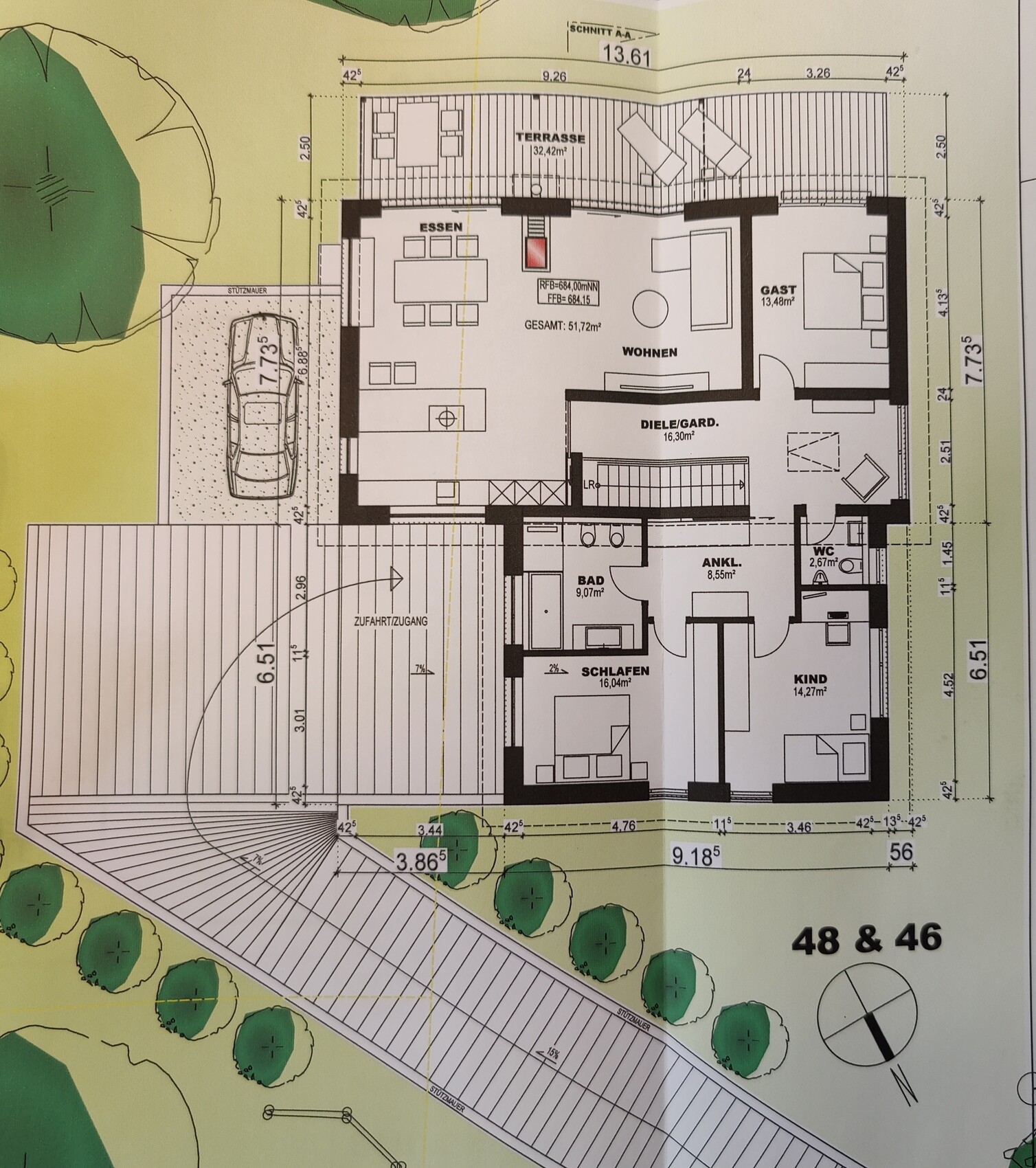
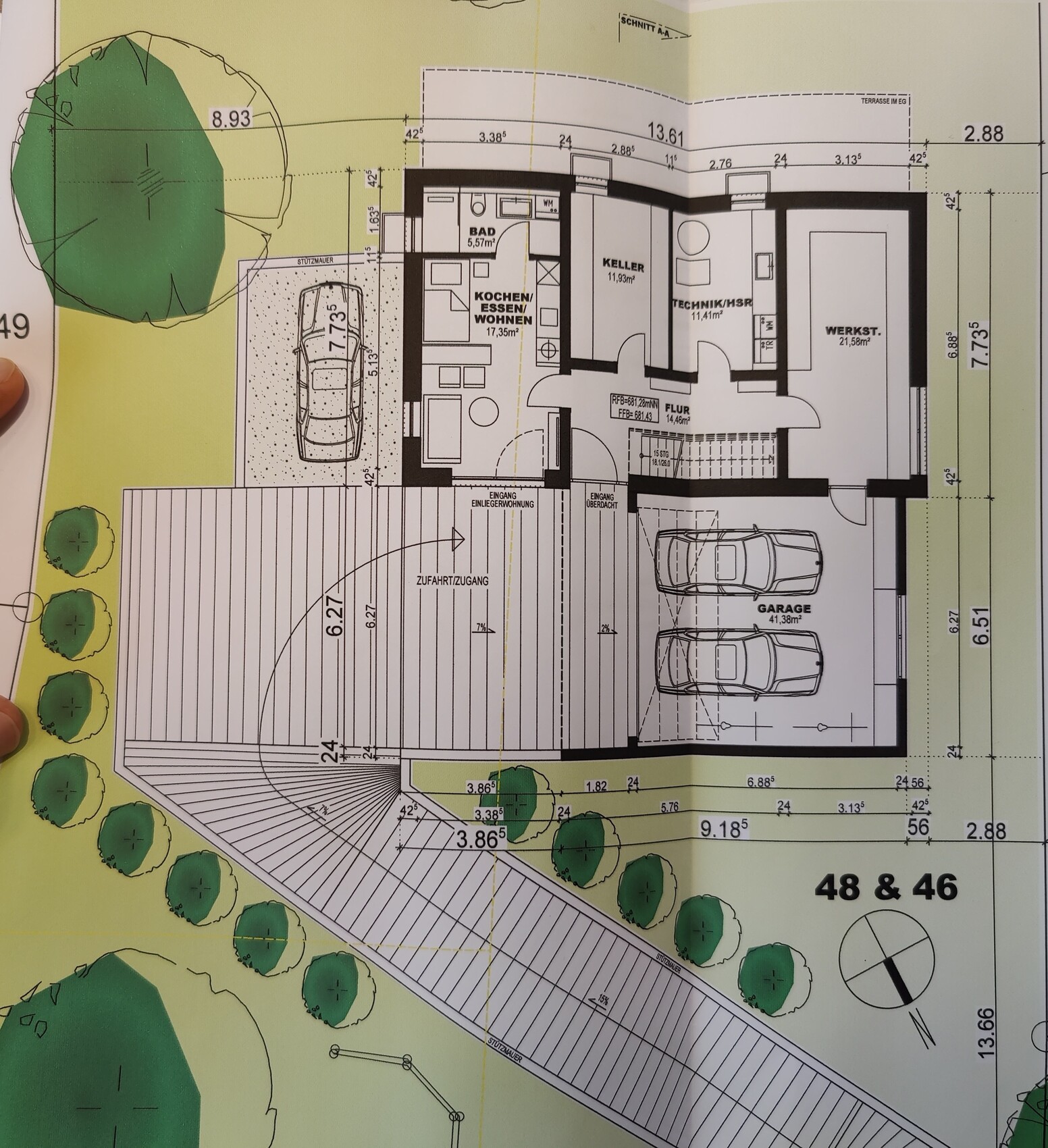
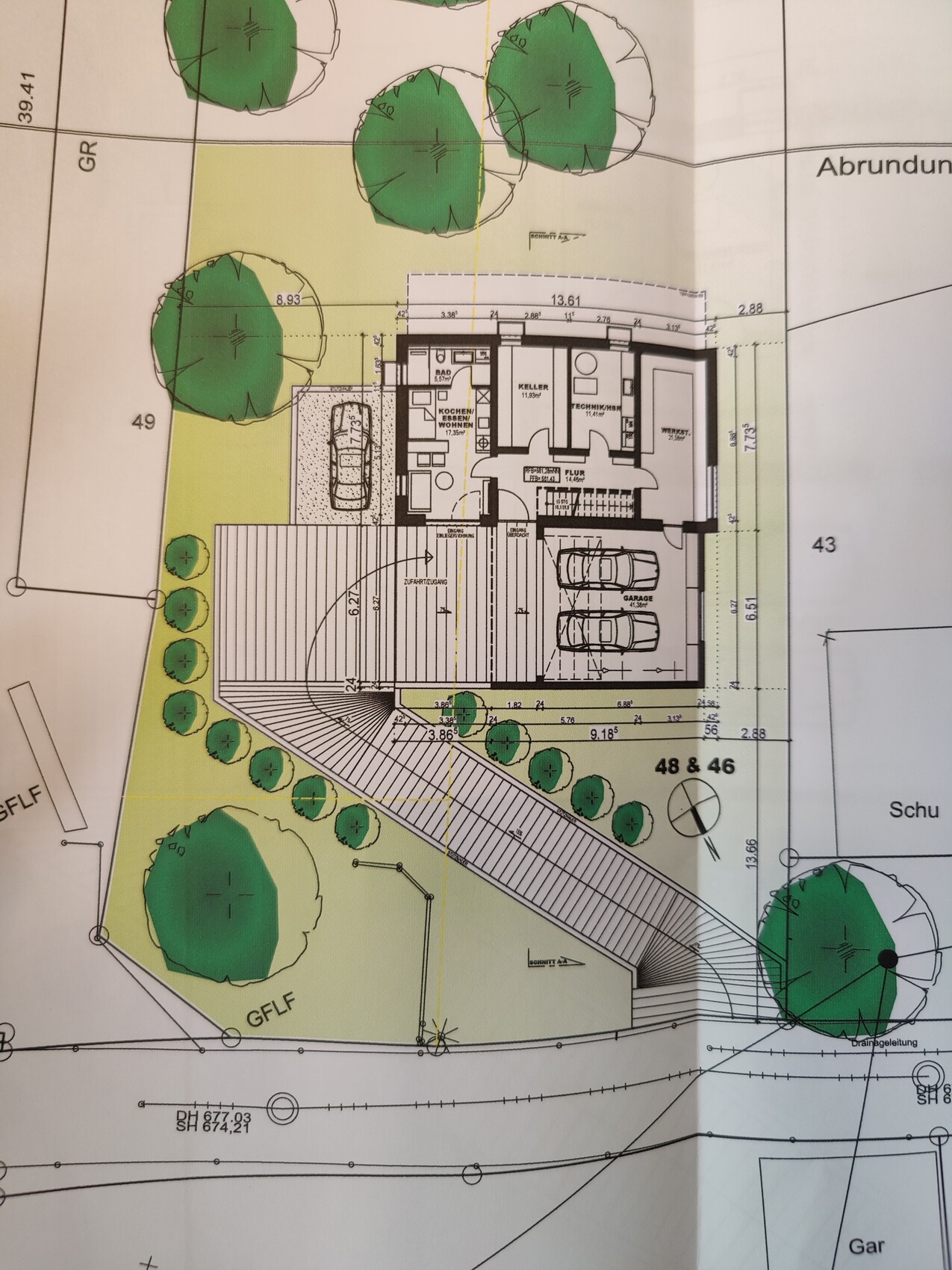
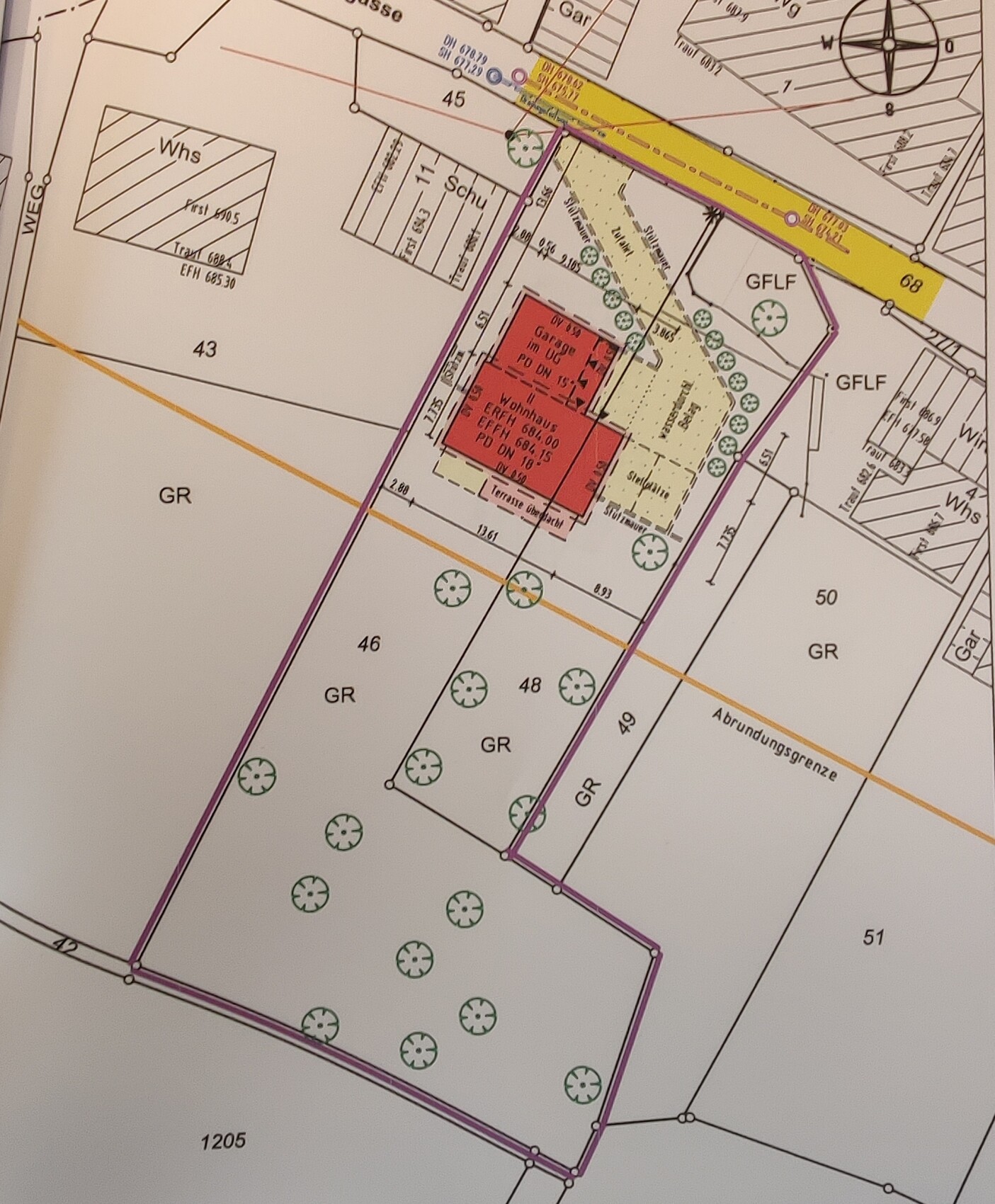
we would really appreciate your opinions on our floor plan. In general, we are quite happy with it. However, we are especially interested in your thoughts on the living floor. Specifically, the area with the master bedroom, children's room, and the bathroom. For example, in the bathroom there is currently no space to hang clothes that have been worn once or to place a laundry basket.
Development Plan/Restrictions
Plot size: 2262 sqm (2,4355 sq ft)
Slope: yes
Floor area ratio: 0.4
Plot ratio: 0.8
Building envelope, building line, and boundary: see images
Number of parking spaces: 4 (double garage, 2 on the street)
Number of floors: 2-2.5 (basement, ground floor, attic)
Roof type: staggered shed roofs (15° and 18°)
Orientation: northeast/southwest
Additional regulations: no formal development plan, slope rises away from the street
Owners’ Requirements
Style, roof shape, building type: relatively modern, staggered shed roof, single-family house
Basement, floors: 1 full floor + “half” basement (half embedded in the slope)
Number of people, ages: 2 (27 + 33), possibly 2 children planned
Space requirements on ground and upper floors:
Storage is in the basement and attic. The basement includes the technical room, workshop, and a granny flat. The upper floor has an open living area, a guest bathroom, a bathroom, 2 offices/children’s rooms, and the master bedroom. An attic is planned above the hallway and the “kitchen.”
Office:
Currently, 2 offices/children’s rooms are planned. Since we are uncertain about having children, we do not want an extra office. If another office is needed later, the granny flat will be used or a separate garden shed will be built.
Guests per year: 15 (in the granny flat)
Open or closed architecture: rather open. Living room, dining room, and guest area are vaulted. The attic is above the hallway and kitchen.
Conservative or modern building style: more modern
Open kitchen, kitchen island: open kitchen with peninsula
Number of permanent dining seats: 6-8
Fireplace: Swedish wood stove
Music/sound system wall: no preference
Balcony, roof terrace: no
Garage, carport: double garage
Additional wishes: We really wanted a large workshop to store all existing equipment. A double garage was also desired.
House Design
Designed by: Architect
What we like best: living on one level
What we don’t like: the bathroom, because there is no place to put clothes or a laundry basket. The “walk-in closet” is actually the hallway.
Cost estimate by architect/planner: 650,000 (including external landscaping, kitchen, bathroom, incidental building costs)
Personal budget limit for house including equipment: 720,000 (all furniture is available except for bathroom and kitchen)
Preferred heating technology: air-source heat pump
If You Had to Cut Back
Details/finishes you could do without: other than the bidet in the bathroom, nothing else comes to mind (originally, 2 more rooms were planned)
Must-haves: basement, workshop
Why Is the Design Like This?
The plot is quite steep. The driveway goes uphill from the street (see images). The house is set back because the steepest part of the slope is right at the street, creating a “shadow spot.”
Originally, a single-family house with a basement + 2 floors and a double garage was planned. Our architect then suggested that living space could be built above the double garage. This eliminated the second full floor. We also liked the idea of being able to live on one level when we are older (possibly with a stairlift).
Many thanks in advance for your ideas
N
NoSchnitzers2 May 2021 16:13Hello Ventreri,
Thank you for asking. The earthworks have just started, but I’ll summarize everything we can say so far.
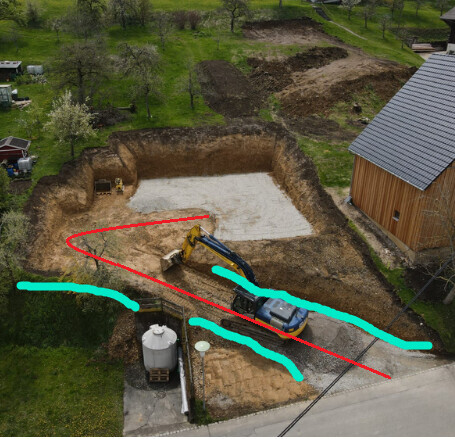
Our driveway is about 35-40 m (115-131 ft) long, with a slope starting at 7%, then increasing to 15%, and then leveling off again at 7%.
The excavation and driveway work is being carried out by a local company. We are working with an architect and contracting trades separately. It was especially important to us to agree on a fixed price for the earthworks and slope stabilization, and the company agreed to that.
We will be paving our driveway with asphalt. We were told that paving stones could also be an option, but asphalt was recommended. (Unfortunately, I don’t remember the exact reasons for all decisions— I believe it was mainly for stability, as individual paving stones might shift, but please don’t hold me strictly to that.) During the construction phase, no final surface will be applied to the driveway yet. The final layer will be added once the house is finished. The driveway can still be used normally in the meantime without causing any damage. The area in front of the garage is planned to be paved with stones.
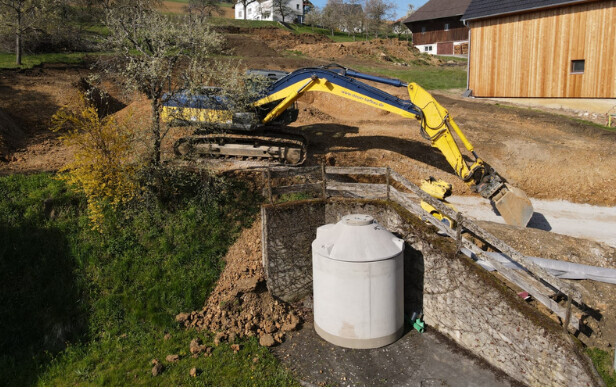
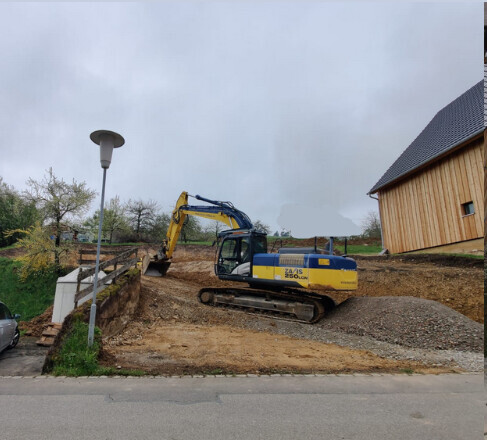
For the slope stabilization, we could choose between L-shaped retaining walls and granite stones. Since the slope is located in front of the house, we decided on the granite stones (approximately 7,000€ additional cost). In one of the pictures, I marked our driveway in red and the area to be stabilized in turquoise. There is already a small retaining wall on our property, so there is a break in the turquoise line on one side. I hope the attached pictures give a rough idea of the steepness of the slope.
If you have any specific questions, just ask.
(Regarding the aerial photos, I should mention that they were taken with license and permission.)
Thank you for asking. The earthworks have just started, but I’ll summarize everything we can say so far.
Our driveway is about 35-40 m (115-131 ft) long, with a slope starting at 7%, then increasing to 15%, and then leveling off again at 7%.
The excavation and driveway work is being carried out by a local company. We are working with an architect and contracting trades separately. It was especially important to us to agree on a fixed price for the earthworks and slope stabilization, and the company agreed to that.
We will be paving our driveway with asphalt. We were told that paving stones could also be an option, but asphalt was recommended. (Unfortunately, I don’t remember the exact reasons for all decisions— I believe it was mainly for stability, as individual paving stones might shift, but please don’t hold me strictly to that.) During the construction phase, no final surface will be applied to the driveway yet. The final layer will be added once the house is finished. The driveway can still be used normally in the meantime without causing any damage. The area in front of the garage is planned to be paved with stones.
For the slope stabilization, we could choose between L-shaped retaining walls and granite stones. Since the slope is located in front of the house, we decided on the granite stones (approximately 7,000€ additional cost). In one of the pictures, I marked our driveway in red and the area to be stabilized in turquoise. There is already a small retaining wall on our property, so there is a break in the turquoise line on one side. I hope the attached pictures give a rough idea of the steepness of the slope.
If you have any specific questions, just ask.
(Regarding the aerial photos, I should mention that they were taken with license and permission.)
N
NoSchnitzers2 May 2021 16:26A brief note:
At the back of the house, we do not need to secure anything or perform any additional excavation.
In consultation with the architect and the structural and civil engineers, we raised our house by half a meter (1.6 feet) compared to the initial plan. This allows the rear to be almost level (as level as possible on such a slope) and lets us keep the natural terrain slope after the terrace.
At the back of the house, we do not need to secure anything or perform any additional excavation.
In consultation with the architect and the structural and civil engineers, we raised our house by half a meter (1.6 feet) compared to the initial plan. This allows the rear to be almost level (as level as possible on such a slope) and lets us keep the natural terrain slope after the terrace.
H
hanghaus20002 May 2021 17:42NoSchnitzers schrieb:
In consultation with the architect, structural engineer, and civil engineer, we raised our house by half a meter (1.6 feet) compared to the initial plan. This allows us to have the back almost level (as level as is possible on such a slope) and keep the natural terrain slope after the terrace. I would have suggested the same after reviewing Section A. However, the driveway has become somewhat steeper.
N
NoSchnitzers2 May 2021 18:06hanghaus2000 schrieb:
I would have suggested that as well after reviewing Section A. But the driveway ended up a bit steeper. You’re right. I took the information from the old plan. 😳
We made the driveway 1 to 1.5 degrees steeper to reach the 50cm (20 inches).
Since it’s quite steep now, the architect coordinated this directly with the site manager and the civil engineering team. If they had advised against it, we would have left it as it was. (Apparently, the 15% slope corresponds to some kind of standard or regulation.)
For me, it was important because every centimeter (inch) of height gives us more light in winter, since we’re located quite deep in a valley.
H
hanghaus20003 May 2021 09:44NoSchnitzers schrieb:
You’re right about that. I got the details from the old plan. 😳
We made the driveway 1–1.5 degrees steeper to reach the 50 cm (20 inches).
Since the slope is now quite steep, the architect coordinated this directly with the civil engineering team on site. If they had advised against it, we would not have done it. (Apparently, this 15% corresponds to a standard or something like that…)
For me, it was also important because every centimeter in elevation brings us more light in winter, as we are located quite deep in a valley. Yes, 15% is a general guideline.
The slightly higher position on the north-facing slope makes a lot of sense. I hope for you that no development is planned or will be built to the south of your house. Unfortunately, that is not visible in any plan.
N
NoSchnitzers3 May 2021 20:40hanghaus2000 schrieb:
I hope for your sake that there won’t be any construction south of your house or coming up there. Unfortunately, this is not shown on any plan. I found some plans on our city’s website and did a bit of sketching.
Fortunately, our plot is quite long — about 80 meters (260 feet) in total. Behind the house, we still have roughly 50 meters (165 feet) to the property boundary toward the southwest.
Beyond that, the village ends and agricultural land begins.
Several years ago, there were discussions about possibly expanding the new development area along the red-marked street. So, we’ll have to wait and see what time brings.
This winter, we examined the shadow pattern cast by the red-marked house (basement plus 2 full stories). Even if another house of the same size is built next to it, we believe we will still get enough sunlight (and those 50 centimeters (20 inches) really make a big difference) 🙂
Similar topics