
Development Plan / Restrictions
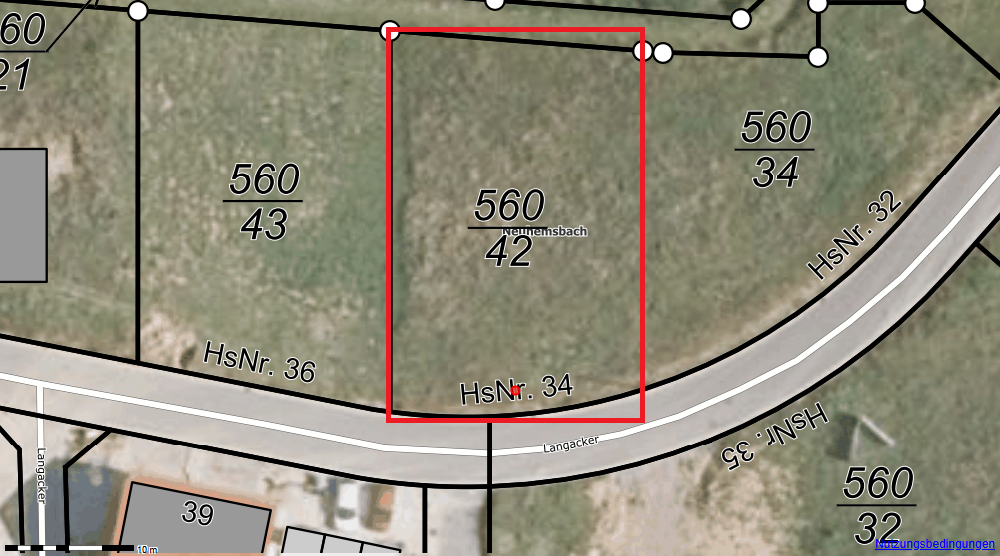
Plot size: 561m2 (6039 ft2)
Slope: yes, from street (south) to end of property (north) approximately 4 meters (13 feet) elevation difference
Floor area ratio (FAR): 0.4
Gross floor area ratio (GFAR): 0.8
Building setback line / building line / boundary: 15 meters (49 feet)
Edge development
Number of parking spaces: 2
Number of storeys: 2
Roof type: SD, KWD, WD, VPD (17 - 45°)
Architectural style: open
Orientation: north
Maximum height / limits: eaves height max. 5.10 meters (17 feet), ridge height max. 10.60 meters (35 feet)
Owners’ Requirements
Architectural style, roof type, building type: open, SD, single-family house
Basement, storeys: no basement, 1.5 storeys
Number of occupants, age: 2 (26, 28)
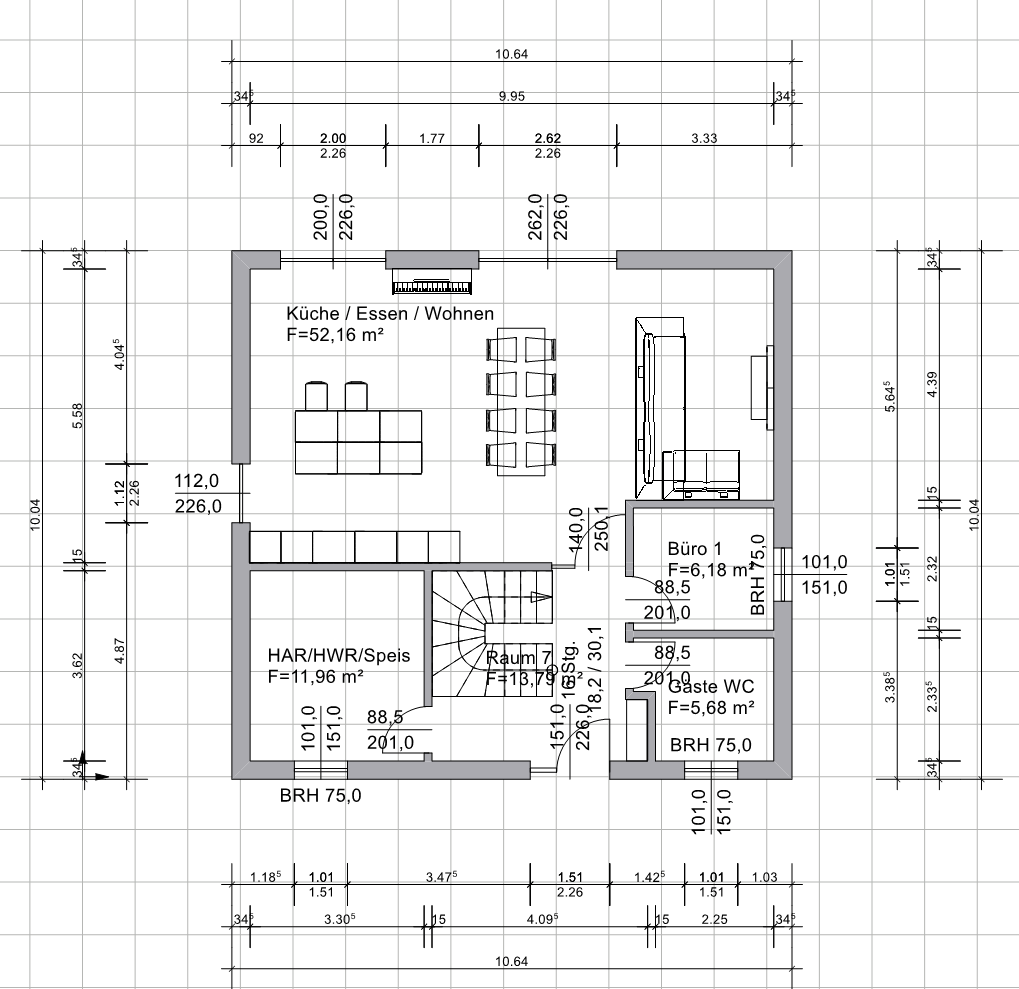
Room requirements on ground floor / upper floor: large kitchen / living / dining area, 2 offices, technical room / utility room / pantry, guest bathroom, wardrobe, bedroom including dressing room, bathroom, 2 children’s rooms
Office use: family use or home office? Home office
Guest overnight stays per year: 2
Open or closed architecture: closed
Conservative or modern construction: modern
Open kitchen, kitchen island: open kitchen with island
Number of dining seats: 8
Fireplace: no
Music / stereo wall: no
Balcony, roof terrace: no
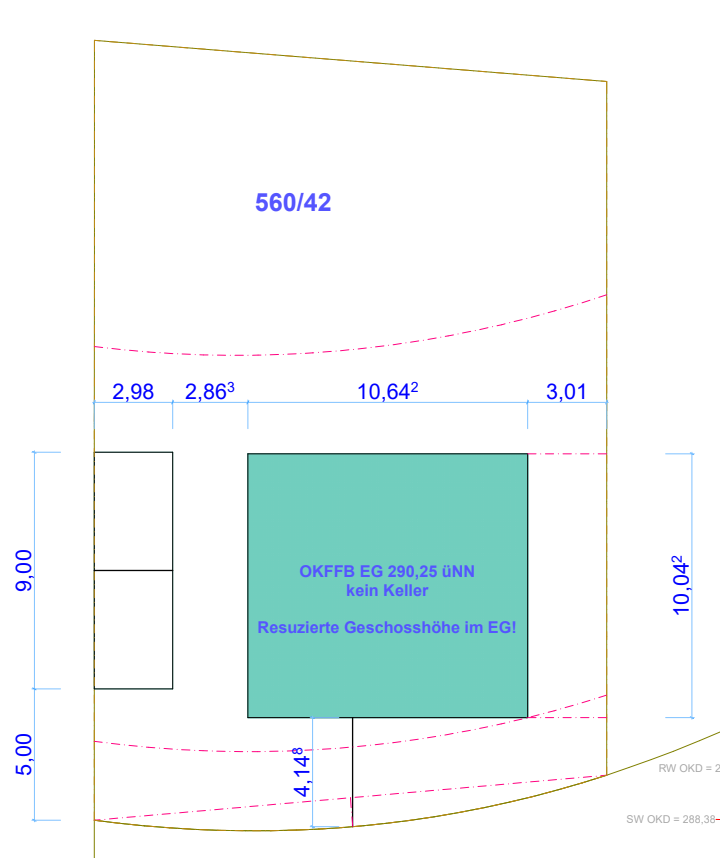
Garage, carport: yes, on the left side of the house (property boundary) – garage and house to be connected
Utility garden, greenhouse: no
House Design
Design by:
- Architect
- Do-it-yourself and consultations with consultant from the prefab house company
What do you particularly like? Why?
- Large dining-living area. We have a big family, and many people gather for celebrations etc. Two separate offices are also very helpful as you can work undisturbed.
- Kitchen located on the left so groceries can be put away directly through the door to the carport.
What do you not like? Why?
- We generally like the floor plan. We just want your opinions and to identify potential areas for improvement. Maybe also points we have completely overlooked.
Price estimate according to architect/planner: $460,000 including $100,000 for the plot, excluding $80,000 of own work (electrical, heating, drywall, doors)
Personal price limit for the house, including fixtures: There is no real limit. Financing is already secured. We are currently in the planning phase.
Preferred heating technology: heat pump (WP)
If you have to give things up, which details / additions
- can you give up: stair shape, guest bathroom size, utility room size
- cannot give up: two offices, two children’s rooms, large kitchen / living / dining area
Why is the design the way it is now? Standard draft from the architect, including our adjustments after consultations with the prefab house company’s consultant
Roof pitch: 38°
Knee wall height: 1.50m (upper edge of finished floor: ~1.33m) (5 feet, 4.3 inches (4 feet, 4.7 inches))
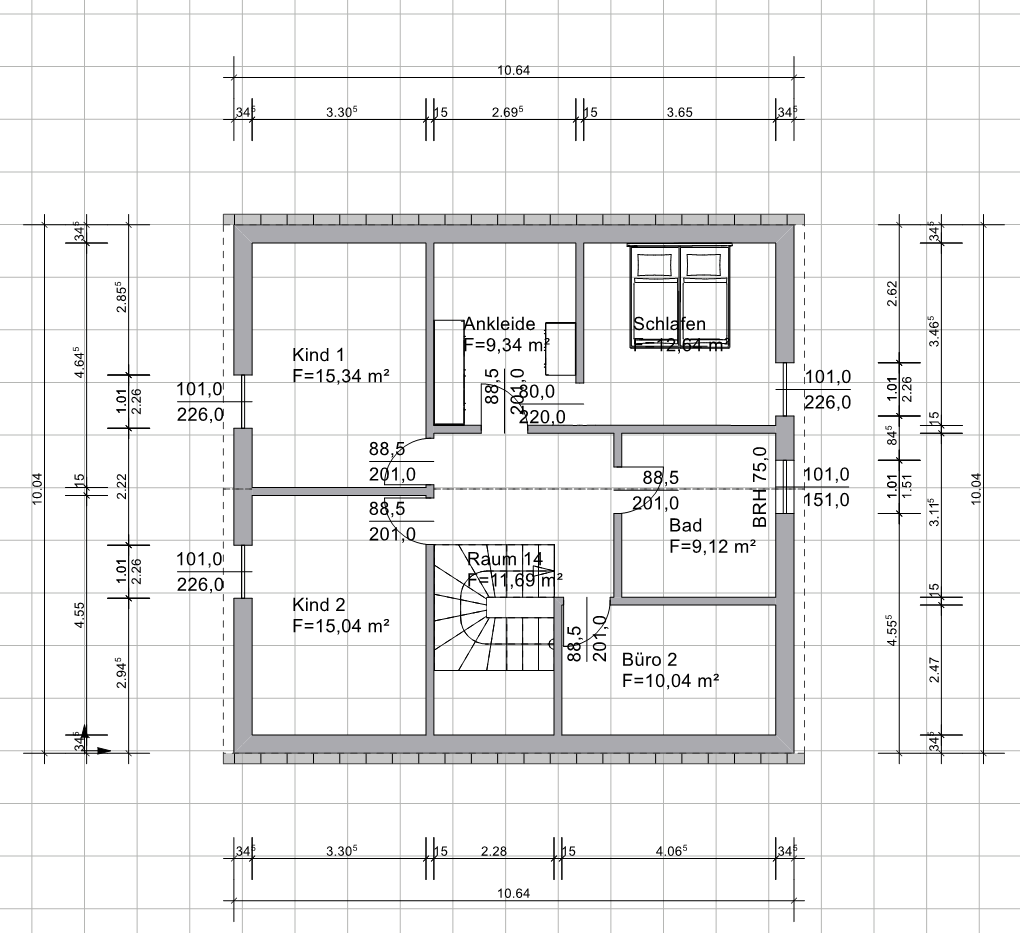
Plot size: 561m2 (6039 ft2)
Slope: yes, from street (south) to end of property (north) approximately 4 meters (13 feet) elevation difference
Floor area ratio (FAR): 0.4
Gross floor area ratio (GFAR): 0.8
Building setback line / building line / boundary: 15 meters (49 feet)
Edge development
Number of parking spaces: 2
Number of storeys: 2
Roof type: SD, KWD, WD, VPD (17 - 45°)
Architectural style: open
Orientation: north
Maximum height / limits: eaves height max. 5.10 meters (17 feet), ridge height max. 10.60 meters (35 feet)
Owners’ Requirements
Architectural style, roof type, building type: open, SD, single-family house
Basement, storeys: no basement, 1.5 storeys
Number of occupants, age: 2 (26, 28)
Room requirements on ground floor / upper floor: large kitchen / living / dining area, 2 offices, technical room / utility room / pantry, guest bathroom, wardrobe, bedroom including dressing room, bathroom, 2 children’s rooms
Office use: family use or home office? Home office
Guest overnight stays per year: 2
Open or closed architecture: closed
Conservative or modern construction: modern
Open kitchen, kitchen island: open kitchen with island
Number of dining seats: 8
Fireplace: no
Music / stereo wall: no
Balcony, roof terrace: no
Garage, carport: yes, on the left side of the house (property boundary) – garage and house to be connected
Utility garden, greenhouse: no
House Design
Design by:
- Architect
- Do-it-yourself and consultations with consultant from the prefab house company
What do you particularly like? Why?
- Large dining-living area. We have a big family, and many people gather for celebrations etc. Two separate offices are also very helpful as you can work undisturbed.
- Kitchen located on the left so groceries can be put away directly through the door to the carport.
What do you not like? Why?
- We generally like the floor plan. We just want your opinions and to identify potential areas for improvement. Maybe also points we have completely overlooked.
Price estimate according to architect/planner: $460,000 including $100,000 for the plot, excluding $80,000 of own work (electrical, heating, drywall, doors)
Personal price limit for the house, including fixtures: There is no real limit. Financing is already secured. We are currently in the planning phase.
Preferred heating technology: heat pump (WP)
If you have to give things up, which details / additions
- can you give up: stair shape, guest bathroom size, utility room size
- cannot give up: two offices, two children’s rooms, large kitchen / living / dining area
Why is the design the way it is now? Standard draft from the architect, including our adjustments after consultations with the prefab house company’s consultant
Roof pitch: 38°
Knee wall height: 1.50m (upper edge of finished floor: ~1.33m) (5 feet, 4.3 inches (4 feet, 4.7 inches))
H
hanghaus202321 May 2026 20:33Unfortunately, the excerpt of the development plan is unreadable; I guess TH 4.7m (15.4 feet) on average. If I am to continue here, I will need the complete development plan, both the plan and the text version, as well as any applicable municipal regulations.
H
hanghaus202321 May 2026 21:58dorjan schrieb:
Regarding reduced floor height: Since the eave height relative to the street can only be a maximum of 5 meters (16 feet 5 inches), the architect says we have to reduce the ground floor ceiling height (clear height) from 2.75 meters (9 feet) to 2.55 meters (8 feet 4 inches). In return, we would then have a knee wall height of 1.50 meters (4 feet 11 inches). Eave height according to drawing WA3b is, in my opinion, 4.7 meters (15 feet 5 inches).
The ceiling is 36 cm (14 inches) thick with a clear height of 2.55 meters (8 feet 4 inches). According to the plan, the floor height is 2.91 meters (9 feet 6 inches). 4.70 meters (15 feet 5 inches) minus 2.91 meters (9 feet 6 inches) equals a knee wall height of 1.79 meters (5 feet 10 inches). With 20 cm (8 inches) more clear height, the knee wall is still 1.59 meters (5 feet 3 inches).
Why is 2.75 meters (9 feet) ceiling height considered normal?? 2.55 meters (8 feet 4 inches) is quite sufficient.
H
hanghaus202322 May 2026 08:07In Rhineland-Palatinate, § 8 of the State Building Code (LBauO) regulates boundary development within setback areas. For buildings without their own setback zones (such as garages, carports, or ancillary structures), the maximum average wall height at the boundary is 3.20 m (10.5 ft), with a total length of up to 12 m (39.4 ft) allowed per property boundary.
The terrain slopes down towards the northeast, so the gradient at the boundary is approximately 13%.
The boundary garage is 9 m (29.5 ft) long, resulting in a height difference (delta h) of 1.17 m (3.8 ft). To illustrate, here is a sketch.
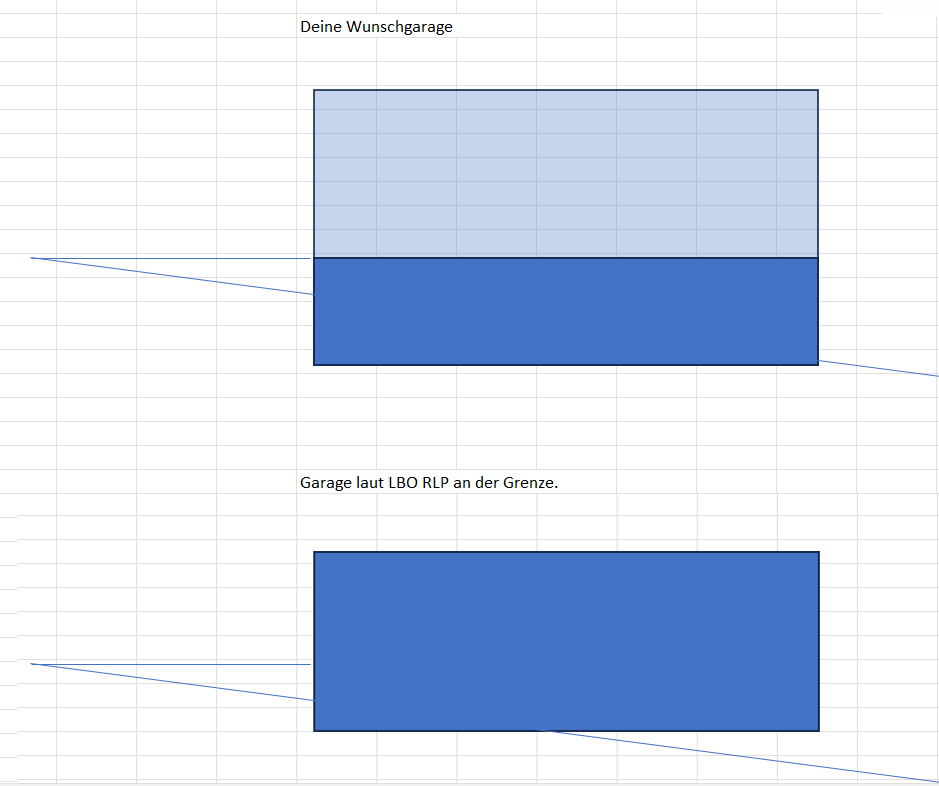
Before you got fully rested, I looked up the development plan myself. There are no specific regulations for the boundary garage, so the LBauO applies.
Unfortunately, I don’t have access to the RLP geoportal and therefore not to the original PDF plan, which can be scaled. This is necessary to read the planning drawing properly. Consequently, I am sticking with my assumption of a total height of 4.7 m (15.4 ft).
You now have two options:
1. Submit an application for an exemption.
2. Build the garage according to the LBauO requirements (and then place the house at a lower position, which would solve many problems).
You might want to call the building authority and ask if an exemption application has any chance of approval. In my opinion, the answer will probably be no, but in a small community, it could be different.
Check in the development area if someone has built on the boundary like you want to.
Take a look at house number 11. They also built a garage on a slope and probably had to set it back 3 m (9.8 ft) from the boundary.
Did you create the terrain model yourself?
The terrain slopes down towards the northeast, so the gradient at the boundary is approximately 13%.
The boundary garage is 9 m (29.5 ft) long, resulting in a height difference (delta h) of 1.17 m (3.8 ft). To illustrate, here is a sketch.
Before you got fully rested, I looked up the development plan myself. There are no specific regulations for the boundary garage, so the LBauO applies.
Unfortunately, I don’t have access to the RLP geoportal and therefore not to the original PDF plan, which can be scaled. This is necessary to read the planning drawing properly. Consequently, I am sticking with my assumption of a total height of 4.7 m (15.4 ft).
You now have two options:
1. Submit an application for an exemption.
2. Build the garage according to the LBauO requirements (and then place the house at a lower position, which would solve many problems).
You might want to call the building authority and ask if an exemption application has any chance of approval. In my opinion, the answer will probably be no, but in a small community, it could be different.
Check in the development area if someone has built on the boundary like you want to.
Take a look at house number 11. They also built a garage on a slope and probably had to set it back 3 m (9.8 ft) from the boundary.
Did you create the terrain model yourself?
H
hanghaus202322 May 2026 08:31I have finally found the scalable development plan.
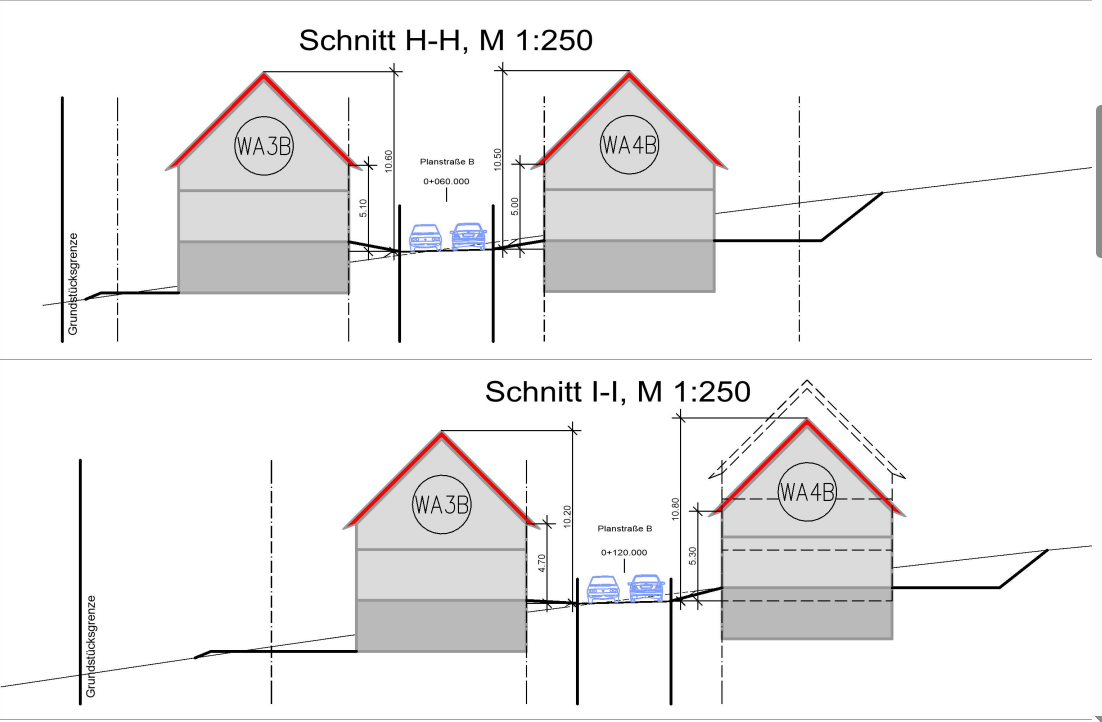
The one below is your example. So, it is 4.7 m (15.4 ft) after all. Or do you want to build the house as high as in the example above?
The one below is your example. So, it is 4.7 m (15.4 ft) after all. Or do you want to build the house as high as in the example above?
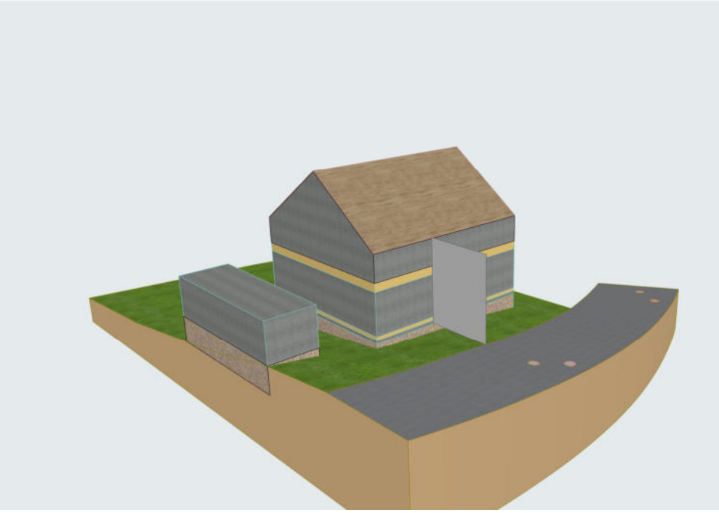
Thank you for your effort! The site plan was created by the architect. According to the architect, the house should be positioned slightly below street level on the left side and above street level on the right side, as the street slopes downward. The architect also mentioned there would be a slight slope at the garage entrance, but this is not apparent on the site plan. I also don’t understand why he drew the garage with a length of 9 meters (30 feet). We want a standard prefabricated garage. An extension at the back is not necessarily required.
We would like to position the house as level as possible with the street, since we have a family member who uses a wheelchair and want to make access as easy as possible. Building into the slope was not an option for us, as we don’t like the idea of having the living, dining, and kitchen areas in the basement. That would mean entering the house and immediately going down stairs.
Regarding the earthworks, I’m not too worried, as we already have a quote of 13,000 for the excavation work (preparation for the garage/house). Of course, the entire exterior landscaping is not included in this. We also have a buffer of around 50,000 that has not yet been budgeted. We were aware that the complete construction (house, garage, landscaping) up to final completion to our specifications would cost more. Nevertheless, we decided to proceed and want to complete it step by step.
About the ceiling height: yes, I agree with you—2.55 meters (8.4 feet) is sufficient. However, the manufacturer’s standard is 2.75 meters (9 feet), and we couldn’t really imagine the difference. In the end, we decided on a ceiling height of 2.55 meters (8.4 feet) with a higher knee wall instead.
We would like to position the house as level as possible with the street, since we have a family member who uses a wheelchair and want to make access as easy as possible. Building into the slope was not an option for us, as we don’t like the idea of having the living, dining, and kitchen areas in the basement. That would mean entering the house and immediately going down stairs.
Regarding the earthworks, I’m not too worried, as we already have a quote of 13,000 for the excavation work (preparation for the garage/house). Of course, the entire exterior landscaping is not included in this. We also have a buffer of around 50,000 that has not yet been budgeted. We were aware that the complete construction (house, garage, landscaping) up to final completion to our specifications would cost more. Nevertheless, we decided to proceed and want to complete it step by step.
About the ceiling height: yes, I agree with you—2.55 meters (8.4 feet) is sufficient. However, the manufacturer’s standard is 2.75 meters (9 feet), and we couldn’t really imagine the difference. In the end, we decided on a ceiling height of 2.55 meters (8.4 feet) with a higher knee wall instead.
H
hanghaus202322 May 2026 11:32dorjan schrieb:
Thanks for your effort! I’m happy to help. I prefer not to see people end up in financial ruin. That seems to be the case here.
dorjan schrieb:
The site plan was prepared by the architect. That’s a good first step, in my opinion. You wouldn’t believe some of the things I have seen so far.
dorjan schrieb:
According to the architect, the house will be positioned slightly below the street level on the left side and above the street level on the right side because the road slopes downwards. That’s exactly what I found as well. In that case, you might even be able to apply the example with a 5.1m (17 ft) ridge height.
dorjan schrieb:
According to the architect, there is a slight slope at the garage driveway. But I can’t see it from the site plan. I can see it—it’s almost 40 cm (16 inches) over a width of 6 m (20 ft).
Similar topics