
ᐅ Floor Plan Optimization for a Single-Family Home with Basement on a Small Plot
Created on: 16 Sep 2019 08:38
A
AnniSke
Hello everyone!
After reading here for quite some time (and checking out nearly all floor plan questions for similar lot sizes and building dimensions), we now have some questions about the preliminary design from our builder.
Our situation is similar to the forum post from Wednesday, but our main focus is on the basement J
This is the first draft based on a rough idea of what we envision and what is important to us (the design seems quickly done to me—see the projecting dormer—or is that common nowadays?), but overall all our requests have been considered. We see room for improvement especially in the basement level, the basement stairs/daylight wells, and the size of the living/dining area (probably only fixable with a larger house footprint). The upper floor works well for us.
Independently from the builder, we came up with a similar floor plan that meets our needs; it is nothing “special” but fits our ideas well.
We would appreciate it if some of you could share practical tips or suggestions for changes so that we can respond to the builder and discuss possible deviations.
Feel free to be thorough and please also point out any potentially major planning mistakes.
I have attached the following:
Development Plan / Restrictions
Lot size: approx. 360 m² (still not fully measured, as the plot is being subdivided)
Slope: no
Floor area ratio (FAR): 0.4
Floor space index (FSI): 0.8
Building envelope, building line and boundary: see site plan; 3 m (approx. 10 ft) on three sides, less on street side due to protected green strip with fruit trees (not our property); open building style
Edge development: no (usually allowed for townhouses, but specifically excluded for carports and garages in the development plan); edge development allowed for uncovered parking spaces
Number of parking spaces: 2
Number of stories allowed: 1-2 full stories
Roof type: gable roof (up to 38°), shed roof, flat roof (up to 25°)
Architectural style: classic-modern?
Orientation: ridge line along the street
Maximum heights / limits: eaves height max. 7.50 m (24.6 ft) above the access road (lot lies slightly below street level)
Additional requirements: none
Homeowner Requirements
Style, roof shape, building type: classic/modern detached single-family house, gable roof 38°, knee wall preferably raised to 1 m (3 ft)
Basement, number of floors: basement included, 1.5 floors
Number of people, ages: 2 (both 29), 1 child (1.5 years), at least 1 more (preferably 2) planned
Room requirements on ground floor (GF), upper floor (UF)
GF: kitchen (with sliding door, can be smaller, no separate dining area), living/dining area (currently about 32 m² (344 sq ft), our furniture is designed for this and we would like to keep it), future master bedroom, bathroom with shower (house should theoretically be usable on one level in an age-appropriate way)
UF: 3 children’s rooms, bathroom
Basement: utility room, technical room, workshop, office/guest room
Office (family use or home office?): office desired (in basement), home office at least once a week
Guests per year: about twice a month 2 people, every two weeks 1 person → guest room desired (can later be combined with office in the basement if a bedroom is needed on the ground floor)
Open or closed architecture: closed
Conservative or modern construction: rather conservative
Open kitchen, cooking island: no, smaller cooking area, separated by sliding door
Number of dining seats: permanently for 5 (current dining table has 8 seats)
Fireplace: yes, preferred
Music / stereo wall: no
Balcony, roof terrace: no
Garage, carport: no
Vegetable garden, greenhouse: some vegetable garden, so we want to place the building close to the build boundary to maximize garden space
Additional wishes / special features / daily routine, also reasons why some things should or should not be: none
House Design
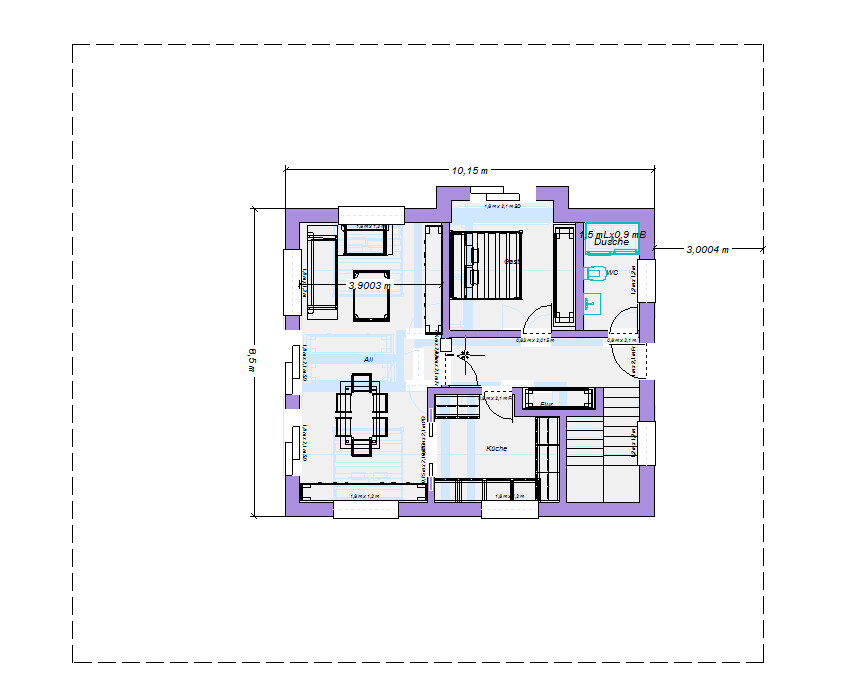
Planner: planner from a building company; the second attached version is our own adjusted “solution” with the house widened by 0.5 m (approx. 1.6 ft) and furniture drawn in the living/dining and bedroom areas which we already own.
What do you especially like?: the solution with a coat area and shower niche on the ground floor, the stairs, level, masonry showers, spacious children’s rooms, fireplace location between living and dining areas, large home office/guest room in basement, where both “uses” can be nicely combined.
Why?: we had not thought of the coat and shower concept in the floor plan ideas, find it practical and reasonably age-appropriate (though the dimensions could be slightly wider), and had no clue where best to put a fireplace.
What don’t you like? Why?: living/dining area too small, at 22 m² (237 sq ft) we cannot fit our furniture, kitchen is too large, we don’t need a separate seating area in the kitchen (we currently eat all meals in the dining area), the exterior basement stairs with the bend take up too much space, and we don’t want a carport as it would have to be inside the building zone (uncovered parking is allowed as edge development), the concrete daylight wells in the basement.
Price estimate from architect/planner: not yet available, initial rough offer before planning (130 m² (1400 sq ft) with basement) was 315,000 including standard ancillary construction costs, but with a “standard basement”; we might need a waterproof concrete shell (“white tub”), estimated extra cost about 20,000 according to the builder
Personal price limit for the house: 340,000 (furniture is already owned from current large apartment (126 m² (1356 sq ft) living space), kitchen belongs to us and only needs minor changes, cost covered separately)
Preferred heating technology: we considered a ground source heat pump, but the builder has had problems twice in the building area with insufficient supply temperature and therefore recommends an air-to-water heat pump on the south side of the house. Has anyone had experience with this?
If you have to give up something, what details/features?
Can give up: dormer, large kitchen, fully heated basement
Cannot give up: basement (due to small lot and 3 children planned), bedroom on ground floor, bathroom with shower on ground floor
Why is the layout the way it is now?
Draft from planner after a brief initial discussion about our preferences (we did not provide a detailed list of requirements)
Which wishes were implemented by the architect? bedroom on ground floor, bathroom with shower, staircase design, bathroom with shower and tub on upper floor, basement with office
What do you think works well or poorly? we like the overall distribution of floors, but are not yet convinced by the basement layout.
What is the most important/basic question about the floor plan in 130 characters?
Any ideas to improve the basement (e.g., no bent stairs, maybe no basement hallway at stairs, maybe no daylight wells)? Any improvements for other floors (e.g., larger living/dining area)? Is there any place to add a laundry chute (nice to have but not essential)?
We look forward to your ideas and feedback J
Best regards and many thanks in advance!
After reading here for quite some time (and checking out nearly all floor plan questions for similar lot sizes and building dimensions), we now have some questions about the preliminary design from our builder.
Our situation is similar to the forum post from Wednesday, but our main focus is on the basement J
This is the first draft based on a rough idea of what we envision and what is important to us (the design seems quickly done to me—see the projecting dormer—or is that common nowadays?), but overall all our requests have been considered. We see room for improvement especially in the basement level, the basement stairs/daylight wells, and the size of the living/dining area (probably only fixable with a larger house footprint). The upper floor works well for us.
Independently from the builder, we came up with a similar floor plan that meets our needs; it is nothing “special” but fits our ideas well.
We would appreciate it if some of you could share practical tips or suggestions for changes so that we can respond to the builder and discuss possible deviations.
Feel free to be thorough and please also point out any potentially major planning mistakes.
I have attached the following:
- Site plan assumed by the builder
- Builder’s planning (floor plans, section, exterior view)
- Our modified floor plans based on the builder’s draft (larger living/dining area, smaller kitchen, different basement stairs)
Development Plan / Restrictions
Lot size: approx. 360 m² (still not fully measured, as the plot is being subdivided)
Slope: no
Floor area ratio (FAR): 0.4
Floor space index (FSI): 0.8
Building envelope, building line and boundary: see site plan; 3 m (approx. 10 ft) on three sides, less on street side due to protected green strip with fruit trees (not our property); open building style
Edge development: no (usually allowed for townhouses, but specifically excluded for carports and garages in the development plan); edge development allowed for uncovered parking spaces
Number of parking spaces: 2
Number of stories allowed: 1-2 full stories
Roof type: gable roof (up to 38°), shed roof, flat roof (up to 25°)
Architectural style: classic-modern?
Orientation: ridge line along the street
Maximum heights / limits: eaves height max. 7.50 m (24.6 ft) above the access road (lot lies slightly below street level)
Additional requirements: none
Homeowner Requirements
Style, roof shape, building type: classic/modern detached single-family house, gable roof 38°, knee wall preferably raised to 1 m (3 ft)
Basement, number of floors: basement included, 1.5 floors
Number of people, ages: 2 (both 29), 1 child (1.5 years), at least 1 more (preferably 2) planned
Room requirements on ground floor (GF), upper floor (UF)
GF: kitchen (with sliding door, can be smaller, no separate dining area), living/dining area (currently about 32 m² (344 sq ft), our furniture is designed for this and we would like to keep it), future master bedroom, bathroom with shower (house should theoretically be usable on one level in an age-appropriate way)
UF: 3 children’s rooms, bathroom
Basement: utility room, technical room, workshop, office/guest room
Office (family use or home office?): office desired (in basement), home office at least once a week
Guests per year: about twice a month 2 people, every two weeks 1 person → guest room desired (can later be combined with office in the basement if a bedroom is needed on the ground floor)
Open or closed architecture: closed
Conservative or modern construction: rather conservative
Open kitchen, cooking island: no, smaller cooking area, separated by sliding door
Number of dining seats: permanently for 5 (current dining table has 8 seats)
Fireplace: yes, preferred
Music / stereo wall: no
Balcony, roof terrace: no
Garage, carport: no
Vegetable garden, greenhouse: some vegetable garden, so we want to place the building close to the build boundary to maximize garden space
Additional wishes / special features / daily routine, also reasons why some things should or should not be: none
House Design
Planner: planner from a building company; the second attached version is our own adjusted “solution” with the house widened by 0.5 m (approx. 1.6 ft) and furniture drawn in the living/dining and bedroom areas which we already own.
What do you especially like?: the solution with a coat area and shower niche on the ground floor, the stairs, level, masonry showers, spacious children’s rooms, fireplace location between living and dining areas, large home office/guest room in basement, where both “uses” can be nicely combined.
Why?: we had not thought of the coat and shower concept in the floor plan ideas, find it practical and reasonably age-appropriate (though the dimensions could be slightly wider), and had no clue where best to put a fireplace.
What don’t you like? Why?: living/dining area too small, at 22 m² (237 sq ft) we cannot fit our furniture, kitchen is too large, we don’t need a separate seating area in the kitchen (we currently eat all meals in the dining area), the exterior basement stairs with the bend take up too much space, and we don’t want a carport as it would have to be inside the building zone (uncovered parking is allowed as edge development), the concrete daylight wells in the basement.
- Regarding the basement daylight wells: my father (landscape architect) suggests a landscaped slope on that side of the house instead of concrete daylight wells (I roughly marked some slope lines on our design) with stairs integrated into the slope at the rear of the house. What do you think of this option? We are unsure about stair drainage for rain, but this should be manageable with proper drainage (could be routed by pipe to the cistern we must install per development plan). Any other ideas?
Price estimate from architect/planner: not yet available, initial rough offer before planning (130 m² (1400 sq ft) with basement) was 315,000 including standard ancillary construction costs, but with a “standard basement”; we might need a waterproof concrete shell (“white tub”), estimated extra cost about 20,000 according to the builder
Personal price limit for the house: 340,000 (furniture is already owned from current large apartment (126 m² (1356 sq ft) living space), kitchen belongs to us and only needs minor changes, cost covered separately)
Preferred heating technology: we considered a ground source heat pump, but the builder has had problems twice in the building area with insufficient supply temperature and therefore recommends an air-to-water heat pump on the south side of the house. Has anyone had experience with this?
If you have to give up something, what details/features?
Can give up: dormer, large kitchen, fully heated basement
Cannot give up: basement (due to small lot and 3 children planned), bedroom on ground floor, bathroom with shower on ground floor
Why is the layout the way it is now?
Draft from planner after a brief initial discussion about our preferences (we did not provide a detailed list of requirements)
Which wishes were implemented by the architect? bedroom on ground floor, bathroom with shower, staircase design, bathroom with shower and tub on upper floor, basement with office
What do you think works well or poorly? we like the overall distribution of floors, but are not yet convinced by the basement layout.
What is the most important/basic question about the floor plan in 130 characters?
Any ideas to improve the basement (e.g., no bent stairs, maybe no basement hallway at stairs, maybe no daylight wells)? Any improvements for other floors (e.g., larger living/dining area)? Is there any place to add a laundry chute (nice to have but not essential)?
We look forward to your ideas and feedback J
Best regards and many thanks in advance!
AnniSke schrieb:
There will probably be a 3 m (10 ft) setback area in the new development plan. I don’t think so. How far along is the development plan (public participation, public display, date for the planning permission decision)?
AnniSke schrieb:
with the updated development plan Is that planned anyway?
ypg schrieb:
Replace basement staircase with attic staircase That’s not necessary. The current design already has three floors connected by a proper staircase. The whole structure will just be raised so the lowest level isn’t buried.
Wugler1978 schrieb:
I’d rather have guests in the basement than reduce the living room by 15 m² (160 ft²). That’s not really the alternative here. The question is only whether one floor should be underground or above ground. Those in favor of the basement overlook that the opponents don’t want to eliminate the floor completely but simply bring it above ground level. This saves a lot of earthworks, a basement exterior staircase, possibly even a waterproof concrete shell, and if needed, the dormer window. Since I’m neither a wine collector, a conspiracy theorist, nor Austrian, I can’t see any advantage to having a subterranean space compared to one above ground. The only argument I see is the appearance. If you don’t like ground floor, first floor, attic layout, no other arguments matter. Convertible or station wagon? A convertible is more expensive, has only two doors, less legroom in the back, a smaller trunk, and after ten years the roof leaks. And still, many wouldn’t want to switch.
First, let’s see what the plot and the development plan finally look like. Then the legal building limits can be compared with the financial ones. And if there is still some design flexibility left, we can discuss the dusty attic space.

Escroda schrieb:
the dusty attic... I didn’t even mention that earlier: dust is everywhere, even in the smallest cabin, and it doesn’t have to be in Rome for that. I have even seen dust in basements, personally.https://www.instagram.com/11antgmxde/
https://www.linkedin.com/company/bauen-jetzt/
haydee schrieb:
Do you have a general contractor or a main contractor?Oh dear, by definition I think it’s a main contractor, a small regional company that has been operating for 25 years and works together with local tradespeople. We are buying the land separately. It will basically be a turnkey house (of course without painting and flooring – as always these can be done later for an extra cost). Naturally, we want to get comparison quotes (usually at least three, or do you think we should get more?), we’ve had appointments with two so far. Up to now, only one has given us a more concrete offer; at first impression, he seemed more down-to-earth and especially more accurate with cost estimates, he also clearly pointed out critical issues and potential additional costs related to his estimate. So a good first impression… but of course we’ll wait for the other offers.
11ant schrieb:
the workspace had call center vibesHe says, I quote: “I don’t need light, I work in the dark anyway so I can see the monitor better” – typical software developer. No, but I totally agree with you, if the rooms are to be used properly they definitely need adequate lighting.
Escroda schrieb:
How far along is the development plan?Public participation finished last year, next is just the city council’s approval at the upcoming meeting (they only made some adjustments regarding drainage requirements: no longer necessary to slow down water return from the cistern). Also completing the surveying of our subparcel and updating the utility plans accordingly. So theoretically all the “preparatory work” is done, if everything goes as planned (does it ever…), then after the approval there is a four-week period during which the development agreement is made, and afterwards development work could begin. Escroda schrieb:
The only argument I see is the appearance.That’s exactly what we are cutting back on right now… as practical and reasonable as your suggestions are, we just don’t like the modern townhouse look at all. Escroda schrieb:
Then building regulations and financial limits can be matched.I think you’re absolutely right, it won’t be long before all conditions are fixed and we also have a cost estimate (hopefully from more companies) and the results of the soil survey, so then we can still see if we can afford a basement or if we have to settle for the (in our view) combination version instead of the mole convertible. 11ant schrieb:
I’ve seen dust in basements too, firsthand even.Really? We never have. Currently we’re still working on possible floor plans (the husband is finally involved as well – it’s his potential workshop and hobby basement, after all).
So once again, many thanks for all your help and opinions! We’ll of course keep you updated as soon as there are new ideas, redesigns, offers, etc. And further criticism is always welcome.

Well, the appearance is a given. On such a small footprint, it looks like a high-rise building. This immediately raises the question of whether to increase the footprint and rearrange the rooms. But the plot is tiny. A dilemma and an advantage for those who prefer basements. Although that wouldn’t be an option for me. I’m a fan of natural light.
The tiny house almost completely fills the plot:
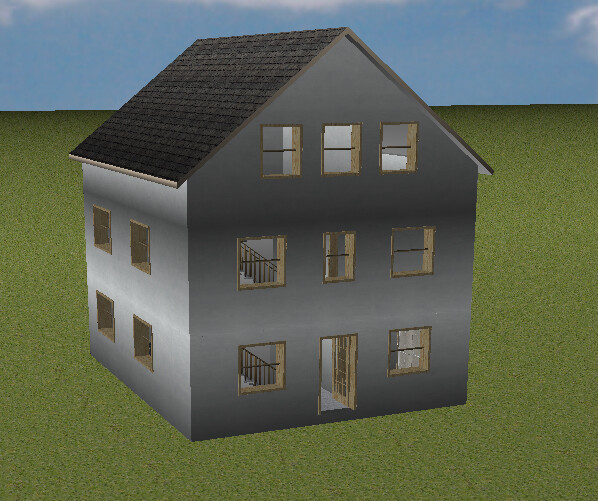
The tiny house almost completely fills the plot:
kaho674 schrieb:
I am a fan of natural light. You shouldn’t stay in there; only the guests should sleep there, and laundry as well as technical equipment should be in that space.
Speaking of technical equipment: where is the HVAC room?
AnniSke schrieb:
"I don’t need light, I actually work in the dark anyway so I can see the monitor better" That’s exactly my point: switching my gaze between the monitor and trees makes me feel less fatigued at the screen significantly longer than switching between the monitor and another spot inside the room.
AnniSke schrieb:
We just don’t like the look of the typical townhouse at all With a pitched roof and knee wall, the association with those instead-of-villa houses is reliably avoided.
AnniSke schrieb:
The husband is finally getting involved too That actually boosted the discussion back then with @StanSch, and with @Milmay, @derpikniker even registered here themselves.
https://www.instagram.com/11antgmxde/
https://www.linkedin.com/company/bauen-jetzt/
Similar topics