
ᐅ Floor Plan Optimization: Narrow 1,595 sq ft Single-Family Home on a 5,420 sq ft Lot
Created on: 10 Dec 2025 22:58
D
Drummer
Dear forum,
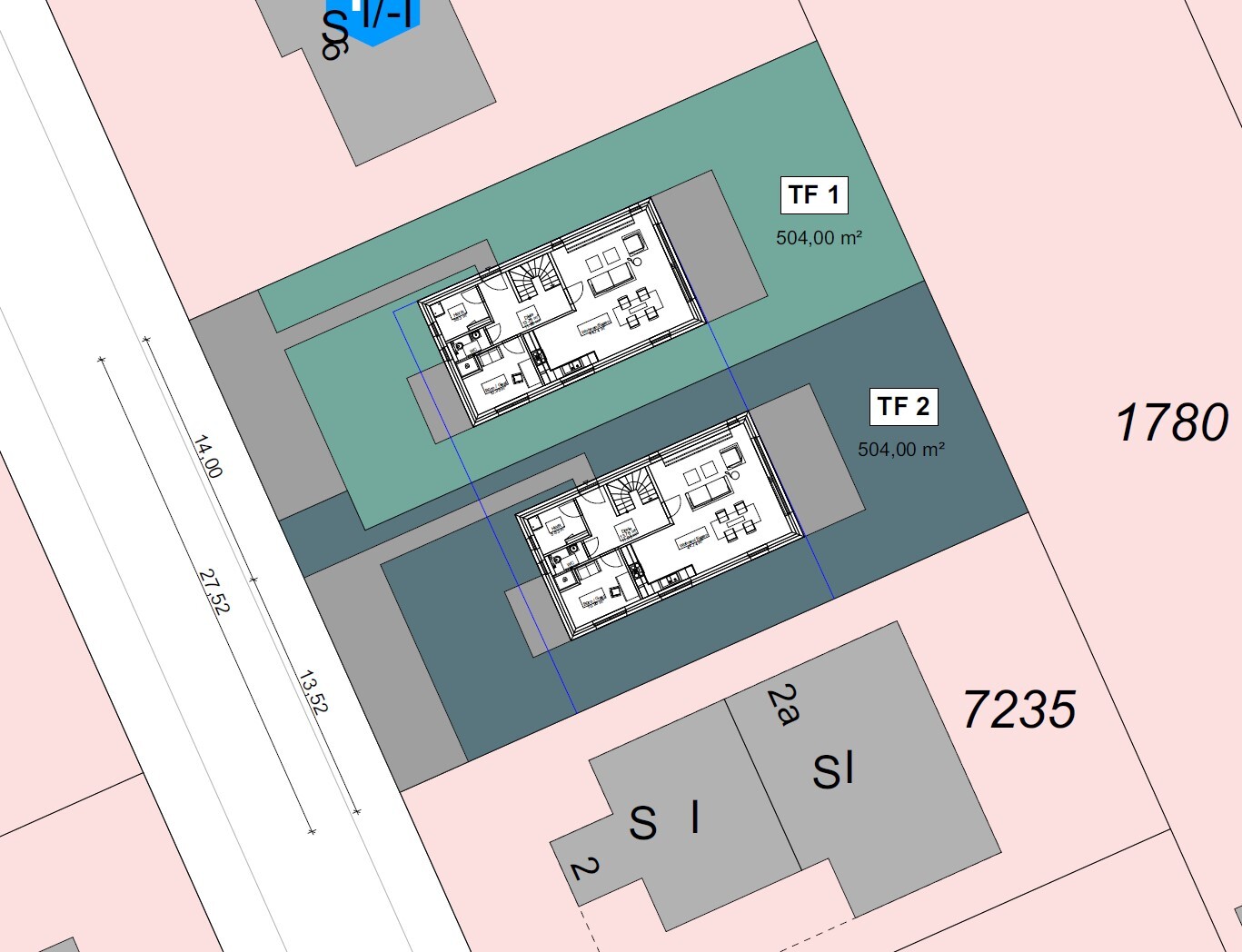
My wife and I purchased a plot of land in Hamburg in October. The financing is secured, a general contractor (production home builder) has been selected, and now we are working on the fine-tuning (or maybe a complete rethink?) of the floor plan. The 504 m2 (5,420 sq ft) parcel (lot 8370, see subdivision plan, lot 1778 in the development plan, TF) is part of a larger property and was found through a project developer who carried out the concept design. Here is the initial questionnaire:
Development Plan / Restrictions
Who designed the plan: We modified the first draft provided by the project developer several times according to our preferences.
What do you like most and why?
Personal price limit for the house including fittings: 450,000 € excluding landscaping, etc.
Preferred heating system: air-water heat pump (including photovoltaic, see above)
If you had to give up some details/extra features:
- What can you live without:
Carport, garage, basement, walk-in closet, two bathrooms upstairs and similar trends, pantry, large bathrooms, expensive kitchen (IKEA is completely sufficient for us; the location of the plot was more important)
- What you cannot do without:
Size of the living room (if possible, it could even be larger)
Why did the plan become as it is now?
We modified the project developer’s initial proposal several times according to our wishes. For example, the utility room was slightly enlarged, and the shape of the living room was adjusted. If interested, I can gladly share the original draft here.
After shifting the walls back and forth, we feel that a fresh look from more experienced people could be beneficial.
We look forward to your thoughts and critiques on this floor plan draft 🙂
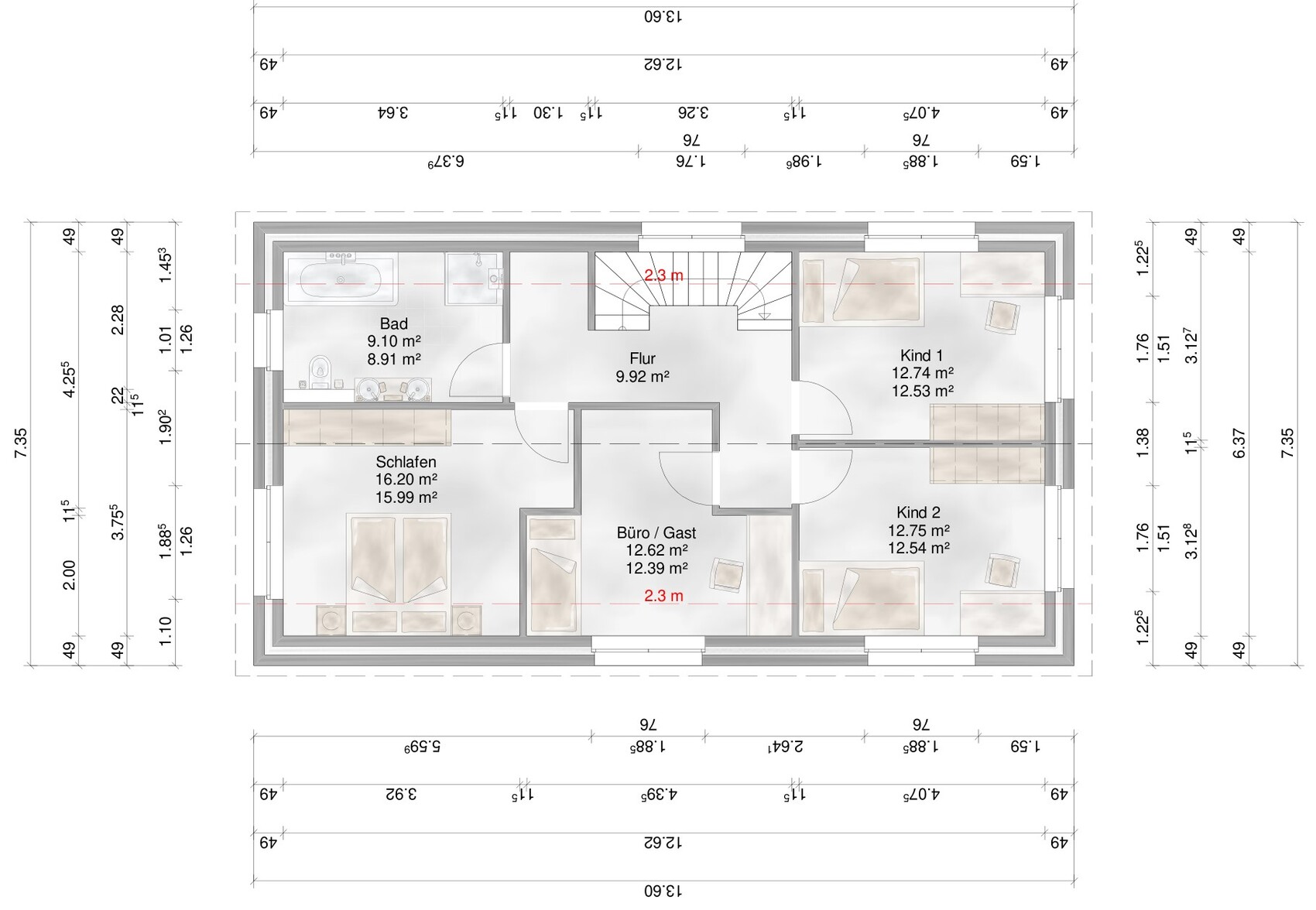
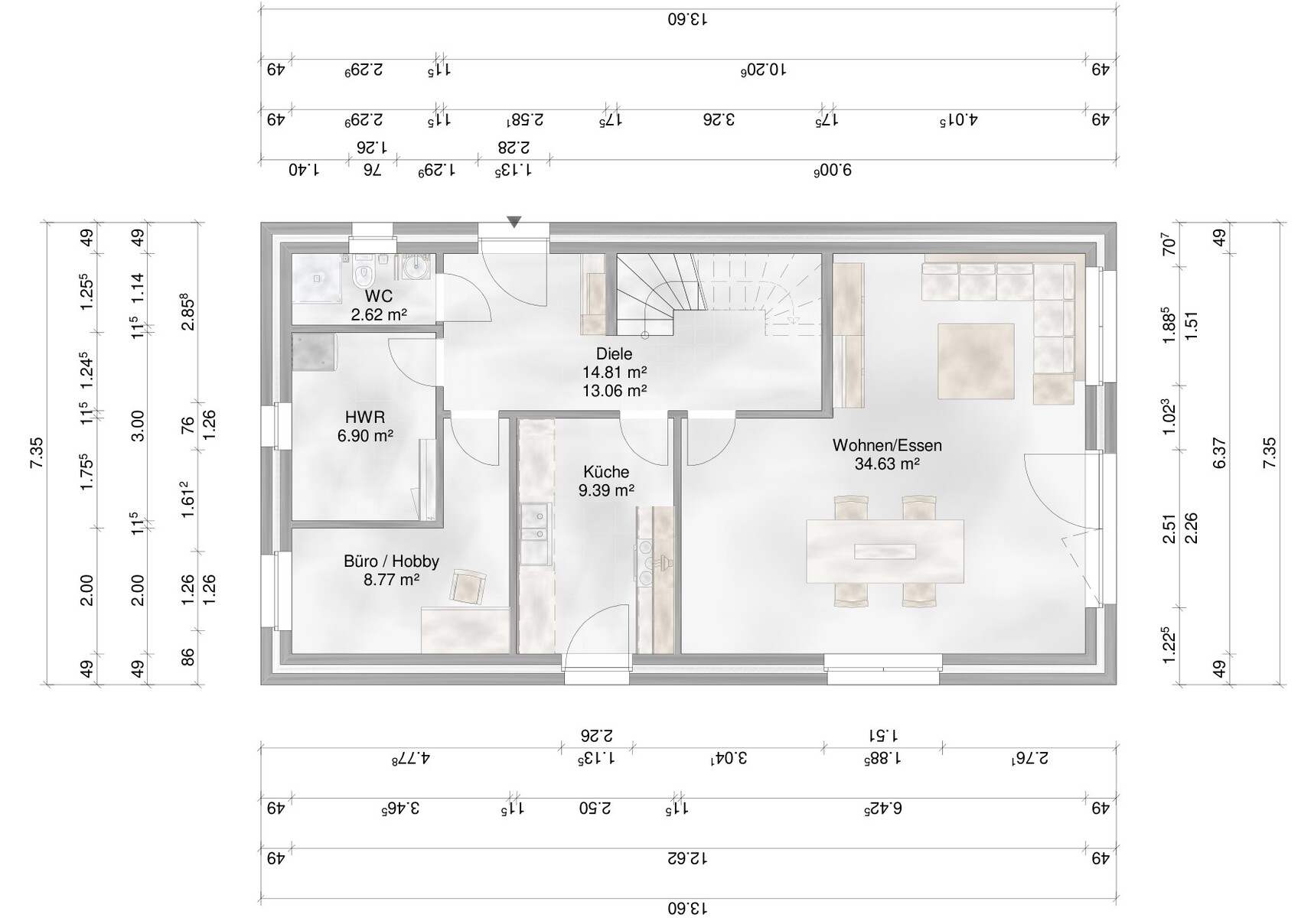
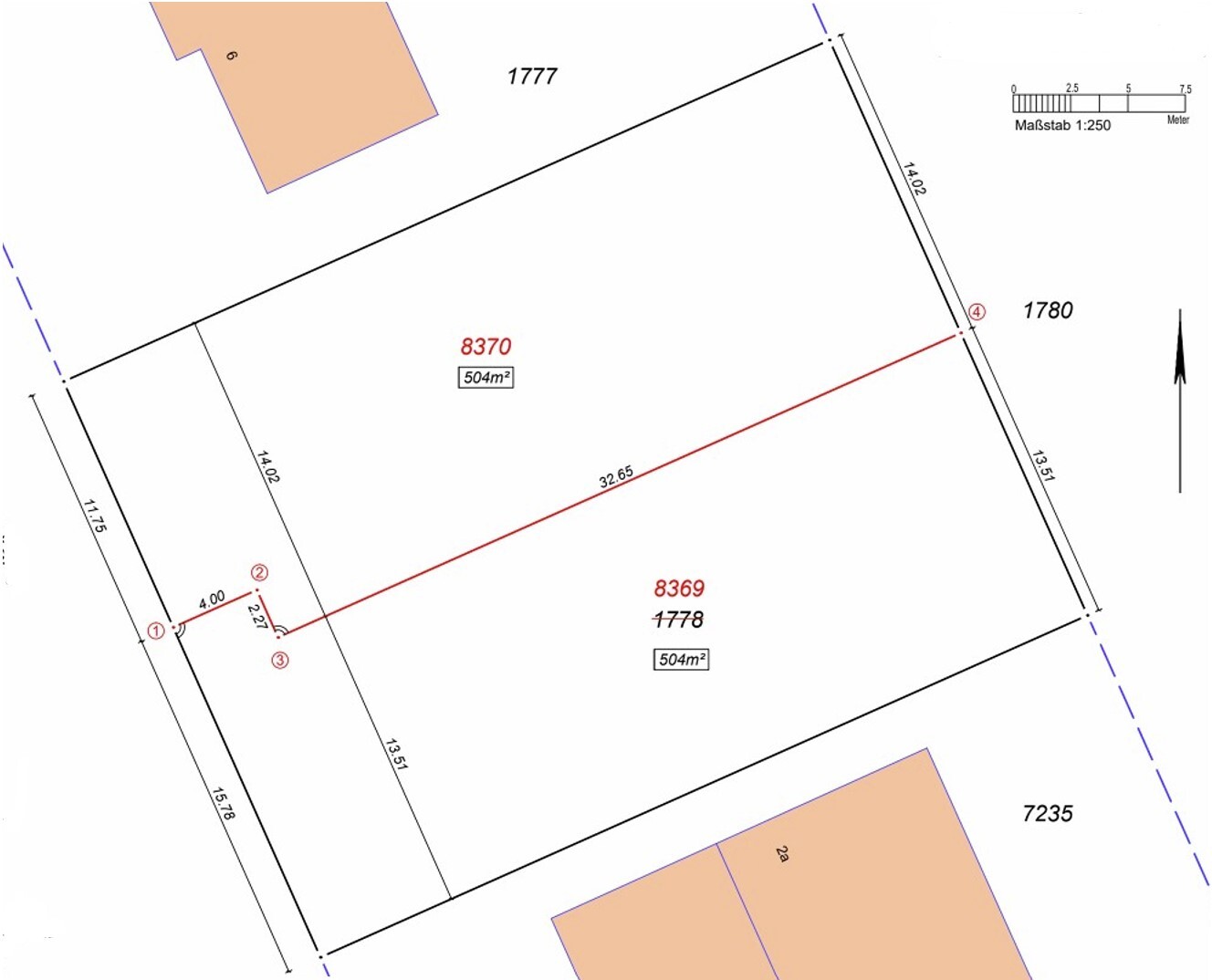
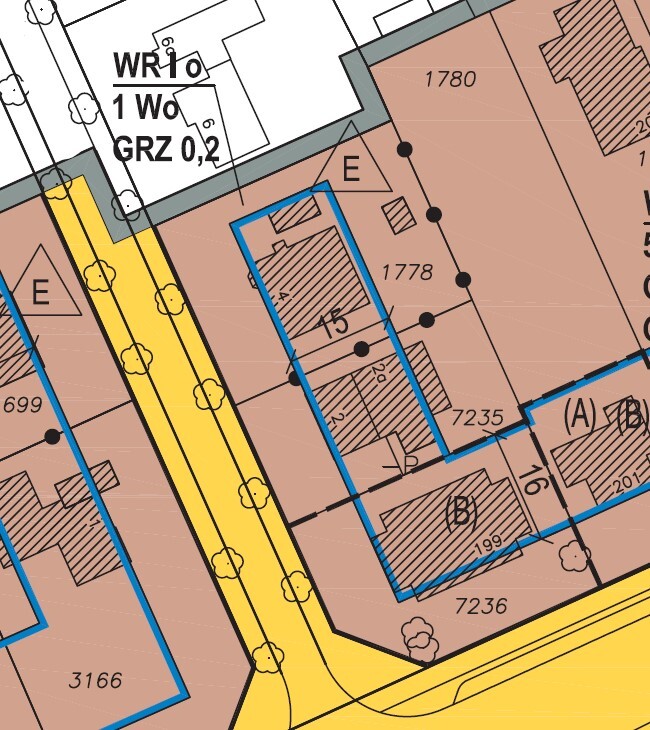
 [ATTACH width="720px" alt="Exterior views V7.jpg"]94206[/ATTACH]
My wife and I purchased a plot of land in Hamburg in October. The financing is secured, a general contractor (production home builder) has been selected, and now we are working on the fine-tuning (or maybe a complete rethink?) of the floor plan. The 504 m2 (5,420 sq ft) parcel (lot 8370, see subdivision plan, lot 1778 in the development plan, TF) is part of a larger property and was found through a project developer who carried out the concept design. Here is the initial questionnaire:
Development Plan / Restrictions
- Plot size: 504 m2 (5,420 sq ft), dimensions as per subdivision plan
- Slope: no
- Site coverage ratio (floor area ratio): 0.2
- Floor area ratio: none specified in the development plan
- Building envelope, building line, and boundary: Based on the building envelope depth of 15 m (49 feet) and the plot width of 14 m (46 feet) after subdivision, minus setback distances (2.5 m / 8 feet on the right and 4 m / 13 feet on the left, as it is the end of the building envelope), a buildable area of 15 x 7.5 m (49 x 25 feet) results. Due to the site coverage ratio of 0.2, a house with external dimensions of 13.60 x 7.35 m (45 x 24 feet) can be constructed. The project developer who planned this (double) plot recommended leaving a 15 cm (6 inches) tolerance to the full width.
- Row development: allowed
- Number of parking spaces: 2
- Number of floors: 1.5
- Roof shape: no specifications in the development plan
- Architectural style: no specifications in the development plan
- Orientation: no specifications in the development plan
- Maximum heights / limits: no specifications in the development plan
- Other requirements: 30% of the roof area must be covered with photovoltaic panels (Hamburg)
- Style, roof shape, building type: To best utilize the buildable area, the “town villa” building type seemed most suitable. The standard roof solution for single-story town villas would be a 16° hip roof. To create some storage space, we instead chose a 35° gable roof with the highest possible knee wall height (1.85 m / 6 ft above the raw floor). We also prefer this look aesthetically.
- Basement, floors: ground floor, upper floor, crawl space for storage, no basement
- Number of occupants, ages: 2 persons, 28 (m) and 29 (f) years old, 2 children planned
- Space requirements on ground floor:
- Living/dining room, shower bathroom, utility room/technical room, kitchen, office/hobby room (space for a desk and a drum set approximately 2 x 2 m / 6.5 x 6.5 ft)
- Space requirements on upper floor:
- Bedroom, 2 children’s rooms, full bathroom, office/guest room (space for desk and a double guest bed, likely a fold-out sofa)
- Office: family use or home office: ground floor office as frequently used home office, upper floor office to be often used by future children as a play area or for homework, etc.
- Occasional overnight guests per year: 2 people about 4 times annually, sometimes 4 people at once every 1-2 years
- Open or closed architecture
- Conservative or modern construction style
- Open kitchen, kitchen island: no
- Number of dining seats: permanently 6, preferably expandable to 10
- Fireplace: no
- Music / stereo wall: yes
- Balcony, roof terrace: no
- Garage, carport: 2 open parking spaces planned; possibly a carport if budget allows
- Utility garden, greenhouse: no
- The office/hobby room on the ground floor is only 2 m (6.5 ft) wide as it mainly needs to fit a drum set roughly under 2 x 2 m (6.5 x 6.5 ft) and a desk.
- Additional storage space is planned under the stairs on the ground floor and in a niche to the left of the stairs on the upper floor, to be enclosed with drywall partitions later as a DIY project. This is not currently shown in the floor plan.
Who designed the plan: We modified the first draft provided by the project developer several times according to our preferences.
What do you like most and why?
- L-shaped living room
- Room layout upstairs (bedroom not directly adjacent to children’s rooms)
- Elongated kitchen shape – we do not like corner cabinets :p
- Space for wardrobe (to the right of the entrance)
- All required rooms are included
- The kitchen could be somewhat larger
- Access routes to the ground floor office/hobby room and the upper floor office/guest room and second child’s room require relatively large circulation space. We are currently looking for ways to use the available floor area more efficiently.
Personal price limit for the house including fittings: 450,000 € excluding landscaping, etc.
Preferred heating system: air-water heat pump (including photovoltaic, see above)
If you had to give up some details/extra features:
- What can you live without:
Carport, garage, basement, walk-in closet, two bathrooms upstairs and similar trends, pantry, large bathrooms, expensive kitchen (IKEA is completely sufficient for us; the location of the plot was more important)
- What you cannot do without:
Size of the living room (if possible, it could even be larger)
Why did the plan become as it is now?
We modified the project developer’s initial proposal several times according to our wishes. For example, the utility room was slightly enlarged, and the shape of the living room was adjusted. If interested, I can gladly share the original draft here.
After shifting the walls back and forth, we feel that a fresh look from more experienced people could be beneficial.
We look forward to your thoughts and critiques on this floor plan draft 🙂

Drummer schrieb:
Unlike other developers, who sometimes seem to be employed by construction companies, in this case we were able to choose the builder ourselves.Tax offices are not allowed to provide advice but must give information. So, describe the situation and ask whether the house price is included in the property transfer tax (also known as stamp duty or land transaction tax). I am fairly certain it is not, but my opinion is not legally binding.Drummer schrieb:
Many thanks to @ypg and @11ant for the detailed warnings regarding single-story construction, especially concerning structural engineering. Once my contacts return from their Christmas holiday, I will clarify this. Virtus actually has a lot of experience with building approval-compliant single-story homes in Hamburg, so I’m surprised they didn’t raise objections during the plan review.There is probably nothing to complain about, but a comment would have been appropriate. Planners usually have good expertise and know that clients want as much standing height as possible. My guess is that they worked out a maximum utilization of the “non-full-storey” status, which only holds true under unchanged conditions. In other words, it is calculated as drawn (with a lot of effort and compromises) not to be a full storey — until, and this is yet to come, the structural engineer says: “the hip roof’s small front section doesn’t work; I need gable walls for the intermediate purlins.” However, if the roof is converted from a hip roof to a gable roof, several hundred liters of space are added in the triangle areas, which invalidates the calculation proving the “non-full-storey” status. As an experienced planner and plan reviewer, alarm bells go off for me whenever I see the combination of a hip roof on a knee wall and also read about “non-full-storey” status.It may be that the roof needs to be lowered by only about twenty centimeters (approximately 8 inches) to eliminate the hip and still maintain the “non-full-storey” status without risk. But that then reduces the standing height near the eaves to “almost one head shorter.” That is why one should always be cautious about pushing the limits of non-full storeys!
This situation sets up a problem that often remains unnoticed before the structural engineer’s assessment arrives: the dilemma is “building permit or structural engineering?” Because (in my assessment) the design might just barely be approval-compliant but structurally unbuildable; and if you fix one issue, you ruin the other. The possible solution (removing the hip roof / switching to a gable roof, but lowering it) then comes at the cost of standing height. It’s a sort of magical (gable) triangle. Apparently, Virtus does not have people like me on their team, but that doesn’t necessarily mean they are doing badly.
Drummer schrieb:
Virtus actually has a lot of experience with building approval-compliant single-story homes in Hamburg,That is precisely where the problem lies — they are playing a dangerous game on a knife edge; if they miscalculate, the whole plan bursts like a soap bubble.https://www.instagram.com/11antgmxde/
https://www.linkedin.com/company/bauen-jetzt/
11ant schrieb:
whether the house price is included in the property transfer tax in this case. I’m sure it is not, but my opinion is not legally binding. In our case, the contracts were clearly separated. The notice for the property transfer tax has already been paid and referred only to the land.
11ant schrieb:
It may be that the roof only needs to be lowered by about twenty centimeters (8 inches) to maintain the non-full-floor status without risk. However, that would reduce the standing height near the eaves by almost a head’s length. If we had to modify the roof, lowering the knee wall would definitely not be a disaster. Our latest floor plan idea (post #22) actually simplifies the bathroom layout, since the shower, unlike in post #1, no longer conflicts with the sloping roof.
Drummer schrieb:
Our latest floor plan idea (post #22) really simplifies the bathroom design Ugh... I don’t see this as a valid topic for discussion at all: a 2-meter (6 ft 7 in) wide office, a 160cm (63 in) wide hallway that doesn’t even allow space for a suitably deep wardrobe cabinet.
Space-saving staircase. With a deeper knee wall, the gable-end windows also don’t fit.
And again, a room with a narrow, awkward entrance—who would want to enter a room like that? The bathroom is under 2 meters (6 ft 7 in) wide—once you add the necessary partition walls, there’s hardly any usable space left.
ypg schrieb:
I don’t think this is up for debate at all: (...) a 160cm (63 inches) wide hallway plank, where there isn’t even space for a properly deep wardrobe cabinet. What minimum hallway width would you recommend? The width of 1.63m (64 inches) was already present in the designs in posts #1 and #9, with the difference that in #1 there was only room for a 1.20m (47 inches) wide wardrobe area, and this was completely missing in post #9, the original design from our project developer. The forum mainly said about the latter design (#9) that it probably couldn’t be much better and that we would probably end up there in the end anyway. From that perspective, I definitely see our latest design as a step in the right direction — better to have 0.3 x 3 m (1 x 10 feet) of wardrobe space than none at all, right? Since I still see my design in post #22 as in need of improvement, I’m curious to hear how it could be done better. 😉
ypg schrieb:
a 2 meter wide office The ground floor office actually meets my requirements quite well: space for a desk and a drum set about 1.80m (71 inches) wide. Of course, bigger is always possible, but a wider room would probably mostly mean more circulation space around the drum set, which I don’t necessarily need.
ypg schrieb:
With a deeper knee wall, the gable-side windows won’t fit either. From when, would you say, do the windows no longer fit? I initially worked with a 35° roof pitch and a 1.85m (6 feet) knee wall height (as in post #1).
ypg schrieb:
And again a room with a narrow entrance corridor. I don’t really like that either, but unfortunately I don’t have ideas on how to solve it better. At least we were able to reduce the number of suboptimal access points by 50% compared to post #1, which had entrances to both studies 🙂
ypg schrieb:
The bathroom is too narrow at under 2 meters. That’s true; I would have liked a bit more width there.
As mentioned, I think the design in #22 improves on several things compared to #1: somewhat less compartmentalized, one less inconvenient access point, more wardrobe space, no room doors in the dirt zone of the main entrance, possible symmetrical window layouts facing the street. Since it can certainly be done better, I am grateful for tips on how to achieve that 🙂 (And yes, we have done a lot of drawing and rearranging already — I’ll spare you the designs where the kitchen-dining path runs through the entire house here …)
Similar topics